


What Documents Do You Need to Sell a Diamond?

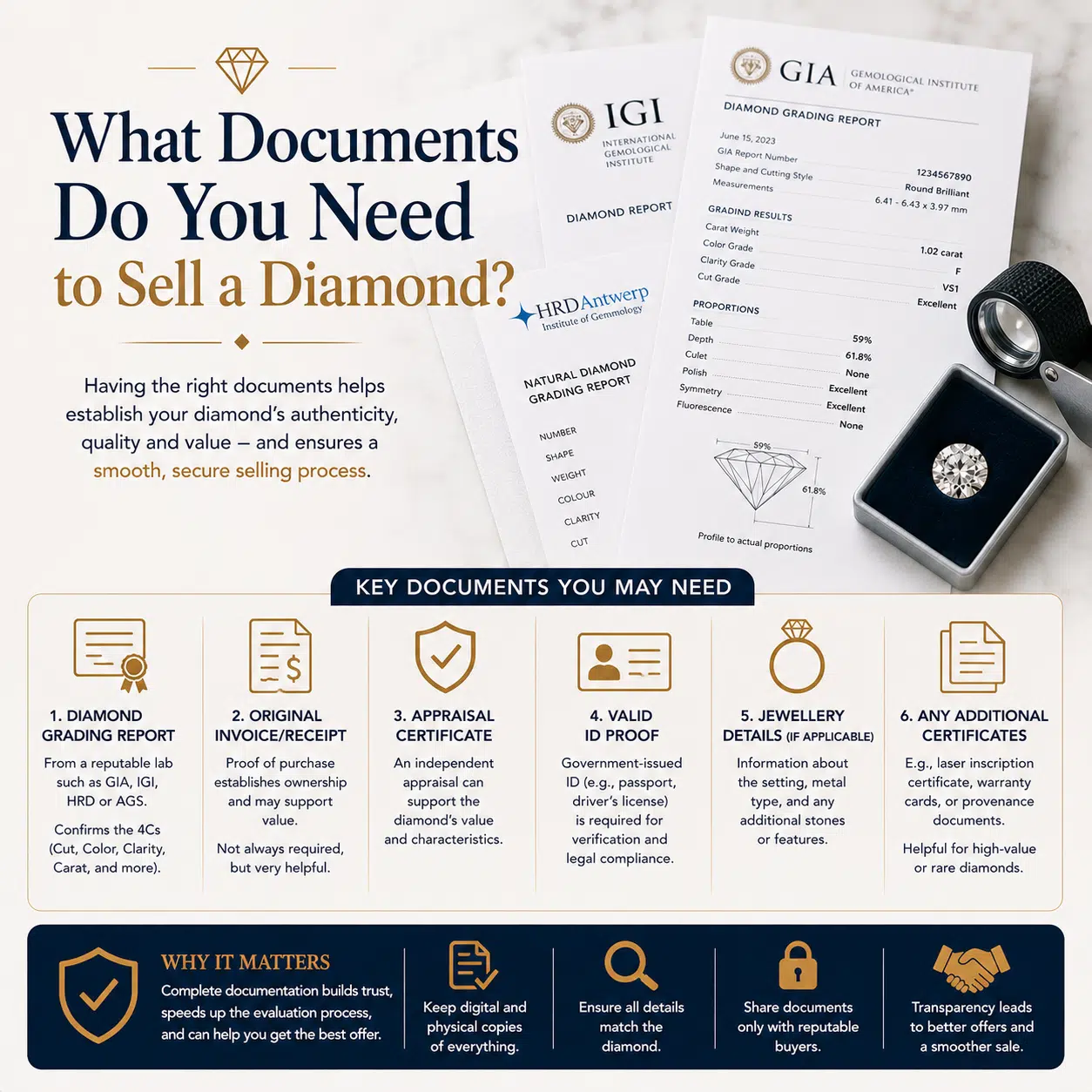
The documents needed to sell a diamond normally fall into three categories: documents that identify you, documents that describe the diamond and documents that help establish your authority to sell it. For an initial online valuation, clear photographs and any available diamond information may be enough to begin. Before a final sale and payment, however, a professional buyer may request valid identification, payment details and additional evidence concerning ownership or provenance.
A diamond certificate, purchase receipt or insurance appraisal can make the assessment easier, but missing paperwork does not automatically prevent you from selling a diamond. The buyer may instead need to inspect, test and document the item more carefully. Requirements differ by country, buyer type, transaction value, payment method and the circumstances in which you acquired the diamond. Always ask the buyer for a written list of the documents required for your specific transaction.
Quick Answer: Which Documents Are Usually Needed?
For a diamond or jewellery sale, you may need clear photographs of the complete item, the diamond grading report if available, and the original purchase receipt or invoice. You can also provide any insurance appraisal, valuation, brand information, repair or service records, and provenance documents.
For identity and payment, the buyer may require a valid government-issued photo ID and proof that you own or are authorised to sell the item. When completing the sale, provide bank or payment details that are in the seller’s name. You do not necessarily need every document on this list. A person who bought a certified engagement ring recently may have a complete invoice and grading report. Someone selling an inherited ring may have no receipt or certificate but may possess an insurance schedule, old photographs or estate documentation.
The appropriate evidence depends on the item and how it came into your possession.
Diamond-Selling Document Checklist
| Document | What it helps establish | Is it always required? | Preparation tip |
| Government-issued photo ID | Your identity and legal name | Commonly required before completing a sale | Check that it is valid and readable |
| Diamond grading report | The diamond’s recorded quality characteristics | No | Upload every page and include the report number |
| Purchase receipt or invoice | Where, when and how the item was purchased | No | Include the complete document, not only the price |
| Proof of ownership or authority | Your right to approve the sale | Depends on the circumstances | Provide estate, gift, divorce or company records where relevant |
| Insurance appraisal | Description, photographs and historical replacement value | No | Do not assume the appraisal value is the resale value |
| Provenance records | Brand, history, previous owners or origin | No | Preserve names, dates, signatures and reference numbers |
| Repair or service records | Alterations, replaced stones and condition history | No | Include records relating to the centre stone or setting |
| Branded box and papers | Possible brand and model identification | No | Photograph the complete set |
| Bank-account confirmation | The account into which payment will be made | Often required at payment stage | The account holder’s name should be clear |
| Address evidence | Current address where required | Depends on buyer and jurisdiction | Ask which documents and issue dates are accepted |
| Export or customs records | Lawful cross-border movement | Only for relevant transactions | Confirm requirements before shipping |
| Seller declaration or sale agreement | Transaction terms and ownership statement | Often created during the sale | Read it before signing and keep a copy |
Do You Need ID to Sell a Diamond?
You should expect a professional diamond buyer to request valid identification before completing a purchase. The accepted document may be a passport, national identity card, driving licence or another government-issued photo ID. Which documents are accepted depends on the country, buyer and compliance process.
The buyer may need to confirm the seller’s legal name and that the person completing the transaction is the actual seller. They may also verify that payment is being sent to an appropriate account and that the item is not being sold anonymously. These checks help the buyer maintain proper transaction records and complete any required anti-fraud, identity, or compliance checks before the sale is completed. The name on your identification should normally be consistent with the seller’s name in the sale agreement and payment instructions. A name difference may be legitimate—for example, after marriage or a legal name change—but the buyer may ask for an explanatory document.
An initial valuation form should not require your bank password, card PIN or one-time security code. These are not identity documents and should never be disclosed.
What Forms of Identification May Be Accepted?
Depending on local requirements, a buyer may accept one or more of the following:
- Passport
- National identity card
- Photographic driving licence
- Residence permit
- Government-issued identity document
An expired document may not be accepted. A photograph, screenshot or photocopy may be sufficient for an initial compliance review but not for final verification. If you are selling in person, bring the original document unless instructed otherwise. If you are selling remotely, ask how the buyer protects uploaded identity documents and whether a secure verification system is available.
Do not email highly sensitive documents to an unverified address. First confirm that you are communicating with the genuine buyer.
Is a Diamond Certificate Required to Sell a Diamond?
No. You can often request a valuation and potentially sell a diamond without its certificate. A grading report—commonly called a diamond certificate—records characteristics such as the diamond’s measurements, carat weight, colour, clarity, cut, proportions and fluorescence. Depending on the laboratory and report type, it may also address treatments or whether the diamond is natural or laboratory-grown.
A recognised, verifiable report can make the initial assessment more precise. It can also help a buyer compare the physical diamond with previously recorded characteristics.
However, a grading report is not normally:
- Proof that you own the diamond
- A purchase receipt
- A guarantee of authenticity in every circumstance
- A current resale valuation
- A guarantee of the price a buyer will offer
The physical diamond must still be examined. The buyer may compare its measurements, identifying characteristics and any girdle inscription with the report. If you do not have a report, read the dedicated guide on selling a diamond without a certificate.
What Should You Upload from a Diamond Grading Report?
Upload a clear image or PDF of the complete report. Do not send only the section showing the colour and clarity grades.
Useful information can appear throughout the document, including:
- Issuing laboratory
- Report number
- Report date
- Shape and cutting style
- Measurements
- Carat weight
- Colour grade
- Clarity grade
- Cut, polish and symmetry grades
- Fluorescence
- Proportions
- Clarity plot
- Comments
- Treatment information
- Natural or laboratory-grown identification
- Laser-inscription details
Comments and additional information can materially affect interpretation. Hiding an unfavourable comment will not prevent it from being discovered during physical inspection.
How Do You Verify a Diamond Certificate?
Use the issuing laboratory’s official report-verification service when one is available.
Enter the report number directly on the laboratory’s official website. Compare the archived information with the paper or digital report in your possession.
A matching report number is useful, but it does not by itself prove that the physical diamond is the stone described. A specialist should also compare measurements, weight, inclusions and any laser inscription.
Do not rely on a verification page sent by an unknown buyer. Fraudulent websites can imitate genuine laboratory-report services.
Recognised laboratories have different report formats and verification processes. Examples commonly encountered in Europe and the United States include GIA, IGI and HRD Antwerp.
What If You Lost the Diamond Certificate?
Start by searching old emails, cloud storage, insurance files, purchase invoices and photographs. The report number may have been recorded even if the original paper document is missing.
A jeweller, insurer or previous appraiser may also have retained a copy.
Some diamonds have a microscopic report number inscribed on the girdle. A specialist may be able to locate it under magnification and search the issuing laboratory’s database.
For example, GIA states that it does not issue duplicate reports in the ordinary sense. If the report number is known, the grading information may be available through GIA Report Check, and qualifying reports may have a downloadable PDF.
Do not attempt to remove a diamond from its setting just to find an inscription. Improper removal can damage the setting or chip the stone.
Is a Purchase Receipt Required?
A purchase receipt is helpful, but it is not always required.
The receipt may show:
- The original purchaser
- Purchase date
- Jeweller or retailer
- Description of the diamond or ring
- Brand or collection
- Metal and setting details
- Diamond report number
- Original retail price
- Taxes paid
- Warranty information
A receipt supports the item’s history but does not necessarily prove its current condition or resale value. The diamond may have been damaged, recut, replaced or altered since the purchase.
The original retail price is also not the amount a seller should automatically expect to recover. Retail pricing may include tax, shop overhead, design, branding, warranties and the retailer’s margin. A resale offer is based on the verified item and current secondary-market demand.
What If the Receipt Is in Someone Else’s Name?
There may be a legitimate explanation. The diamond could have been a gift, inheritance, family transfer or purchase made by a spouse.
Tell the buyer how you acquired it and provide any available supporting evidence. Depending on the circumstances, this could include:
- A gift letter
- A will or estate document
- A marriage or name-change record
- A divorce settlement
- Written authorisation from the purchaser
- Earlier photographs showing the item in your possession
- Insurance records in your name
A receipt in another person’s name should not be altered. Preserve the original information and explain the ownership history honestly.
What Counts as Proof of Ownership for a Diamond?
There is no single universal document that proves ownership in every situation.
Useful evidence can include:
- Purchase invoice in your name
- Payment record connected to the purchase
- Insurance policy or schedule naming the item
- Estate or inheritance records
- Gift letter from the previous owner
- Divorce or property-settlement documentation
- Written transfer agreement
- Previous appraisal addressed to you
- Repair or service records in your name
- Photographs showing your long-term possession
- Police recovery or insurance-return documents
- Company records authorising the disposal of a business-owned asset
A grading report alone normally describes a diamond rather than its legal owner.
The buyer may consider several pieces of evidence together. If ownership is disputed, resolve the issue before attempting to sell the diamond.
Documents for an Inherited Diamond
Inherited diamonds often have incomplete paperwork. The original receipt may be decades old or no longer available, and family members may not know whether the stone was ever laboratory graded.
Preserve everything found with the item, including old boxes, handwritten notes, photographs, valuations, insurance schedules and repair receipts.
Depending on the estate and local law, useful authority documents may include:
- A will
- Probate or estate-administration documentation
- An executor or administrator appointment
- A distribution statement
- A letter from the estate representative
- Written consent from other people with an ownership interest
- A receipt or inventory showing that the item was allocated to you
Not every inherited diamond requires every document listed above. The correct evidence depends on how the estate was administered and whether ownership is contested.
If several heirs may have an interest in the jewellery, do not assume that physical possession gives one person sole authority to sell it. Obtain appropriate local advice before proceeding.
Illustrative example
A woman inherits a solitaire ring from her grandmother. There is no purchase receipt or grading report, but she has a copy of the will, an estate inventory, an insurance valuation from 2008 and several photographs showing her grandmother wearing the ring.
Those records do not establish the diamond’s current grade or resale value. They can, however, help explain the item’s history and the seller’s authority to request an assessment. The diamond must still be physically tested and valued.
This is an illustrative scenario, not an actual customer transaction.
Documents for a Diamond Received as a Gift
A gifted diamond may come with a receipt in the giver’s name. That does not automatically prevent a sale, but the ownership transfer should be explainable.
Where available, provide:
- The original receipt
- A dated gift letter
- Written confirmation from the giver
- Insurance records transferred to your name
- Photographs or correspondence relating to the gift
A useful gift letter identifies the giver, recipient, item and approximate date of the transfer. Whether it is legally sufficient depends on local law and the circumstances.
If the giver now disputes that the item was a gift, resolve the dispute before selling it.
Documents Following Divorce or Separation
Jewellery ownership after a divorce or separation can be fact-specific. An engagement ring, wedding jewellery or jointly purchased diamond may be treated differently depending on local law, agreements and court decisions.
Relevant records may include:
- Settlement agreement
- Court order
- Property-division schedule
- Written agreement between the parties
- Original gift or purchase evidence
- Confirmation from a legal representative
A diamond buyer should not be expected to decide a complex ownership dispute. If another person may have a valid claim, obtain local legal advice before submitting the item for sale.
Documents for Company-Owned, Trust-Owned or Family-Owned Diamonds
If the diamond belongs to a company, trust, partnership or family estate, the person attending the appointment may not be the legal owner.
The buyer may request documents establishing both the entity and the representative’s authority, such as:
- Company registration information
- Director or officer identification
- Board or management authorisation
- Trust documentation
- Partnership authorisation
- Executor or administrator appointment
- Letter of authority
- Beneficial-owner information where required
The payment account may also need to correspond with the legal seller.
Do not direct the proceeds of a company-owned diamond to a personal account without confirming that the arrangement is authorised and compliant.
Is an Insurance Appraisal Useful?
Yes, but it must be interpreted correctly.
An insurance appraisal can help identify:
- The ring or jewellery design
- Approximate diamond characteristics
- Precious-metal content
- Brand or maker
- Report number
- Photographs
- Previous condition
- Replacement value on the appraisal date
The stated insurance value is not normally a guaranteed resale price. Insurance valuations commonly estimate the cost of replacing an item in a retail environment. That amount may include taxes, retail margins, design and manufacturing costs.
A buyer’s offer is based on what the verified item can achieve in the current resale market.
Upload the appraisal because its descriptive information may be valuable, but do not use the replacement figure as the only test of whether an offer is fair.
Are Old Appraisals and Certificates Still Useful?
Yes. An older document can help identify the diamond and establish its history.
Its limitations should also be recognised. The diamond may have been chipped, repolished or reset since the report was issued. Grading standards, testing technology and market conditions may also have changed.
An old document should be presented with its original date visible. Do not edit the date or imply that it represents a recent examination.
The buyer can then decide whether the document is sufficient for an initial estimate or whether updated testing is needed.
Repair, Resizing and Service Records
Repair records can reveal changes that affect the diamond or complete jewellery item.
Useful records include:
- Ring resizing
- Prong replacement
- Centre-stone resetting
- Replacement of side stones
- Polishing or refinishing
- Laser-welding work
- Brand servicing
- Diamond recutting or repolishing
- Damage inspection
- Replacement following an insurance claim
A repair invoice can also connect the item to a particular report number, brand reference or owner.
Do not withhold evidence of damage or replacement work. Physical inspection may reveal it, and incomplete information can make a preliminary estimate less reliable.
Brand Papers, Boxes and Serial Numbers
For signed or branded diamond jewellery, the complete set may matter.
Preserve:
- Branded box
- Authenticity card
- Warranty booklet
- Original invoice
- Serial or reference number
- Service history
- Boutique correspondence
- Packaging specific to the collection
A box by itself does not prove that the diamond ring inside is genuine. Boxes and authenticity cards can be separated from the original item.
The signature, craftsmanship, serial numbers and construction should be examined together. Do not remove engravings, hallmarks or brand marks before valuation.
Provenance Documents for Antique or Historically Important Jewellery
Provenance describes the documented history of an item. It can be particularly relevant to antique jewellery, signed pieces, rare coloured diamonds and items connected to a notable collection.
Potential provenance evidence includes:
- Historic invoices
- Auction catalogues
- Estate inventories
- Family correspondence
- Exhibition records
- Published photographs
- Earlier sale agreements
- Dealer records
- Maker’s archives
- Independent research
A family story can be meaningful, but an unsupported story is not the same as documented provenance. Preserve the story while clearly distinguishing it from independently verified evidence.
Do not write a more dramatic history in an attempt to increase the value. False provenance can create serious legal and commercial problems.
Do You Need Bank Details to Sell a Diamond?
Payment details are normally required only when the transaction is ready to be completed.
The buyer may ask for:
- Account holder’s name
- Bank name
- IBAN or account number
- BIC or SWIFT code for certain transfers
- Routing information in the United States
- Proof that the payment account belongs to the seller
The precise requirements depend on the payment system and country.
A buyer does not need your online-banking password, card PIN, complete card photograph or one-time authorisation code to send you money.
The name on the payment account should generally correspond with the verified seller. If payment must be made to another person or entity, explain the reason and obtain approval before completing the transaction.
Do You Need Proof of Address?
A buyer may request proof of address as part of identity, transaction or risk checks. This is not required in exactly the same way for every sale.
Commonly requested documents can include:
- Recent utility bill
- Bank statement
- Government correspondence
- Residence certificate
- Tax document
- Official registration record
Ask which document types are accepted and how recent they must be.
If the document contains unrelated financial information, ask whether those details may be redacted. Do not obscure your name, address, issue date or other information the buyer has said is necessary.
Documents for Cross-Border Diamond Sales
Cross-border transactions can require more documentation than a domestic appointment, particularly when the diamond moves between customs territories.
Possible requirements include:
- Accurate contents description
- Declared value
- Commercial or pro forma invoice
- Customs declaration
- Proof of lawful ownership
- Export or import documentation
- Carrier insurance records
- Tax or duty information
- Country-of-origin information where required
Do not describe a diamond as a low-value sample, gift or costume jewellery to reduce customs scrutiny. An inaccurate declaration can invalidate insurance and create customs or legal problems.
The grading laboratory named on a report is not necessarily the diamond’s geographic origin. A diamond graded in Antwerp, London or New York was not necessarily mined there.
Confirm current carrier and customs requirements before shipping. For transport guidance, read how to ship a diamond safely.
Country and Regional Document Callouts
The following is general preparation guidance, not country-specific legal advice. Ask the buyer to confirm the current requirements for your transaction.
| Location | What sellers should prepare for |
| Belgium and Antwerp | The buyer may request official identification, ownership information and payment-account confirmation. Ask what must be presented before an Antwerp appointment or insured shipment. |
| European Union | Identity and compliance processes can differ between member states, buyer types and payment methods. Cross-border movement within the EU may also be treated differently from shipment into or out of the EU customs area. |
| United Kingdom | Buyer, auction, second-hand dealer and high-value cash rules can affect the documents requested. Obtain a current written list from the buyer rather than relying on pre-Brexit EU guidance. |
| Switzerland, Norway and other non-EU European countries | Even when the journey is within Europe, customs and import or export documentation may apply because the transaction crosses a customs border. |
| United States | Identification and second-hand-property requirements can vary by state, city and buyer type. Federal and state reporting or tax considerations may also depend on the payment method and whether the seller acts privately or as a business. |
| International sellers | Confirm identity, shipping, insurance, sanctions, customs and payment requirements before transferring the diamond. A buyer accepting online enquiries does not automatically mean it can purchase from every country. |
Country requirements change. Before publishing a translated or localised version of this article, add a link to the current local government guidance or a country-specific Sothis selling guide.
What Documents Should You Upload for an Online Valuation?
For the first valuation request, concentrate on documents that help identify and describe the item.
A useful submission normally includes:
- Face-up photograph of the diamond or ring
- Side views of the setting
- Underside of the jewellery
- Hallmarks, engravings and brand signatures
- Visible damage
- Full grading report
- Purchase invoice
- Appraisal or insurance schedule
- Branded box and papers
- Repair history
- Brief explanation of how you acquired the item
If the diamond is loose, photograph it inside a secure gem container or diamond paper. Do not hold it over a sink, hard floor or open drain.
You may not need to upload sensitive identity or banking documents with the first enquiry. Follow the buyer’s secure process when identity verification or payment information becomes necessary.
How Should You Protect Sensitive Documents?
First verify that you are using the genuine buyer’s website and secure upload process.
When providing personal documentation:
- Use the buyer’s official secure portal where available
- Avoid public file-sharing links
- Do not send documents through an unknown social media account
- Check the recipient’s email domain carefully
- Ask why the document is needed
- Ask how long it will be retained
- Read the buyer’s privacy information
- Submit only the information required for the transaction
- Keep a record of what you supplied
Where the buyer and local rules permit it, an identity copy may be marked with the intended recipient, purpose and date. Do not alter a document in a way that prevents required verification.
Never share your password, PIN, recovery phrase or one-time verification code. For additional protection, review the guide to diamond selling scams and fake payments.
What If You Have No Documents at All?
You can still begin by submitting what you know and providing clear photographs.
Explain:
- Whether the diamond is loose or mounted
- How you acquired it
- Approximate purchase or inheritance date
- Whether you believe it is natural or laboratory-grown
- Estimated carat weight, if known
- Any remembered jeweller or laboratory
- Whether the item has been repaired or altered
- Whether another person may have an ownership interest
Do not guess grades and present them as facts. “The family believes it is approximately one carat” is more accurate than claiming “one-carat G VS1” without supporting evidence.
The buyer may need to conduct additional testing or recommend laboratory grading. That does not mean you should automatically pay for a new certificate before requesting an initial review.
Should You Pay for a New Certificate Before Selling?
Not automatically.
New laboratory grading can be useful when precise identification is likely to improve marketability enough to justify the expense. It may be considered for a significant loose diamond, an undocumented fancy-coloured stone or an item whose natural or laboratory-grown origin is uncertain.
It may not be commercially sensible when the diamond is small, heavily damaged, outside the buyer’s purchasing criteria or worth less than the combined grading, removal, transport and insurance costs.
Begin with an initial assessment. Before approving new grading, ask:
- Which laboratory will examine the diamond?
- Must the stone be removed from its setting?
- Who will perform and insure the removal?
- What will grading and transport cost?
- Who pays if you reject the final offer?
- How long will the process take?
- Will the report materially affect the buyer’s offer?
Do not remove a mounted diamond yourself.
How Documents Affect the Diamond Offer
Documents do not create value independently of the diamond, but they can reduce uncertainty.
A verifiable grading report may allow a more precise initial assessment. Brand papers and service records may support the identity of signed jewellery. Provenance can matter for certain antique or historically important pieces.
However, paperwork cannot override the physical item. If a report describes a 1.50-carat natural diamond but the submitted stone does not match its measurements or characteristics, the buyer must value the diamond that was actually received.
Similarly, a high insurance appraisal does not require a buyer to make an equivalent resale offer.
Documents support an evidence-based valuation; they do not replace physical verification or market analysis.
Three Practical Document Examples
Example 1: Recently purchased certified ring
A seller has a five-year-old engagement ring with its original invoice, GIA report, branded box and insurance appraisal.
For the valuation request, the seller uploads the complete report, invoice and photographs. Identification and payment-account information are provided later through the verified transaction process.
The documentation makes the item easier to identify, but the final offer still depends on physical condition and current market demand.
Example 2: Inherited ring without a certificate
A seller inherits a ring with no grading report or receipt. Available records include an old insurance schedule, a photograph of the former owner wearing the ring and estate documentation.
The seller submits those records with clear photographs. Physical examination is necessary to determine whether the centre stone is a diamond, whether it is natural or laboratory-grown and what characteristics can be verified.
The absence of a certificate does not make the item worthless, but it limits the precision of an online estimate.
Example 3: Gift with a receipt in another name
A seller received a diamond pendant as a gift. The receipt is in the giver’s name, but the seller has a dated gift letter and insurance records in their own name.
The seller provides the unaltered receipt and explains the ownership transfer. The buyer can then determine whether any additional evidence is required.
These are illustrative examples and should not be presented as actual Sothis Diamonds transactions.
How to Organise Your Documents Before Selling
Create one folder for the transaction and use clear filenames.
For example:
- 01-diamond-front.jpg
- 02-diamond-side.jpg
- 03-hallmark.jpg
- 04-grading-report.pdf
- 05-purchase-invoice.pdf
- 06-insurance-appraisal.pdf
- 07-ownership-document.pdf
- 08-repair-history.pdf
Photograph or scan the complete document in good light. Make sure corners, dates, report numbers and comments remain visible.
Do not edit grades, prices or dates. If a document contains information you believe is incorrect, include it and explain the issue separately.
Keep the originals in a secure place. Send original documents with the diamond only when the buyer’s verified process specifically requires them.
Final Checklist Before Completing the Sale
Before handing over or shipping the diamond, confirm that:
- Your identification is valid
- The seller’s name and payment-account name are consistent
- You are legally authorised to sell the item
- Any co-owner or estate issue has been resolved
- The complete grading report has been copied
- Purchase, insurance and provenance records have been preserved
- The buyer has confirmed which documents are required
- Sensitive files are being transferred securely
- You understand why each requested document is needed
- The written offer identifies any conditions or deductions
- Shipping and return arrangements are documented
- You will receive a copy of the sale agreement
- Payment will be verified through your own bank or provider
You can review the wider transaction sequence in what happens after an online diamond valuation.
Frequently Asked Questions About Documents Needed to Sell a Diamond
1. What documents do I need to sell a diamond?
You may need valid identification, a grading report if available, purchase or ownership evidence and payment details. The exact requirements depend on the buyer, country and transaction.
2. Can I sell a diamond without paperwork?
Potentially, yes. Submit clear photographs and explain what you know. The diamond may require additional physical testing or grading.
3. Can I sell a diamond without a certificate?
Yes. A grading report can make an assessment easier, but it is not always required to begin a valuation.
4. Do I need ID to sell a diamond?
A professional buyer will commonly require government-issued identification before completing the purchase and payment.
5. Can I request a valuation before providing ID?
Often, yes. Photographs and diamond information may be sufficient for an initial review. Identity checks may be completed later.
6. What ID is accepted when selling diamonds?
Accepted documents vary. A passport, national identity card, driving licence or residence permit may be accepted, depending on the buyer and country.
7. Can I use an expired passport?
It may not be accepted. Ask the buyer whether another valid identification document can be used.
8. Can I sell using a foreign passport?
Possibly, but the buyer may request additional address, residency or payment information. Confirm before travelling or shipping.
9. Do I need proof of address?
Sometimes. The buyer should tell you which documents are accepted and how recent they must be.
10. Why does a diamond buyer need my identification?
Identification can support fraud prevention, transaction records, payment verification and applicable compliance checks.
11. Is it safe to send my ID online?
Use only a verified buyer’s secure upload system. Confirm why the document is required and how it will be protected.
12. Should I send my bank password to receive payment?
No. A buyer does not need your password, PIN or one-time security code to pay you.
13. What is the difference between a diamond certificate and receipt?
A grading report describes the diamond’s characteristics. A receipt records a purchase transaction. Neither automatically performs the other function.
14. Does a diamond certificate prove ownership?
No. A grading report generally identifies and describes a diamond; it does not normally name or establish its current legal owner.
15. Does a receipt prove that the diamond is genuine?
Not conclusively. A receipt records what was sold, but the current physical item should still be examined and matched to its documentation.
16. Is a GIA report required?
No. A GIA report can be useful, but diamonds with reports from other laboratories or without reports can still be submitted for review.
17. Is a grading report the same as an appraisal?
No. A grading report records quality characteristics. An appraisal assigns a monetary value for a stated purpose and date.
18. Is an appraisal the same as a resale offer?
No. An appraisal, particularly for insurance, may estimate retail replacement cost. A resale offer reflects the current secondary market.
19. Can I sell a diamond with an old certificate?
Yes. Upload the old report with the date visible. The buyer may decide that updated testing is necessary.
20. What if the certificate number is worn or unreadable?
Submit the best available image and check old invoices, emails and insurance records. A specialist may look for a girdle inscription.
21. Can a lost GIA report be replaced?
GIA says it does not issue ordinary duplicate reports. If you know the report number, information may be available through GIA Report Check, with a PDF available for qualifying reports.
22. Should I get a new certificate before requesting a valuation?
Not automatically. Begin with an initial review and compare the likely benefit with the grading, removal, shipping and insurance costs.
23. Do I need the original purchase receipt?
No, not in every case. A copy or alternative evidence may be useful when the original is missing.
24. What if my receipt has faded?
Photograph or scan it carefully. Also search for card records, emails, warranties, insurance records or copies held by the original jeweller.
25. Can I sell a diamond if the receipt is in my spouse’s name?
Possibly, but the buyer may request evidence that you own or are authorised to sell it.
26. Can I sell a diamond that was a gift?
Yes, provided you own it and are authorised to sell it. A gift letter or related records may help explain its history.
27. Do I need a gift letter?
Not always. It can be helpful when the receipt remains in the giver’s name or the ownership history requires clarification.
28. Can I sell an inherited diamond without a receipt?
Potentially, yes. Estate records, insurance documents, photographs and other evidence may help establish authority and history.
29. What inheritance documents might be requested?
Depending on the situation, a buyer may request a will, estate inventory, executor appointment, distribution statement or other evidence that you received the item.
30. Can an executor sell an estate’s diamond?
Potentially, if the executor has the necessary authority. The required process depends on the estate and local law.
31. Can one heir sell a jointly inherited diamond?
Not safely without confirming that the seller has authority from all relevant owners or the estate representative.
32. What documents are needed after divorce?
A settlement agreement, property schedule, court order or written confirmation may be relevant when ownership could be disputed.
33. Can I sell a diamond belonging to my company?
Only if you have authority to act for the company. Corporate records and payment to an appropriate account may be required.
34. Do insurance documents prove ownership?
They can support an ownership history, but they may not be conclusive on their own.
35. Does the insurance value determine my sale price?
No. Insurance values commonly concern replacement cost rather than the amount obtainable in resale.
36. Should I include repair records?
Yes. They may identify the item and disclose resizing, replacement stones, resetting, damage or other alterations.
37. Should I include the original box?
Yes, especially for signed or branded jewellery. The box is supporting material but does not prove authenticity by itself.
38. What is diamond provenance?
Provenance is the documented ownership and history of the item. It can matter particularly for rare, antique, signed or historically important jewellery.
39. Are family stories considered provenance?
They can provide useful leads, but unsupported stories should be distinguished from verified documentary evidence.
40. Do I need customs documents to sell across a border?
Possibly. Requirements depend on the countries, customs territories, shipment value and direction of movement.
41. Can I declare a diamond as a gift when shipping it?
Only if that description is accurate. A false customs description may cause legal, tax and insurance problems.
42. Do I need to provide my bank statement?
A buyer may request evidence that the payment account belongs to you. Ask whether unrelated balances and transactions may be redacted.
43. Can payment be sent to someone else’s account?
The buyer may refuse or require additional checks. Explain the reason before completing the transaction.
44. Should the name on my ID match my bank account?
A consistent name generally makes verification easier. Provide legitimate name-change documentation if necessary.
45. Should I send original documents with the diamond?
Only if the buyer’s verified process requires them. Keep clear copies and record exactly what is included.
46. Can I hide the original purchase price?
Do not alter an invoice. If you do not want to provide it, ask whether another document is acceptable.
47. Can I redact personal information?
Possibly, but ask first. Do not hide information the buyer needs for identity, ownership or compliance checks.
48. What photographs should accompany the documents?
Include the complete item, front, sides, underside, hallmarks, engravings, brand marks, visible damage and packaging.
49. What if the certificate does not match the diamond?
Stop relying on the report until the discrepancy is explained. The wrong document may have been stored with the item, or the stone may have been replaced or altered.
50. Can documents increase the value of my diamond?
They can reduce uncertainty and support brand, identity or provenance. They cannot make the physical diamond better than its verified characteristics.
51. Will a buyer keep copies of my documents?
A buyer may need to retain certain transaction records. Ask about the purpose, security, retention period and privacy policy.
52. What documents should I keep after selling?
Keep the signed sale agreement, final offer, payment confirmation, shipping or handover record and copies of the documents you supplied.
53. Do document requirements differ between Europe and the USA?
Yes. They can also vary within Europe and between US states and cities. Confirm the requirements for the buyer and location involved.
54. Can Sothis review a diamond with incomplete documents?
You can begin by submitting photographs and whatever certificate, receipt, appraisal, insurance record or ownership information remains available. Further steps depend on the item and verification required.
Prepare What You Have and Begin with a Private Review
Complete documentation can make a diamond easier to identify and a transaction easier to verify. It is still common for inherited, older or gifted jewellery to have missing paperwork.
Do not create, alter or guess documents. Gather what you have, explain the item’s history honestly and allow the diamond itself to be professionally examined.
For the initial review, prepare clear photographs and upload any available grading report, receipt, appraisal, insurance record, provenance document or ownership evidence.
Upload your available documents and request a private diamond valuation.
