


Diamond Selling Scams: Red Flags, Fake Payments and Pressure Tactics

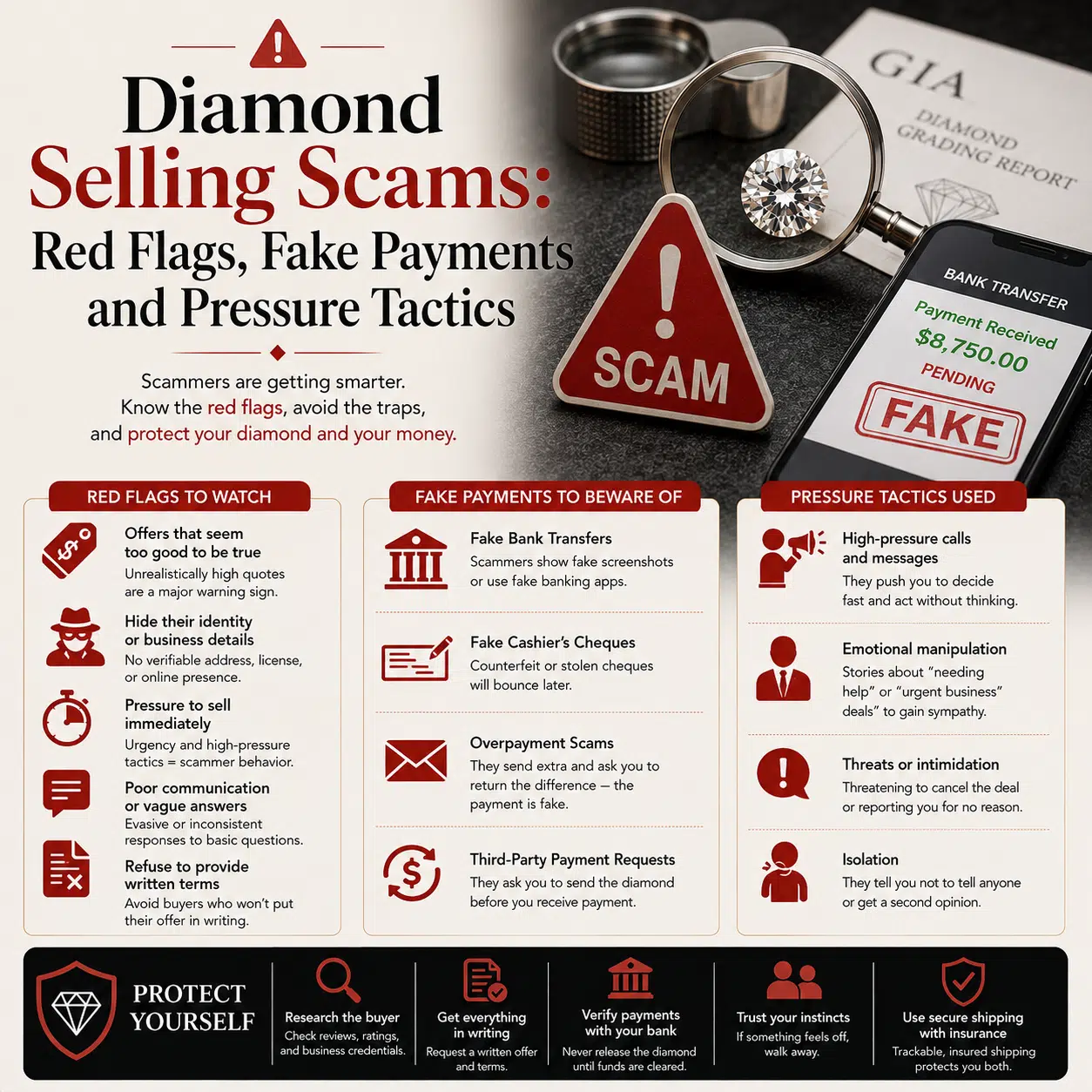
Selling a diamond should be a controlled transaction in which you understand who is receiving your jewellery, how it will be assessed, what you will be paid and what happens if you reject the final offer.
Unfortunately, diamonds are also attractive targets for fraud. They are valuable, portable and difficult for an inexperienced seller to identify once separated from their documentation. Scammers exploit these characteristics through fake payment confirmations, buyer impersonation, fraudulent courier instructions, overpayment schemes and pressure tactics.
The safest rule is simple: never release your diamond because of a screenshot, email, text message or verbal promise. Independently verify the buyer, destination, payment and return terms before your jewellery leaves your possession.
This guide explains how diamond selling scams work, how to distinguish fraud from an ordinary low offer and what to do if something feels wrong.
Quick Answer: How Can You Avoid Diamond Selling Scams?
To avoid a diamond selling scam, keep the transaction within a verifiable process. Confirm the buyer through contact details you found independently, obtain the offer and terms in writing, check the destination before shipping and verify any payment directly through your own bank or payment provider.
Do not ship or hand over a diamond based only on:
- A payment screenshot or forwarded bank receipt
- An email claiming that funds are pending
- A request to pay a fee to release your money
- A cheque written for more than the agreed price
- A buyer’s promise that payment will appear later
- A last-minute request to use a different address
- Pressure to make an immediate decision
- A request for your password, PIN or verification code
A genuine transaction should remain understandable at every stage. If the explanation becomes confusing, the terms suddenly change or the buyer will not allow you time to verify something, pause the sale.
Diamond Selling Scam Warning Signs at a Glance
| Warning sign | What may be happening | Safest response |
| Payment is visible only in an email or screenshot | The confirmation may be forged | Check your own bank account and contact your bank independently |
| Buyer says you must upgrade your account to receive payment | Fake payment or advance-fee scam | Do not pay; contact the payment provider through its official website |
| Buyer sends more than the agreed amount | Overpayment or fake-cheque scam | Do not refund the difference or release the diamond |
| Buyer asks for a verification code | Account takeover or identity misuse | Never share the code |
| Shipping address changes at the last minute | Account compromise, interception or impersonation | Stop and reverify the buyer and destination |
| Buyer sends their own courier or shipping label | Package diversion or inadequate insurance | Verify the carrier, address and coverage independently |
| Offer drops after inspection without a clear reason | Possible bait-and-switch pressure | Request the findings and revised offer in writing |
| Unexpected return, release or administration fee appears | Seller may be trapped into accepting or paying | Refer to the original written terms and pause the transaction |
| Buyer insists on leaving the marketplace platform | Attempt to bypass seller protection or records | Keep communication and payment within the approved system |
| Buyer creates extreme urgency | Pressure intended to prevent verification | Stop and review the transaction without the buyer on the call |
| A company contacts you from a lookalike email domain | Buyer impersonation or phishing | Contact the real company using details from its official website |
| Buyer asks for bank login information, PIN or remote access | Financial account theft | End contact and notify your bank if anything was shared |
One warning sign does not always prove fraud. However, several warning signs appearing together should be treated seriously.
Why Diamond Sellers Are Targeted
A diamond can represent thousands of euros or dollars in an object small enough to fit inside an envelope. Once it has been shipped to a fraudulent address or handed to an unknown person, recovering it may be difficult.
Many sellers are also completing this type of transaction for the first time. They may not know the difference between an appraisal, an estimate, a conditional offer and a final purchase price. A dishonest person can use that uncertainty to create urgency or make unreasonable instructions sound like standard industry practice.
The emotional circumstances behind a sale can increase the risk. Someone selling an engagement ring after a separation, dealing with an inheritance or needing money quickly may be more vulnerable to statements such as:
- “This offer is available for the next hour only.”
- “No legitimate buyer will pay you more.”
- “You need to ship today to secure the price.”
- “The payment has been made, so you must send the diamond.”
- “You will lose the offer if you speak to another buyer.”
A legitimate buyer may explain that diamond prices can change, but normal market movement does not justify forcing someone to decide within minutes.
Is a Low Diamond Offer Always a Scam?
No. A low diamond offer can be disappointing without being fraudulent.
Retail jewellery prices, insurance replacement values and resale offers measure different things. A buyer may also revise an initial estimate after discovering that a diamond’s measurements, condition, treatment status or grading differ from the information originally supplied.
The important distinction is how the buyer behaves.
A commercially genuine buyer should be able to explain the basis of an offer and identify why a final offer differs from an earlier estimate. You should then be free to accept or reject it according to the agreed terms.
A possible lowball tactic is more concerning when the buyer:
- Advertises an unrealistically high estimate to obtain the diamond
- Refuses to explain a major reduction
- Introduces previously undisclosed fees
- Claims the diamond is worthless without supporting details
- Uses threats or repeated pressure to force acceptance
- Makes returning the diamond unexpectedly expensive or difficult
- Changes the terms only after gaining possession of the jewellery
Fraud involves deception intended to take your diamond, money, personal information or account access. A disagreement over value is not automatically fraud.
If you need to assess two genuine proposals, read how to compare diamond offers using the net payment, conditions, fees and return terms.
1. Fake Bank Transfer Confirmations
One of the simplest diamond buyer scams begins with a convincing payment confirmation.
The buyer may send a screenshot showing your name, the agreed amount and a transaction reference. You might also receive an email designed to resemble a message from a bank or payment service. The buyer then asks you to ship the diamond immediately.
Screenshots and emails can be edited, copied or generated. A transaction reference supplied by the buyer is not proof that money has reached your account.
Verify payment by signing in to your bank through the app or website you normally use. Do not use a link in the buyer’s message. For a high-value or unfamiliar transaction, contact your bank using the number on its official website or your bank card and ask what the transaction status means.
Depending on the payment method, there can be a difference between a payment being initiated, pending, available, settled or still subject to investigation. Ask your bank whether the funds have actually been credited and whether any relevant restriction or risk remains.
Never let a buyer rush you by saying the transfer will be cancelled unless you ship immediately.
Illustrative scenario
A seller agrees to sell a diamond for €4,800. The supposed buyer emails a professional-looking transfer receipt and says the money is being held because the seller has a “personal account.” A second email says the seller must pay €200 to upgrade to a business account before the €5,000 total can be released.
The seller has not received €4,800. The transfer receipt and account-upgrade requirement are part of the same deception. Paying the €200 would create an additional loss.
2. Payment-App Upgrade and Release-Fee Scams
A genuine payment provider does not normally require a private seller to send money to a buyer before receiving an incoming payment.
In this scam, a message claims that your payment is waiting but cannot be released until you:
- Upgrade your account
- Pay a processing charge
- Increase a transaction limit
- Buy a gift card
- Send cryptocurrency
- Refund a temporary overpayment
- Pay a courier or customs fee
The message may use the provider’s logo and formatting. The sender’s address, however, may contain an extra letter, an unusual domain or an unrelated email service.
Do not click the link or telephone the number in the message. Open the provider’s official application or type its website address yourself. If no payment appears there, assume the notification is unreliable until the provider confirms otherwise.
3. Fake Cheques and Overpayment Scams
Cheque scams are particularly relevant to sellers in the United States and in markets where cheques are still used.
The supposed buyer sends a cheque for more than the agreed purchase price. They explain that the excess was accidental or is intended to pay their courier, insurance agent or another third party. They ask you to deposit the cheque and return the difference.
The funds may initially appear in your account because banks can make deposited funds available before establishing that a cheque is genuine. If the cheque is later identified as fraudulent, the deposit can be reversed. The money you refunded and the diamond you shipped may already be gone.
Never accept a cheque for more than the agreed price, and never use part of a cheque deposit to pay the buyer or an associated third party.
Illustrative scenario
A buyer in the United States agrees to pay $6,500 for a diamond ring but sends a cheque for $7,000. They ask the seller to return $500 through a payment application.
The apparent $7,000 balance does not establish that the cheque is valid. If the seller returns $500 and ships the ring, the seller could lose both amounts when the cheque is rejected.
4. Fake Refund Requests
A variation of the overpayment scam uses a digital payment notification rather than a cheque.
The buyer claims to have paid twice or transferred an incorrect amount. They send screenshots showing the supposed payments and ask for an immediate refund.
Do not refund money merely because the buyer has supplied an image. Check your own account. If a genuine payment error occurred, contact the payment provider and follow its official resolution process instead of sending a separate payment to details supplied in a message.
A separate refund can be especially dangerous if the original transaction was made using a compromised account or is later disputed.
5. Buyer Impersonation and Lookalike Websites
A scammer may pretend to represent a genuine diamond company, jeweller, auction house or marketplace. They can copy a company’s logo, photographs, employee names and website text.
Common impersonation techniques include:
- Registering a domain with one altered letter
- Adding words such as “payments,” “valuation” or “shipping” to a company name
- Using a free email account while displaying a legitimate company name
- Creating a duplicate social media profile
- Spoofing the number shown on your caller ID
- Sending messages from a compromised business account
- Copying a legitimate company’s registration details
Do not confirm a company through contact details contained in the suspicious message. Find the organisation’s official website independently and contact it through the published telephone number or contact form.
Ask whether the named employee works there, whether the valuation reference exists and whether the shipping address belongs to the company.
A company’s logo is not verification. A registration number shown in an email is not verification. Even a genuine employee’s name can be copied.
For a broader assessment of credentials, transparency and reputation, use the separate guide on how to choose a reputable diamond buyer.
6. Last-Minute Address Changes and Third-Party Collection
Treat any unexpected destination change as a new transaction that requires verification.
A buyer may initially give you the address of a recognised company. Shortly before shipping, they ask you to send the parcel to a residential address, hotel, storage location, “regional office” or relative instead. A similar request may arrive after a genuine buyer’s email or marketplace account has been compromised.
Do not rely on the fact that the first address was legitimate. Contact the buyer through a previously verified channel and confirm the change. If the buyer cannot provide a clear and independently verifiable explanation, do not ship.
The same rule applies to collection. If a different person or courier arrives, do not hand over the diamond merely because they know the buyer’s name or transaction amount. Confirm their identity and authority through the verified buyer.
7. Fake Courier, Escrow and Insurance Instructions
Fraudsters know that sellers expect valuable jewellery to be insured. They exploit that expectation by creating fake courier portals, false tracking pages and invented insurance charges.
A buyer might send a shipping label and say that the parcel is insured. The label itself does not prove the declared value, insurance cover or final destination. Some policies exclude jewellery, loose diamonds or parcels prepared in a particular way.
An escrow service can also be impersonated. A fake website may claim that the buyer has deposited funds and that the money will be released after shipment. The website may exist only to obtain your diamond or payment details.
Before using a courier or escrow provider:
- Find the provider independently
- Confirm that the domain is correct
- Verify the tracking number through the official website
- Read the jewellery and declared-value exclusions
- Confirm who purchased the cover
- Check the destination shown on the carrier’s system
- Ask how a loss or rejected valuation would be handled
Never pay an unexpected “escrow release fee” through a link supplied by the buyer.
For detailed packaging and insurance guidance, use the guide on how to ship a diamond safely.
8. Verification-Code and QR-Code Scams
A buyer does not need your one-time password, authentication code or account recovery code to pay you.
A scammer may say that a code is needed to confirm you are a real seller, release a transfer or verify a listing. In reality, the code may allow them to create an account linked to your number, reset your password or approve access to an existing account.
A QR code can also direct you to a fraudulent payment page. Scanning it does not make it safer than clicking a suspicious link.
Never share:
- A bank authentication code
- A card PIN
- A payment-app verification code
- An email or social media password
- A code used to reset an account
- A recovery phrase or cryptocurrency wallet key
If you shared a code, change the relevant password immediately, sign out other sessions where possible and contact the affected provider.
9. Bait-and-Switch Diamond Offers
A preliminary estimate can legitimately change after physical inspection. Photographs cannot always reveal exact colour, clarity, treatments, damage, replacement stones or discrepancies between a diamond and its paperwork.
The warning sign is not simply that the offer changed. The warning sign is an unexplained change combined with pressure or undisclosed consequences.
For example, be cautious when a buyer:
- Gives a very high estimate before receiving basic information
- Reduces the offer dramatically without identifying a new finding
- Refuses to provide the inspection result in writing
- Adds return postage or administration charges that were not disclosed
- Claims you must accept immediately
- Says the original estimate never existed
- Delays returning the diamond after you decline
- Tries to renegotiate repeatedly after you have requested its return
Before sending your jewellery, ask whether the initial figure is an estimate or binding offer, what may cause it to change and who pays for an insured return if you decline.
Illustrative scenario
A seller receives a preliminary estimate of €9,000 based on a brief description. After the diamond arrives, the buyer reduces the offer to €3,200 and says it must be accepted within 30 minutes. The buyer will not explain the difference and then reveals an unexpected return fee.
A lower physical-inspection offer is not automatically fraudulent. However, the combination of an unexplained reduction, extreme time pressure and a previously undisclosed return cost is a serious warning sign.
10. Diamond Switching Fears
Some sellers worry that a buyer will replace their diamond with a lower-quality stone. Although suspicion alone does not prove that switching has occurred, you can reduce uncertainty by creating a clear record before transfer.
If the diamond has a laboratory report, record the report number and the diamond’s stated characteristics. If there is a laser inscription, photograph it through suitable magnification when possible. Also photograph the jewellery, setting, visible inclusions and identifying details.
A professional intake process should document what was received. For a valuable item, ask whether the parcel is opened under recorded surveillance and whether the buyer provides a receipt or intake record.
If the diamond is returned, compare it with:
- Your original photographs
- The laboratory report
- The report or inscription number
- Recorded measurements
- Distinctive inclusions
- The setting and its identifying marks
If you have a reasonable concern, do not attempt to settle the matter through hostile messages. Preserve the packaging and transaction record and obtain an independent examination from a qualified professional.
11. Pressure Tactics Used Against Diamond Sellers
Pressure is often used to prevent independent verification.
A dishonest buyer may tell you that contacting your bank will delay or cancel the transfer. They may keep you on the phone while directing you through a payment process, discourage you from speaking to a family member or insist that the transaction is confidential.
Other tactics are emotional rather than technical. The buyer may criticise your intelligence, claim you have wasted their time or threaten legal action because you no longer want to proceed.
A seller is generally entitled to pause before accepting an offer unless a valid agreement already creates specific obligations. If you are uncertain about your legal position, obtain local advice rather than relying on the buyer’s interpretation.
Pressure should never replace documentation.
A safe response is: “I will verify the payment, terms and destination independently before continuing.”
You do not need to debate the buyer. Stop responding until your checks are complete.
12. Unsafe Online Marketplaces and Private Messages
General marketplaces can provide access to many potential buyers, but they are not always designed for high-value diamond transactions.
Be cautious when a buyer immediately tries to move the conversation to a private messaging application. Moving outside the platform can remove transaction records, reporting tools and whatever seller protection the platform provides.
Other marketplace warning signs include:
- A new or nearly empty buyer profile
- An account whose name changes during the transaction
- Messages that ignore the details in your listing
- An offer above your asking price without inspection
- A buyer who refuses every secure payment option
- A request to ship before platform payment appears
- A courier that will supposedly bring cash
- A link asking you to enter card or bank credentials
- A request to mark the item as sold before payment
- Claims that the platform requires you to pay a fee through a message
Review the platform’s current seller-protection rules before listing a diamond. Some services limit protection by item type, value, payment method, destination or proof of delivery. Do not assume that a jewellery sale is covered simply because the platform offers protection for ordinary goods.
13. Risks of Meeting a Private Buyer
An in-person transaction removes shipping risk, but it creates personal-safety and payment risks.
Do not invite an unknown buyer to your home or advertise where the diamond is normally stored. Meet only in a secure, controlled location where the buyer’s identity and payment can be verified. Tell someone where you are going and do not carry other jewellery.
Cash can be counterfeit, and counting a large amount in a public place can expose you to theft. A banking hall may offer a more controlled setting, but you should confirm in advance what assistance the bank can provide.
If the buyer changes the meeting location, arrives with unexpected people or pressures you to enter a vehicle or private property, leave.
14. Personal Information and Identity Theft
A diamond buyer may need certain information to comply with payment, identity-verification, anti-money-laundering or record-keeping requirements. The exact requirements vary by country and transaction.
However, you should understand why each document is needed, how it will be transferred and how it will be protected.
Do not send unnecessary copies of:
- Your passport or national identity card
- A document containing your complete home address
- Bank statements showing unrelated transactions
- Both sides of a payment card
- Tax or social-security identifiers
- Account passwords or security answers
Where appropriate and legally acceptable, a copy of an identity document can be marked with the recipient, purpose and date. Do not alter information that the recipient is legally required to verify. If you are unsure, ask what is required before uploading anything.
Prefer a secure upload system over ordinary email. A request for your bank password, PIN or one-time code is not a normal identity check.
15. False Claims About Certificates and Grading
A scammer may misuse the name of a recognised gemmological laboratory to appear credible.
Grading laboratories assess diamonds and issue reports. Their names should not automatically be interpreted as proof that a buyer is approved, licensed or endorsed by that laboratory.
Be cautious if someone claims that a laboratory:
- Guarantees their purchase offer
- Holds your payment
- Requires you to pay a release fee
- Accredits them as a financial service
- Has instructed you to ship to a private address
Verify a grading report through the laboratory’s official report-checking service where available. Do not follow a link supplied by an unknown buyer.
16. Can a Diamond Certificate Be Faked?
Yes. Paper documents, report numbers and digital images can be copied or altered. A genuine report number may also be presented with a different diamond.
A certificate should therefore be treated as one part of identification, not as automatic proof that the person holding it owns the corresponding diamond or that the stone matches the report.
During a professional inspection, the diamond’s measurements, grading characteristics and any inscription should be compared with the report.
As a seller, keep copies of your report and never send away the only record without making a clear digital copy first.
17. A Safer Way to Verify a Diamond Payment
Payment verification should be independent of the buyer.
Use this sequence:
- Agree on the amount, currency, payment method and account holder in writing.
- Confirm whether fees will be deducted.
- Wait for the transaction to appear through your own bank or payment account.
- Do not use a login link sent by the buyer.
- Check that the amount and currency are correct.
- Contact your bank or provider through an official channel if the status is unclear.
- Do not send refunds or third-party payments.
- Retain the written offer, transaction reference and correspondence.
- Release the diamond only when the agreed payment and handover conditions have been satisfied.
Bank-transfer rules differ between countries and payment systems. Ask your bank about the specific transfer rather than relying on a general statement that all transfers are either reversible or irreversible.
18. How to Verify Shipping Instructions
Before shipping, compare the recipient’s name and address across the written offer, shipping instructions and carrier label.
If they do not match, pause.
You should also know:
- Who has arranged the shipment
- Whether jewellery and loose diamonds are covered
- The maximum insured value
- Whether a drop box is permitted
- Whether an acceptance scan is required
- Who can redirect the parcel
- What signature will be collected
- What happens if the buyer rejects the item
- Who pays for an insured return
Photograph the diamond and packaging process without revealing sensitive information publicly. Obtain a carrier acceptance receipt and retain the tracking history.
Full instructions are available in How to Ship a Diamond Safely: Packaging, Tracking and Insurance.
19. Four Illustrative Diamond Scam Scenarios
The following scenarios are fictional examples showing how warning signs can appear. They are not customer stories.
Scenario 1: The fake payment email
A buyer sends a screenshot showing a €6,200 transfer. The seller’s account shows no incoming funds, but the buyer says international transfers take several hours and demands immediate shipment.
Warning signs: Payment exists only in the buyer’s evidence, and the buyer is using urgency to prevent verification.
Safe response: Do not ship. Verify through the seller’s bank.
Scenario 2: The courier overpayment
A buyer sends a cheque for $8,500 for a $7,700 ring. They ask the seller to send $800 to a courier who will collect the ring.
Warning signs: Overpayment, third-party payment and urgent refund request.
Safe response: Do not deposit or use the cheque and do not pay the courier.
Scenario 3: The unexplained offer switch
A buyer estimates a diamond at €10,000. After receiving it, the buyer offers €4,100, provides no inspection findings and says returning it will cost €600 unless the seller accepts that day.
Warning signs: Unexplained reduction, undisclosed return charge and extreme pressure.
Safe response: Refer to the original terms, request the findings in writing and seek the diamond’s return through the agreed process.
Scenario 4: The changed destination
A person claiming to represent a recognised buyer initially provides the company’s public office address. They later ask the seller to ship to an employee’s apartment because the office is “being renovated.”
Warning signs: Last-minute destination change and unverified private address.
Safe response: Contact the company using the number on its independently located official website.
20. What to Do If You Suspect a Diamond Selling Scam
Stop the transaction immediately. Do not ship the diamond, send a refund, pay a release fee or provide another verification code.
Save the available evidence, including:
- Emails and message histories
- Usernames and profile links
- Website addresses
- Phone numbers
- Payment instructions
- Account details
- Transaction references
- Shipping labels
- Tracking records
- Photographs
- Written offers and terms
If money or banking information may be at risk, contact your bank or payment provider immediately using an official number. Speed can matter when a transfer, account takeover or fraudulent card transaction is involved.
If the diamond has already been shipped, contact the carrier immediately. Ask whether the parcel can be intercepted, held or returned. Do not rely on the buyer to arrange this.
Report the account or listing to the marketplace. If personal identity information was exposed, change affected passwords, enable multi-factor authentication and monitor your relevant accounts.
Where to report fraud
Reporting routes vary by country:
- Belgium: Contact your bank immediately if payment information or money is at risk. Report suspicious online activity through the current Safeonweb guidance and report theft or fraud to the police. Contact Card Stop if card details have been compromised.
- European Union: Contact your bank, payment provider, platform and national police or cybercrime reporting service. For a cross-border consumer dispute involving a business, your national European Consumer Centre may provide guidance.
- United Kingdom: Contact your bank immediately. Fraud and cybercrime in England, Wales and Northern Ireland can be reported through Report Fraud; incidents in Scotland should be reported through Police Scotland.
- United States: Contact your bank or payment provider, report fraud to the Federal Trade Commission and report internet-enabled crime through the FBI’s Internet Crime Complaint Center.
- Other countries: Contact your bank, national cybercrime reporting service and local police. Use reporting links found through official government websites.
If you or another person is in immediate danger, contact the local emergency services.
21. A Fraud-Resistant Diamond Selling Process
The safest diamond sale is one where every important step creates evidence.
Begin with a private valuation request through a website you have independently verified. Provide enough information to receive a realistic preliminary assessment, but do not share passwords, security codes or unnecessary identity documents.
Before sending the diamond, obtain written information covering:
- Whether the first figure is an estimate
- How the physical inspection works
- What may change the final offer
- The destination and recipient
- Shipping and insurance arrangements
- The time allowed to accept or decline
- How payment is made
- Whether any fees are deducted
- How the diamond will be returned if you decline
Keep copies of your diamond’s report, identifying details and photographs. Verify the shipment and retain the acceptance receipt.
After inspection, compare the final offer with the earlier information. If you accept, verify payment through your own financial institution. If you decline, follow the documented return process and monitor the shipment.
You can review the full transaction journey in what happens after requesting an online diamond valuation.
Frequently Asked Questions About Diamond Selling Scams
1. What is the most common diamond selling scam?
Fake payment confirmation is one of the most common risks when selling valuable goods online. The scammer sends a forged screenshot, email or payment-app notification and asks the seller to release the item before genuine funds are verified.
2. How do I know whether a diamond buyer has really paid me?
Check the account through your own bank or payment provider. Do not rely on a screenshot, email, text message or link supplied by the buyer. Contact your bank through an official number if the transaction status is unclear.
3. Is a bank transfer screenshot proof of payment?
No. A screenshot can be edited or fabricated. Even a genuine screenshot may show only that a transfer was initiated. Verify the transaction independently in your own account.
4. Should I ship a diamond while a payment is pending?
Not unless your written agreement and payment provider give you adequate protection and you fully understand the risk. For a high-value diamond, wait until the payment status has been independently verified.
5. Can a buyer cancel a bank transfer after sending it?
That depends on the country, payment system, transaction status and whether fraud is alleged. Ask your bank about the specific transfer rather than accepting the buyer’s explanation.
6. Can fake funds appear in my bank account?
A fraudulent cheque can appear as available funds before the bank discovers that it is invalid. Other payment methods have different rules. Confirm unfamiliar high-value payments with your bank.
7. What is a diamond overpayment scam?
The buyer sends or claims to send more than the agreed amount and asks the seller to return the difference or pay a third party. The original payment is often fake, fraudulent or later reversed.
8. What should I do if a buyer overpays me?
Do not send a separate refund. Contact your bank or payment provider independently and ask how the supposed payment should be handled.
9. Is an account-upgrade fee required to receive money?
A message saying you must pay a buyer or unknown third party to upgrade your account and release incoming money is a strong scam warning. Check directly with the payment provider.
10. Can a buyer need my verification code to send payment?
No buyer should need your private authentication or account recovery code. Do not share one-time passwords or verification codes.
11. Is it safe to scan a QR code sent by a diamond buyer?
Only if you have independently verified what it is and where it leads. A QR code can open a phishing or fake payment page just like an ordinary link.
12. What details does a buyer need to pay me?
The required details depend on the payment method and country. A buyer does not need your bank password, card PIN, one-time authentication code or email password.
13. Is every low diamond offer a scam?
No. Diamond resale offers can be much lower than original retail or insurance values. Fraud is more likely when an offer is paired with deception, undisclosed fees, false claims or coercive pressure.
14. How can I avoid a lowball diamond offer?
Obtain the offer in writing, understand whether it is conditional and compare the net amount after all deductions. Ask for an explanation if the final offer changes after inspection.
15. Is a preliminary diamond estimate guaranteed?
Usually not unless the buyer expressly describes it as binding. Photographs and seller-supplied information may support only a provisional estimate before physical inspection.
16. When is a revised diamond offer suspicious?
It becomes concerning when the buyer cannot explain the revision, introduces new fees, blocks the return of the diamond or pressures you to accept immediately.
17. Can a diamond buyer charge to return my jewellery?
Return charges depend on the buyer’s published terms and your agreement. The cost, insurance and method should be disclosed before you send the diamond.
18. What is a bait-and-switch diamond offer?
It is a tactic in which an attractive initial estimate is used to obtain the diamond, followed by a much lower offer combined with pressure or obstacles to getting the item back.
19. How do I know whether the company contacting me is genuine?
Locate the company’s website independently and contact it through its published details. Confirm the employee, valuation reference and shipping destination.
20. Can scammers copy a genuine diamond buyer’s website?
Yes. Logos, employee names, registration details and website text can be copied. Lookalike domains may differ from the genuine address by only one character.
21. Can caller ID prove that a diamond company called me?
No. Displayed telephone numbers can be spoofed. End the call and contact the company through a number you found independently.
22. Should I ship to a different address if the buyer requests it?
Pause the transaction and verify the change through an established contact channel. Do not redirect a valuable parcel based only on a new email or message.
23. Is a buyer-provided shipping label automatically insured?
No. Verify the carrier, destination, declared value and jewellery exclusions. A label alone does not establish adequate insurance.
24. Is escrow safe for a diamond transaction?
A genuine, independently verified escrow service can reduce certain risks, but fake escrow sites are common. Do not use a service found only through the buyer’s link.
25. Should I use a marketplace to sell a diamond?
A marketplace may help you find buyers, but review its rules and seller protection carefully. High-value jewellery may be excluded or protected only under specific conditions.
26. Why does a scammer want to move the conversation off the marketplace?
Moving to private messages may help the scammer avoid platform monitoring, remove transaction records and bypass seller-protection requirements.
27. Is it safe to accept cash for a diamond?
Cash removes some electronic payment risks but creates risks involving counterfeiting, robbery and personal safety. Do not conduct a large cash transaction at home or in an uncontrolled location.
28. Should I allow a private buyer to visit my home?
It is generally safer not to reveal where valuable jewellery is stored. Use a controlled professional environment where identity, payment and security can be managed.
29. How can I prevent my diamond from being switched?
Record the report number, inscription, measurements, visible inclusions and jewellery details. Use a documented intake process and compare the returned item with your records.
30. What should I do if I believe my diamond was switched?
Preserve all records and packaging, avoid altering the item and obtain an independent professional examination. Report suspected theft or fraud through the appropriate local authorities.
31. Can a diamond certificate be fake?
Yes. A report can be copied, altered or paired with a different stone. Verify the report through the issuing laboratory and confirm that the diamond matches it.
32. Does a grading laboratory certify diamond buyers?
A laboratory may grade diamonds or verify reports, but that does not automatically mean it licenses, guarantees or endorses a buyer.
33. Why is a buyer pressuring me to decide immediately?
Urgency can prevent you from comparing offers, contacting your bank or checking the buyer. Pause the transaction whenever pressure interferes with verification.
34. Can I change my mind after receiving an offer?
That depends on whether you have already accepted a binding agreement and on the applicable terms and law. Do not rely solely on the buyer’s legal claims if there is a dispute.
35. What records should I keep when selling a diamond?
Keep photographs, grading reports, written offers, terms, messages, payment records, shipping instructions, acceptance receipts and tracking information.
36. Should I delete messages after cancelling a suspicious sale?
No. Preserve the correspondence, usernames, website addresses and payment instructions. They may be useful to your bank, platform, carrier or law-enforcement agency.
37. What should I do if I already sent the diamond?
Contact the carrier immediately and ask whether the parcel can be stopped or returned. Also contact the buyer through a verified channel and report suspected fraud to the appropriate authorities.
38. What if I already sent money to a scammer?
Contact your bank or payment provider immediately. Ask whether the transaction can be stopped, recalled or disputed. Then preserve the evidence and report the incident.
39. What if I shared my bank details?
Contact your bank and explain exactly what was shared. Monitor the account and follow the bank’s security instructions. Change any compromised login credentials immediately.
40. What if I shared a one-time password?
Contact the relevant bank or account provider immediately, change the password and review active sessions and recent transactions. Do not approve additional prompts.
41. Can a recovery company get my diamond back?
Be careful. People who have already experienced fraud can be targeted again by supposed recovery specialists demanding upfront fees. Verify any recovery service independently and involve law enforcement or legal counsel where appropriate.
42. Should I pay a fee to have stolen money or jewellery recovered?
An unexpected demand for an upfront recovery, release or administration fee is a major warning sign. Consult your bank, insurer, police or legal adviser before paying anyone.
43. How do I report a fake jewellery payment?
Contact the bank or payment provider being impersonated, report the account to the platform and notify the appropriate fraud or cybercrime authority in your country. Save the payment message and sender information.
44. Is selling a diamond online safe?
It can be safe when the buyer, payment, shipment, insurance and return process are independently verified. The risk increases when a transaction depends on private messages and undocumented promises.
45. What is the safest first step when selling a diamond?
Start with a private valuation request through a buyer’s independently verified website. Obtain the process and terms before sending the diamond or personal documentation.
Protect Your Diamond Before You Commit
A legitimate diamond sale should not depend on confusion, secrecy or fear.
Take time to verify the buyer through an independent channel. Record your diamond’s identifying details. Obtain the offer, destination, fees and return terms in writing. Check payments through your own financial institution, and never share passwords or verification codes.
Most importantly, be willing to stop. A genuine buyer should understand reasonable verification and should be able to explain the transaction clearly.
If you would prefer a private and verifiable route, request a diamond valuation from Sothis and provide your diamond photographs and available grading information.
