


Diamond Resale Value vs Retail Price vs Insurance Appraisal

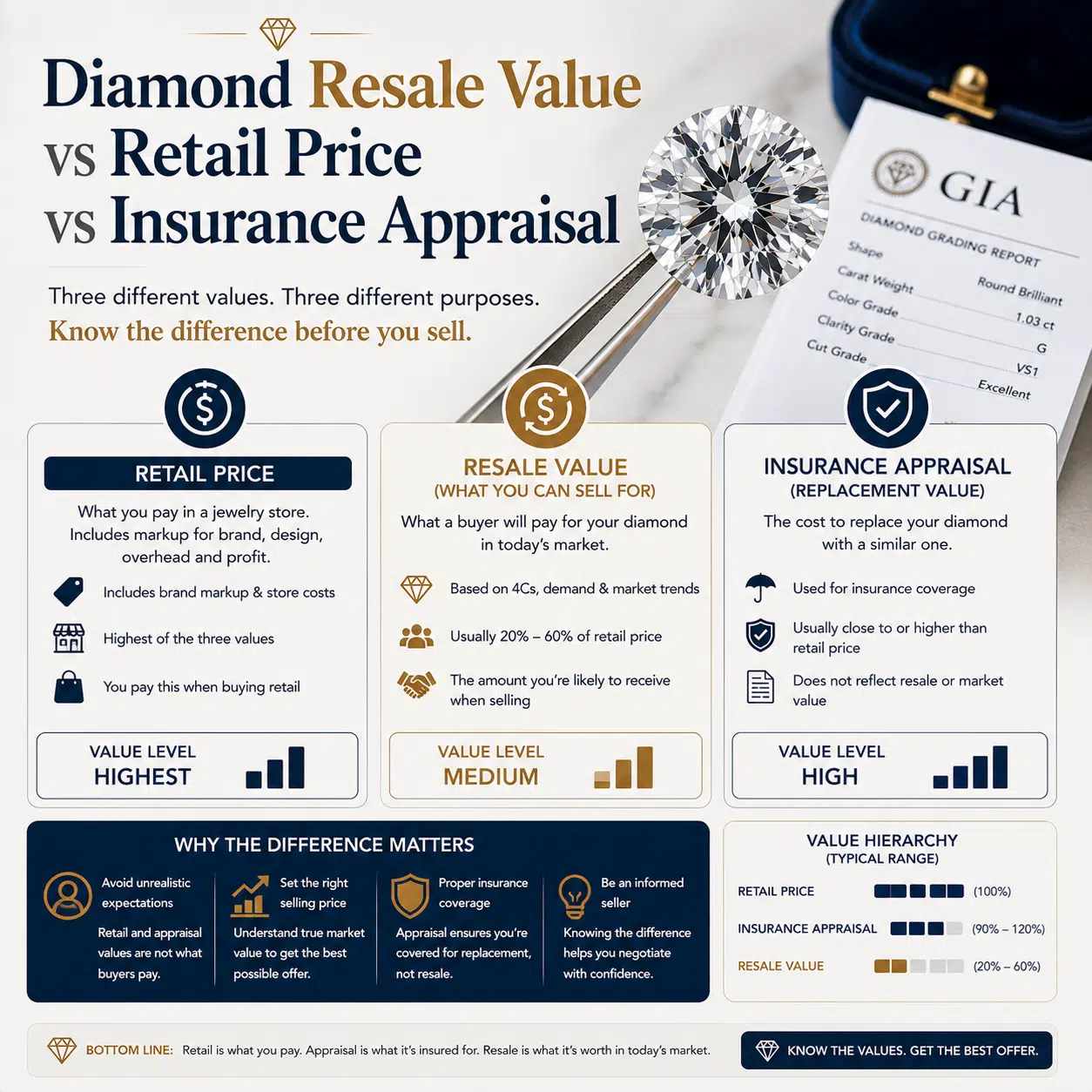
A diamond can have a €10,000 purchase receipt, a €14,000 insurance appraisal and a substantially different resale offer without any of those figures necessarily being fraudulent.
The apparent contradiction exists because retail price, insurance replacement value and resale value measure different things.
Retail price is what a customer pays to purchase the diamond or jewellery from a retailer. Insurance appraisal estimates the amount relevant to replacing or insuring the item under a particular valuation basis. Diamond resale value concerns what the verified item can achieve when it is sold in the current secondary market.
A grading report adds another layer of information, but it does not normally state a monetary value. It records the diamond’s quality and identifying characteristics so that other professionals can use those facts when assessing value.
Understanding these distinctions prevents one of the most common disappointments in diamond selling: assuming that an insurance figure or original receipt is the amount a buyer should pay today.
Quick Answer: Why Is a Diamond Offer Lower Than Its Appraisal?
A diamond resale offer may be lower than an insurance appraisal because the appraisal is often based on the estimated cost of replacing the item through an appropriate retail market. A resale offer is based on the amount a buyer can pay for the existing item in its current condition and resell it within the present secondary market.
The insurance figure may account for retail replacement, taxes, craftsmanship, sourcing and the cost of finding a comparable item. A resale buyer must consider current demand, condition, verification costs, holding time and future selling risk.
The correct comparison is therefore not:
Insurance appraisal = expected cash offer and a purpose-specific replacement figure
Resale value = a current secondary-market assessment
What Is a Diamond’s Retail Price?
The retail price is the amount charged when the diamond or finished jewellery is sold to a consumer.
For a diamond ring, the retail price may include much more than the loose centre stone. It can reflect:
The final price of a diamond includes several costs beyond the diamond itself. These may include the cost of acquiring the diamond, precious-metal setting, side stones, and design and manufacturing expenses. The price can also reflect brand positioning, import expenses, and applicable VAT or sales tax. Retail operating costs such as shop rent and staffing, along with marketing and packaging, also contribute to the overall price. In addition, warranty or service costs, the retailer’s margin, and financing and payment costs may be incorporated into the final selling price.
An insurance appraisal determines the value of jewellery for insurance purposes, typically based on the estimated cost of replacing the item with a comparable piece. This may be referred to as a jewellery valuation for insurance, insurance valuation, replacement-cost appraisal, or retail replacement valuation. A scheduled valuation may also be prepared when specific jewellery items are individually listed and insured for their assessed replacement value.
The original seller received the benefit of a new product, retail environment, consumer protections, presentation and service. A second-hand buyer is purchasing the existing object in its current condition.
Does the Original Retail Price Determine Resale Value?
No. The receipt is useful evidence, but the amount paid does not establish what another buyer must pay later.
The original price can be affected by:
- Where the diamond was purchased
- Whether it was bought online or in a luxury boutique
- Brand premiums
- Negotiated discounts
- Currency movements
- Local taxes
- Whether several products or services were bundled together
Two diamonds with similar grading information can have very different retail receipts. That does not necessarily mean their current resale values will differ by the same amount.
The physical diamond, supporting report, setting, condition and present market must still be examined.
What Is an Insurance Appraisal?
An insurance appraisal is a professional opinion prepared for an insurance-related purpose on a particular date.
Depending on the country, insurer, policy and item, it may be called:
These expressions are not automatically interchangeable. The report should state its intended use and valuation basis.
For a modern diamond ring, the appraiser may consider what it would cost to obtain an equivalent new replacement through an appropriate retailer. For an antique or discontinued signed jewel, the relevant replacement market may instead be the specialist second-hand or auction market.
The policy determines how a claim is handled. An appraisal does not override the insurance contract.
Why Can an Insurance Appraisal Be Higher Than the Purchase Price?
An insurance appraisal may exceed the original invoice for several legitimate reasons.
The item may have been purchased at a discount, through a private connection or in a lower-cost market. Replacement through a suitable retailer may cost more.
The appraisal may also have been prepared several years later, after changes in:
A highly specific ring may be expensive to reproduce even if its individual materials would not realise the same amount when sold separately.
An appraisal can also be too high. An inflated valuation may result from weak research, outdated assumptions or an attempt to make a purchase appear more attractive. A large figure is not automatically a better appraisal.
Can an Insurance Appraisal Be Lower Than the Retail Price?
The retail transaction may have included an unusually high brand premium, financing cost or retailer markup that is not required to replace the item in the relevant market.
The item may also have been purchased during a period of higher prices or from an expensive location. A later appraisal could identify a lower replacement cost.
Because the valuation date and purpose matter, neither direction should be assumed.
Does an Insurance Appraisal Guarantee an Insurance Payout?
No. The insurance policy—not the appraisal alone—governs the claim.
Depending on the contract, the insurer may:
A €15,000 appraisal does not automatically mean that the insurer will transfer €15,000 in cash after a loss. Review the actual policy and ask the insurer how jewellery claims are settled.
What Is Diamond Resale Value?
Diamond resale value is the amount the existing diamond or jewellery can achieve when sold in the current secondary market.
It is not one permanent number. The result can vary depending on:
- The diamond’s verified characteristics
- Whether it is natural or laboratory-grown
- Condition
- Documentation
- Market demand
A direct buyer’s offer, auction hammer price, consignment selling price and private-sale amount may all differ because they involve different timelines, costs and risks.
When comparing options, focus on the net amount you will receive, not only the advertised or headline price.
Resale Value Is Not the Same as an Asking Price
An online listing shows what a seller wants, not what a buyer has agreed to pay.
Some listings remain online for months because the price is unrealistic. Others omit condition, grading or transaction details. The displayed amount may also include retailer services, return rights or commission.
Useful resale evidence comes from genuinely comparable completed transactions. Even then, adjustments may be required for:
A jewellery valuation takes into account several important factors, including the date and location of the valuation, the item’s condition, and the laboratory that has assessed or certified the diamond. The brand may also influence the value, along with applicable fees and taxes. Detailed diamond characteristics, such as carat weight, colour, clarity, and cut, are considered when determining value. The type of sale, whether retail, auction, private sale, or another transaction, can also affect the final valuation.
A marketplace listing for a “one-carat diamond ring” is not a meaningful comparison if its colour, clarity, cut, origin, condition and documentation are unknown.
What Is Market Value?
“Market value” is a valuation term that should be used with a clearly defined basis.
International valuation principles generally frame market value around an exchange between willing, knowledgeable parties acting without compulsion after appropriate marketing.
The expected marketing period and market participants matter. If you ask, “What is my diamond’s market value?” a useful follow-up question is: For what purpose, in which market and over what selling period?
What Is Fair Market Value?
Fair market value is used in certain tax, estate, charitable and legal contexts, particularly in the United States. Its precise meaning and application depend on the jurisdiction and purpose.
It commonly concerns a hypothetical transaction between informed and willing parties, neither being forced to act. That is different from walking into a business and requesting an immediate purchase.
A fair-market-value appraisal prepared for tax or estate purposes should not automatically be presented as a guaranteed resale offer. Obtain qualified local advice when the valuation will be used for tax, probate, divorce, donation or litigation.
What Is Liquidation Value?
Liquidation value concerns a sale under a shorter or more restricted timeframe than an ordinary market-value assessment.
An orderly liquidation may allow some marketing time. A forced liquidation may assume urgent disposal with limited exposure to potential buyers.
A seller requiring immediate cash may therefore receive a different result from a seller who can wait months for a particular collector.
Do not use “liquidation,” “resale” and “market” value as if they always mean the same thing.
Is a Diamond Grading Report an Appraisal?
No.
A laboratory grading report records technical and identifying information about the diamond. Depending on the report, it can include:
- Shape and cutting style
- Measurements
- Carat weight
- Colour grade
- Clarity grade
A grading report does not normally state how much the diamond should be insured for or what a buyer should pay.
The report provides evidence used in valuation. It is not the valuation itself.
Is a Diamond Certificate the Same as a Valuation?
No. The word “certificate” is often used conversationally, but professional laboratories may call the document a grading report.
A grading report describes the stone that was examined. A valuation applies a monetary opinion for a specified purpose and date. A purchase offer states what a particular buyer is prepared to pay subject to its terms.
These are three different documents:
- Grading report: What is the diamond?
- Valuation or appraisal: What is it worth for a defined purpose?
Confusing them can create unrealistic expectations.
Why Is a Diamond Buyer’s Offer Often Lower Than the Retail Price?
A resale buyer is not reversing the original retail transaction.
The buyer may need to account for:
- Physical testing and grading
- Repairs or professional removal
- Recutting risk
- Insurance and secure transport
- Holding time
- Market-price movement
- Customer acquisition
The buyer also cannot normally recover the original owner’s experience of buying the item new. Packaging, boutique presentation, financing and sentimental meaning may have been valuable to the purchaser but do not necessarily transfer to the next transaction.
This does not justify any arbitrary offer. It explains why a professional resale offer is calculated from the current item and market rather than by subtracting a fixed percentage from the receipt.
Why Is the Resale Offer Lower Than the Insurance Appraisal?
The insurance appraisal may estimate what it would cost to replace the item through a suitable retail source. The buyer is calculating what it can pay to acquire the existing item for resale.
The replacement route may include retail sourcing, workmanship, taxes and insurer requirements. The resale route includes buyer costs, liquidity and future market risk.
A difference between the figures is therefore expected in many cases. The size of that difference cannot be determined through a universal percentage.
Why This Article Does Not Give a “Diamond Resale Percentage”
Claims that every diamond resells for a fixed percentage of retail price are unreliable.
A diamond’s value and resale potential depend on several factors, including whether it is naturally mined or laboratory-grown, its carat weight, colour, clarity, cut quality, and shape. The presence and reputation of a laboratory report, any treatments, and the diamond’s overall condition can also influence its value. Brand reputation and the type of setting may further affect pricing, while market demand plays an important role in determining how desirable the diamond is at a given time. The purchase channel, original markup, applicable taxes, selling method, and associated fees also impact the final amount received upon resale. Finally, timing can significantly affect the outcome, as market conditions and buyer demand may change over time.
A diamond bought at a strong price through a competitive online retailer cannot be compared directly with a similar-looking ring purchased from a luxury boutique. A rare signed jewel cannot be compared with an unbranded mass-produced setting.
Any percentage quoted without examining the diamond, receipt, appraisal and selling route creates an illusion of precision.
A Hypothetical Example of Three Different Values
Consider a fictional diamond ring purchased for €11,500, including VAT, a platinum setting, boutique service and the retailer’s margin.
Several years later, an appraiser assigns an insurance replacement value of €14,000. The appraiser believes that obtaining a comparable replacement through an appropriate retail source would cost that amount on the valuation date.
The owner then requests a resale offer. The professional buyer examines the centre diamond, setting, condition, grading report and present market. The buyer produces a separate figure based on what it can pay for the existing ring in the secondary market.
That resale figure may be materially lower than both €11,500 and €14,000. This does not mean the original receipt or appraisal was necessarily false. Each figure answers a different question.
The numbers in this example are entirely illustrative. They do not predict the resale value of another ring or establish a normal recovery percentage.
Retail Price Can Vary Between Sellers
There is no universal retail price for every diamond matching the same broad grades.
When evaluating a purchase, it is important to consider the exact proportions, cut performance, fluorescence, and the location of inclusions, as well as any brown, grey, or green colour modifiers. Other important factors include the laboratory and brand, sourcing practices, return policy, warranty, store location, inventory costs, and any available discounts.
Even two diamonds both described as one-carat G VS2 round brilliants may not be equally desirable.
This is why the original receipt should be treated as evidence of the transaction, not a complete valuation formula.
How Taxes Affect the Expectation Gap
Retail prices may include VAT, sales tax or other charges. These amounts were paid as part of the original consumer transaction but are not a physical part of the diamond.
When the owner later sells the item, the buyer is not normally refunding the original tax.
Tax treatment differs by country, seller status and transaction. If you are selling as a business, exporting a diamond or calculating a taxable gain or loss, obtain local professional advice.
How the Setting Affects Resale Value
A ring’s retail price includes the setting, but the setting’s resale contribution varies.
A well-made platinum setting, valuable side stones or recognised designer signature may add meaningful value. A worn, generic or difficult-to-resell setting may contribute mainly its recoverable material value.
The buyer may consider:
- Precious-metal type and weight
- Side-diamond quality
- Brand
- Design
- Craftsmanship
Do not assume that the setting has no value. Equally, do not assume that its original manufacturing cost will be fully recovered.
How Brand Affects Diamond Resale Value
A genuine signed jewel can sometimes retain value differently from an unbranded item.
When evaluating a piece, it is important to consider its authenticity, recognisable design, current market demand, and overall condition. The presence of the original box and papers, serial or reference numbers, and a documented service history can also add value. It is equally important to determine whether the piece has been altered or modified and to assess the strength of its secondary market, as these factors can significantly influence its resale value and long-term desirability.
The brand name on a box is not sufficient. The item’s construction, signatures and records should be verified.
Some branded jewellery may be best considered as a complete piece rather than valued only as a loose diamond and scrap metal.
How Condition Affects Value
Insurance replacement may assume an equivalent item in appropriate condition. A resale buyer must assess the actual diamond and jewellery being offered.
Relevant condition issues include:
- Chips
- Abrasions
- Scratches
- Damaged prongs
- Missing side stones
A diamond does not wear in the same way as a soft material, but it can still chip or become abraded. A change in carat weight or proportions after recutting can affect marketability.
How the Grading Laboratory Affects Resale Assessment
Buyers consider both the reported grades and the reliability of the evidence supporting them.
A verifiable report from a recognised laboratory can reduce uncertainty. An unverified, altered or inconsistent report may require additional testing.
When reviewing a grading report, it is important to verify the report number, measurements, carat weight, and grading date. The report should also include a clarity plot, relevant comments, any laser inscription, and the physical characteristics of the stone. Together, these details help confirm the identity, characteristics, and documented grading information of the piece.
If the diamond does not match the report, the report’s grades should not be used to calculate the offer.
Natural vs Laboratory-Grown Diamond Resale Value
Natural and laboratory-grown diamonds participate in different supply and resale markets.
A laboratory-grown diamond should not be valued using assumptions developed for natural diamonds. The original retail price, production costs and current replacement availability can move differently.
The diamond’s origin must be accurately identified. A receipt or family belief is not a substitute for appropriate testing.
A laboratory-grown diamond may still receive an offer if it meets the buyer’s current criteria, but the relevant market must be used.
Fancy-Coloured Diamond Value
Fancy-coloured diamonds require specialist analysis because colour origin, hue, tone, saturation and distribution can materially affect market interest.
A pale diamond described casually as “yellow” should not be compared with a laboratory-graded Fancy Intense or Fancy Vivid yellow diamond.
For important coloured diamonds, an appropriate laboratory report may be particularly important. Treatment and natural colour origin must be established before meaningful comparisons are made.
Antique and Vintage Jewellery
An antique diamond ring may have value as a complete historical object rather than merely as a centre diamond and metal setting.
Assessment may include:
- Period
- Construction
- Originality
- Maker
When evaluating a collectible piece, it is important to consider its provenance, condition, diamond cutting style, rarity, and any restoration or alterations it may have undergone. Collector demand is also a key factor, as strong interest from collectors can significantly influence the piece’s desirability, market value, and long-term investment potential. An insurance replacement valuation for an antique item may use a specialist second-hand replacement market rather than the cost of manufacturing a modern copy. The correct resale channel may also differ from the best channel for a standard loose diamond
Why Market Timing Matters
Diamond resale values can change.
The value and demand for gemstones can be influenced by a range of market factors, including consumer preferences, economic conditions, currency movements, supply levels, retail inventory, and manufacturing demand. Fashion trends and geopolitical events can also affect market sentiment and pricing, while the availability of comparable stones provides an important reference point for valuation. In addition, changes in the laboratory-grown diamond market can influence consumer behaviour, supply dynamics, and the pricing of natural stones.
An appraisal prepared five years ago answers a question at an earlier valuation date. It should not automatically be treated as a current market assessment. This does not mean a seller should constantly wait for a theoretically perfect moment. It means an old figure should be updated before making an important decision.
How Selling Channel Changes the Net Amount
Different selling channels expose the diamond to different buyers, costs and timelines.
A direct buyer may offer speed and certainty after inspection. An auction can expose an exceptional item to competitive bidding but introduces scheduling, reserve and commission considerations. Consignment may seek a higher retail-facing price but can take much longer and may not produce a buyer.
A private sale may avoid some intermediary fees but transfers security, marketing and payment risk to the seller. This article focuses on value definitions. For the wider transaction-model comparison, read direct buyer vs auction vs consignment
Auction Estimate vs Diamond Resale Value
An auction estimate is not a promise.
The final hammer price may fall within, above or below the estimate, subject to the reserve and sale terms. The item may also remain unsold.
The seller’s net proceeds can be lower than the hammer price after:
- Seller commission
- Photography or catalogue charges
- Insurance
- Shipping
- Testing
- Restoration
- Tax
- Withdrawal or unsold charges where applicable
When comparing an auction proposal with a direct offer, compare the estimated net proceeds and payment certainty—not the highest number printed in the catalogue proposal.
Consignment Price vs Resale Value
A consignment listing price is not a completed sale price.
The consignee may list the ring at a retail-facing amount while expecting negotiation, commission and a long marketing period. The seller receives payment only if an end customer completes the transaction according to the contract.
Ask:
- What amount will be advertised?
- What is the minimum acceptable price?
- Who can approve a discount?
- What commission is deducted?
- Which expenses apply?
- When is the seller paid?
- What happens if the item remains unsold?
- Can the item be withdrawn?
- Who insures it?
A high listing price has little value if no buyer appears.
How to Read an Appraisal Before Selling
Do not look only at the final amount. Review the entire report.
Identify:
- Valuation purpose
- Basis of value
- Valuation date
- Market assumed
- Whether tax is included
- Replacement type
- Item description
- Diamond measurements
- Estimated or exact grades
- Grading-report number
- Condition
- Photographs
- Assumptions and limitations
- Appraiser’s qualifications
If the document says “insurance replacement,” “new replacement value” or similar wording, do not interpret it as a resale offer.
A probate, divorce or tax valuation may use a different basis. Do not switch documents between purposes without professional advice.
Appraisal Terminology by Region
Terminology differs across countries and should be localised carefully.
| Region | Terms sellers may encounter | Important distinction |
| United States | Insurance appraisal, replacement cost value, actual cash value, fair market value | Insurance, tax and resale figures serve different purposes |
| United Kingdom | Valuation for insurance, new replacement value, second-hand replacement value, probate valuation | The relevant replacement market may depend on whether the jewellery is modern, antique or second-hand |
| Belgium and EU markets | Insurance valuation, replacement value, market value and country-specific equivalents | Confirm the basis, tax treatment, valuation date and policy wording |
| International or cross-border cases | Market value, fair value, replacement value, liquidation value | A literal translation may not carry the same professional or legal meaning |
When translating this article, do not use a single local word for every form of “value.” Preserve the purpose-specific distinction.
Can an Insurance Appraisal Help When Selling?
Yes. It can provide useful identification and historical information.
An appraisal may contain:
- Photographs
- Measurements
- Estimated grades
- Report number
- Metal information
- Brand
- Hallmarks
- Condition
- Item description
- Replacement research
Upload the complete document when requesting a valuation. The buyer can use the description as a starting point while making a separate current market assessment.
Do not hide the appraisal date or valuation basis.
Can a Retail Receipt Help When Selling?
Yes. A receipt may confirm:
- Original retailer
- Purchase date
- Description
- Report number
- Brand reference
- Price paid
- Tax
- Ownership history
The receipt can support provenance, but it does not remove the need for physical verification.
A receipt from a recognised boutique may be particularly useful for branded jewellery. A generic receipt stating only “diamond ring” provides less valuation detail.
How to Obtain a Current Diamond Resale Valuation
Begin with the physical item and its available evidence.
Prepare:
- Clear photographs
- Complete grading report
- Purchase receipt
- Insurance appraisal
- Repair records
- Brand papers
- Ownership information
- Description of damage or alterations
The initial review can identify whether the diamond falls within the buyer’s criteria and whether an appointment or insured shipment should be arranged.
A final market-based offer can be confirmed after the diamond has been physically inspected and its relevant characteristics have been verified.
How to Compare a Resale Offer with an Appraisal
Do not ask only, “Why is this below my appraisal?”
Instead, ask:
- What valuation purpose does the appraisal state?
- When was it prepared?
- Does it describe the same diamond?
- Is its grading information verified?
- Is the figure a new replacement value or second-hand replacement value?
- Does it include tax?
- What market does it assume?
- What does the buyer’s offer include?
- Are any fees deducted?
- Is the offer final after inspection?
- When will payment be made?
- What happens if you decline?
These questions turn an emotional comparison into an evidence-based one.
Warning Signs in Diamond Valuations and Offers
Be cautious when someone:
- Guarantees value without inspecting the diamond
- Uses the insurance figure as proof of an investment return
- Applies one resale percentage to every diamond
- Refuses to identify the valuation purpose
- Calls a grading report a guaranteed valuation
- Compares an unverified diamond with an unrelated retail listing
- Hides fees behind a high headline figure
- Claims a consignment asking price is a completed sale
- Changes the offer without explaining a new finding
- Pressures you to accept immediately
- Refuses to return the diamond after rejection
A low offer is not automatically fraudulent, but it should be understandable and compared on a net basis.
For further guidance, read how to compare diamond offers.
Frequently Asked Questions About Diamond Resale Value and Appraisals
1. What is diamond resale value?
Diamond resale value is the amount an existing diamond or jewellery item can achieve in the current secondary market through a particular selling channel.
2. Is resale value the same as retail price?
No. Retail price concerns a consumer purchase from a retailer. Resale value concerns selling the existing item back into the market.
3. Is resale value the same as an insurance appraisal?
No. An insurance appraisal generally supports coverage or replacement. It is not a guaranteed cash offer.
4. Why is my diamond offer lower than its appraisal?
The appraisal may estimate retail replacement, while the buyer is calculating what it can pay for the current item after considering market demand, condition, costs and risk.
5. Why is my diamond worth less than I paid?
The original price may have included tax, retailer margin, brand presentation, setting manufacture, financing and services that are not recovered separately during resale.
6. Do all diamonds lose the same percentage of value?
No. There is no reliable universal diamond resale percentage.
7. What percentage of retail should I expect when selling?
A responsible estimate cannot be produced from the retail price alone. The diamond, documents, condition, brand, market and selling route must be evaluated.
8. Can you calculate resale value by subtracting VAT?
No. Tax is only one part of the difference. The physical item and secondary market still determine the resale assessment.
9. Does a high insurance appraisal mean my diamond is valuable?
It may indicate significant replacement cost, but the report’s basis, accuracy and date must be reviewed. It does not establish a cash resale price.
10. Can an appraisal be inflated?
Yes. An appraisal can be excessive if it uses poor comparisons, inappropriate assumptions or weak research.
11. Is a higher appraisal always better?
No. Excessive insurance valuation may lead to unnecessary premiums without guaranteeing a larger claim payment.
12. Can an insurance appraisal be lower than the purchase price?
Yes. The relevant replacement market may cost less than the original retail transaction.
13. Does an insurance company pay the appraisal amount in cash?
Not necessarily. Claim settlement depends on the policy, coverage type, limits, excess and replacement arrangements.
14. What is replacement value?
Replacement value concerns the cost of replacing the item according to the stated valuation basis and relevant market.
15. What is new replacement value?
It generally concerns replacing an item with an equivalent new item through an appropriate market. The precise definition should be stated in the appraisal or policy.
16. What is second-hand replacement value?
It generally considers replacing the item through the appropriate second-hand market, which may be relevant to antique, discontinued or pre-owned jewellery.
17. What is actual cash value?
Actual cash value is an insurance term whose definition depends on the policy and jurisdiction. It should not be assumed to mean the same as resale value.
18. What is fair market value?
Fair market value generally concerns a transaction between informed and willing parties without compulsion. Its formal use depends on the legal or tax context.
19. What is liquidation value?
Liquidation value considers a shorter or restricted sale period. It may differ from value after proper marketing.
20. Is a GIA report an appraisal?
No. A GIA report records technical characteristics and does not state an appraisal value.
21. Does GIA certify a diamond’s value?
No. GIA states that it does not appraise diamonds or state monetary values in its reports.
22. Is a diamond certificate proof of the amount I should receive?
No. It can support identification and grading, but current market evidence and physical inspection are still required.
23. Does a grading report prove ownership?
No. A report describes a diamond rather than establishing its current legal owner.
24. Can an old grading report still be useful?
Yes. The buyer should verify that the report corresponds with the current physical diamond and consider whether it has been altered or damaged.
25. Does an appraisal expire?
An appraisal is an opinion as of a stated date. Insurers and valuers may recommend periodic updates because replacement markets change.
26. How often should jewellery be reappraised?
Ask your insurer. The appropriate interval depends on the policy, item and market conditions.
27. Should I obtain a new insurance appraisal before selling?
Not automatically. A current resale review may be more relevant when your purpose is to sell rather than insure.
28. Should I pay for a new grading report before selling?
Not automatically. First determine whether the likely improvement in valuation precision or marketability justifies the cost and time.
29. Can I sell a diamond without an appraisal?
Yes. A professional buyer can begin with photographs, available documents and physical verification.
30. Can I sell a diamond without a certificate?
Potentially, yes. Additional testing or grading may be required.
31. Does the purchase receipt establish current value?
No. It records the historical transaction, not the present resale market.
32. Why do two similar diamonds have different retail prices?
Exact cut, proportions, fluorescence, inclusion position, laboratory, brand, retailer and services can produce different prices.
33. Why do buyers make different offers for the same diamond?
Buyers may have different customers, inventory needs, costs, market access, risk limits and resale strategies.
34. Is the highest offer always the best?
Not necessarily. Compare conditions, fees, payment certainty, shipping, insurance and return terms.
35. Is an auction estimate the same as resale value?
It is an opinion about a possible auction result. It does not guarantee a sale or the seller’s net proceeds.
36. Is the auction hammer price what the seller receives?
Not necessarily. Seller commission, expenses, tax and other agreed charges may be deducted.
Move from Appraisal Confusion to a Current Market Valuation
Your retail receipt explains what was paid. Your insurance appraisal supports a particular replacement or coverage purpose. Your grading report describes the diamond.
None of those documents alone states what the diamond can achieve in today’s resale market.
To obtain a relevant assessment, submit clear photographs, the complete grading report and any purchase, insurance, brand or service documents. After physical verification, the item can be considered against current market demand.
