


Online vs Local Diamond Buyers: Which Gives the Better Net Offer?

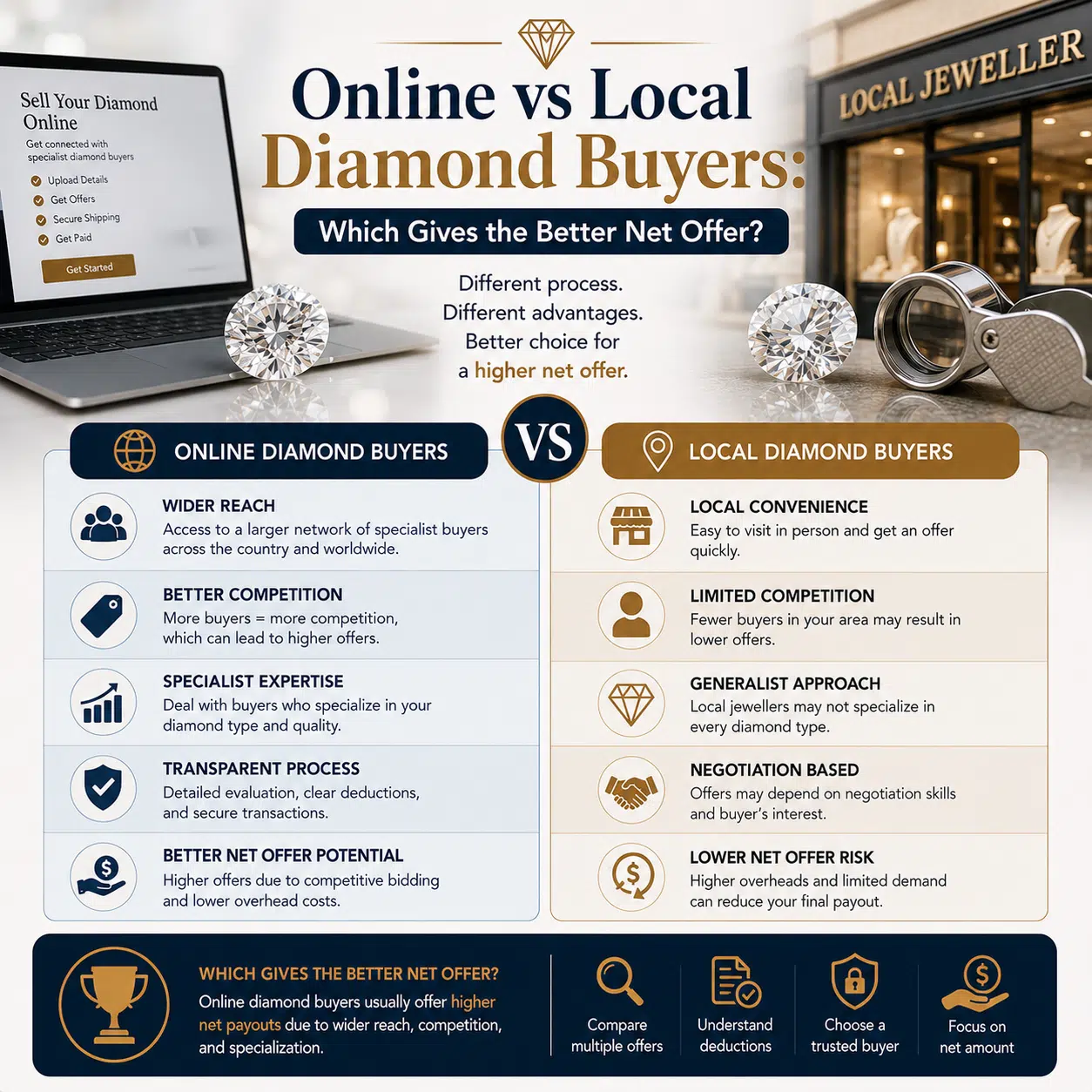
Selling a diamond online can give you access to specialist buyers beyond your city, while selling locally lets you discuss the item face to face and avoid shipping it yourself.
Neither option automatically produces the better price. The stronger result usually comes from the buyer who understands your type of diamond, can explain the valuation and gives you the highest credible net offer after every cost and condition is considered.
Quick answer
An online diamond buyer may provide the better net offer when the seller’s nearby jewellers do not actively purchase pre-owned diamonds or when a remote specialist has stronger demand for the exact stone.
A local jeweller may be the better choice when it has genuine diamond-buying expertise, the item requires an in-person examination, or the seller prioritises face-to-face control and same-day completion.
Do not compare an online estimate with a local final offer. First ask both buyers to assess the same information. Then compare the amount you will actually receive after physical verification, shipping, insurance, travel, return costs and other deductions.
Bottom line: Online can expand your reach, while local can simplify physical inspection. Expertise, market access and transparent terms matter more than the buyer’s postcode.
What this comparison includes—and what it does not
In this guide, an online diamond buyer means an established business that lets you begin remotely by submitting photographs, grading documents and item details. The buyer then examines the physical item before confirming a final direct-purchase offer.
A local jeweller means a nearby jewellery business that may purchase the diamond directly after an in-person evaluation. Not every retail jeweller buys diamonds from the public, so this must be confirmed before the appointment.
What is a net diamond offer?
The best diamond offer is not necessarily the largest number mentioned at the beginning of the process.
The net offer is the final amount the seller receives after the diamond has been verified and all seller-paid costs have been deducted.
Net offer = Final confirmed purchase price − Seller-paid costs and deductions
Possible seller costs can include:
- Shipping or specialist collection
- Insurance or declared-value coverage
- Return shipping after a declined offer
- Travel, parking or accommodation for an appointment
- Independent testing or laboratory work
- Bank or currency-conversion charges
- Handling or administration fees disclosed by the buyer
Many direct diamond buyers do not charge a separate seller commission. That does not make one offer automatically better. Every buyer still accounts for operating costs, risk and resale margin when calculating what it can pay.
When comparing online and local buyers, ask for the final purchase amount and every possible seller-paid cost in writing. Do not compare a gross figure from one route with a net figure from the other.
Why an online diamond buyer may give the better net offer
The advantage of an online diamond buyer is not the website itself. The advantage is access.
A remote process lets a seller reach businesses that specialise in the exact item instead of relying only on the nearest jewellery shops.
1. A wider pool of specialist buyers
Your closest jeweller may be excellent at selling new engagement rings but may rarely purchase pre-owned diamonds.
An online search can connect you with buyers who regularly assess:
- Loose natural diamonds
- Diamond engagement rings
- Signed diamond jewellery
- Inherited diamond pieces
- Fancy-coloured diamonds
- Larger diamonds
- Uncertified diamonds
Specialisation matters because the buyer needs a realistic route for reselling the item.
A business with demand for your diamond’s size, shape, quality and documentation may be able to make a stronger offer than a business that considers the item difficult to resell.
Wider reach does not guarantee a higher offer. It gives you more qualified options to compare.
2. You can begin without travelling
An online diamond review can start with:
- Clear photographs of the complete item
- Photographs or a PDF of the grading report
- The report number and grading laboratory
- The diamond’s shape and carat weight, if known
- Details about the metal, maker or brand
- Notes about damage, repairs or missing documents
This lets the buyer decide whether the item fits its current purchasing criteria before either party arranges a physical examination.
For a seller who lives far from a diamond centre, avoiding multiple speculative appointments can save meaningful time and travel expenses.
3. Written terms are easier to compare
A well-run online process creates a written record of:
- The information you submitted
- Whether the first figure is preliminary
- What must be verified physically
- Who pays for shipping and insurance
- How long the inspection should take
- How a declined offer is returned
- When payment will be made after acceptance
Written communication can make it easier to compare two buyers without relying on memory.
However, written terms are valuable only when they are complete and issued by a verifiable business.
4. Greater privacy than a public listing
Selling to an online direct buyer is not the same as advertising your diamond publicly.
You should not need to post your home address, telephone number, personal story or high-value item on an open marketplace.
A private submission can reduce unwanted contact from strangers.
You will still need to share enough information for the buyer to evaluate the item and meet identification or payment requirements. Check how personal data and uploaded documents are handled.
5. Easier comparison when local demand is weak
A local offer may reflect what one shop can resell to its existing customers.
An online specialist may have professional relationships in a broader diamond market.
This can matter for diamonds that are less common in the seller’s local area, including:
- Unusual diamond shapes
- Larger diamonds
- Natural fancy-coloured diamonds
- Signed jewellery
- High-clarity stones
- Loose diamonds
- Pieces requiring specialised knowledge
The deciding factor is not simply “online versus local.” It is whether the buyer has an active route for the particular item.
When a local jeweller may give the better net offer
A local sale can be the stronger option when the nearby business genuinely buys diamonds, has the right expertise and provides a clear final offer without unnecessary deductions.
1. The item can be examined in person immediately
Photographs cannot confirm everything about a diamond.
A physical examination may be required to verify:
- Whether the stone is a diamond
- Whether it is natural or laboratory-grown
- Whether it matches the submitted grading report
- Its weight and measurements, where accessible
- Colour, clarity, cut and proportions
- Fluorescence and possible treatments
- Chips, abrasions or other damage
- The metal, side stones and condition of a complete ring
A qualified local buyer may be able to complete much of this work during an appointment. That can reduce the time between the preliminary discussion and final decision.
2. You retain more immediate physical control
Many sellers are uncomfortable sending a small, valuable item away.
A local appointment lets you hand the diamond directly to the examiner and ask how it will be handled.
You may also be able to watch parts of the assessment or receive the item back immediately if you decline the offer.
Confirm this before attending because some jewellers send items elsewhere for advanced testing.
3. Face-to-face questions can build understanding
An in-person conversation allows you to ask the buyer to explain:
- Which characteristics support the offer
- Whether the centre stone is valued separately
- How the setting contributes to the amount
- Whether the grading report matches the stone
- Whether damage or treatments affect marketability
- Whether the amount is final
- When payment will be made
Face-to-face contact can be reassuring, but a confident presentation is not a substitute for diamond expertise or fair written terms.
4. Travel may cost less than secure shipping
If a reputable buyer is nearby, a short appointment may be simpler than organising insured transport and waiting for delivery, examination and payment.
For a high-value item, however, travel also requires planning.
Do not reveal unnecessarily that you are carrying a diamond, and do not arrive without a confirmed private appointment.
5. The local jeweller knows the complete piece
A jeweller that sold, serviced or documented the original ring may already understand its maker, setting and repair history.
That information can help with identification.
However, familiarity does not guarantee the best cash offer. The original retailer may prefer trade-ins, may not buy from the public or may have no current demand for the piece.
Why online does not automatically mean a higher offer
Online diamond buyers are not all specialists, and a polished website does not prove expertise.
An online buyer may provide a weaker net result when:
- The initial estimate is designed only to attract the submission.
- The final offer is reduced without a clear explanation.
- Return shipping or insurance is charged after you decline.
- The buyer has limited demand for your type of item.
- The buyer pressures you to accept rather than return the diamond.
The most important question is not, “Does this buyer operate online?”
It is, “What happens from the moment I submit the form until the diamond is either paid for or returned?”
Why local does not automatically mean safer or better
Proximity can make a transaction more convenient, but it does not confirm that the business is qualified to buy diamonds.
A local offer may be weaker when:
- The shop primarily sells new jewellery and rarely buys second-hand pieces.
- The buyer values the ring mainly for its gold or platinum.
- The centre diamond is not assessed separately.
- The explanation focuses on the original purchase price rather than current marketability.
A nearby shop should be checked with the same care as a remote buyer.
Verify the legal business identity, physical address, experience, written terms and method of payment.
Physical verification is necessary in both routes
An online diamond-selling process is not purely virtual.
A responsible buyer should not confirm a final diamond-purchase offer from photographs alone.
The same principle applies locally. Looking briefly at a ring across a counter is not a complete professional assessment.
The final offer may depend on confirming that:
- The diamond is genuine.
- Its origin is natural or laboratory-grown.
- It matches the grading report supplied.
- Its condition has not changed since the report was issued.
A grading report helps communicate the stone’s characteristics, but it is not a monetary valuation or guarantee of the resale amount.
If a report number is available, its recorded information can be checked with the issuing laboratory before the physical diamond is matched to it.
How to compare an online and local diamond offer fairly
Step 1: Give both buyers the same information
If one buyer receives the complete report, high-quality photographs and damage disclosure while the other receives only the carat weight, their estimates are not comparable.
Prepare a single item file and use it for both enquiries.
Include:
- Clear photographs
- The complete grading report
- Original purchase document
- Information about missing documents
Step 2: Label every number correctly
For each amount, clearly identify what type of figure it represents: an automated estimate, a preliminary human-reviewed estimate, a range subject to physical examination, or a final purchase offer. Only compare figures that are of the same type, and most importantly, compare final offers only with other final offers. If a local buyer has physically inspected the diamond while an online buyer has assessed it only from photographs, the online figure should still be treated as conditional rather than as a final offer.
Only compare final with final.
If the local buyer has physically inspected the diamond but the online buyer has seen only photographs, the online figure is still conditional.
Step 3: Calculate the net amount
For the online route, include any seller-paid:
- Shipping
- Insurance
- Return transport
- Handling costs
For the local route, include meaningful:
- Travel
- Parking
- Accommodation
- Time away from work
Minor convenience costs should not outweigh a substantially stronger credible offer, but they should not be ignored.
Step 4: Compare custody and timing
- When the buyer takes possession
- How the item is identified on the receipt
- Who carries the risk of loss or damage
- How the diamond will be returned
Step 5: Compare the explanation
A strong buyer should be able to explain the offer using the diamond’s verified characteristics, condition, documentation and present marketability.
Be cautious when a buyer provides only a number and refuses to explain important deductions or discrepancies.
Step 6: Compare your ability to walk away
You should understand your rights and costs before the examination begins.
A no-obligation offer is meaningful only if declining it is practical. For a local appointment, ask whether you can leave with the item immediately
Online diamond-selling safety checklist
Before sending a diamond to an online buyer:
Before sending your diamond or jewellery to a buyer, verify the business name, address, contact information, and trading history, and confirm that the buyer purchases your specific type of diamond or jewellery. Ask whether the initial estimate is preliminary or binding, and carefully review the inspection, acceptance, payment, and return terms. Before dispatch, confirm the carrier and service, as well as the exact insurance or declared-value coverage in writing, including when the coverage begins and ends. Follow the buyer’s approved packaging instructions, photograph the item, grading report, and package before handing it over, and retain the receipt and tracking information for your records.
Avoid writing words such as “diamond” or “jewellery” on the outside of the package unless specifically instructed by the buyer or carrier. Do not send the item through an ordinary uninsured service. Confirm in advance how the item will be returned and insured if the buyer declines the offer. Independently verify that the payment has been received and cleared before treating the transaction as complete. Finally, keep copies of all emails, agreements, shipping documents, receipts, and other records related to the transaction.
Be cautious of overpayment schemes. If a supposed buyer sends more than the agreed amount and asks you to return the difference, pay a courier or transfer money elsewhere, stop the transaction and verify it independently.
Local diamond-selling safety checklist
Before attending a local appointment:
- Confirm that the business actively buys diamonds from private sellers.
- Arrange an appointment rather than arriving unexpectedly with a valuable item.
- Verify the exact address and person you are meeting.
- Avoid discussing publicly when and where you will carry the diamond.
- Bring the grading report, receipt and other documents securely.
- Ask whether the examination will happen in your presence.
- Do not leave the item without a detailed receipt.
- Make sure the receipt identifies the diamond or complete jewellery item.
- Ask whether the final figure includes every deduction.
- Confirm the payment method and expected clearing time.
Privacy: Online submission vs local appointment
Privacy is not simply a question of whether the transaction happens through a website.
Information an online buyer may require
An online buyer may request:
- Your name and contact details
- Your country and collection address
- Photographs of the diamond and jewellery
- A grading report or report number
- Bank details after you accept an offer
Before uploading documents, check that the website uses a secure connection and that the business explains how submitted information is handled.
Do not send identity documents through an unverified messaging account or to an unrelated email address.
Information a local buyer may require
- Identification
- Ownership information
- Contact details
- Payment information
- A signed sales receipt
- Records of the item purchased
Do not assume that an undocumented cash transaction is safer or more private. A legitimate buyer may be required to retain transaction records, and the seller should retain a sales receipt as well.
Practical examples: When online or local may work better
The following scenarios illustrate the decision process. They do not promise a particular selling price.
Example 1: The nearest jewellers do not buy pre-owned diamonds
A seller has a documented natural 1.02-carat oval diamond ring. The nearby jewellery shops sell new bridal jewellery but either do not buy second-hand diamonds or provide only a general trade-in figur
In this case, contacting an online specialist buyer may produce a more relevant direct-purchase assessment. The benefit comes from specialist demand, not simply from conducting the transaction online.
Example 2: An inherited ring has no report
A seller inherits a diamond ring with no certificate, unknown repairs and several smaller side stones. The exact origin and quality of the centre stone are not known.
If a qualified diamond buyer is available nearby, an in-person appointment may be the most efficient first step. The buyer can examine the complete piece before anyone decides whether additional testing or a laboratory report would be commercially useful. The same seller could still begin with a remote review, but any online estimate would remain highly conditional
Example 3: The seller lives far from a diamond centre
A seller lives several hours from the nearest specialist. Travelling to multiple appointments would require time, transport and possibly accommodation.
The seller can submit the same grading report and photographs to selected online buyers, compare the written preliminary terms and arrange physical verification only with the strongest credible option.
Example 4: The seller wants maximum physical control
A seller owns a high-value loose diamond and is not comfortable shipping it. A reputable local specialist offers a private appointment, documents the stone on arrival and completes the examination in person.
Even if a remote buyer might have broader reach, the local route may provide the better overall outcome for this seller because custody, comfort and decision speed are important parts of the transaction.
Example 5: The local jeweller has the right customer base
A signed diamond ring is known to a local jeweller that regularly handles the same maker and has active demand for similar pieces.
That local knowledge may support a strong direct offer. Sending the item to a general online buyer merely because it operates online would not necessarily improve the outcome.
Which option should you choose?
Choose an online diamond buyer if suitable specialists are not nearby, you want to compare buyers without travelling, or you prefer a private remote process with clear shipping, insurance, inspection and return terms. Choose a local jeweller if you prefer face-to-face assessment, want to keep physical control of the item, or the diamond is uncertified, complex, or difficult to assess from photographs. A hybrid approach can be useful when you want an online preliminary review followed by an appointment or controlled insured shipping.
How Sothis Diamonds Combines Both
Sothis Diamonds allows sellers to start online by providing details, photographs and any available grading report. Depending on the item and location, the next step may be an Antwerp appointment, agreed shipping, or additional documents and photographs. The diamond or jewellery can then be physically examined before a final offer is confirmed, which the seller is free to accept or decline. Request a free diamond valuation
Frequently asked questions about online and local diamond buyers
1. Is it better to sell a diamond online or in person?
It depends on the available buyers.
Online selling can connect you with specialists outside your area, while an in-person sale can simplify examination and give you greater immediate control.
Compare the buyer’s expertise, final net offer, security and terms rather than choosing by channel alone.
2. Do online diamond buyers pay more than local jewellers?
Not always.
An online specialist may pay more when it has stronger demand or broader resale access for your diamond.
A qualified local jeweller may provide the stronger offer when it actively purchases similar items.
No channel guarantees the highest price.
3. Why can online diamond offers be higher?
An online process can give the seller access to buyers beyond the local area.
A specialist with demand for the exact size, shape, quality or brand may value the item more competitively.
Wider access creates opportunity, not a guaranteed premium.
4. Why can a local jeweller’s offer be higher?
A local jeweller may already have customers for the item, understand its maker or avoid shipping-related complexity.
The offer can be strong when the jeweller actively buys pre-owned diamonds and has a suitable resale route.
5. Is an online diamond estimate final?
Usually not.
An estimate based on photographs and grading-report details normally remains subject to physical verification.
The buyer may need to confirm the diamond’s identity, origin, quality, condition and match with its documents before issuing a final offer.
6. Can a local jeweller give a final offer on the same day?
Potentially.
Same-day completion depends on whether the jeweller purchases diamonds directly, has the required expertise and equipment, and can complete the necessary checks.
Some local businesses send items elsewhere for further assessment.
7. Is selling a diamond online safe?
It can be safe when the buyer is verifiable and the shipping, insurance, inspection, return and payment terms are agreed in writing. Never send a valuable diamond until the exact transport and coverage arrangements have been confirmed.
8. Is selling to a local jeweller safer than selling online?
Local selling avoids outbound shipping and may let you remain present during the initial examination. However, proximity does not guarantee expertise, fair terms or secure payment. Verify a local buyer with the same care as an online business.
9. How do I verify an online diamond buyer?
Check the legal business name, physical address, contact information, trading history, written terms and independent reputation. Confirm that the business buys your type of item and that support remains available throughout inspection, acceptance and return.
10. What should I send for an online valuation?
For an initial review, send clear photographs of the complete item, images of the grading report, and the report number. Include the known carat weight and diamond shape, metal information, brand or maker details, and any known damage, repairs, or missing documents.
11. Do I need a certificate to compare online and local offers?
No.
A diamond can be reviewed without a certificate, but preliminary figures may be less precise because more characteristics remain unverified. Read the guide to selling a diamond without a certificate before paying for new grading.
12. Can a photograph show what my diamond is worth?
Photographs can support an initial review but cannot confirm every characteristic. Physical testing is normally required to verify origin, weight, grading, condition, treatments and whether the stone matches its report.
13. Should I get both an online and local offer?
Yes, when practical.
One qualified online review and one qualified local review can help you understand whether geography or specialist demand is affecting the result. Make sure you compare equivalent final offers.
14. How many diamond buyers should I contact?
Two or three carefully selected buyers are usually more useful than sending personal documents to numerous unknown websites. Choose businesses that clearly buy your category of diamond or jewellery.
15. What costs should I compare?
Compare all possible costs, including shipping, insurance, return transport, travel, parking, accommodation, independent testing, currency conversion, bank charges, and any handling or administration fees. Ask the buyer to confirm all seller-paid costs in advance so you know the total expense before transferring the diamond or jewellery.
16. Who pays for insured shipping to an online buyer?
Some buyers arrange and pay for approved transport, while others require the seller to pay or use a specified service. Confirm the exact coverage, value limit, conditions and return arrangements in writing.
A no-obligation offer should not conceal an impractical or expensive return process.
17. Can I sell a diamond online from another country?
Potentially.
Availability depends on the buyer’s service area, transport coverage, customs requirements and purchasing criteria. Do not dispatch an international shipment until these responsibilities and costs have been confirmed.
18. What is the best first step?
Gather the grading report, receipt and clear photographs, then request a private preliminary review. Use that response to decide whether secure shipping or an in-person appointment is the more practical route.
Final conclusion
An online diamond buyer can offer wider specialist reach, remote convenience, and written comparisons, while a local jeweller can provide face-to-face advice, immediate physical control, and faster verification. Neither option automatically guarantees the better offer.
The best buyer is one who understands your specific diamond or jewellery, verifies it professionally, explains the offer clearly, discloses all costs and conditions, protects the item during transit or custody, gives you the freedom to decline, and provides the highest credible net amount within your preferred timeframe. Start with the information you already have, compare qualified buyers, and insist on clear written terms before proceeding. Request a free valuation from Sothis Diamonds
