


Direct Diamond Buyer vs Auction vs Consignment: Speed, Fees and Certainty

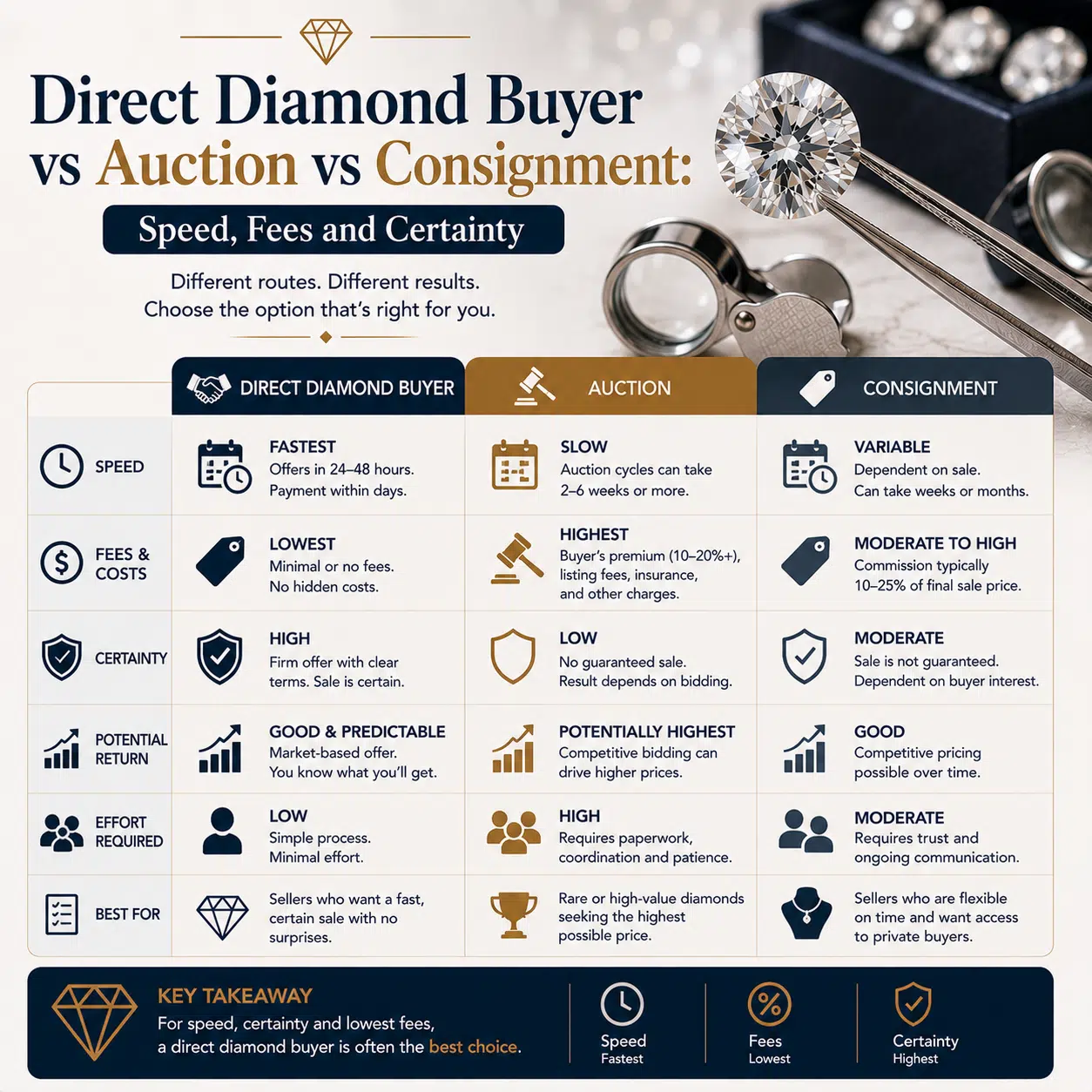
Should you sell your diamond directly to a buyer, place it in an auction or offer it on consignment?
The best route depends on what you are selling and what matters most to you. A direct diamond buyer generally offers the greatest speed and price certainty. An auction can be suitable for an exceptional diamond or signed piece capable of attracting competitive bidding. Consignment may work for desirable jewellery with retail appeal when the owner is prepared to wait for the right customer.
The highest advertised selling price is not necessarily the highest amount you receive. To compare the three options properly, look at net proceeds after commissions, insurance, shipping, photography, marketing, possible reductions and other agreed costs.
You should also consider what happens if the diamond does not sell.
Quick Answer: Direct Buyer, Auction or Consignment?
A direct sale is usually the strongest choice when you want a clear offer, a controlled transaction and a relatively short timeline. Once the diamond has been inspected and the final offer accepted, the sale can proceed without waiting for an auction date or retail customer.
An auction may be worth considering when the diamond or jewellery is rare enough to create competition. This could include an important fancy-colour diamond, an exceptional large stone, a documented antique jewel or a signed piece from a recognised jewellery house. However, an auction estimate is not a guaranteed sale price, and the item may remain unsold if bidding does not meet the reserve.
Consignment places the diamond or jewellery with a business that markets it to retail customers. You normally retain ownership until it sells. Consignment may create access to a higher retail asking price, but the final sale can take weeks or months, and there is no guarantee that a customer will buy it.
Here is the basic distinction:
| Selling model | How the price is created | Typical speed | Price certainty | Main seller risk |
| Direct diamond buyer | The buyer makes a direct purchase offer | Usually the shortest route | High after inspection and final offer | Accepting less than an uncertain future auction or retail result |
| Auction | Buyers compete through bidding, usually subject to a reserve | Depends on the auction calendar and settlement process | Low until the lot sells and payment is completed | Reserve not met, commissions, expenses or an unsold lot |
| Consignment | The item is marketed at an agreed retail price | Often open-ended or dependent on the contract term | Low until a customer purchases it | Long waiting period, markdowns, commission or no sale |
This comparison concerns transaction models. A direct purchase, auction or consignment arrangement may each involve remote and in-person steps.
Understanding the Three Selling Models
Before comparing speed and fees, it is important to understand who is purchasing the diamond.
With a direct diamond buyer, the business evaluates the diamond for its own inventory or resale network. It is the purchaser, not simply an intermediary. The buyer examines the grading information, current market demand, condition and physical characteristics before making or confirming an offer.
At an auction, the auction house does not normally purchase the diamond from you in advance. It accepts the item for a future sale, promotes it to potential bidders and conducts the bidding. If the highest eligible bid meets the applicable conditions and reserve, the item sells.
With consignment, a jeweller, dealer or specialist business holds and markets the diamond or jewellery on your behalf. The consignee receives a commission or agreed margin when a customer buys it. Until a completed sale occurs under the agreement, ownership generally remains with the consignor—the original owner.
These structural differences explain why each route has a different balance of speed, risk and possible return.
Selling to a Direct Diamond Buyer
A direct buyer removes the need to wait for another consumer. The buyer assesses the diamond, determines what it can pay and presents an offer. If the owner accepts, the transaction can move directly toward payment and transfer of ownership.
This is particularly useful when the seller needs to settle an estate, divide assets, release capital or simply complete the sale without a prolonged marketing process.
A professional direct-buying process commonly begins with information such as:
- The grading laboratory and report number, if available
- Carat weight, shape, colour and clarity
- Cut grade or proportions where relevant
- Whether the diamond is natural or laboratory-grown
- Fluorescence and other report details
- Photographs of the diamond and jewellery
- The condition, brand, provenance and original paperwork
An initial assessment based on documents and photographs is usually provisional. A final purchase offer generally requires physical verification because a grading report cannot show every factor that may affect resale demand or condition.
For example, an inscription must be matched to the report when one exists. The buyer may also need to inspect the stone for damage, wear, chips, undisclosed treatments or differences between the submitted information and the actual diamond.
The Main Advantage: Certainty
The central advantage of a direct buyer is not necessarily a spectacular headline price. It is the ability to compare a defined offer with the uncertainty of other routes.
Once the offer is final, the seller knows the proposed purchase price. There is no reserve to meet, no bidding audience to attract and no retail customer to wait for.
A direct offer can therefore serve as a useful benchmark even when you are considering auction or consignment. If an auction house provides an estimate or a consignee suggests a retail asking price, a direct offer gives you a concrete alternative against which to compare the projected net result.
How Direct Buyers Account for Costs
A direct diamond buyer usually provides an all-in purchase offer rather than charging an auction-style seller’s commission. The buyer’s operating costs, risk and expected resale margin are reflected in the price it is prepared to pay.
That does not make the transaction free automatically. Before sending or presenting the diamond, ask whether you are responsible for shipping, insurance, appraisal, return delivery, bank charges or any other cost.
The important number is the amount you will actually receive—not whether a cost is described as a fee, commission, deduction or margin.
When a Direct Sale May Be the Best Fit
Consider a documented 1.25-carat natural round diamond being sold as part of an estate. The beneficiaries want a fair process, but they also need to complete the distribution without waiting several months.
The diamond may be valuable, but it is not necessarily rare enough to justify a specialist auction campaign. In this situation, a direct buyer can provide a clear offer that the beneficiaries can accept, reject or compare with other professional evaluations.
The result is not guaranteed to be higher than every possible future selling price. It is simply more certain and usually easier to plan around.
Selling a Diamond at Auction
An auction attempts to create competition among potential buyers. Instead of receiving one direct purchase offer, the seller places the diamond into a scheduled sale where bidders determine the final hammer price.
This model is most compelling when multiple serious buyers may compete for the same object. Rarity, provenance, historical importance, brand, design and market timing can matter as much as the basic diamond grading details.
An auction could be appropriate for:
- A rare natural fancy-colour diamond
- A large diamond with exceptional characteristics
- An important signed jewel
- A documented antique or period piece
- Jewellery with significant provenance
- A collection capable of attracting specialist bidders
An ordinary diamond ring, even if it originally had a high retail price, may not automatically generate meaningful auction competition. Retail price, sentimental value and auction demand are different concepts.
Auction Estimate vs Guaranteed Result
An auction estimate is a pre-sale opinion about the range in which the lot may attract bidding. It is not a promise that the diamond will sell within that range—or sell at all.
Bidding can end below, within or above the estimate, depending on the auction conditions and reserve. The seller should therefore avoid treating the high estimate as expected proceeds.
This distinction is essential when comparing an auction estimate with a direct purchase offer. One is a projection before the sale. The other is an amount a buyer is offering to pay, normally subject to inspection and agreed transaction terms.
What Is a Reserve Price?
The reserve is the minimum price at which the item may be sold under the auction agreement. It is usually confidential and must be agreed with the auction house.
If bidding does not reach the reserve, the lot may be described as unsold or “bought in.” The diamond remains with the seller, subject to the auction contract and any applicable charges or return arrangements.
A reserve can protect the owner from an unacceptably low result, but an unrealistic reserve can also prevent a sale. It should be set using current market evidence rather than the original purchase price or an insurance replacement valuation.
Hammer Price Is Not the Same as Seller Proceeds
The hammer price is the winning bid announced when bidding closes. It is not automatically the amount transferred to the seller.
The amount you receive from a sale may be reduced by costs such as seller’s commission, photography or catalogue fees, insurance and storage, shipping and handling, laboratory or condition assessment expenses, research, marketing or illustration charges, and any applicable taxes or other contract-specific costs.
Before accepting an offer, ask the buyer to provide a clear breakdown of all deductions so you understand the final net amount you will receive. The winning bidder may also pay a buyer’s premium on top of the hammer price. That additional payment generally belongs to the auction house under its terms; it should not be assumed to increase the seller’s proceeds. Because fee schedules and contractual terms differ by auction house, country, category and value, sellers should request a written net-proceeds illustration based on the current contract.
Auction Timing
Auction timing is determined by more than the day of the sale. The full process may include initial review, physical inspection, acceptance, cataloguing, photography, promotion, preview, bidding, buyer payment and seller settlement. If the item misses the deadline for a suitable auction, the seller may need to wait for a later sale. If it remains unsold, the owner must decide whether to revise the reserve, enter another auction, pursue a private sale or choose a direct buyer. An auction can therefore create an excellent result for the right item, but it is rarely the most predictable route.
A Realistic Auction Scenario
Imagine a signed Art Deco ring containing a documented natural fancy-colour diamond. The ring has strong provenance, distinctive design and a condition suitable for specialist collectors. Its value may extend beyond the diamond’s carat weight and grading report. Competitive bidding could recognise the combination of rarity, maker, period and design more effectively than a standard diamond-only valuation.
Auction may be a credible option in this case. Even so, the owner should compare the reserve, estimated seller deductions and expected settlement timeline with a no-obligation direct offer. That comparison makes it easier to judge how much uncertainty the possible auction upside is worth.
Selling a Diamond on Consignment
Consignment sits between a direct sale and an auction. A business markets the item to its customers, but it does not normally pay you when it accepts the piece. You receive proceeds only after a completed sale, according to the consignment agreement.
This model may be suitable for jewellery with strong retail appeal. A beautifully designed diamond ring, signed jewel or wearable vintage piece may attract an end customer willing to pay more than a trade buyer. Reaching that customer, however, can take time. The consignee may display the jewellery in a showroom, offer it privately to clients, list it through its sales network or include it in selected marketing. The exact method should be stated or discussed before the item is handed over.
Diamond Consignment vs Direct Sale
The central difference in a diamond consignment vs sale comparison is when risk and ownership move.
In a direct sale, the buyer purchases the diamond and takes on the future resale risk after the transaction is completed. The seller receives the agreed payment and no longer has to wait for another purchaser. In consignment, the seller retains much of the risk while the consignee searches for a customer. The potential asking price may be higher, but no proceeds are created until an actual sale occurs.
A suggested retail price is therefore not equivalent to a purchase offer. When comparing consignment with a direct buyer, ask the consignee for the expected amount payable to you—not only the amount displayed to customers.
Consignment Commission and Pricing
Consignment arrangements can be structured in different ways. Some specify a percentage commission. Others guarantee the owner an agreed net amount while allowing the consignee to set the retail price. There may also be separate expenses. The agreement should clearly state the initial asking price, the amount or percentage paid to the consignee, and whether the price can be reduced without your approval. It should also specify the minimum amount you will receive and who is responsible for insurance, shipping, repairs, and marketing costs.
The agreement should also explain when your payment will be released after the item is sold and how customer returns, cancellations, or payment disputes will be handled. Make sure these terms are clear before signing or handing over the item.
Do not rely on a verbal statement that the item “should sell” for a particular amount. Ask what evidence supports the proposed price and how long comparable items have taken to sell.
What If the Consigned Diamond Does Not Sell?
A consignment agreement should have a defined term or a clear termination process. Without one, a seller may discover that the diamond has been unavailable for months while producing no proceeds. The contract should explain whether you can withdraw the item, whether early withdrawal creates a charge and how quickly the diamond will be returned. It should also address the item’s condition when returned and who is responsible for loss, theft or damage while it is in the consignee’s possession. This is especially important for jewellery that customers may handle or try on.
A Realistic Consignment Scenario
Consider a wearable signed diamond ring with good documentation and strong design appeal, but without the rarity usually required for a major specialist auction. A retail-facing consignee may be able to present the ring to customers who value the complete jewel rather than evaluating only the centre diamond. If the owner is not in a hurry and the commission, insurance and return terms are acceptable, consignment may be worth testing for a defined period.
The seller should still compare the projected net consignment proceeds with a direct offer. A higher asking price is only beneficial if the item sells and the deductions do not consume the difference.
Comparing the Net Proceeds
The most reliable comparison is based on what remains after every deduction.
For a direct sale:
Estimated direct net proceeds = final accepted offer − disclosed seller-paid expenses
For an auction:
Estimated auction net proceeds = hammer price − seller’s commission − agreed auction expenses − applicable seller obligations
For consignment:
Estimated consignment net proceeds = completed sale price − consignment commission − agreed expenses − applicable adjustments or returns
These formulas are comparison frameworks, not valuation promises. The figures depend on the individual diamond, contract, location, taxes and transaction.
Suppose an auction house provides an attractive estimate but also lists seller’s commission, photography, shipping and insurance costs. A consignee proposes an even higher retail asking price but cannot estimate how long the sale may take. A direct buyer makes a lower-looking offer with few or no seller deductions.
The direct offer may produce the highest immediate net amount. Alternatively, the auction or consignment route may justify its additional costs and waiting period if the item has genuine competitive or retail demand. Only a written net comparison can show the difference.
Which Option Is Fastest?
A direct buyer is generally the fastest because the transaction does not depend on finding a separate customer. The principal stages are document review, physical verification, final offer, acceptance and payment. Auction is tied to a scheduled event. Preparation and settlement add time before and after the sale date. Consignment is the least predictable. The item may sell quickly, but it may also remain available throughout the entire contract term without receiving a suitable offer.
Speed has financial value. Waiting may involve insurance costs, market risk, administrative effort and delayed access to the proceeds. Sellers should consider those factors rather than treating time as free.
Which Option Offers the Greatest Certainty?
A final direct purchase offer generally provides the most certainty. You know the amount being offered and can decide whether to proceed. An auction provides certainty only after the reserve has been met, the sale has completed and the buyer has fulfilled the relevant payment obligations.
Consignment provides the least certainty because an asking price does not create a buyer. Even after customer interest appears, the agreement may need to address returns, failed payments, resizing, repairs or other conditions. Certainty does not mean that a direct offer must be accepted. It means the seller has a definite figure that can be compared against less certain possibilities.
Which Route Can Produce the Highest Price?
Any of the three routes can produce the strongest net result in the right circumstances. Auction has the greatest visible upside when an exceptional item attracts at least two motivated bidders. Consignment may capture a retail-oriented price when a patient seller has a desirable piece and the consignee reaches an appropriate customer. A direct buyer may provide the best net result for a more standard diamond once commissions, expenses, waiting time and non-sale risk are included. The correct question is not, “Which route always pays the most?” No honest answer applies to every diamond.
A better question is:
Which route provides the strongest risk-adjusted net result for this particular diamond and this seller’s timeline?
What Happens If the Diamond Does Not Sell?
Non-sale risk is one of the most important differences between the three models. A direct buyer can decline the diamond or make an offer you choose not to accept. If there is no agreement, the diamond should be returned or collected under the terms established before inspection.
At auction, the lot may remain unsold because the reserve was not met or because no qualifying bid was received. The seller may still be responsible for certain agreed costs. An unsold public auction appearance can also affect how the item is perceived if it is offered again soon afterward. With consignment, the item may simply reach the end of the agreed term without finding a customer. The owner then needs to retrieve it, extend the agreement, revise the price or choose another selling method. Ask about non-sale consequences before handing over the diamond—not after the planned sale fails
Questions to Ask a Direct Diamond Buyer
A trustworthy direct buyer should be willing to explain how the transaction works in clear language. Ask whether the initial indication is provisional, what physical inspection involves and whether the final offer can change. Confirm how the diamond will be transported, insured and returned if you decline.
You should also know exactly when ownership transfers and how payment will be made. Do not send a valuable diamond until the shipping instructions, declared value, insurance coverage and return process are documented.
Questions to Ask an Auction House
Request the proposed estimate and reserve in writing, together with all current seller charges that could apply. Ask why the item is appropriate for that particular auction and what type of bidder is expected to compete for it. Find out what happens if the reserve is not reached, whether the item can be offered privately afterward and whether additional costs arise after an unsuccessful sale. The seller’s agreement should also explain withdrawal rights, liability, insurance, settlement and dispute procedures.
Questions to Ask a Consignee
Ask who will possess the diamond, where it will be stored and whether customers will be allowed to handle or try on the jewellery. The contract should define the asking price, commission, minimum seller proceeds, markdown authority and length of the arrangement. It should also explain exclusivity: are you allowed to accept a direct offer or place the item elsewhere while it is consigned?
Finally, confirm what happens if a customer returns the jewellery after you have been notified of a sale. The word “sold” should have a precise contractual meaning.
How to Make a Fair Comparison
Obtain written figures for all three routes where they are genuinely appropriate. For each option, record:
- The likely or guaranteed gross amount
- Every seller-paid commission and expense
- The estimated time before funds become available
- What happens if the diamond remains unsold
- Who bears loss, damage, shipping and insurance risk
- Whether you can withdraw without a penalty
- The amount you are actually expected to receive
Do not compare an auction house’s high estimate with a direct buyer’s final offer as though they were the same type of figure. Similarly, do not compare a consignment asking price with cash proceeds.
Compare direct net offer with projected auction net proceeds and projected consignment net proceeds.
Choosing the Right Route for Your Diamond
A direct diamond buyer may be the better fit when you value speed and a defined outcome, want to avoid a lengthy marketing period, or have a diamond that is commercially desirable but not exceptionally rare. This option can also be particularly useful when settling an estate or dividing assets, as well as when you want a concrete offer before considering other selling routes.
Auction may deserve consideration when the item has qualities capable of generating genuine bidder competition. Rarity, provenance, historical importance and recognised design can matter more here than the original retail receipt. Consignment may be appropriate when the jewellery has strong consumer appeal, you are willing to wait and the contract protects your ownership, minimum proceeds and right to retrieve the item. If you are uncertain, begin with information gathering. A no-obligation direct offer can establish a real benchmark without preventing you from considering auction or consignment.
Documents That Can Strengthen the Evaluation
A recognised diamond grading report can help a buyer, auction specialist or consignee understand the stone’s characteristics. Original invoices, signed-jewellery documentation, provenance records, service history and good photographs may also support the assessment. However, a grading report describes the diamond; it does not guarantee a resale value. An insurance valuation may reflect the cost of replacing the item in a retail environment, which can be substantially different from its resale market value.
If the diamond has no certificate, it may still be saleable. A professional buyer can advise whether obtaining a new laboratory report is likely to add enough value or confidence to justify the cost and time.
Protecting Yourself Before Releasing the Diamond
Document the diamond and setting before it leaves your possession. Photograph the stone, jewellery, hallmarks, report, inscription and any existing condition issues. When shipping is required, use the method agreed with the receiving business. Confirm packaging requirements, declared value, insurance coverage and tracking. Ordinary parcel insurance may exclude loose stones, jewellery or high-value items.
You should also verify the legal business identity, physical address, contact details and written terms of the company holding your property. Never rely solely on an advertised estimate or an informal message.
The Bottom Line
There is no universal winner in the direct diamond buyer vs auction vs consignment comparison. A direct buyer offers the clearest combination of speed and certainty. Auction offers the possibility of competitive bidding but introduces fees, scheduling and non-sale risk. Consignment may reach a retail customer, but the seller must be comfortable with an uncertain timeline and a carefully defined agreement
The best decision is based on net proceeds, not the most impressive advertised price. Before committing your diamond to a lengthy auction or consignment process, request a free, no-obligation direct offer. You can then compare a concrete purchase offer with the projected net auction or consignment result and make an informed decision without pressure.
Frequently Asked Questions
Is it better to sell a diamond at auction or directly to a buyer?
A direct buyer is generally better for speed and price certainty. Auction may be more suitable for an exceptional diamond or jewel capable of attracting competitive bidding. Compare the direct offer with the auction’s projected net proceeds after commission and expenses.
What is the difference between a direct buyer and an auction house?
A direct buyer purchases the diamond for its own inventory or network. An auction house markets the diamond to bidders and completes a sale only if the applicable bidding and reserve conditions are met.
What is the difference between diamond consignment and a direct sale?
In a direct sale, the buyer pays for and purchases the diamond. In consignment, a business markets the diamond for you, and you are normally paid only after it sells to another customer.
Which method sells a diamond fastest?
A direct buyer is usually fastest because the transaction does not depend on an auction date or a future retail customer. Physical verification is still normally required before a final offer is confirmed.
Does an auction estimate guarantee the sale price?
No. An auction estimate is a pre-sale opinion, not a guarantee. The hammer price can fall below, within or above the estimate, and the lot may remain unsold if it does not meet the reserve.
What is a diamond auction reserve?
A reserve is the minimum price at which the seller permits the item to be sold under the auction agreement. It is normally confidential and agreed before the auction.
What happens if bidding does not reach the reserve?
The diamond is normally recorded as unsold or bought in. The seller retains the item but may still have responsibilities for agreed expenses, collection, shipping or future sale arrangements.
What is the hammer price?
The hammer price is the winning bid when auction bidding closes. It is not necessarily the seller’s net proceeds because seller’s commission and other expenses may be deducted.
Does the seller receive the buyer’s premium?
The buyer’s premium is generally charged to the winning bidder by the auction house in addition to the hammer price. Sellers should not assume that it becomes part of their proceeds unless their written agreement expressly says otherwise.
How much are diamond auction fees?
Diamond auction fees vary by auction house, market, item value and contract. They may include seller’s commission and agreed costs for photography, insurance, shipping, storage, research or other services. Request a current written fee schedule and net-proceeds estimate.
Can auction fees apply if my diamond does not sell?
Certain agreed costs may still apply even if a lot remains unsold. The answer depends on the seller’s contract, so review non-sale, withdrawal, insurance and return charges before consigning the diamond.
Is consignment the same as auction?
No. Auction involves competitive bidding during a defined sale. Consignment usually places the diamond with a business that offers it to customers at an asking price over an agreed period.
Who owns a diamond while it is on consignment?
The consignor generally retains ownership until a completed sale occurs under the agreement. The contract should define when title transfers and what happens if the consignee or customer fails to pay.
How long does diamond consignment take?
There is no universal timeline. A diamond may sell quickly, remain available throughout the contract term or never sell. Ask for a defined consignment period and a clear return procedure.
Can a consignee reduce the price of my diamond?
Only according to the authority provided in the consignment agreement. The contract should state whether price reductions require your approval and whether there is a minimum net amount you must receive.
What percentage does a diamond consignee charge?
Commission structures vary by business, location, jewellery type and expected selling price. Use the current written agreement rather than relying on a general percentage quoted online.
Can I withdraw my diamond from consignment?
Usually, withdrawal depends on the contract. Some agreements permit it with notice, while others impose a minimum term, exclusivity requirement or withdrawal charge.
Who insures a consigned diamond?
The agreement should state who is responsible for insurance while the diamond is being transported, stored, displayed or handled by customers. Do not assume the business’s general insurance fully covers your item.
What happens if a consigned diamond is damaged?
Responsibility should be defined before the consignee takes possession. The contract should address condition reports, handling, repairs, loss, theft, damage and the valuation used for any insurance claim.
Can a buyer return a consigned diamond after purchasing it?
That depends on the consignee’s customer policy and your agreement. Clarify whether you are paid only after the return period ends and who bears costs if a customer sends the item back.
Why can a direct offer be lower than a consignment asking price?
A direct buyer takes ownership, commits capital and assumes the risk of reselling the diamond. A consignment asking price is an unconfirmed retail target and must still be reduced by commission, expenses and possible markdowns.
Does a direct diamond buyer charge commission?
A direct buyer normally makes a purchase offer rather than charging seller’s commission. Its costs, market risk and resale margin are reflected in the offer. Confirm whether any separate shipping, insurance or payment costs apply.
Can I negotiate a direct diamond offer?
You can ask the buyer to explain the valuation and whether the offer is negotiable. Strong documentation, accurate grading information and competing written offers may support a useful discussion, but they do not guarantee an increased price.
Should I get several offers before selling?
Comparing more than one credible evaluation can be helpful, provided the figures are comparable. A final direct offer should be compared with net auction or consignment projections—not with gross estimates or asking prices.
Does a diamond certificate increase auction or consignment value?
A recognised grading report can improve confidence and make the diamond easier to evaluate, but it does not create a guaranteed price. Brand documentation and provenance may be especially important for signed or historical jewellery.
Can I sell a diamond without a certificate?
Yes. You can sell a diamond without a certificate, although physical assessment becomes particularly important. Before paying for a new report, ask whether certification is likely to improve the expected net result enough to justify the cost.
Can an online diamond calculator tell me which route is best?
A diamond valuation calculator can provide an initial indication based on submitted characteristics. It cannot inspect condition, verify identity, assess provenance or predict competitive bidding, so it should not be treated as a final offer.
Are antique and signed diamond jewels better suited to auction?
Some are, particularly when the maker, period, rarity, provenance and condition could attract specialist competition. Others may perform better through direct sale or retail consignment. The designation “antique” or “signed” does not guarantee auction success.
Should I remove the diamond from its setting before selling?
Not without professional advice. Removing a diamond creates cost and risk, and the complete jewel may have design, brand or historical value. Let the buyer, auction specialist or consignee assess the intact piece first.
Is the original retail price useful when selling a diamond?
It provides purchase history but does not establish current resale value. The original price may include retail overhead, design, tax, brand positioning and services that are not fully recoverable in the secondary market.
Is an insurance appraisal the same as resale value?
No. An insurance appraisal is often intended to estimate replacement cost. Resale value reflects what a buyer or market participant is prepared to pay for the existing item under current conditions.
What is the safest way to compare all three options?
Obtain written terms, calculate expected net proceeds, confirm insurance and return responsibilities, and compare the time and uncertainty attached to each route. A no-obligation direct offer is especially useful because it provides a concrete benchmark against projected outcomes.
What should I do before accepting an offer?
Confirm the final amount, deductions, payment method, ownership-transfer point and return procedure. Read the entire agreement and make sure all verbal promises appear in writing.
Can I get a direct offer without committing to sell?
Yes. Sothis Diamonds offers a private, no-obligation assessment process. Request a direct diamond offer and compare it with your other options before deciding.
