


Kunt u een beschadigde of afgebrokkelde diamant verkopen? Mogelijkheden voor reparatie, herslijpen en verkoop

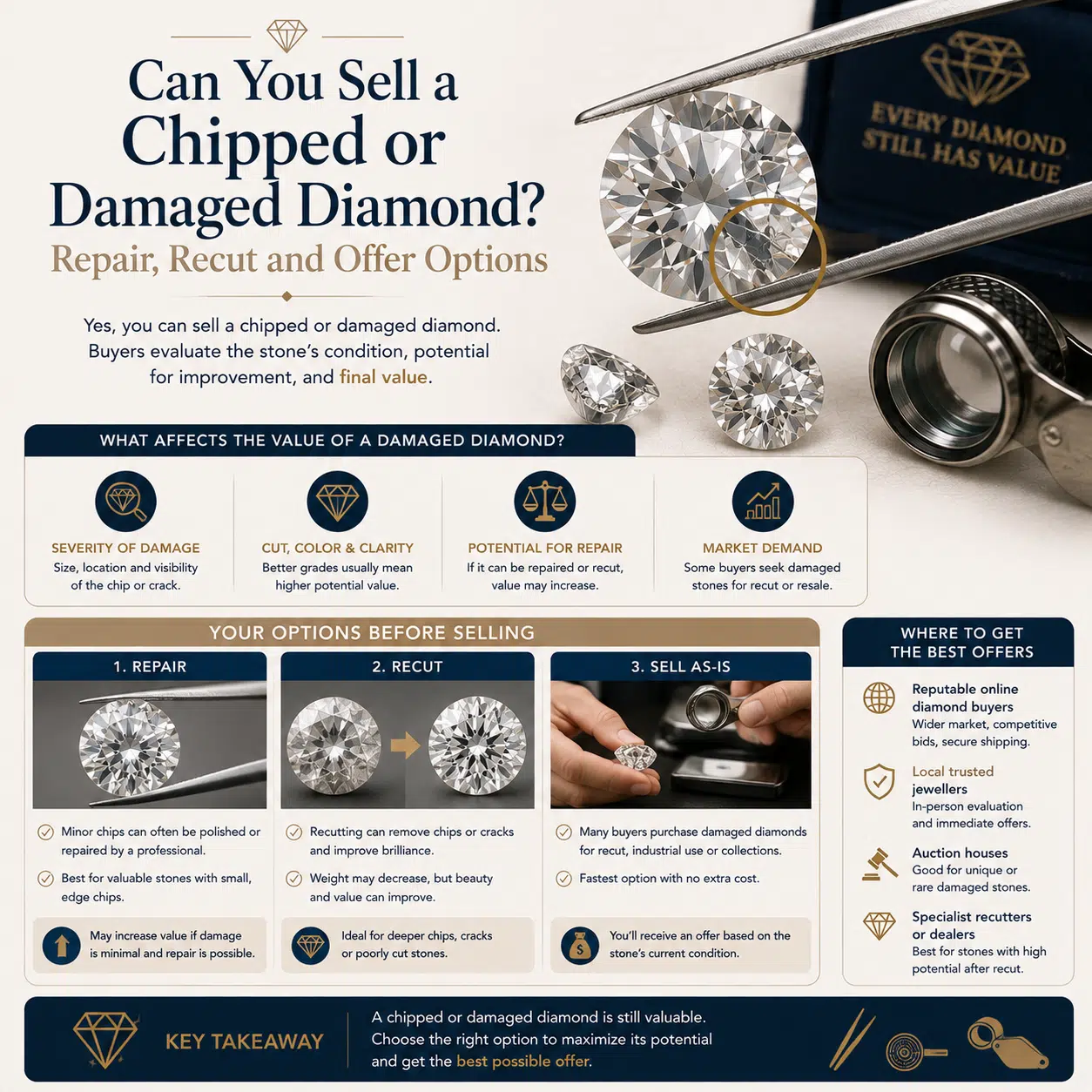
Een afgebrokkelde of beschadigde diamant kan nog steeds worden verkocht. Het bod hangt af van de plaats van de beschadiging, hoe diep deze doorloopt, of de steen structureel stevig blijft en hoeveel bruikbaar gewicht na het opnieuw polijsten of herslijpen behouden kan blijven.
Een kleine beschadiging bij de rondist kan een heel ander effect hebben dan een breuk die door een groot deel van de diamant loopt. In sommige gevallen kan een slijper het beschadigde gedeelte verwijderen met slechts een beperkt gewichtsverlies. In andere gevallen zou herslijpen de diamant aanzienlijk kleiner maken of andere zwakke plekken blootleggen.
Laat de steen niet repareren of herslijpen voordat u een waardebepaling in de huidige staat hebt ontvangen. Een specialist moet de huidige waarde van de diamant vergelijken met de verwachte waarde, de kosten en de risico’s van de voorgestelde bewerking.
Snel antwoord: Kunt u een afgebrokkelde diamant verkopen?
Ja. Gespecialiseerde kopers kunnen interesse hebben in afgebrokkelde, gebarsten, afgesleten of anderszins beschadigde diamanten.
Een professionele beoordeling moet het type en de omvang van de beschadiging vaststellen, evenals het huidige gewicht en de kwaliteit van de diamant en of een commercieel rendabele herslijping mogelijk is. Ook de natuurlijke of in een laboratorium gekweekte oorsprong, vorm, kleur, zuiverheid, het rapport en de huidige vraag zullen van invloed zijn op het bod.
De drie belangrijkste opties zijn de diamant in de huidige staat verkopen, een klein beschadigd gedeelte opnieuw polijsten of de diamant opnieuw slijpen tot een kleinere diamant. De beste optie is degene die het sterkste nettoresultaat oplevert na het verlies aan gewicht, de slijpkosten en de risico’s — niet noodzakelijk de optie die de steen er het meest nieuw uit laat zien.
Vraag een gratis, vrijblijvende waardebepaling van uw diamant aan..
Diamanten zijn hard, maar niet onbreekbaar
Diamant is zeer goed bestand tegen krassen, maar hardheid is niet hetzelfde als taaiheid. Taaiheid beschrijft hoe goed een edelsteen bestand is tegen breken, afbrokkelen of barsten na een impact.
De kristalstructuur van een diamant bevat richtingen waarlangs hij gemakkelijker kan splijten. Een harde klap op een kwetsbare plek kan daarom schade veroorzaken, vooral bij een dunne rondist, een scherpe hoek of een insluiting die tot aan het oppervlak reikt.
Peer-, marquise-, princess- en hartvormige diamanten kunnen kwetsbaar zijn rond hun punten. Ronde en cushion diamanten hebben geen scherpe punten, maar hun rondist en bestaande insluitsels kunnen nog steeds beschadigd raken.
Een diamant kan ook beschadigd raken tijdens het zetten, verwijderen, dagelijks dragen of bij contact met een andere diamant.
What Kind of Damage Does the Diamond Have?
“Cracked diamond” is a common description, but several different features can create a cracked appearance.
| Damage or characteristic | What it generally means |
| Abrasie | Kleine inkepingen of slijtage langs de randen van de facetten, waardoor soms een wazig uiterlijk ontstaat |
| Afgebrokkeld gedeelte | Een oppervlakkige opening veroorzaakt door oppervlakteschade, vaak bij de rondist, culasse of een overgang tussen facetten |
| Blauwe plek / slagplek | Een inslagpunt met daaronder kleine, wortelachtige veertjes onder het oppervlak |
| Holte | Een hoekige opening waar materiaal is afgebroken of waar een kristal dat tot het oppervlak reikte is uitgevallen |
| Veer | Een vakterm voor een interne breuk of fissuur, die het oppervlak al dan niet kan bereiken |
| Splijting of grote breuk | Een ernstigere breuk die structurele problemen kan veroorzaken |
| Losse steen | Beweging veroorzaakt door beschadigde of versleten zettingsonderdelen en niet door schade aan de diamant zelf |
Vuil dat onder de steen vastzit, reflecties van de zetting en normale insluitsels kunnen ook worden aangezien voor barsten. Voor een juiste diagnose zijn vergroting en professioneel onderzoek noodzakelijk.
How Damage Affects Diamond Resale Value
Beschadigingen beïnvloeden de waarde op het gebied van uiterlijk, duurzaamheid, gewicht en verkoopbaarheid.
Een kleine beschadiging die verborgen zit bij een zetting kan visueel weinig effect hebben, maar de koper moet nog steeds rekening houden met het risico dat de beschadiging zich verder uitbreidt tijdens het verwijderen, opnieuw zetten of herslijpen.
Beschadigingen onder de tafel of op een duidelijk zichtbare plaats wanneer de diamant van bovenaf wordt bekeken, kunnen opvallender zijn. Een diepe breuk kan er ook voor zorgen dat een toekomstige koper terughoudend is om de diamant te dragen of opnieuw te laten zetten.
Het mogelijke eindgewicht na het herslijpen is bijzonder belangrijk. Als het verwijderen van een beschadiging ervoor zorgt dat een diamant onder een belangrijke karaatgrens komt, kan het waardeverlies groter zijn dan verwacht.
De koper zal ook rekening houden met de oorspronkelijke diamant. Een grote natuurlijke diamant met een gewilde kleur en zuiverheid kan een gespecialiseerde herslijping rechtvaardigen. Een kleine laboratoriumdiamant of een steen met een lagere vraag krijgt mogelijk niet genoeg extra waarde om de kosten van de bewerking te dekken.
Is een beschadiging anders dan een insluitsel?
Yes. An inclusion can form naturally inside the diamond, while a chip is surface damage that normally occurs after the stone has been cut.
However, the two can be connected. A surface-reaching feather near the girdle may make the diamond more vulnerable if that area receives a hard blow.
An older grading report may plot an inclusion that looks like damage to an untrained observer. Conversely, a chip that occurred after grading will not appear on the original report.
A specialist should compare the physical diamond with the report before assuming that a visible feature is new damage.
Blijft het bestaande gradatierapport geldig?
A grading report remains useful for identifying the diamond and understanding its condition at the time of examination. It may no longer describe the stone’s current weight, clarity or measurements accurately if significant damage or recutting occurred later.
A minor chip may change the clarity assessment. Recutting will change the diamond’s weight, measurements and possibly its shape, cut, polish, symmetry or clarity grade.
After a material recut, a new report may be advisable for a diamond whose value justifies the expense. The buyer or cutter should discuss this before work begins.
Kan een beschadigde diamant worden gerepareerd?
A diamond cannot be healed in the way that metal can be soldered. The practical options involve changing its shape or hiding the damage.
A minor surface issue may be reduced through repolishing. A deeper chip may require partial or complete recutting. In a mounted diamond, a jeweller might reposition a prong or choose a protective setting, but this does not remove the underlying damage.
Fracture filling can make certain surface-reaching fractures less visible by introducing a glass-like material. It does not heal the diamond or improve its underlying structural condition. The treatment is not considered permanent, can be affected by heat and cleaning, and must be disclosed. GIA does not issue its standard grading reports for fracture-filled diamonds.
Fracture filling is therefore not a shortcut that restores an untreated diamond’s resale position.
Opnieuw polijsten versus herslijpen
Repolishing is the lighter intervention. It may remove abrasion, small scratches or very minor edge damage while preserving most of the original shape and weight.
Partial recutting changes one or more areas of the diamond to remove a localised chip. The finished stone may retain its general shape but lose weight or symmetry.
A full recut can create a substantially different diamond. It may improve appearance or remove serious damage, but it can also reduce carat weight, change the shape and require a new grading report.
The cutter should provide an estimated finished weight and explain whether the damage might extend farther than it appears. An estimate is not a guarantee because hidden features can become important once cutting begins.
Should You Recut the Diamond Before Selling?
Not automatically. Obtain both an as-is assessment and a recutting opinion first.
The basic commercial comparison is:
Expected value after recutting, minus cutting, grading, removal, resetting and insurance costs, compared with the strongest as-is offer.
Risk must also be considered. The diamond could finish below the predicted weight, reveal additional fractures or move below a commercially important carat threshold.
For example, a damaged diamond weighing slightly above one carat may require enough material removal to finish below one carat. Even if the resulting stone looks cleaner, the change in weight category can limit the financial benefit.
A reputable buyer may prefer to assume the cutting risk and purchase the stone as-is. That option can give the seller greater certainty.
When Recutting May Be Worth Considering
Recutting may make commercial sense when the diamond is large enough to retain a desirable finished weight, the damaged area is removable and the improvement in marketability is expected to exceed the costs.
It can also be considered when a chip threatens continued wear and the owner intends to keep the diamond rather than sell it.
A recut becomes less attractive when the stone is small, the damage extends deeply, the final weight is uncertain or the diamond has limited resale demand. Antique and fancy-colour diamonds require additional caution because recutting can remove historical character or change the face-up colour.
Should the Diamond Be Removed From Its Setting?
Have the complete ring examined first. A mounted inspection may reveal whether the damage is visible, whether the setting is secure and whether removal presents additional risk.
An improvised removal can enlarge a chip or cause a vulnerable diamond to break. If removal is necessary, it should be completed by an appropriately experienced professional under agreed insurance and responsibility terms.
The setting may also contribute value through its precious metal, side stones, craftsmanship or brand. Selling the centre diamond separately without evaluating the complete ring could overlook part of the item’s value.
What to Do Immediately After Discovering Damage
Stop wearing the jewellery until it has been examined. Continued movement inside a damaged setting can worsen a chip or cause the stone to fall out.
Place the ring or diamond in a small, padded container and keep it separate from other jewellery. Avoid ultrasonic or steam cleaning until a specialist has checked the damage and determined whether any treatments are present.
Take clear photographs and locate the grading report, invoice, appraisal and insurance policy. If the damage may be insured, contact the insurer before authorising removal, repair, recutting or sale. Altering the diamond first could affect the claim process.
Selling Options for a Damaged Diamond
A direct sale in the current condition is often the simplest option. The buyer assesses the damage, estimates the possible recut and incorporates the risk into the offer.
Repolishing or recutting before sale may improve the outcome when the expected benefit is clear and the cutter is appropriately experienced. All costs and risks remain with the owner unless another arrangement is documented.
Auction or consignment may suit an exceptional diamond or valuable signed piece, but damage must be disclosed. A general gold buyer may value the setting while failing to assess the centre diamond’s remaining potential.
When comparing offers, ask whether the buyer plans to keep, recut or dismantle the item and whether the quoted amount includes the setting and side stones.
Illustrative Examples
These examples are fictional and show how different damage can produce different decisions.
A Small Girdle Chip
A natural round diamond has a shallow chip near the girdle. A cutter believes it can be removed with modest weight loss, but the diamond would finish just below a major carat threshold.
The seller compares the lower post-recut weight and associated costs with an as-is purchase offer. Selling without recutting provides the better net result.
A Chipped Point on a Pear Shape
A pear-shaped diamond has damage at its point. Repair would shorten the outline and require new proportions.
Because the diamond is large enough to retain a marketable size, specialist recutting may improve its appearance and durability. The decision is made only after receiving an estimated finished weight.
A Fractured Diamond in a Branded Ring
A centre diamond has a visible fracture, but the signed platinum ring and side stones also hold value.
The complete piece is assessed before removal. The offer accounts for the damaged diamond, brand, setting and smaller stones rather than treating the ring only as scrap metal.
How to Request an Accurate Offer
Submit clear photographs of the complete jewellery and close images of the suspected damage. Include the grading report and explain when the damage was noticed.
Do not attempt to assign a new clarity grade from photographs. The buyer needs to inspect the feature’s type, depth, position and relationship to existing inclusions.
Ask for an explanation of the as-is offer and whether recutting could materially change it. If cutting is recommended, request the expected finished weight, shape, costs and responsibility for accidental loss.
Veelgestelde vragen
Can a chipped diamond still have value?
Yes. Its remaining value depends on its origin, size, quality, damage and recutting potential.
Can you sell a cracked diamond?
Potentially. “Crack” can describe anything from a feather to a major structural break, so professional identification is required.
Can a diamond chip even though it is the hardest gemstone?
Yes. Hardness measures resistance to scratching, not resistance to breaking. A diamond can chip when struck in a vulnerable direction.
Where do diamonds most commonly chip?
Damage frequently occurs around girdles, pointed corners, culets and areas containing surface-reaching inclusions.
Does a chip lower the clarity grade?
It can. The effect depends on the chip’s size, position and visibility.
Can a jeweller hide a chip under a prong?
A protective setting may reduce visibility and help protect the area, but it does not repair the diamond. The damage should still be disclosed.
Can fracture filling repair a cracked diamond?
It can make a fracture less visible, but it does not heal the break. The treatment is not permanent and affects grading and resale.
Will GIA grade a fracture-filled diamond?
GIA states that it does not grade diamonds containing fracture-filling material.
How much weight will a diamond lose when recut?
There is no standard amount. Weight loss depends on the shape, position and depth of the damage and the intended finished cut.
Can a recut improve the diamond’s clarity?
Removing a chip or inclusion may improve the resulting clarity, but the finished diamond will weigh less and the outcome is not guaranteed.
Should I make an insurance claim before selling?
If the damage may be covered, contact the insurer before altering or selling the diamond. Policy conditions and documentation requirements vary.
Can Sothis Diamonds assess a damaged diamond?
Yes. Chipped and damaged diamonds can be submitted for an initial review, subject to physical inspection and Sothis Diamonds’ current buying criteria.
Final Thoughts
A damaged diamond is not automatically unsellable, and recutting is not automatically the best solution.
The correct decision depends on what the damage is, how far it extends and what the diamond could become after material is removed. A small chip may allow a practical repolish, while a deeper fracture could make a recut risky or uneconomic.
Start by obtaining an as-is assessment. Compare that offer with the predicted net value after any proposed work, and do not authorise an irreversible recut without understanding the likely finished weight.
Vraag een gratis, vrijblijvende waardebepaling van uw diamant aan..
