


Selling Fancy Colour Diamonds: How Hue, Tone and Saturation Affect Value

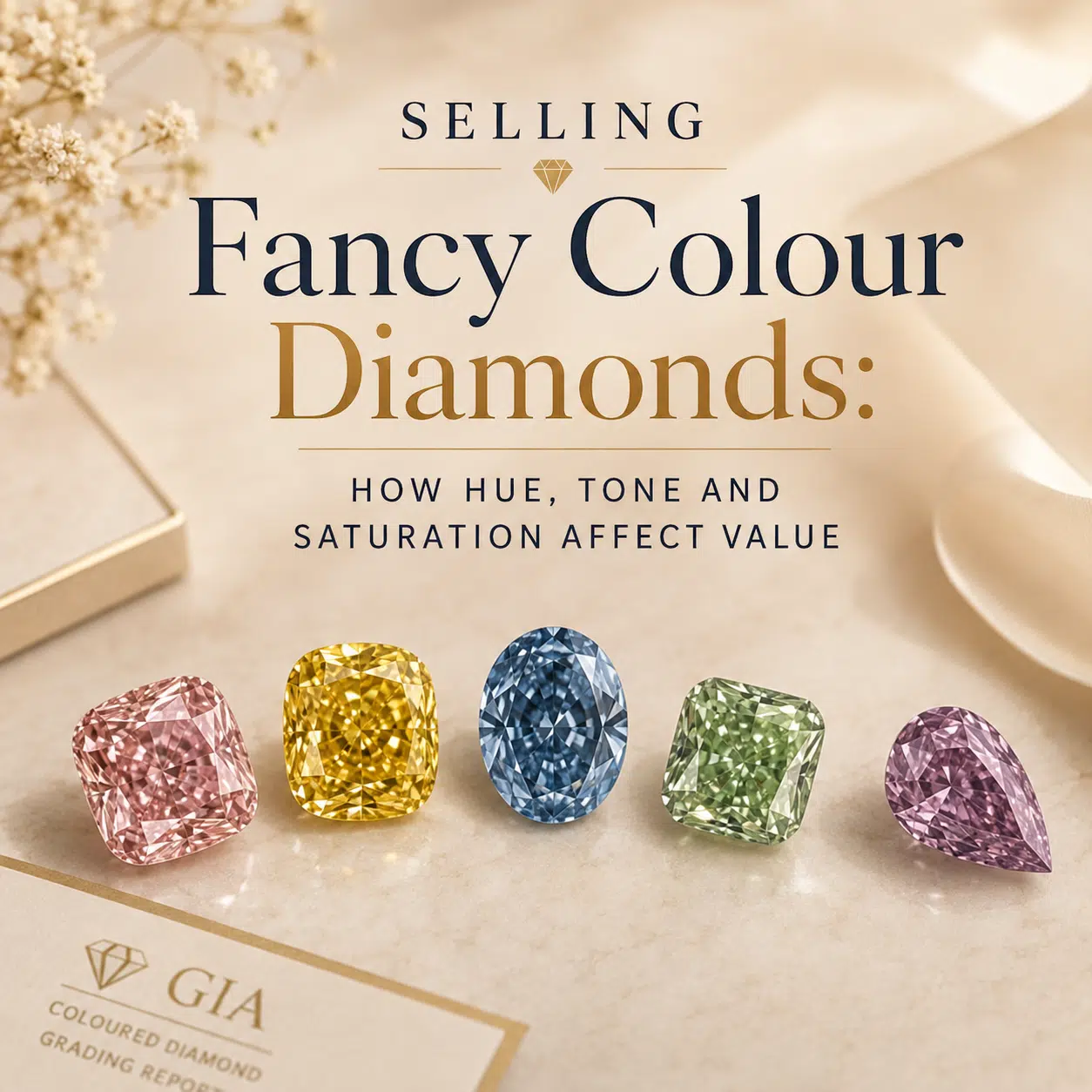
Selling a fancy-colour diamond requires more than identifying it as yellow, pink, blue or green. Small differences in colour description, intensity and origin can create major differences in rarity, buyer demand and resale value.
A natural-colour diamond, a treated natural diamond and a laboratory-grown coloured diamond may look similar in photographs while belonging to entirely different markets. Even two natural fancy yellow diamonds of the same weight can receive different offers because their tone, saturation, colour distribution, modifiers, shape and condition are not identical.
For this reason, a responsible fancy-colour diamond valuation normally begins with a recognised laboratory report or specialist testing. The buyer must understand exactly what the diamond is before deciding what it may be worth.
Quick Answer: What Determines Fancy-Colour Diamond Resale Value?
Fancy-colour diamond value is primarily influenced by the colour’s hue, tone, saturation, distribution and origin.
Hue identifies the colour, such as yellow, pink or blue. Tone describes how light or dark the colour appears. Saturation describes the colour’s strength or purity.
A recognised laboratory may combine tone and saturation into descriptions such as Fancy Light, Fancy, Fancy Intense, Fancy Vivid, Fancy Deep or Fancy Dark. The exact terminology depends on the diamond’s colour appearance.
The buyer then considers whether the colour is natural or treated, whether the diamond is natural or laboratory-grown, and how the carat weight, shape, clarity, cut, condition, report and current market demand affect the complete result.
Fancy-Colour Diamond Factors at a Glance
| Waarderingsfactor | Wat de koper onderzoekt | Why it matters |
| Hue | Dominant colour and modifying colours | Different hues and combinations have different rarity and demand |
| Tone | Relative lightness or darkness | Excessively light or dark appearance may change desirability |
| Saturation | Strength and purity of colour | Stronger colour can increase rarity within the appropriate hue range |
| Intensity grade | Laboratory description of tone and saturation | Helps position the diamond within its colour category |
| Colour distribution | Whether colour appears even or uneven | Consistent face-up colour may be more marketable |
| Colour origin | Natural or treated colour | Natural and treated colour belong to different markets |
| Herkomst van de diamant | Natural or laboratory-grown diamond | Origin materially affects supply and resale demand |
| Karaatgewicht | Exact weight of the diamond | Larger sizes can be much rarer in particular colour categories |
| Shape and cut | Face-up colour concentration and visual appeal | Cutting can strengthen or weaken apparent colour |
| Clarity and condition | Inclusions, fractures, chips and abrasion | Durability and visual appearance still matter |
| Grading report | Verified colour description and origin | Reduces uncertainty for buyers |
| Current demand | Active interest in the exact specification | Rarity does not guarantee immediate liquidity |
No table or online calculator can determine the exact value of an individual fancy-colour diamond. Physical verification and current market comparison remain necessary.
What Is a Fancy-Colour Diamond?
Most colourless-to-light-yellow or light-brown diamonds are evaluated using the D-to-Z colour scale, where reduced visible colour is generally preferred.
Fancy-colour diamonds are evaluated differently. Their colour is desirable rather than something to minimise. The grading system describes the presence and strength of colour using hue, tone and saturation.
Natural fancy-colour diamonds may appear yellow, brown, pink, red, blue, green, orange, purple, violet, grey, black or in combinations of modifying and dominant colours.
Not every visibly yellow or brown diamond qualifies for a fancy-colour grade. Some fall within the lower end of the ordinary D-to-Z range. The distinction should be established by a recognised laboratory rather than guessed from photographs.
What Does Hue Mean?
Hue is the diamond’s characteristic colour.
A diamond may have one principal hue, such as yellow, or a combination that includes a modifying colour. Examples might include orangy yellow, brownish yellow, purplish pink or greyish blue.
In laboratory colour descriptions containing more than one hue, the final colour term generally identifies the dominant appearance. A “purplish pink” diamond is predominantly pink with a purple modifier, while a “pinkish purple” diamond is predominantly purple with a pink modifier.
This difference is not merely grammatical. Dominant hue and modifier can influence rarity, desirability and the buyers interested in the stone.
Sellers should reproduce the colour description exactly as it appears on the report. Do not shorten “brownish yellow” to “yellow” or describe “greyish blue” as pure blue.
What Does Tone Mean?
Tone describes how light or dark a colour appears.
Two blue diamonds can share a similar basic hue while one appears light and airy and the other appears dark and deep. Their tone changes how the colour is perceived and how it interacts with saturation.
A darker tone is not automatically better. If a diamond becomes too dark, its colour and brilliance may appear less distinct. A very light tone can create a delicate appearance but may not show the strength sought by certain buyers.
The most desirable balance depends on the hue, saturation, shape and market. Different colour families do not behave identically.
What Does Saturation Mean?
Saturation describes the strength, depth or purity of the colour.
A weakly saturated diamond can appear pale, greyish or brownish. A highly saturated diamond shows a stronger colour impression.
Greater saturation can support rarity and value, particularly when the tone allows the colour to remain vivid and attractive. However, saturation should not be evaluated independently from hue and tone.
A dark diamond is not necessarily highly saturated, and a highly saturated colour does not always receive the same intensity term across every hue family.
Professional grading uses controlled lighting, observation conditions and colour comparisons. Camera settings and display screens cannot reproduce these conditions reliably.
Understanding Fancy-Colour Intensity Grades
GIA’s fancy-colour terminology can include Faint, Very Light, Light, Fancy Light, Fancy, Fancy Intense, Fancy Vivid, Fancy Deep and Fancy Dark.
These terms describe the combined effect of tone and saturation. They should not be read as a simple ladder in which every later word is automatically more valuable.
Fancy Vivid generally describes strong saturation with a tone that allows the colour to remain bright and lively. Fancy Deep indicates another combination of strong colour and deeper tone, while Fancy Dark involves darker appearance.
The desirability of each grade depends on the hue and the actual diamond. A beautiful Fancy Deep diamond can attract more interest than a less appealing stone carrying a different intensity label.
Not every colour appears across every part of the grading range in the same way. Yellow diamonds, for example, occur across a broad range of saturations, while some other natural colours are much rarer.
Does Fancy Vivid Always Have the Highest Value?
No universal rule applies to every fancy-colour diamond.
Fancy Vivid is highly desirable because it combines strong saturation with an attractive tone. However, value also depends on hue, modifying colours, exact weight, shape, distribution, clarity, condition and origin.
A small Fancy Vivid diamond does not automatically exceed the value of every larger Fancy Intense or Fancy Deep diamond. Likewise, a Fancy Vivid treated-colour diamond should not be compared directly with a natural-colour diamond carrying the same intensity term.
The complete report description must be considered.
Why Colour Origin Is Critical
A coloured diamond’s appearance can be natural, treated or produced through laboratory growth.
Treatments can change or enhance colour using processes such as irradiation, heating or High Pressure High Temperature treatment. Coatings may also alter apparent colour in some diamonds.
A treated natural diamond is still a natural diamond, but its colour does not have the same origin as naturally occurring colour. Its resale market should therefore be assessed separately.
Laboratory-grown diamonds can also be produced or treated to display yellow, pink, blue and other colours. They share the physical properties of diamond but have a manufactured origin and different supply economics.
A professional laboratory uses specialised testing to determine whether the diamond is natural, whether the colour is natural and whether detectable treatments are present.
Natural Colour vs Natural Diamond Origin
These two statements answer different questions.
“Natural diamond” describes how the diamond crystal formed. “Natural colour” describes how its colour developed.
A natural diamond can have treated colour. A laboratory-grown diamond can also display colour caused during growth or by post-growth treatment.
For the strongest resale comparison, the buyer needs both pieces of information:
- Is the diamond natural or laboratory-grown?
- Is the colour natural or treated?
A seller should never assume that a natural diamond automatically has natural colour.
Why Fancy Yellow Diamond Resale Value Varies
Yellow diamonds are among the most familiar fancy-colour diamonds, but their values still vary widely.
The report may describe a pure yellow or a yellow modified by brown, orange, green or another hue. Colour intensity can range from Fancy Light through stronger categories such as Fancy Intense, Fancy Vivid and Fancy Deep.
A buyer considers whether the yellow appears bright, saturated and evenly distributed. A brownish modifier may affect demand differently from an orangy modifier, depending on the complete appearance.
Carat weight, shape and cutting also matter. Radiant, cushion, pear and oval cuts are often used to concentrate face-up colour, but no shape guarantees a high grade.
An attractive natural Fancy Intense yellow can have a very different resale position from a treated yellow diamond or a lower-saturation stone of similar size.
What Determines Pink Diamond Value?
Natural pink diamonds are evaluated according to their dominant hue, modifying colours, tone, saturation, distribution, size and condition.
The report may describe a diamond as pink, purplish pink, orangy pink or brownish pink. Because pink is the dominant hue in these examples, it appears last in the description.
A pure or particularly attractive pink may receive stronger demand than some modified colours, but the exact effect depends on the individual stone.
Natural colour origin is essential. Pink colour can occur in natural diamonds, treated diamonds and laboratory-grown diamonds. Visual appearance alone cannot reliably separate these categories.
Even modest differences in a recognised report’s colour description can materially change how a natural pink diamond is positioned in the market.
What Determines Blue Diamond Value?
Natural blue diamonds are exceptionally specialised. Their value depends heavily on natural colour origin, hue, tone, saturation, modifiers, size and report.
A blue diamond may carry modifying colours such as grey or green. A greyish blue diamond should not be marketed as an unmodified blue.
Some natural blue diamonds can appear relatively light while remaining rare. Their value should not be judged using yellow-diamond expectations because the natural availability of different hue families is not the same.
Blue colour can also be created or altered through treatment, and laboratory-grown blue diamonds are available. Advanced testing is therefore particularly important.
A credible blue diamond buyer should insist on verifying the complete report and physical stone before making a final offer.
How Green Diamond Value Is Assessed
Natural green colour can be difficult to evaluate because exposure to natural radiation can create colour in diamonds, while artificial irradiation can also produce or alter green colour.
Surface-related colour zoning and other features may require specialised laboratory interpretation. In some cases, determining natural colour origin can be complex.
Do not clean, repolish or recut a potentially important green diamond before laboratory advice. Removing material from the surface could affect evidence relevant to colour-origin determination.
A seller should avoid describing a green diamond as naturally coloured unless a recognised laboratory report supports that conclusion.
Brown, Orange, Grey and Other Fancy Colours
Fancy-colour valuation should not be reduced to pink, blue and yellow.
Natural brown diamonds occur in a wide range of tones and saturations and may be marketed using descriptive trade names. These trade names are not substitutes for the laboratory colour grade.
Orange diamonds can carry brown or yellow modifiers, while grey, violet and purple diamonds each have their own rarity and demand patterns.
Black and white fancy-colour diamonds are evaluated differently from transparent saturated colours. Their appearance can relate to inclusions, structural characteristics or treatments, and specialist identification remains important.
The exact report description should always take priority over an informal marketing name.
How Modifying Colours Affect Value
A modifying colour can strengthen, soften or change the market’s response to the dominant hue.
For example, an orangy yellow diamond may appeal differently from a brownish yellow. A purplish pink can attract strong interest, while a brownish pink may occupy another price and demand category.
Modifiers are not automatically negative. Some combinations are extremely attractive and may be rare.
Their impact depends on the dominant hue, strength of the modifier, tone, saturation and overall visual appearance. It is therefore misleading to apply a fixed discount to every modified colour.
Why Colour Distribution Matters
A grading report may describe fancy-colour distribution as even or uneven.
Even distribution means the face-up colour appears relatively consistent across the diamond. Uneven distribution indicates noticeable areas of stronger and weaker colour.
An even appearance may be easier to market, but an uneven grade does not automatically make a diamond unattractive. The pattern, severity, shape and face-up effect matter.
A setting can hide weak areas or use coloured metal to influence appearance. Laboratory grading should be distinguished from how the diamond looks in a particular ring.
How Shape and Cut Affect Fancy Colour
Fancy-colour diamonds are often cut to strengthen the face-up colour rather than to maximise colourless-diamond brilliance.
Facet arrangement, depth, outline and light path can influence how colour is concentrated. Radiant and cushion cuts may display colour differently from step cuts such as emerald or Asscher.
A recut can sometimes improve colour appearance, but it also removes weight and creates risk. The resulting diamond may move into another intensity grade—or it may not.
Never recut a valuable coloured diamond based only on a visual prediction. Expected weight, colour outcome, clarity effects, costs and risks should be considered first.
Does Clarity Matter Less in Fancy-Colour Diamonds?
Colour is often the dominant value factor, but clarity still matters.
Some collectors accept visible inclusions in a rare natural-colour diamond when the colour is exceptional. This does not make clarity irrelevant.
Dark inclusions, surface-reaching fractures, cavities and durability concerns can reduce marketability. Inclusions may also affect transparency and the way the colour appears.
The buyer considers whether the clarity characteristic is merely visible or whether it creates a structural risk.
How Carat Weight Affects Resale Value
Larger fancy-colour diamonds can be substantially rarer than smaller stones within the same hue and colour-origin category.
However, value does not rise in a perfectly predictable line. A larger diamond with weak or uneven colour may receive less interest than a smaller stone with a highly attractive natural colour.
Important weight thresholds can influence demand, but exact weight must be verified. A mounted estimate is not the same as weighing a loose stone.
Do not remove a rare coloured diamond solely to confirm weight before the complete jewellery has been evaluated.
Does Fluorescence Affect Fancy-Colour Value?
Fluorescence can interact with the diamond’s visible appearance, but its effect must be evaluated individually.
The fluorescence colour and strength, body colour and lighting environment may all influence what an observer sees. A laboratory report may record fluorescence separately from the fancy-colour grade.
Ultraviolet response cannot reliably establish natural colour origin. Treatment and origin determination require specialist testing.
A buyer should inspect the diamond under controlled and ordinary lighting rather than making a decision from fluorescence alone.
Why Photographs Cannot Establish Colour Grade
Fancy-colour grading is sensitive to lighting, background, camera white balance, exposure, reflections and display calibration.
A photograph can make a yellow diamond appear more saturated or cause a pink diamond to look brown, purple or orange. Coloured settings and nearby objects can also reflect into the stone.
Photographs remain useful for identifying the type of item, shape, setting, report and obvious condition concerns. They should not be used to assign an exact fancy-colour grade.
An online figure based on photographs should remain preliminary until the report and physical diamond have been verified.
Waarom het gradatierapport belangrijk is
A recognised fancy-colour diamond report can state the colour grade, colour origin, shape, measurements, weight, clarity and detectable treatments, depending on the report type.
GIA offers different natural coloured-diamond services. A comprehensive grading report and a more limited identification-and-origin report do not contain identical information.
Read the actual report title and every comment. Do not assume that “origin report” always refers to the country where the diamond was mined; it may refer to the natural or treated origin of colour, depending on the service.
Verify the report number through the issuing laboratory and match the document to the physical diamond.
Can a Mounted Fancy-Colour Diamond Be Tested?
Certain colour-origin information may be obtainable while a diamond remains mounted, but a setting can limit grading and prevent exact weighing.
A full colour grade may require the stone to be loose. The setting can influence apparent colour and conceal parts of the diamond.
Do not remove the diamond yourself. A specialist should first examine whether the complete jewel has brand, antique or design value and whether removal is necessary.
If professional removal is recommended, agree on insurance, responsibility, cost and resetting arrangements before work begins.
Selling a Fancy-Colour Diamond Without a Report
A fancy-colour diamond can be submitted for an initial review without a grading report, but a final valuation may depend heavily on specialist testing.
The buyer must determine whether the stone is diamond, whether it is natural or laboratory-grown and whether the colour is natural or treated.
For an important natural-colour diamond, obtaining an appropriate laboratory report may substantially improve buyer confidence and marketability. It is not automatically worthwhile for every small, treated or commercial-quality stone.
Request an initial assessment before paying for grading. Read How to Sell a Diamond Without a Certificate.
Does the Jewellery Setting Add Value?
Yes. Gold, platinum, side diamonds, coloured gemstones, craftsmanship and brand may contribute to the complete jewellery’s value.
The setting can also influence how the centre diamond’s colour appears. Yellow gold beneath a yellow diamond or a contrasting halo around a pink diamond may intensify its visual effect.
This visual enhancement should not be confused with the laboratory colour grade.
A signed or antique fancy-colour diamond ring should be valued intact before any stone is removed. The complete piece may have value beyond the centre diamond.
Fancy-Colour Diamond Resale vs Insurance Value
An insurance appraisal may estimate what it would cost to replace the jewellery through a retail channel. It is not a guaranteed resale price.
A fancy-colour diamond grading report describes the stone but does not normally state what a buyer will pay.
A resale offer reflects the verified diamond, current buyer demand, transaction costs, risk and expected resale route. It may therefore differ substantially from an older appraisal or original invoice.
Do not apply a generic percentage to the retail price. Small differences in colour origin and grade can make percentage-based calculations particularly unreliable.
Illustrative Fancy-Colour Diamond Examples
These examples are fictional and explain valuation principles. They do not predict specific prices.
Example 1: Two Fancy Yellow Diamonds
One natural yellow diamond is larger but has a Fancy Light grade and noticeably uneven distribution. A smaller diamond has a Fancy Intense yellow grade and strong, even face-up colour.
The larger stone does not automatically receive the stronger offer. The buyer compares size with saturation, tone, distribution, shape and demand.
Example 2: Purplish Pink vs Pink
Two natural pink diamonds have similar weights. One is described as purplish pink, while the other has an unmodified pink description.
Their hues are not identical. The buyer considers the strength and desirability of the modifier instead of treating both stones simply as “pink diamonds.”
Example 3: A Treated Blue Diamond
A blue diamond has an attractive appearance but a report showing that its colour was treated.
The buyer values it within the treated-colour market. It should not be compared with a natural-colour blue diamond of similar appearance.
Example 4: A Mounted Yellow Diamond
A yellow diamond looks especially intense inside a yellow-gold setting. After professional assessment, the setting is found to enhance its apparent colour.
The buyer relies on the verified laboratory grade and also values the complete ring’s metal, side stones and design.
Example 5: A Coloured Diamond Without Papers
A family inherits a greenish diamond without a report and assumes the colour is natural.
Instead of advertising it as a natural fancy green, the owner submits it for specialist review. Laboratory testing is considered before a final description or offer is made.
How to Compare Fancy-Colour Diamond Offers
Ensure every buyer is valuing the same verified colour description and origin.
An offer based on an assumed natural Fancy Vivid diamond cannot be compared with another made after testing identifies treated colour or a different grade.
Ask whether the buyer has included the centre diamond, side stones, setting and brand. Confirm whether the offer remains conditional on laboratory verification and whether testing, shipping, insurance or return costs will be deducted.
For an auction or consignment proposal, compare the estimated net proceeds, reserve, commission, insurance and expected payment timeline with a direct written purchase offer.
How to Prepare a Fancy-Colour Diamond for Valuation
Keep the diamond in its current setting or secure gem container. Do not remove, recut, repolish or submit it for treatment.
Collect the complete grading report, invoice, appraisal, repair records and branded documents. Photograph the stone in neutral indirect light, but avoid editing the colour.
Include full images of the report, setting and hallmarks. State whether the colour description comes from a laboratory report, appraisal, receipt or your own observation.
If the stone is loose, do not hold it over a hard floor or use unfamiliar metal tweezers. Its handling and shipping should be agreed with the buyer in advance.
Vraag een gratis, vrijblijvende waardebepaling van uw diamant aan..
Veelgestelde vragen
What is a fancy-colour diamond?
It is a diamond evaluated for the presence and quality of colour rather than the relative absence of colour used in ordinary D-to-Z grading.
Is “fancy” a diamond shape?
Not in this context. “Fancy colour” describes a colour category. “Fancy shape” refers to any shape other than round.
What are the three main elements of fancy colour?
Hue, tone and saturation.
What is hue in a diamond?
Hue is the characteristic colour, such as yellow, pink, blue or green.
What is tone?
Tone describes how light or dark the colour appears.
What is saturation?
Saturation describes the strength or depth of colour.
Which word is the dominant colour in “purplish pink”?
Pink is the dominant colour because it appears last. Purple is the modifier.
Is orangy yellow mostly orange or yellow?
It is predominantly yellow with an orange modifier.
Does a modifying colour always reduce value?
No. Some colour combinations are attractive and rare. The effect depends on the complete appearance and market.
What are the fancy-colour intensity grades?
Report terminology can include Faint, Very Light, Light, Fancy Light, Fancy, Fancy Intense, Fancy Vivid, Fancy Deep and Fancy Dark.
Is Fancy Vivid stronger than Fancy Intense?
Fancy Vivid generally represents a combination with stronger saturation and an appropriate tone. The actual market comparison still depends on the individual diamonds.
Is Fancy Deep better than Fancy Vivid?
Neither is universally better. They represent different combinations of tone and saturation.
Is Fancy Dark the most saturated grade?
Not necessarily. Fancy Dark emphasises darker tone and should not be interpreted as a simple maximum-saturation category.
What does “even” colour distribution mean?
It means the face-up colour appears relatively consistent across the diamond.
Does uneven colour make a diamond worthless?
No. The severity, pattern, hue, shape and complete appearance determine the effect.
Are all yellow diamonds fancy yellow?
No. Some yellowish diamonds remain within the D-to-Z range. A laboratory should determine the correct category.
Does a Y-Z diamond count as fancy yellow?
Not automatically. Y-Z is part of the D-to-Z scale. A fancy-colour grade is a different classification.
Do fancy yellow diamonds have resale value?
They can. Value depends on natural or treated colour, intensity, modifiers, distribution, size, quality and demand.
Are Fancy Vivid yellow diamonds rare?
Natural Fancy Vivid yellow diamonds are relatively rare compared with lower-intensity yellow diamonds. Individual value still requires verification.
Why are pink diamonds valuable?
Natural pink colour in attractive quality and size is rare. Tone, saturation, modifiers, distribution and origin remain important.
Does every pink diamond have high value?
No. The diamond could be treated, laboratory-grown, small, damaged or carry a less demanded colour description.
Are natural blue diamonds valuable?
They can be exceptionally valuable, but natural colour origin and the exact report description must be verified.
How can I find a legitimate blue diamond buyer?
Choose a verifiable specialist who requires recognised documentation, explains testing and provides written transaction terms.
Are green diamonds difficult to grade?
Colour-origin determination can be complex because both natural and artificial radiation can create or alter green colour.
Can brown diamonds be fancy colours?
Yes. Natural brown diamonds can receive fancy-colour descriptions depending on their appearance and grading category.
Are black diamonds fancy-colour diamonds?
Black diamonds can be evaluated as coloured diamonds, but their appearance and treatments require specialist identification.
Are “champagne” and “cognac” official GIA grades?
They are trade descriptions rather than substitutes for the exact laboratory colour grade.
Can a diamond’s colour be treated?
Yes. Various processes can change or enhance colour. Detectable treatments should be disclosed.
Is a treated diamond still a real diamond?
A treated natural diamond remains a diamond, but its colour origin and resale market differ from a naturally coloured diamond.
Can lab-grown diamonds have fancy colours?
Yes. Laboratory-grown diamonds can be produced or treated in several colours. They belong to the laboratory-grown resale market.
Can photographs show whether colour is natural?
No. Natural, treated and laboratory-grown colour may require advanced testing.
Can I grade a fancy-colour diamond at home?
No. Precise grading requires controlled conditions, comparison methods and specialised expertise.
Does the setting affect the colour?
It can affect perceived colour through reflection and contrast, but it does not change the official loose-diamond grade.
Should I remove the stone from its setting?
No. Submit the complete piece first. Professional removal should only occur when justified.
Can a mounted fancy-colour diamond be tested?
Certain identification and colour-origin services may examine mounted diamonds, but complete grading and exact weight can require a loose stone.
Do I need a GIA report to sell a fancy-colour diamond?
Not necessarily for an initial review, but a recognised report may be especially important for establishing colour origin and grade.
What is a colour-origin report?
It is a laboratory document that states whether the diamond’s colour is natural or treated, according to the report’s scope.
Is colour origin the same as mining country?
No. Colour origin concerns whether colour is natural or treated. Geographic origin concerns where the diamond was mined and requires a different service and evidence.
Does a grading report guarantee value?
No. It describes the diamond. Resale value is determined separately.
Does clarity matter in fancy-colour diamonds?
Yes, although an exceptional colour can remain desirable with a lower clarity grade. Durability concerns still matter.
Does cut matter?
Yes. Cutting affects how colour is concentrated and displayed face-up.
Which shape is best for fancy-colour diamonds?
There is no universal best shape. Radiant, cushion, pear, oval and other cuts can concentrate colour differently.
Are round fancy-colour diamonds valuable?
They can be. Round cutting may not concentrate colour in the same way as certain fancy shapes, so each stone must be assessed individually.
Does a larger coloured diamond always have a higher value?
No. Colour origin, hue, intensity, modifiers, distribution and condition can outweigh size differences.
Should I recut a fancy-colour diamond?
Only after specialist analysis. Recutting changes weight and may improve or weaken colour appearance.
Can recutting change the colour grade?
It can change how colour appears face-up, but the outcome is not guaranteed.
Does fluorescence change the fancy-colour grade?
Fluorescence is recorded separately and may affect appearance under certain lighting. It should not be confused with body colour.
Can a chipped fancy-colour diamond be sold?
Potentially. The damage, recutting options, rarity and remaining marketability must be examined.
Is an insurance appraisal the resale price?
No. Insurance and resale values serve different purposes.
Can an online calculator value a pink or blue diamond?
Not reliably. Small differences in colour grade and origin can materially affect value, and these cannot be confirmed by a calculator.
Can I sell an inherited coloured diamond without papers?
Yes, but specialist testing may be needed before a responsible offer can be confirmed.
Can antique fancy-colour diamond jewellery have additional value?
Yes. Maker, setting, craftsmanship, condition and provenance can contribute beyond the centre diamond.
Is auction the best way to sell a rare coloured diamond?
It may suit exceptional stones, but a direct specialist offer can provide greater certainty. Compare fees, reserve terms, timing and net proceeds.
Can I sell a fancy-colour diamond online?
You can begin online with photographs and documents. A final offer normally requires physical and report verification.
How should I ship a fancy-colour diamond?
Use an agreed insured process that covers the item and declared value. Do not rely on tracking alone.
Can Sothis Diamonds assess fancy-colour diamonds?
Natural fancy-colour diamonds can be submitted for specialist review. Treated and laboratory-grown coloured diamonds remain subject to Sothis Diamonds’ current buying criteria.
Final Thoughts
Fancy-colour diamonds should never be valued from a colour name alone.
Hue identifies the colour, tone describes its relative lightness or darkness, and saturation describes its strength. The laboratory intensity grade brings these elements together, while modifying hues and colour distribution provide additional context.
Most importantly, the buyer must establish whether the diamond and its colour are natural, treated or laboratory-grown. That distinction can change the relevant resale market completely.
Preserve the diamond, report and complete jewellery. Avoid treatments, recutting or removal before an initial specialist review.
A verified, item-specific assessment is the most reliable way to understand what your yellow, pink, blue, green or other fancy-colour diamond may be worth today.
Vraag een gratis, vrijblijvende waardebepaling van uw diamant aan..
