


¿Se puede vender un diamante astillado o dañado? Opciones de reparación, recorte y venta

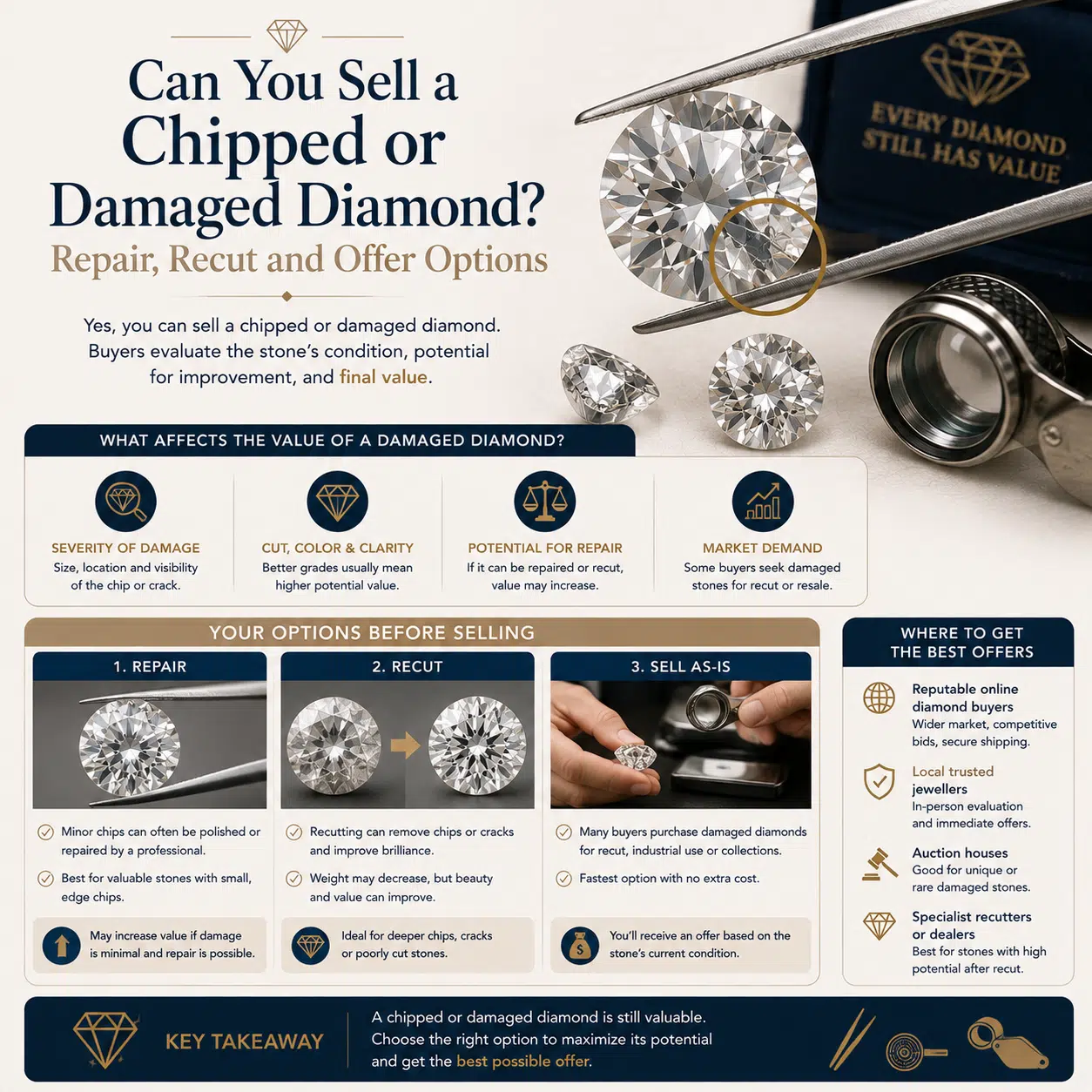
Un diamante astillado o dañado todavía puede venderse. La oferta dependerá de dónde se encuentre el daño, de qué tan profundo sea, de si la piedra mantiene su estabilidad estructural y de cuánto peso aprovechable podría conservarse después de un nuevo pulido o tallado.
Una pequeña astilla cerca de la cintura puede tener un efecto muy diferente al de una fractura que atraviesa una gran parte del diamante. En algunos casos, un tallador puede eliminar la zona dañada con una pérdida de peso limitada. En otros, volver a tallar el diamante lo haría mucho más pequeño o podría revelar otras zonas de debilidad.
No repare ni vuelva a tallar la piedra antes de obtener una valoración en su estado actual. Un especialista debería comparar el valor actual del diamante con el valor previsto, el coste y los riesgos de cualquier trabajo propuesto.
Respuesta rápida: ¿Se puede vender un diamante astillado?
Sí. Los compradores especializados pueden considerar diamantes astillados, fracturados, desgastados por abrasión o dañados de cualquier otra forma.
Una evaluación profesional debe determinar el tipo y el alcance del daño, el peso y la calidad actuales del diamante y si es posible realizar un nuevo tallado que resulte comercialmente rentable. Su origen natural o de laboratorio, forma, color, pureza, informe gemológico y la demanda actual también influirán en la oferta.
Las tres opciones principales son vender el diamante en su estado actual, volver a pulir una zona dañada de menor importancia o volver a tallarlo para obtener un diamante más pequeño. La mejor opción es la que ofrece el resultado neto más favorable después de tener en cuenta la pérdida de peso, los costes de tallado y el riesgo, y no necesariamente la opción que haga que la piedra parezca más nueva.
Solicite una valoración gratuita y sin compromiso de su diamante..
Los diamantes son duros, pero no irrompibles
El diamante es muy resistente a los arañazos, pero la dureza no es lo mismo que la tenacidad. La tenacidad describe la capacidad de una gema para resistir la rotura, las astillas o las grietas después de un impacto.
La estructura cristalina de un diamante contiene direcciones a lo largo de las cuales puede partirse con mayor facilidad. Por ello, un golpe fuerte en una zona vulnerable puede causar daños, especialmente cerca de una cintura delgada, una esquina puntiaguda o una inclusión que llega hasta la superficie.
Los diamantes con forma de pera, marquesa, princesa y corazón pueden ser vulnerables alrededor de sus puntas. Los diamantes redondos y de talla cojín no tienen puntas, pero sus cinturones y las inclusiones existentes también pueden sufrir daños.
Un diamante también puede astillarse durante el engaste, al retirarlo, durante el uso diario o al entrar en contacto con otro diamante.
What Kind of Damage Does the Diamond Have?
“Cracked diamond” is a common description, but several different features can create a cracked appearance.
| Damage or characteristic | What it generally means |
| Abrasión | Pequeñas muescas o desgaste a lo largo de los bordes de las facetas, que a veces pueden crear un aspecto borroso |
| Astilla | Una abertura superficial causada por un daño en la superficie, normalmente cerca de la cintura, la culata o la unión de las facetas |
| Magulladura | Un punto de impacto acompañado de pequeñas inclusiones tipo pluma con forma de raíz debajo de la superficie |
| Cavidad | Una abertura angular donde se ha desprendido material o donde ha salido un cristal que llegaba hasta la superficie |
| Pluma | Término comercial utilizado para describir una rotura o fisura interna, que puede o no llegar hasta la superficie |
| Clivaje o fractura importante | Una rotura más grave que puede generar problemas estructurales |
| Piedra suelta | Movimiento causado por componentes de la montura dañados o desgastados, en lugar de un daño en el propio diamante |
La suciedad atrapada debajo de la piedra, los reflejos de la montura y las inclusiones normales también pueden confundirse con grietas. El diagnóstico requiere un examen con aumento y una evaluación profesional.
How Damage Affects Diamond Resale Value
Los daños afectan al valor en términos de apariencia, durabilidad, peso y facilidad de comercialización.
Una pequeña astilla oculta cerca de una garra puede tener un efecto visual limitado, pero el comprador debe tener en cuenta el riesgo de que la astilla se extienda durante la extracción, el nuevo engaste o el recorte.
Los daños situados debajo de la tabla o en una posición prominente cuando se observa la piedra de frente pueden ser más visibles. Una fractura profunda también puede hacer que un futuro comprador se muestre reacio a usar o volver a engastar el diamante.
El posible peso final después del recorte es especialmente importante. Si eliminar una astilla hiciera que el diamante quedara por debajo de un umbral de quilates importante, la pérdida de valor podría ser mayor de lo esperado.
El comprador también tendrá en cuenta el diamante original. Un diamante natural grande con un color y una pureza deseables puede justificar un recorte especializado. Un diamante pequeño cultivado en laboratorio o una piedra con menor demanda puede no aumentar lo suficiente de valor como para cubrir el coste del trabajo.
¿Es una astilla diferente de una inclusión?
Yes. An inclusion can form naturally inside the diamond, while a chip is surface damage that normally occurs after the stone has been cut.
However, the two can be connected. A surface-reaching feather near the girdle may make the diamond more vulnerable if that area receives a hard blow.
An older grading report may plot an inclusion that looks like damage to an untrained observer. Conversely, a chip that occurred after grading will not appear on the original report.
A specialist should compare the physical diamond with the report before assuming that a visible feature is new damage.
¿Sigue siendo válido el informe de graduación existente?
A grading report remains useful for identifying the diamond and understanding its condition at the time of examination. It may no longer describe the stone’s current weight, clarity or measurements accurately if significant damage or recutting occurred later.
A minor chip may change the clarity assessment. Recutting will change the diamond’s weight, measurements and possibly its shape, cut, polish, symmetry or clarity grade.
After a material recut, a new report may be advisable for a diamond whose value justifies the expense. The buyer or cutter should discuss this before work begins.
¿Se puede reparar un diamante astillado?
A diamond cannot be healed in the way that metal can be soldered. The practical options involve changing its shape or hiding the damage.
A minor surface issue may be reduced through repolishing. A deeper chip may require partial or complete recutting. In a mounted diamond, a jeweller might reposition a prong or choose a protective setting, but this does not remove the underlying damage.
Fracture filling can make certain surface-reaching fractures less visible by introducing a glass-like material. It does not heal the diamond or improve its underlying structural condition. The treatment is not considered permanent, can be affected by heat and cleaning, and must be disclosed. GIA does not issue its standard grading reports for fracture-filled diamonds.
Fracture filling is therefore not a shortcut that restores an untreated diamond’s resale position.
Repulido frente a recorte
Repolishing is the lighter intervention. It may remove abrasion, small scratches or very minor edge damage while preserving most of the original shape and weight.
Partial recutting changes one or more areas of the diamond to remove a localised chip. The finished stone may retain its general shape but lose weight or symmetry.
A full recut can create a substantially different diamond. It may improve appearance or remove serious damage, but it can also reduce carat weight, change the shape and require a new grading report.
The cutter should provide an estimated finished weight and explain whether the damage might extend farther than it appears. An estimate is not a guarantee because hidden features can become important once cutting begins.
Should You Recut the Diamond Before Selling?
Not automatically. Obtain both an as-is assessment and a recutting opinion first.
The basic commercial comparison is:
Expected value after recutting, minus cutting, grading, removal, resetting and insurance costs, compared with the strongest as-is offer.
Risk must also be considered. The diamond could finish below the predicted weight, reveal additional fractures or move below a commercially important carat threshold.
For example, a damaged diamond weighing slightly above one carat may require enough material removal to finish below one carat. Even if the resulting stone looks cleaner, the change in weight category can limit the financial benefit.
A reputable buyer may prefer to assume the cutting risk and purchase the stone as-is. That option can give the seller greater certainty.
When Recutting May Be Worth Considering
Recutting may make commercial sense when the diamond is large enough to retain a desirable finished weight, the damaged area is removable and the improvement in marketability is expected to exceed the costs.
It can also be considered when a chip threatens continued wear and the owner intends to keep the diamond rather than sell it.
A recut becomes less attractive when the stone is small, the damage extends deeply, the final weight is uncertain or the diamond has limited resale demand. Antique and fancy-colour diamonds require additional caution because recutting can remove historical character or change the face-up colour.
Should the Diamond Be Removed From Its Setting?
Have the complete ring examined first. A mounted inspection may reveal whether the damage is visible, whether the setting is secure and whether removal presents additional risk.
An improvised removal can enlarge a chip or cause a vulnerable diamond to break. If removal is necessary, it should be completed by an appropriately experienced professional under agreed insurance and responsibility terms.
The setting may also contribute value through its precious metal, side stones, craftsmanship or brand. Selling the centre diamond separately without evaluating the complete ring could overlook part of the item’s value.
What to Do Immediately After Discovering Damage
Stop wearing the jewellery until it has been examined. Continued movement inside a damaged setting can worsen a chip or cause the stone to fall out.
Place the ring or diamond in a small, padded container and keep it separate from other jewellery. Avoid ultrasonic or steam cleaning until a specialist has checked the damage and determined whether any treatments are present.
Take clear photographs and locate the grading report, invoice, appraisal and insurance policy. If the damage may be insured, contact the insurer before authorising removal, repair, recutting or sale. Altering the diamond first could affect the claim process.
Selling Options for a Damaged Diamond
A direct sale in the current condition is often the simplest option. The buyer assesses the damage, estimates the possible recut and incorporates the risk into the offer.
Repolishing or recutting before sale may improve the outcome when the expected benefit is clear and the cutter is appropriately experienced. All costs and risks remain with the owner unless another arrangement is documented.
Auction or consignment may suit an exceptional diamond or valuable signed piece, but damage must be disclosed. A general gold buyer may value the setting while failing to assess the centre diamond’s remaining potential.
When comparing offers, ask whether the buyer plans to keep, recut or dismantle the item and whether the quoted amount includes the setting and side stones.
Illustrative Examples
These examples are fictional and show how different damage can produce different decisions.
A Small Girdle Chip
A natural round diamond has a shallow chip near the girdle. A cutter believes it can be removed with modest weight loss, but the diamond would finish just below a major carat threshold.
The seller compares the lower post-recut weight and associated costs with an as-is purchase offer. Selling without recutting provides the better net result.
A Chipped Point on a Pear Shape
A pear-shaped diamond has damage at its point. Repair would shorten the outline and require new proportions.
Because the diamond is large enough to retain a marketable size, specialist recutting may improve its appearance and durability. The decision is made only after receiving an estimated finished weight.
A Fractured Diamond in a Branded Ring
A centre diamond has a visible fracture, but the signed platinum ring and side stones also hold value.
The complete piece is assessed before removal. The offer accounts for the damaged diamond, brand, setting and smaller stones rather than treating the ring only as scrap metal.
How to Request an Accurate Offer
Submit clear photographs of the complete jewellery and close images of the suspected damage. Include the grading report and explain when the damage was noticed.
Do not attempt to assign a new clarity grade from photographs. The buyer needs to inspect the feature’s type, depth, position and relationship to existing inclusions.
Ask for an explanation of the as-is offer and whether recutting could materially change it. If cutting is recommended, request the expected finished weight, shape, costs and responsibility for accidental loss.
Preguntas frecuentes
Can a chipped diamond still have value?
Yes. Its remaining value depends on its origin, size, quality, damage and recutting potential.
Can you sell a cracked diamond?
Potentially. “Crack” can describe anything from a feather to a major structural break, so professional identification is required.
Can a diamond chip even though it is the hardest gemstone?
Yes. Hardness measures resistance to scratching, not resistance to breaking. A diamond can chip when struck in a vulnerable direction.
Where do diamonds most commonly chip?
Damage frequently occurs around girdles, pointed corners, culets and areas containing surface-reaching inclusions.
Does a chip lower the clarity grade?
It can. The effect depends on the chip’s size, position and visibility.
Can a jeweller hide a chip under a prong?
A protective setting may reduce visibility and help protect the area, but it does not repair the diamond. The damage should still be disclosed.
Can fracture filling repair a cracked diamond?
It can make a fracture less visible, but it does not heal the break. The treatment is not permanent and affects grading and resale.
Will GIA grade a fracture-filled diamond?
GIA states that it does not grade diamonds containing fracture-filling material.
How much weight will a diamond lose when recut?
There is no standard amount. Weight loss depends on the shape, position and depth of the damage and the intended finished cut.
Can a recut improve the diamond’s clarity?
Removing a chip or inclusion may improve the resulting clarity, but the finished diamond will weigh less and the outcome is not guaranteed.
Should I make an insurance claim before selling?
If the damage may be covered, contact the insurer before altering or selling the diamond. Policy conditions and documentation requirements vary.
Can Sothis Diamonds assess a damaged diamond?
Yes. Chipped and damaged diamonds can be submitted for an initial review, subject to physical inspection and Sothis Diamonds’ current buying criteria.
Final Thoughts
A damaged diamond is not automatically unsellable, and recutting is not automatically the best solution.
The correct decision depends on what the damage is, how far it extends and what the diamond could become after material is removed. A small chip may allow a practical repolish, while a deeper fracture could make a recut risky or uneconomic.
Start by obtaining an as-is assessment. Compare that offer with the predicted net value after any proposed work, and do not authorise an irreversible recut without understanding the likely finished weight.
Solicite una valoración gratuita y sin compromiso de su diamante..
