


How Accurate Are Online Diamond Value Calculators?

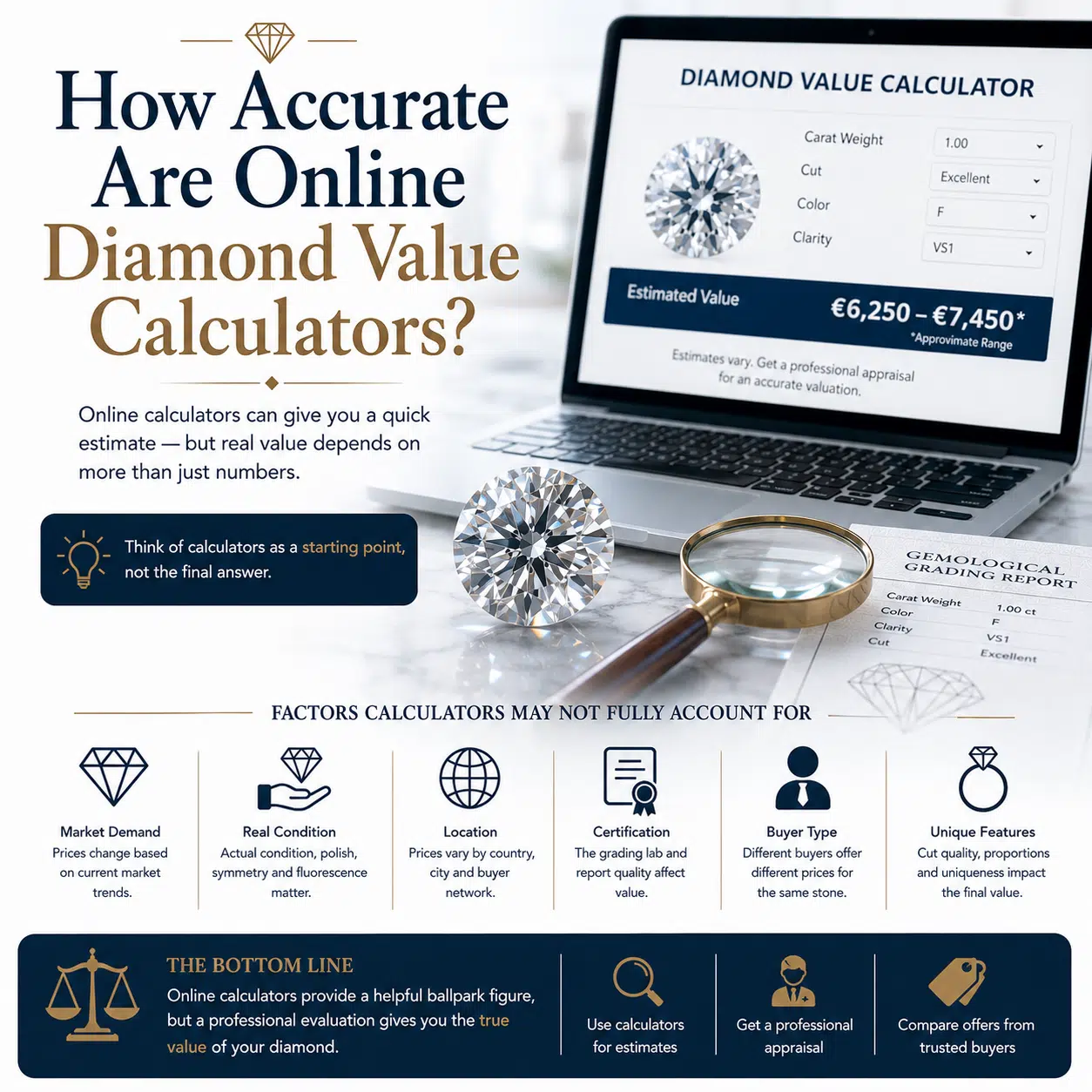
An online diamond value calculator can produce an estimate within seconds. Enter the carat weight, shape, colour, clarity and cut, and the tool may return what appears to be a precise monetary value.
That number should be treated as a starting point—not a guaranteed selling price.
Calculator accuracy depends on the information entered, the market data behind the tool and what type of value it is attempting to estimate. A calculator based on verified grading-report data may produce a useful range for a standard loose diamond. A tool using guessed grades, outdated prices or retail listings can produce a seriously misleading result.
Automated calculators also struggle with factors that require physical judgement. These include visible inclusions, transparency, damage, treatments, fancy-shape proportions, antique character and the value of a complete branded or period piece.
The most reliable process uses a calculator for orientation, an expert review for context and physical verification before a final offer.
Quick Answer: Are Diamond Value Calculators Accurate?
Online diamond value calculators can be reasonably useful for establishing a broad preliminary range when the diamond has a current, verifiable grading report and the calculator uses relevant market data.
They are less dependable when the origin, carat, colour, clarity or condition is unknown. A photograph cannot reliably establish all these characteristics, and a mounted diamond cannot normally be weighed precisely.
A calculator also needs to define what it is estimating. Retail price, insurance replacement value, private-sale asking price and immediate buyer offer are different figures.
No calculator can guarantee what you will receive. A final resale offer normally requires confirmation that the physical diamond matches the submitted information and remains in the documented condition.
What Does an Online Diamond Value Calculator Do?
A diamond calculator applies supplied characteristics to an underlying pricing model.
A basic model may use only carat, colour and clarity. More detailed calculators may also consider shape, cut, grading laboratory, polish, symmetry, fluorescence and natural or laboratory-grown origin.
The model then compares that combination with pricing data, previous transactions, current inventory or the buyer’s own purchasing criteria.
The apparent precision of the result does not prove accuracy. A calculator displaying €4,237 may still be less reliable than a specialist providing a well-supported range of €3,800 to €4,400.
Four Different Types of Online Diamond Valuation
Not every online tool performs the same task.
| Valuation method | What it usually provides | Main limitation |
| Basic automated calculator | Instant estimate from a small number of fields | May ignore origin, condition, proportions, treatments and marketability |
| Report-based calculator | Estimate using documented 4Cs and additional report information | Assumes the report is authentic, matches the diamond and remains current |
| Expert-reviewed online valuation | Preliminary range based on documents and photographs reviewed by a specialist | Still limited by photography and lack of physical inspection |
| Physical market valuation | Assessment after identity, origin, quality, condition and documentation are verified | Requires the diamond or jewellery to be examined directly |
A calculator and a final purchase offer answer different questions and should not be presented as interchangeable.
Calculator Value vs Retail Price
Some calculators estimate the current price of a comparable new diamond sold through a retailer.
Retail pricing can include inventory costs, store overhead, marketing, warranties, sales services and profit margin. Taxes may also be included or excluded depending on the country and tool.
A buyer purchasing a pre-owned diamond does not usually pay the full retail replacement price. The buyer must verify, hold and resell the stone while assuming transaction risk.
A calculator based on retail listings can therefore be accurate for one purpose while being unsuitable for estimating cash resale value.
Calculator Value vs Insurance Appraisal
Insurance appraisals generally estimate what it could cost to replace an item through an appropriate retail market.
That amount may include the diamond, setting, craftsmanship, taxes and the cost of sourcing a comparable piece. It is not normally the amount available through an immediate sale.
Entering an insurance value into a resale calculator does not make the appraisal a market offer. The two valuations use different assumptions.
Our guide to diamond resale value versus insurance appraisal explains the distinction.
Calculator Value vs Final Purchase Offer
A calculator estimates value from data. A purchase offer states what a specific buyer is prepared to pay under stated conditions.
The offer may depend on physical verification, payment terms, shipping, insurance, report matching and current purchasing criteria.
A calculator cannot commit funds, take ownership or guarantee that the diamond fits a buyer’s inventory.
Before accepting, determine whether the displayed amount is an estimate, conditional offer or confirmed net payment.
Why Accurate Inputs Matter
A calculator can only work with the information supplied.
If a natural diamond is mistakenly entered as laboratory-grown—or the reverse—the resulting estimate may be completely unsuitable. Guessing that a stone is one carat when it actually weighs 0.70 carats can create another large error.
Colour and clarity should not be estimated from casual photographs. Lighting, camera processing, magnification and the setting can change how a diamond appears.
Whenever possible, enter the characteristics from a verifiable grading report rather than from memory, a receipt or an old insurance appraisal.
Natural vs Laboratory-Grown Origin
Origin is one of the most important calculator inputs.
Natural and laboratory-grown diamonds can have comparable beauty and physical properties, but they operate in separate resale markets with different supply and pricing conditions.
A calculator that does not ask whether the diamond is natural or laboratory-grown should be treated cautiously.
If origin is unknown, the output should be a very broad preliminary indication rather than a confident estimate. Specialised testing may be necessary before value can be calculated responsibly.
Why Carat Weight Is Easy to Enter Incorrectly
Carat measures weight rather than visible size. One metric carat equals 0.20 grams.
A loose diamond can be weighed precisely. A mounted stone cannot normally be weighed separately without professional removal, so any carat figure may be an estimate unless supported by a matching laboratory report.
People also confuse total carat weight with centre-stone weight. A ring described as “one carat total weight” may contain a smaller centre stone surrounded by several additional diamonds.
Entering the total weight as though it belonged to one diamond can produce a greatly overstated result.
Why Colour and Clarity Estimates Cause Errors
Colour and clarity are professionally graded under controlled conditions.
A mounted diamond can reflect colour from the metal. Dirt and lighting can make it appear warmer or duller. Photographs can alter white balance and contrast.
Clarity is assessed under magnification. A visible dark inclusion and a pale inclusion close to the edge may produce different market reactions even when the stones share a grade.
A calculator normally sees only the selected grade. It cannot determine whether an SI1 diamond is eye-clean or contains a prominent inclusion beneath the table.
Why Cut Quality Matters
Cut affects brightness, fire, scintillation, apparent size and buyer demand.
A calculator that asks only for carat, colour and clarity may treat two very different diamonds as equivalent. One could have Excellent cut and balanced proportions, while the other appears dark or small for its weight.
For qualifying round brilliant diamonds, a recognised report may provide an overall cut grade. The calculator should still consider measurements, polish and symmetry where possible.
Fancy shapes require more individual interpretation because an overall standard GIA cut grade is not provided for oval, pear, cushion, emerald and other non-round shapes.
Why Shape Changes Calculator Accuracy
Round brilliant diamonds are relatively standardised and widely compared in the market. This can make report-based calculation more consistent.
Fancy shapes vary considerably. Two one-carat ovals can share the same colour and clarity while having different outlines, ratios, bow-ties and face-up dimensions.
Emerald cuts may differ in windowing and contrast. Cushions can have different facet patterns, while pears and marquises require balanced symmetry and intact points.
A calculator selecting “oval” or “cushion” cannot fully evaluate these visual differences.
Why Proportions and Face-Up Size Matter
Two diamonds with the same carat weight can look different in size.
A deep diamond may carry hidden weight below the girdle and appear smaller face-up. A shallow diamond may appear wider but suffer from weak light performance.
Round-diamond calculators may use table, depth, crown and pavilion information when available. Basic tools often ignore these fields.
For fancy shapes, length, width, depth, ratio and actual outline can have a material effect on demand.
Why Fluorescence Can Change the Result
Fluorescence does not create a standard premium or deduction.
Its effect depends on intensity, colour, the diamond’s body colour, transparency and market preferences. Medium blue fluorescence may have little negative effect and can complement the appearance of some warmer diamonds.
Strong or Very Strong fluorescence may narrow demand in certain high-colour categories, particularly if transparency is affected.
A calculator that automatically deducts the same percentage for every fluorescent diamond may oversimplify the market.
Why Grading Laboratory Matters
The laboratory influences how buyers interpret the documented characteristics.
A GIA, IGI or HRD Antwerp report can provide useful information, but the buyer still verifies the report and physical diamond. Report types, terminology and market familiarity differ.
Some calculators do not ask which laboratory issued the grades. They may assume that every report using identical letters is interpreted in exactly the same way.
For a valuable stone, this can make the estimate less dependable.
Read our GIA vs IGI vs HRD report comparison for additional context.
Why Report Verification Matters
A calculator may produce a detailed estimate from a report number without proving that the stone matches the record.
A genuine report can be presented with the wrong diamond. The stone may also have been chipped, repolished or recut after grading.
The report number should be checked through the laboratory’s official database. The physical diamond should then be matched through shape, measurements, inscription and identifying characteristics.
Our guide explains how to read and verify a diamond grading report.
Condition Is a Major Calculator Limitation
Most calculators assume the diamond remains in normal, undamaged condition.
A chip, cavity, abrasion or damaged point can affect appearance, durability and the cost of making the stone marketable again. The buyer may need to estimate recutting or repolishing.
Corrective work can reduce carat weight. If a 1.01-carat diamond falls below one carat after repair, the lost weight category may have a meaningful financial effect.
Photographs can reveal obvious damage, but minor chips and girdle issues may require magnification.
Treatments Are Difficult to Calculate Automatically
Colour and clarity treatments can affect marketability.
Fracture filling, laser drilling, HPHT processing, irradiation and coating do not have one universal value effect. The type, stability, documentation and disclosure all matter.
A calculator that does not ask about treatments may assume the stone is untreated.
If treatment information appears in the report comments, it must be included in the valuation request.
Transparency and Haziness
Two diamonds with identical report grades can differ in transparency.
Concentrated clouds, internal graining, surface contamination or other characteristics may create a hazy or milky appearance. The report comments can provide clues, but the physical stone remains important.
An automatic calculator rarely evaluates how transparent the diamond looks in several lighting environments.
A clear, lively stone may attract more demand than a hazy diamond with the same headline 4Cs.
Calculators Cannot Fully Assess Inclusions
Clarity grade is a category rather than a complete visual description.
An SI1 diamond with a pale inclusion near the edge can appeal differently from an SI1 containing a dark crystal beneath the table.
Inclusion position may also affect durability. A surface-reaching feature near a vulnerable point requires different consideration from a small internal crystal.
An expert can review the clarity plot and images, but physical magnification provides the strongest assessment.
Calculators Struggle With Antique Diamonds
Old European, old mine, rose and other antique cuts were produced according to different proportions and aesthetic preferences.
A calculator designed for modern diamonds may interpret their depth, culet, symmetry or outline as weaknesses without recognising historical character.
The original setting, age, maker and provenance may also contribute value.
An antique diamond should not be recut or removed from its jewellery simply to fit a modern calculator’s input fields.
Branded Jewellery Requires Separate Assessment
A calculator often values the centre diamond and metal while ignoring the jewellery’s maker.
A signed ring from a recognised jewellery house may carry value through its design, documentation, serial number, craftsmanship and condition.
Removing the centre stone can reduce the value of the complete piece. The same problem can occur with fine antique jewellery.
Submit branded jewellery intact and include the box, receipt, service record and other documents where available.
Small Diamonds and Total Carat Weight
Calculators designed for a single centre stone may not work for pavé, halo, tennis bracelets or multi-stone jewellery.
Several small diamonds do not necessarily equal the value of one diamond with the same combined carat weight. Individual stone size, matching, setting condition and removal costs matter.
A five-carat tennis bracelet therefore cannot be valued by entering “five carats” into a loose centre-diamond calculator.
The complete jewellery item requires a different assessment method.
Regional Market Differences
A calculator may use data from the United States, Europe or another market without explaining the source.
Currency, taxes, buyer demand, common grading reports and popular shapes can differ by region.
A result displayed in euros may simply be converted from another currency rather than calculated using European market evidence.
The tool should state its currency, valuation date and market basis. Otherwise, the output may create false precision.
How Market Data Becomes Outdated
Diamond markets change. Supply, demand and buyer inventory can move even when the physical stone remains unchanged.
A calculator using old retail listings or historical price tables may not reflect the current resale market.
Laboratory-grown pricing can be especially sensitive to changes in production and supply. Natural-diamond demand also varies across size and quality categories.
An evergreen calculator needs regularly reviewed data. A permanent static chart cannot remain accurate indefinitely.
Asking Price vs Completed Transaction Data
Some tools use advertised prices rather than actual transactions.
An online listing shows what the seller hopes to receive. It does not confirm that a buyer paid that amount.
Completed transactions can provide stronger evidence, but they may still involve different regions, services, warranties or payment terms.
A good valuation considers comparable diamonds and the reality of what buyers are currently prepared to pay.
Why Calculators Often Show a Wide Range
A wide range is not always a weakness. It may honestly reflect uncertainty.
If origin, laboratory, condition or inclusion appearance is unknown, a narrow estimate would create misleading confidence.
The range should become more precise as verified information is added. A physical assessment can then resolve factors an algorithm cannot see.
A calculator returning one exact number from minimal information may be less reliable than a tool that explains its uncertainty.
Why Calculator Results Differ From One Website to Another
Different tools may estimate different types of value.
One may use new retail prices, another may estimate insurance replacement and a third may calculate an immediate buyer offer. Their data sources, update schedules and assumptions can also differ.
Some tools incorporate the grading laboratory and fluorescence, while others use only carat, colour and clarity.
Before comparing the numbers, confirm that the calculators are answering the same question.
What Makes a Diamond Calculator More Reliable?
A more useful calculator first identifies whether the diamond is natural or laboratory-grown and loose or mounted.
It should request the grading laboratory, report number, carat, shape, colour, clarity and cut. Additional information such as measurements, polish, symmetry, fluorescence, treatments and condition can improve the estimate.
The tool should define whether the output is retail, replacement, resale or purchase-offer value. It should also state the market, currency and date of its pricing information.
Finally, it should explain that the result is preliminary and subject to report and physical verification.
Warning Signs of a Misleading Calculator
Be cautious when a calculator promises a guaranteed selling price without examining the diamond.
A tool asking only for carat weight cannot responsibly distinguish natural from laboratory-grown origin, colour, clarity or condition.
An exact figure with no range, valuation purpose, data date or explanation may create an impression of accuracy that the underlying information does not support.
Pressure to ship immediately, pay an undisclosed fee or accept an expiring offer should also be treated cautiously.
Online Calculator vs Expert Online Valuation
An automated calculator applies rules to entered data. An expert-reviewed online valuation allows a specialist to examine the report, photographs and context.
The specialist may notice that the report is for a laboratory-grown diamond, the shape carries excessive depth or the item appears branded. These observations can materially change the preliminary result.
The online expert still cannot confirm every characteristic from photographs. Physical inspection may be necessary before the amount becomes final.
Lisez Comment lire et vérifier un rapport de classification d’un diamant avant de le vendre. what happens after requesting an online diamond valuation for the complete process.
Can Artificial Intelligence Value a Diamond?
AI can organise report information, explain the 4Cs and compare documented characteristics. It may also help identify missing information.
It cannot confirm that the report belongs to the physical stone or reliably detect every inclusion, treatment, chip or transparency concern from ordinary photographs.
An AI response also needs current, relevant market data and a clearly defined valuation purpose. Without those elements, a confident figure may still be unsuitable.
AI is most useful as part of a structured preliminary review—not as a substitute for gemological verification and a real purchase offer.
Illustrative Example: Verified One-Carat Round Diamond
Imagine a fictional natural 1.00-carat round diamond with a verifiable report stating G colour, VS2 clarity and Excellent cut.
A detailed calculator can use those grades to create a useful preliminary range. Its accuracy improves if it also includes the laboratory, measurements, fluorescence, polish and symmetry.
The final amount may still change if inspection reveals damage, a prominent inclusion, haziness or a report mismatch.
The calculator is useful because the inputs are verified, but it cannot complete the physical checks.
Illustrative Example: A Ring With Guessed Details
Suppose someone owns a ring described by a relative as containing “about a one-carat diamond.”
The seller selects one carat, natural origin, G colour and VS clarity without documentation. The calculator produces a high estimate.
Inspection later finds that the centre stone weighs significantly less, has lower grades or is laboratory-grown. The estimate fails because the inputs were assumptions rather than verified facts.
Selecting “unknown” and requesting an expert review would have produced a more responsible result.
Illustrative Example: Two Ovals With the Same Grades
Consider two fictional natural 1.50-carat ovals with identical colour and clarity grades.
The first has balanced proportions, attractive face-up dimensions and a mild bow-tie. The second is deep, looks smaller and displays a strong dark bow-tie.
A basic calculator may value them similarly. A buyer examining the physical stones may produce different offers because their marketability is not the same.
Illustrative Example: Insurance Value Entered as Resale Value
Imagine a ring with an insurance appraisal of €12,000.
The owner enters that amount into a website expecting a similar resale result. The calculator reinforces the expectation because it uses retail replacement data.
A buyer’s offer is lower because it reflects the verified diamond and current secondary market rather than the cost of obtaining a replacement from a retailer.
Neither figure is automatically false. They answer different valuation questions.
Illustrative Example: Antique Branded Ring
Suppose an inherited ring contains an old-cut diamond and a recognised maker’s signature.
A loose-diamond calculator may assign a modest amount because the proportions do not resemble a modern brilliant. It may also ignore the maker and original setting.
A specialist may find that the complete ring has additional period or collector appeal.
This is why distinctive jewellery should be assessed intact.
How to Use a Diamond Calculator Responsibly
Begin by identifying what the calculator claims to estimate. Do not compare a retail-price result with a resale offer.
Use verified grading-report information wherever possible. If you do not know a field, select “unknown” rather than choosing the grade that looks closest in a photograph.
Treat the output as a range. Record the currency, date and assumptions so you can compare it with an expert-reviewed valuation.
Do not ship or transfer a diamond solely because an automated result looks attractive. Confirm the buyer, inspection process, insurance, return terms and final payment conditions first.
What to Submit for a Better Online Valuation
Provide the complete grading report, including measurements, comments and report number. Add clear photographs of the full item, side profile and underside.
Mention whether the diamond is natural, laboratory-grown or unknown. Disclose damage, treatments, recutting, repairs and brand information.
If the diamond is mounted, leave it in its setting. A professional can determine whether removal is necessary after the initial review.
The more reliable the information, the narrower and more useful the preliminary estimate can become.
Foire aux questions
Are online diamond calculators accurate?
They can provide a useful preliminary range when supplied with verified information. They cannot normally confirm a final selling price.
How close is a calculator to the final diamond offer?
It varies. Accuracy depends on the inputs, pricing data, diamond type, condition and whether the tool estimates resale value.
Can a calculator tell me exactly what my diamond is worth?
No. It can estimate from supplied information, but a final value normally requires report and physical verification.
Why do calculators give different values?
They may use different data, markets and valuation purposes. One could estimate retail while another estimates resale.
Is a free diamond calculator trustworthy?
It can be useful, but free access does not prove accuracy. Review its inputs, assumptions, data date and valuation definition.
Is a paid calculator more accurate?
Not necessarily. Accuracy depends on methodology and information quality rather than price alone.
What information does a diamond calculator need?
Useful inputs include origin, carat, shape, colour, clarity, cut, laboratory, measurements, fluorescence, finish and condition.
Can carat weight alone calculate diamond value?
No. Diamonds of the same weight can differ substantially in quality, origin and demand.
Can I estimate carat from a photograph?
Not reliably. Scale, perspective, shape and setting can distort apparent size.
Can I calculate a mounted diamond’s exact weight?
Not normally without removal or a matching report. Measurements may support an estimate.
Is total carat weight the same as centre-stone weight?
No. Total carat weight includes all diamonds in the item.
Can a calculator grade diamond colour from a photo?
Not reliably. Lighting, metal reflections, cameras and screens distort colour.
Can a calculator grade clarity from a photo?
Ordinary photographs cannot reliably establish clarity. Magnification and controlled examination are required.
Can an AI photograph tool grade a diamond?
It may identify visible features, but it cannot replace laboratory grading or physical inspection.
Can ChatGPT calculate diamond resale value?
It can explain the factors and organise report data, but it cannot confirm a final market value without verified characteristics and relevant current market evidence.
Does the calculator need a grading report?
Not always, but verified report data can substantially improve the estimate.
Can I use a calculator without a certificate?
Yes, but the range should remain broad until origin and quality are confirmed.
Does a GIA report make the calculator more accurate?
A verifiable report provides reliable quality inputs, but the stone must still match it and remain in the documented condition.
Can I enter an IGI or HRD report?
A detailed calculator may accept those reports. The laboratory and exact report type should be identified.
Does the grading laboratory affect calculator results?
It can. Buyers may interpret report types and market recognition differently.
Can a calculator verify my report number?
Some tools connect with report data, but you should independently verify the report through the laboratory’s official website.
Does a valid report guarantee an accurate estimate?
No. The report could be paired with the wrong diamond, or the stone could have been damaged since grading.
Do calculators account for chips?
Many do not. Damage generally requires physical examination.
Do calculators account for treatments?
Only if they request and correctly interpret the treatment information.
Do calculators detect lab-grown diamonds?
A calculator cannot test origin. It depends on the user or grading report to provide that information.
What happens if I enter a lab-grown diamond as natural?
The estimate may be seriously inaccurate because the two origins have separate resale markets.
Do calculators consider fluorescence?
Some do. Its actual effect is too individual for a simple universal adjustment.
Do calculators consider polish and symmetry?
Detailed tools may include them, while basic calculators often ignore them.
Do calculators consider diamond shape?
Most should. Shape affects demand, proportions and comparable pricing.
Are round-diamond calculator results more accurate?
They may be more consistent because round brilliants are more standardised. Physical condition and market data still matter.
Why are fancy shapes harder to calculate?
Outline, ratio, bow-tie, windowing and face-up appearance vary even within identical report grades.
Can a calculator assess an oval bow-tie?
Not from report fields alone. Photographs, video and physical viewing are usually required.
Can a calculator assess an emerald-cut window?
Not reliably from the 4Cs alone. Proportions and physical appearance must be reviewed.
Does a calculator consider visible inclusions?
It may use the clarity grade, but it cannot always determine whether an inclusion is dark, central or eye-visible.
Can two diamonds with the same 4Cs have different values?
Yes. Shape, proportions, fluorescence, inclusion appearance, transparency, laboratory and condition may differ.
Do calculators account for milky or hazy diamonds?
Most automated tools cannot assess transparency reliably.
Do calculators value antique diamonds correctly?
General modern-diamond calculators may overlook historical cut and collector appeal.
Can a calculator value a branded ring?
A loose-diamond calculator may ignore maker, design, documentation and complete-piece demand.
Can I use a diamond calculator for a tennis bracelet?
A single-stone calculator is not appropriate for multi-stone jewellery.
Can I value earrings by entering their combined carat weight?
Not accurately. Matching, individual weights, grades, condition and setting matter.
Can a calculator value a fancy-colour diamond?
A specialised tool may provide an initial indication, but natural colour origin and distribution require expert assessment.
Is a Z-colour diamond the same as Fancy Yellow in a calculator?
No. D-to-Z and fancy-colour diamonds use different grading and valuation systems.
Do calculators use current diamond prices?
Some do, while others use old or static data. Look for the valuation date and methodology.
How quickly do diamond prices change?
Market conditions can change over time and affect different categories differently. Estimates should be dated.
Are online asking prices reliable calculator data?
They show what sellers request, not necessarily what buyers actually pay.
Why does my calculator estimate exceed buyer offers?
The calculator may use retail or replacement pricing, ignore costs or assume ideal condition.
Does a lower offer mean the calculator or buyer is dishonest?
Not automatically. First determine whether they use different value definitions and verified characteristics.
Is an online calculator the same as an appraisal?
No. An automated estimate is not necessarily a formal professional appraisal.
Can I use a calculator result for insurance?
Insurers may require a purpose-specific professional appraisal. Confirm local requirements before relying on an automated result.
Can I use a calculator result for probate or tax?
Formal legal or tax purposes may require a qualified, purpose-specific valuation. Requirements differ by country.
Can I use a calculator during divorce proceedings?
An automated result may be insufficient for a disputed legal valuation. Obtain appropriate local professional advice.
Does an insurance appraisal show resale value?
Usually not. It generally concerns replacement rather than cash resale.
What is an expert-reviewed online valuation?
A specialist reviews the report, photographs and information rather than relying solely on an automatic formula.
Is an expert online valuation final?
It is normally preliminary until the physical item and documentation are verified.
Why is physical inspection necessary?
It confirms identity, origin, quality, condition, treatments, transparency and report matching.
Should I remove my diamond before using a calculator?
No. Use available report information or select mounted or unknown. Do not remove the stone yourself.
Should I clean the diamond first?
Gentle safe cleaning may improve photographs, but it is unnecessary for the calculation. Avoid risky methods.
Can a calculator tell whether my diamond needs recutting?
No. A cutter or specialist must evaluate the likely improvement, weight loss and risk.
Should I recut the diamond to match a better calculator grade?
No. Obtain a professional economic assessment before altering the stone.
Is an exact calculator number more reliable than a range?
Not necessarily. A reasonable range often reflects uncertainty more honestly.
How wide should a preliminary range be?
There is no standard width. It depends on how much verified information is available.
What should a trustworthy calculator disclose?
It should define the valuation type, inputs, currency, market, data date and need for verification.
What are the biggest calculator warning signs?
Guaranteed prices, minimal inputs, undisclosed assumptions, pressure tactics and no explanation of resale versus retail are significant concerns.
Should I provide my report number?
A specialist may need it for verification. Use a secure form and avoid publicly posting unrelated personal details.
Can a calculator sell my personal information?
Data practices depend on the website. Review its privacy policy before submitting contact or report information.
Do I have to accept an offer after using a calculator?
No. A calculator or free valuation should not create an obligation to sell unless you explicitly agree to different terms.
Can the calculator result decrease after inspection?
Yes. A preliminary estimate may change if the grades, origin, condition or report match cannot be confirmed.
Can the final offer increase after inspection?
Potentially. Inspection may confirm stronger characteristics or additional jewellery value not captured online.
How do I compare calculator results?
Make sure every result estimates the same type of value, currency, date and diamond characteristics.
How do I compare a calculator with a buyer offer?
Compare the calculator’s assumptions with the buyer’s written net amount, fees, conditions and payment terms.
Can Sothis review my calculator estimate?
Sothis can review the underlying diamond information and explain whether the automated estimate reflects a realistic current resale basis.
Move From an Automated Estimate to a Verified Offer
A diamond calculator can help you create an initial valuation profile, particularly when you have a verifiable grading report.
It cannot confirm the physical diamond’s identity, origin, inclusion appearance, transparency, condition or complete marketability. These factors can materially change what a buyer is prepared to pay.
Submit the complete report, clear photographs and any information about treatments, damage, brand or repairs for an expert-reviewed initial valuation. Following physical verification, Sothis Diamonds can provide a market-based offer that you remain free to accept or decline.
Demandez une estimation gratuite et sans engagement de votre diamant.
