


Meilleur endroit pour vendre un diamant : acheteur vs bijoutier vs vente aux enchères vs prêteur sur gages

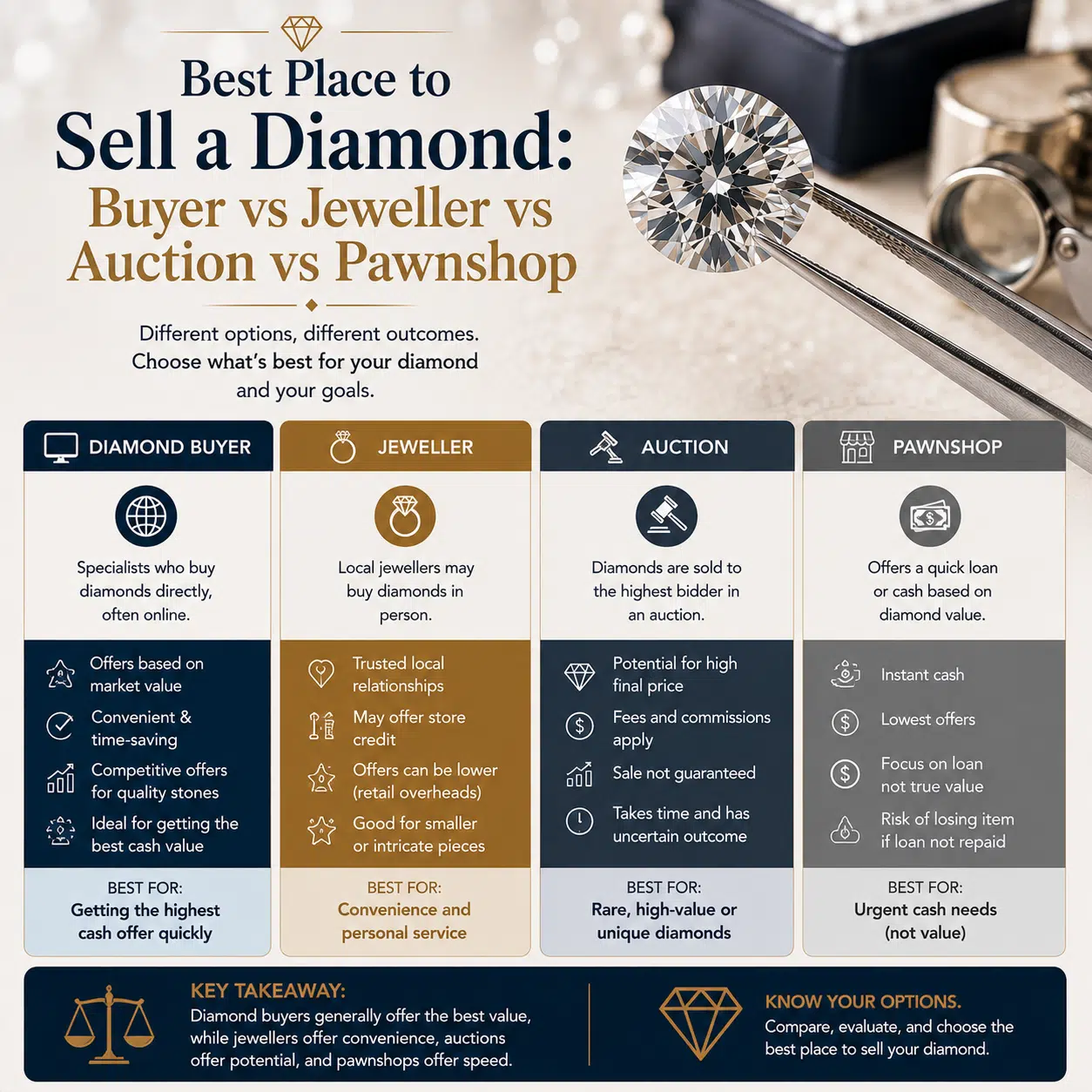
Vendre un diamant ne consiste pas seulement à trouver quelqu’un prêt à l’acheter. La véritable décision consiste à choisir un canal de vente capable de reconnaître la valeur de ce que vous possédez, d’expliquer clairement l’offre et de vous permettre d’obtenir le meilleur résultat net en fonction du temps et du niveau de risque que vous êtes prêt à accepter.
Réponse rapide
For most sellers, a specialist diamond buyer offers the best balance of market knowledge, speed, privacy and price certainty. A jeweller can be a good local option if the business actively buys pre-owned diamonds. An auction house is most suitable for rare, exceptional or signed pieces that can attract collector competition. A pawnshop is usually the fastest route to immediate cash, but speed and broad resale risk may matter more to the shop than achieving the strongest diamond-specific price.
Il n’existe pas un seul canal de vente qui convienne à chaque diamant. Un solitaire d’un carat accompagné de documents, une bague héritée sans certificat et un diamant rare de couleur fantaisie ne devraient pas automatiquement être vendus de la même manière.
The best place to sell your diamond depends on the item, the buyer’s expertise, how the sale is structured and what you will actually receive after fees and conditions.
The four main places to sell a diamond
| Selling channel | Usually best for | Outcome and timing | Main trade-off |
| Specialist diamond buyer | Natural loose diamonds, engagement rings and diamond jewellery that need a diamond-led assessment | Direct purchase offer; often the same day to several days after physical verification | The offer must leave the buyer room for testing, risk and resale |
| Jeweller | Local sellers, trade-ins, familiar jewellery and pieces the shop already knows how to resell | Cash offer, store credit or consignment; same day to several weeks | Not every jeweller buys from the public or values the centre diamond separately |
| Auction house | Rare diamonds, important fancy colours, exceptional sizes, signed jewels and pieces with provenance | Competitive bidding; several weeks to months if the item is accepted and sells | Slower, conditional and potentially costly; the item may remain unsold |
| Pawnshop | Immediate liquidity or a short-term collateral loan | Outright purchase or loan; often the same day | Convenience is prioritised; specialist diamond-market exposure may be limited |
This table is a starting point, not a guarantee. Two businesses in the same category can produce very different offers because their expertise, customers, stock position and interest in a particular diamond are different.
What does “best place” actually mean?
The highest headline estimate is not always the best deal. Compare each route across five factors.
1. Net amount
Ask what will reach your bank account after the seller’s commission, administration, shipping, insurance, laboratory work, repairs or other agreed costs.
Simple comparison:
Net cash received = Final sale proceeds − Seller fees − Approved transaction costs
A direct offer normally has no separate seller’s commission because the buyer builds its costs and resale margin into the offer.
An auction or consignment figure may appear higher before deductions. However, the seller should compare the final net settlement rather than the hammer price or asking price.
2. Speed
“Fast” has two meanings:
- The time required to receive an estimate
- The time required to receive cleared payment
An online estimate can arrive quickly but remain conditional until the diamond is physically inspected.
An auction estimate is not a completed sale. The item still needs to be accepted, catalogued, marketed, offered to bidders and paid for if it sells.
3. Certainty
A firm direct offer that you can accept or decline is different from:
- An asking price
- An insurance appraisal
- An auction estimate
- A marketplace listing
- A trade-in allowance
Ask whether the number you receive is preliminary, conditional or final. You should also ask what findings could cause the amount to change.
4. Specialist expertise
Diamonds are not priced by weight alone.
Carat weight, colour, clarity and cut work together. Shape, fluorescence, proportions, condition, treatments, natural or laboratory-grown origin, grading documentation and current demand can also affect marketability.
For a diamond ring, the precious metal, craftsmanship, signed maker, side stones and condition may matter as well.
A buyer who mainly purchases gold may focus on the metal value. A diamond specialist should be able to explain how the centre stone and the complete piece have been assessed.
5. Safety and control
Before transferring possession of your diamond, confirm:
- Who is responsible for the item
- How the item is insured
- How its identity will be recorded
- When you can decline an offer
- How it will be returned if you do not sell
- When and how payment will be made
A secure selling process should be understandable before the item leaves your hands.
Option 1: Selling to a specialist diamond buyer
A specialist diamond buyer purchases the diamond directly.
You provide information and photographs, the buyer conducts an initial review, and the item is physically tested before a final offer is confirmed. If you accept the offer, ownership transfers and payment is made under the agreed terms.
When a specialist buyer is usually the strongest fit
A specialist buyer may be the best place to sell your diamond when:
- You want a direct sale rather than a loan, trade-in or open-ended listing.
- The centre diamond represents a meaningful part of the item’s value.
- You have a loose diamond, solitaire, engagement ring or diamond-led piece.
- You want a confidential process with a clear accept-or-decline decision.
- You value speed but still want the item assessed by someone who works in the diamond market.
Advantages of selling to a specialist diamond buyer
- Diamond-specific testing and valuation
- A direct offer rather than waiting for an end consumer
- No auction reserve or risk of a public no-sale
- A shorter route from verification to payment
- The ability to begin remotely using photographs and a grading report
- Clearer assessment of the centre diamond and complete setting
Possible limitations
- A buyer is purchasing for resale and must account for market risk and operating costs.
- An online figure may change after the diamond’s origin, weight, grading, condition or documentation is physically verified.
- Buying criteria vary between businesses.
- A buyer may be interested in natural diamonds but not every laboratory-grown diamond, small stone or damaged piece.
Questions to ask a specialist diamond buyer
- Is the initial review free and without obligation?
- Is the offer preliminary or final?
- Who will perform the physical examination?
- What characteristics will be checked?
- Is the diamond valued separately from its gold or platinum setting?
- Are there any commissions or deductions from the stated offer?
- How are appointments, shipping, insurance, returns and payment handled?
- Can I take time to consider the final offer?
How the Sothis Diamonds process works
Sellers can begin by submitting photographs, item details and any available grading report.
A preliminary review is followed by physical verification before a final offer is confirmed. Sellers remain free to accept or decline the offer.
Depending on the item and the seller’s location, an Antwerp appointment or an agreed shipping process may be available.
Ready for a specialist opinion?
Demandez une estimation gratuite et sans engagement de votre diamant. from Sothis Diamonds before deciding which selling route is right for you.
Option 2: Selling to a jeweller
A jeweller—or “jeweler” in American English—can be a convenient option because you may already know the business and can discuss the piece face to face.
However, “selling to a jeweller” can describe three different transactions.
Direct purchase
The jeweller purchases the diamond or jewellery and pays you directly.
Trade-in
The jeweller gives you store credit toward another jewellery purchase.
Dépôt-vente
The jeweller displays or markets the item and pays you only after it sells, minus any agreed commission or costs.
These transactions should not be compared as though they are identical.
A trade-in allowance may be higher than a cash offer because the money remains within the jeweller’s business. A consignment asking price is not necessarily the amount you will receive or the date you will receive it.
When a jeweller can be a good fit
A jeweller may be suitable when:
- The shop actively buys pre-owned fine jewellery rather than only selling new pieces.
- You prefer an in-person local transaction.
- The ring has a style, maker or customer appeal that fits the jeweller’s clientele.
- You want to trade the item toward another piece and would use the store credit.
- The jeweller can explain both the value of the diamond and the complete setting.
Questions to ask a jeweller
- Are you making a cash offer, trade-in allowance or consignment proposal?
- If it is consignment, who sets the asking price?
- How long will the consignment agreement last?
- What commission and other costs will be deducted?
- Who insures the item while it is in the shop?
- What happens if the item does not sell?
- Are the diamond, precious metal and signed setting valued separately?
- When will payment be made after a sale?
The key consideration is specialisation.
A respected retail jeweller may have little demand for second-hand diamonds, while another jeweller may operate an active estate-jewellery business.
Ask about the actual resale route rather than assuming every jewellery shop purchases diamonds in the same way.
Option 3: Selling through an auction house
An auction house does not normally purchase the diamond directly from you.
Instead, it accepts the item on consignment, prepares it for sale and offers it to bidders. If bidding reaches the required level and the lot sells, the auction house later pays the net proceeds under the seller agreement.
When auction may be the best place to sell a diamond
An auction house may be suitable when:
- The diamond has an exceptional combination of size, colour, clarity or rarity.
- The stone has a natural fancy colour supported by recognised documentation.
- The jewellery is signed by a sought-after jewellery house or designer.
- The piece has notable provenance, age, craftsmanship or collector appeal.
- The auction house believes its specialist audience can create competition.
- The seller is willing to wait for the correct auction and settlement date.
Auction is not automatically the best option for an ordinary commercial-quality solitaire.
Auction houses select items that fit particular sales, and competitive bidding is never guaranteed.
Facts to understand before consigning a diamond
The estimate is not a promise
An auction estimate is a pre-sale range used to position the item. It does not guarantee that the diamond will sell within that range.
The reserve matters
The reserve is the confidential minimum price agreed for the sale, subject to the auction contract.
If bidding does not reach the reserve, the item may remain unsold.
Fees affect the net result
Seller’s commission and agreed expenses may be deducted from the proceeds.
The hammer price is therefore not necessarily the amount the seller will receive.
The process takes time
Evaluation, acceptance, catalogue preparation, marketing, the auction and settlement can take weeks or months.
The diamond may not sell
You should understand the costs, return process and post-sale options if bidding does not reach the reserve.
Questions to ask an auction house
- What is the estimated selling range?
- What reserve price is recommended?
- What seller’s commission will apply?
- Are photography, shipping, insurance or laboratory costs deducted?
- When will the auction take place?
- When will settlement be paid?
- What happens if the diamond does not sell?
- Can the item be sold privately after an unsuccessful auction?
- What withdrawal charges apply if you change your mind?
Read the seller agreement carefully. It should state the estimate, reserve, commission, possible costs, insurance terms, sale date, payment schedule, withdrawal conditions and what happens after a no-sale.
Option 4: Selling or pawning at a pawnshop
A pawnshop may either purchase an item outright or provide a loan secured against it.
These are different transactions.
If you sell the diamond, the transaction is permanent.
If you pawn it, you retain the right to recover the item by repaying the loan and charges within the contract terms. Failure to repay can result in the shop selling the item.
When a pawnshop may be practical
A pawnshop may be considered when:
- Immediate access to money is the overriding priority.
- You value a walk-in, same-day decision more than specialist market exposure.
- You want a short-term collateral loan rather than a permanent sale.
- You fully understand the repayment cost, deadline and risk.
Why a pawnshop may not produce the best diamond price
Pawnshops commonly handle many categories, including:
- Electronics
- Tools
- Montres
- Musical instruments
- Gold
- Jewellery
- Collectables
Their offer must support a quick local resale and protect the business against uncertainty.
Unless the pawnshop has genuine diamond expertise and a strong network of jewellery buyers, it may not price the diamond as precisely as a specialist buyer.
Before accepting, ask whether the amount is a purchase price or a loan. Request all charges, interest, conditions and deadlines in writing.
If time allows, compare the pawnshop’s amount with at least one specialist diamond-purchase offer.
Never pawn a sentimental item unless you are confident that you can meet the repayment terms.
Which selling channel fits your diamond? Four practical examples
The following examples use realistic diamond characteristics and selling situations. They do not predict a particular offer. They demonstrate how the best selling route changes with the item and the seller’s goal.
Example 1: A documented 1.10-carat round solitaire
Imagine a natural round brilliant diamond weighing 1.10 carats, graded G colour and VS2 clarity, mounted in a simple platinum solitaire and accompanied by a recognised grading report.
A specialist buyer is a logical first option because the diamond can be compared with current professional demand after its identity and condition are verified.
A jeweller may also make sense if the shop actively purchases solitaire rings.
A major auction house may decide that the item is attractive commercial jewellery but not distinctive enough for a specialist auction.
A pawnshop could provide a fast result, but the seller should compare a diamond-led offer before choosing convenience.
Example 2: A signed Art Deco ring with a rare centre stone
Consider a period ring with a maker’s signature, original documentation, strong provenance and an unusual natural fancy-coloured centre diamond.
In this situation, the jewellery’s authorship, history and collector appeal may add value beyond the individual values of the stone and precious metal.
An auction specialist may be able to present the ring to international collectors and explain its history properly.
A direct specialist offer is still useful as a certainty benchmark. Selling the piece only for its component diamond and metal values could overlook its potential collector premium.
Example 3: An inherited ring without a grading report
An inherited diamond ring may arrive with no certificate, receipt or original box. The seller may have only an old insurance schedule.
The seller does not yet know:
- The exact carat weight
- The colour or clarity
- Le fait que le diamant soit naturel ou issu d’un laboratoire
- Whether the stone has been treated
- Whether the old appraisal reflects replacement cost
- Whether the setting has separate value
The sensible first step is a professional review, not an immediate auction listing or gold-only offer.
The seller should submit the complete ring and avoid removing the stone at home.
Example 4: A seller who needs money quickly
A pawnshop may offer the shortest route to immediate cash, but “same day” does not have to mean “first offer.”
The seller can prepare photographs and documents in advance, request a specialist review and compare:
- The net purchase amount
- Payment timing
- Inspection requirements
- Possible deductions
- Return conditions
Even under time pressure, one additional qualified opinion can reveal whether speed is costing more than expected.
What determines the offer for a diamond?
No honest buyer can value every diamond from carat weight alone.
A professional offer normally considers the characteristics of the complete item and the resale market available to that buyer.
Le poids en carats
Carat describes the diamond’s weight, not its visible diameter.
Two diamonds with the same carat weight can have different measurements, proportions, quality characteristics and market values.
Couleur
For most diamonds within the colourless-to-light-yellow range, less visible colour is generally rarer.
Natural fancy-coloured diamonds are evaluated differently. Their colour strength, distribution and origin can have a substantial effect on marketability.
Clarté
Clarity considers the diamond’s inclusions and blemishes.
The type, size, number, position, nature and visibility of these characteristics can influence the diamond’s grade and appearance.
Cut and proportions
Cut affects how a fashioned diamond interacts with light.
The diamond’s proportions, polish and symmetry can affect its brightness, fire, scintillation and overall visual appearance.
Forme
Different shapes have different patterns of demand.
Common diamond shapes include:
- Rond
- Ovale
- Émeraude
- Coussin
- Poire
- Princess
- Marquise
- Rayonnant
- Asscher
- Le cœur
A buyer’s current customers and resale network may influence demand for a particular shape.
Fluorescence
Fluorescence should be considered alongside the diamond’s colour, clarity and overall appearance.
Its commercial effect varies according to the strength of the fluorescence and how the diamond looks under different lighting conditions.
S’il est naturel ou issu d’un laboratoire
Chips, abrasions, scratches and other damage can affect a diamond’s value.
The position and severity of the damage, along with any potential recutting risk, must be examined.
Origin and treatments
Natural, laboratory-grown and treated diamonds belong to different markets.
They must not be priced as though they are commercially equivalent.
Documentation and the complete jewel
A recognised grading report can reduce uncertainty by recording important identifying and quality information.
However, a grading report is not a cash valuation.
The buyer still needs to confirm that the diamond matches the report and assess its present condition.
For mounted jewellery, additional factors may include:
- Gold or platinum content
- Side stones
- La qualité de fabrication
- Maker’s marks
- La marque
- Age
- S’il est naturel ou issu d’un laboratoire
- Original documentation
- Provenance
- Collector demand
A generic setting may contribute mainly its metal value. A signed, antique or historically important setting may be worth preserving and selling as part of the complete jewel.
Current diamond marketability
Two diamonds with similar grading-report characteristics can receive different offers.
Differences may arise from:
- Proportions
- Apparence visuelle
- Fluorescence
- S’il est naturel ou issu d’un laboratoire
- Forme
- Report age
- Les traitements
- Brand or setting
- Current demand
- The buyer’s resale channels
That is why an online calculator or old appraisal should be treated as preparation rather than a guaranteed selling price.
How to compare diamond offers fairly
Use the same information for every buyer and compare the same type of transaction.
1. Prepare one item file
Include:
- Des photographies claires
- Le rapport de gradation complet
- The original receipt, if available
- Previous appraisals
- Known repairs or alterations
- Brand marks
- Original packaging
- Relevant ownership information
2. State your objective
Tell each business whether you want:
- A direct cash sale
- A trade-in
- A consignment arrangement
- An auction sale
- A collateral loan
3. Request itemised terms
Ask for:
- The gross amount
- Every deduction
- The final net amount
- The payment method
- The expected payment date
4. Separate estimates from offers
Record whether each number is:
- An online indication
- An auction estimate
- An asking price
- A trade-in allowance
- A preliminary purchase offer
- A firm purchase offer
5. Confirm the inspection conditions
Ask what will be tested and what findings could change the preliminary amount.
6. Check custody and insurance
Get the appointment, shipping, declared-value, loss, damage and return responsibilities in writing.
7. Compare timing
Record when the item will leave your control and when cleared funds should arrive.
8. Keep the right to decline
A valuation should not become a pressured sale.
Decision rule: Choose the highest credible net outcome that fits your deadline, risk tolerance and need for certainty—not simply the largest number shown at the beginning of the process.
Red flags when choosing where to sell a diamond
Be cautious if you encounter:
- A guaranteed “top price” before the item or grading report has been reviewed
- Pressure to hand over the diamond immediately
- An offer that expires within an unreasonably short period
- No verifiable business identity
- No physical address or written terms
- Refusal to explain whether the amount is an estimate, loan or purchase offer
- Unclear insurance or return responsibility
- A request to ship before the carrier and coverage are agreed
- Payment instructions that change unexpectedly
- Payment requested through an unrelated individual or account
- An assessment that values only the gold when the centre diamond may be significant
- A buyer who will not provide a receipt identifying the item
- Refusal to explain possible deductions
- Pressure to sign a document you have not had time to read
The bottom line: Where should you sell your diamond?
For a typical natural diamond, loose stone or engagement ring, begin with a reputable specialist diamond buyer and use that offer as a clear benchmark.
Consider a jeweller when it has an active pre-owned jewellery business or when a trade-in genuinely suits your plans.
Approach an auction house when the diamond or complete jewel is exceptional enough to attract collectors.
Use a pawnshop when immediate liquidity is more important than a specialist selling process—and make sure you understand whether you are selling the diamond or borrowing against it.
Sothis Diamonds offers a free initial diamond review for sellers who want to understand their options before committing.
Submit clear photographs, the complete grading report if available and a short description of the item.
After physical verification, you can receive an offer that you remain free to accept or decline.
Request your free diamond valuation and compare your options with confidence.
Frequently asked questions about the best place to sell diamonds
1. What is the best place to sell a diamond?
For most natural diamonds and diamond rings, a reputable specialist diamond buyer offers the strongest balance of expertise, speed and a clear purchase decision.
Rare, signed or exceptional pieces may perform better at auction. A jeweller can be suitable when it actively buys pre-owned jewellery, while a pawnshop is normally chosen for speed or a collateral loan.
2. Who usually pays the most for a diamond?
No category of buyer always pays the most.
The best payer is usually the buyer with the right expertise and a strong resale route for your exact item. Compare net offers from qualified businesses.
For an exceptional collector piece, competitive auction bidding may outperform a direct offer, but the result is slower and not guaranteed.
3. Is a diamond buyer better than a jeweller?
A specialist diamond buyer is often better for a diamond-led item because the business routinely purchases and evaluates diamonds.
A jeweller may be equally suitable if it actively purchases estate jewellery and has customers for the piece.
Ask how the centre stone, setting and resale route are valued before deciding.
4. Is it better to sell a diamond to a jeweller or a pawnshop?
If both businesses are making cash purchase offers, a jeweller with diamond expertise may provide a more specialised assessment.
A pawnshop may be faster and may also offer a loan, but it frequently prices items for quick general resale.
Compare the written net purchase amounts and do not confuse a pawn loan with a permanent sale.
5. Can I sell my diamond at auction?
Yes, if an auction house accepts it.
Auction is usually most appropriate for rare diamonds, important fancy colours, exceptional sizes, signed jewellery or pieces with provenance.
Ask about the estimate, reserve, seller’s commission, additional costs, insurance, settlement timing and consequences if the item does not sell.
6. Does an auction always produce a higher diamond price?
Non.
Auction can create competition, but only if the right bidders want the item and bidding reaches the required level.
Fees reduce the seller’s net proceeds, payment takes longer, and the diamond may remain unsold.
A firm direct offer can be better when certainty and speed matter.
7. Is it safe to sell a diamond online?
It can be safe when the business is verifiable and the complete process is agreed in writing.
Begin with photographs and documents. Before sending the item, confirm the carrier, insurance, declared value, packaging, tracking, inspection period, return terms and payment method.
Read the complete guide to selling a diamond online safely before arranging a shipment.
8. Should I sell my diamond locally or online?
Local selling provides face-to-face access and can reduce shipping concerns.
Online enquiries can widen the pool of specialist buyers and allow you to compare options before travelling.
The best route may combine both methods: begin online and complete physical verification through an appointment or agreed insured shipment.
9. How many diamond offers should I obtain?
Two or three qualified, comparable offers are normally more useful than numerous random quotations.
Use the same documents for each buyer and compare the same transaction type.
Do not directly compare a cash offer with an insurance appraisal, trade-in allowance or auction estimate.
10. Is an online diamond estimate a final offer?
Généralement, non.
Photographs and grading-report information support an initial opinion, but a final offer commonly depends on physical testing.
The buyer may need to confirm the diamond’s:
- Weight
- Mesures
- L’origine naturelle ou créée en laboratoire
- Couleur
- Clarté
- Couper
- Les traitements
- S’il est naturel ou issu d’un laboratoire
- Grading documentation
11. Do I need a diamond certificate to sell?
No. You may be able to sell a diamond without a certificate.
However, a recognised grading report can make the initial comparison clearer and reduce uncertainty.
If the report is missing, a specialist should advise whether obtaining a new laboratory report is likely to improve the selling outcome enough to justify the time and expense.
12. Can I sell a diamond without paperwork?
Potentially, yes.
Gather any receipt, old appraisal, insurance schedule, repair record, original box or family documentation you have.
The item will still need to be identified, tested and assessed. You must also be legally authorised to sell it.
13. Is an insurance appraisal the amount I should receive?
Non.
Insurance appraisals commonly address the cost of replacing an item through a retail channel.
A resale offer reflects what a buyer can pay in the current secondary market after accounting for verification, risk and resale.
Treat an insurance appraisal as descriptive background rather than a guaranteed cash figure.
14. Will I receive the original retail price for my diamond?
Généralement, non.
A retail price can include design, manufacturing, retailer overhead, taxes, service and profit margin.
A resale buyer works backwards from present secondary-market demand.
The relevant comparison is between today’s credible net offers, not only between the offer and the original shop receipt.
15. Is it easier to sell a loose diamond or a diamond ring?
A loose diamond can be weighed, measured and examined from every angle, which can make verification more direct.
A diamond ring may have additional precious-metal, design, brand or provenance value.
Do not remove a mounted diamond yourself merely to make it easier to sell. The complete piece should be assessed first.
16. Should I remove the diamond from its setting before selling?
Not without professional advice.
Removing a diamond at home can chip the stone, damage the setting or destroy value in a signed, antique or well-made piece.
Submit photographs of the complete ring and ask whether removal is necessary for testing or commercially sensible.
17. Can I sell a laboratory-grown diamond through the same channels?
You can submit a laboratory-grown diamond, but it must be assessed within the laboratory-grown resale market and according to each buyer’s current purchasing criteria.
It should not be priced using natural-diamond assumptions.
State its origin honestly and provide the laboratory report if available.
18. Does a famous jewellery brand increase resale value?
It can.
A verifiable signature, original paperwork, serial information, distinctive design and good condition may create collector demand for the complete jewel.
Authentication matters. Do not assume that a brand premium applies if the item has been altered, cannot be verified or is separated from important documentation.
19. Where should I sell an inherited diamond?
Begin with a specialist assessment that separates identification, quality and resale value from an old insurance figure.
Preserve all documents and avoid aggressively cleaning, resetting or removing the stone before receiving professional advice.
If several heirs have an interest in the item, confirm authority and agreement before transferring it.
20. Can I sell a chipped or damaged diamond?
Potentiellement.
Damage does not automatically remove all value, but the chip’s position, severity, visual effect and possible recutting risk matter.
Disclose known damage and expect the final offer to depend on physical inspection.
21. How quickly can I get paid for a diamond?
Timing depends on the selling channel.
A direct diamond buyer or pawnshop can sometimes complete a transaction shortly after verification.
A jeweller’s consignment arrangement or an auction can take weeks or months, and payment will follow the contract.
Ask for the expected date of cleared payment—not only the valuation date.
22. What is the safest payment method when selling a diamond?
A traceable bank transfer to an account in your name is commonly practical for higher-value transactions.
Confirm the payer’s business identity and written settlement terms.
Do not release the diamond merely because you have seen a payment screenshot, pending notification or transfer message. Confirm that the funds have cleared.
23. Can I decline a diamond offer?
Yes, provided that the valuation is stated to be without obligation and you have not accepted a binding sale.
Confirm this before sending or handing over the item. You should also understand any agreed return-shipping or third-party costs.
A reputable selling process should not depend on pressure.
24. Is there a best time of year to sell a diamond?
There is no universal month that guarantees a better result.
The diamond’s characteristics, current professional demand and the buyers you approach normally matter more than a simple seasonal rule.
If the sale is not urgent, allow enough time to prepare your documents and compare qualified offers.
25. Are diamond valuation calculators accurate?
A diamond valuation calculator can organise grading-report details and provide an initial reference.
However, it cannot fully verify identity, origin, condition, visual appearance, setting value or current buyer demand.
Use a calculator to prepare for a professional assessment—not as a guaranteed purchase offer.
26. Are there taxes when I sell a diamond?
Tax treatment depends on where you live, how you acquired the item, its original cost and whether the transaction produces a taxable gain under local law.
Keep your purchase, inheritance and sale records. Ask a qualified tax adviser when the amount is material.
