


How Diamond Buyers Calculate an Offer: Quality, Demand, Condition and Costs

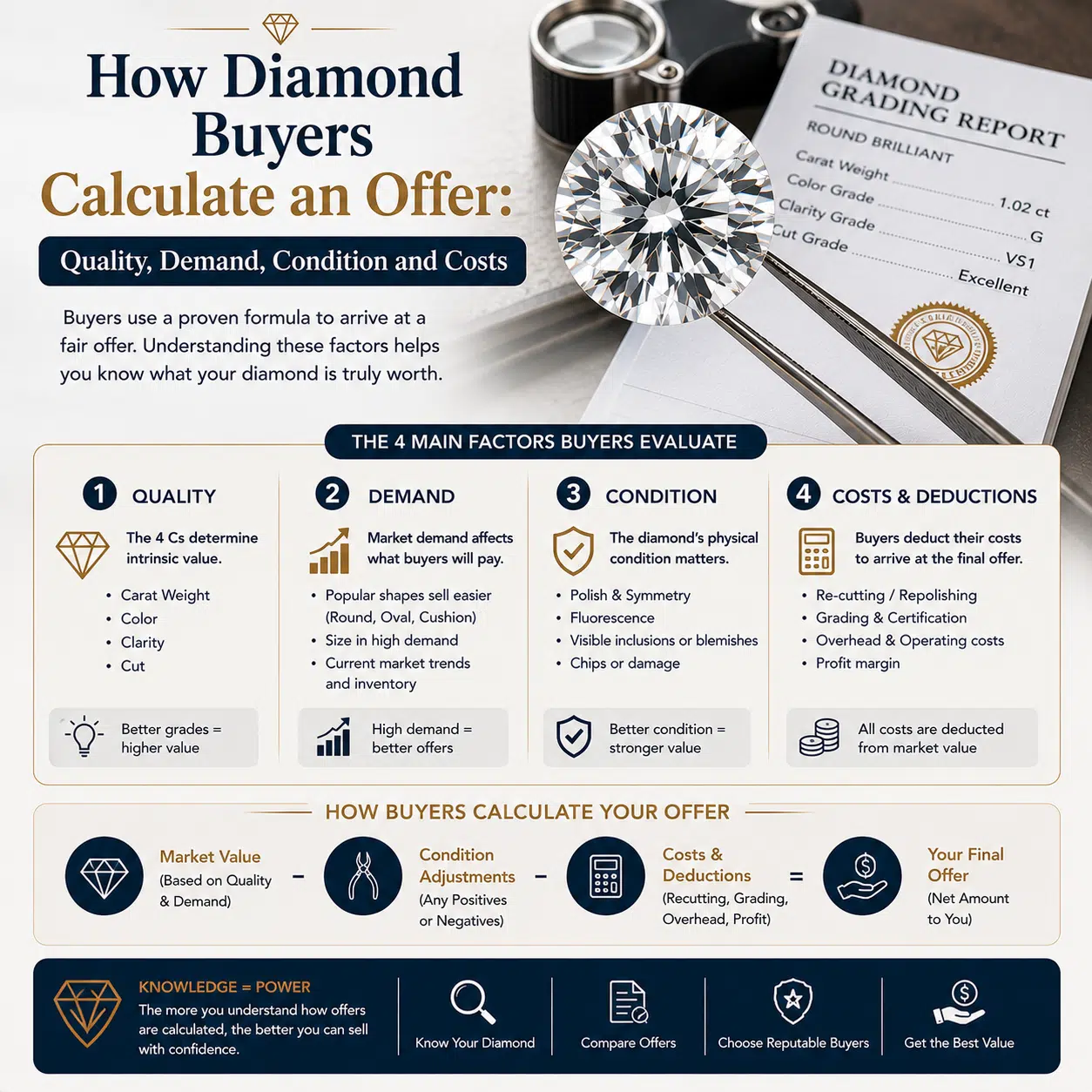
A diamond buyer does not normally calculate an offer by applying a standard percentage to the amount you originally paid. The buyer begins by identifying the diamond, confirming its quality and evaluating how it is likely to perform in the current resale market.
Carat weight, colour, clarity and cut are central to this process, but they are not the only factors. The diamond’s shape, proportions, grading report, natural or laboratory-grown origin, treatments, fluorescence, condition and current market demand can all influence an offer. If the diamond is mounted, the setting, side stones, precious metal, brand and overall jewellery condition may also contribute to the calculation.
The buyer must then consider what it will cost to verify, prepare, insure, hold and eventually resell the item. This is why a diamond’s future retail-facing price is not the same as the amount that can be offered to the present owner.
A final offer should therefore be based on the exact diamond—not a generic online price chart, an old appraisal or the purchase price alone.
Quick Answer: How Is a Diamond Offer Calculated?
A professional diamond buyer first estimates the diamond’s current resale potential. From that amount, the buyer accounts for any necessary testing, grading, repair, transport, insurance and selling costs. The expected selling time, risk of market movement and required operating margin are also considered.
A simplified model is:
Expected resale potential − verification and selling costs − market risk − buyer margin = purchase offer
This is not a universal industry formula. Different buyers have different customers, costs, inventory requirements and resale channels. Two reputable buyers may therefore offer different amounts for the same diamond. The most reliable offer is usually produced after the physical diamond has been inspected and matched with its documentation.
The Main Factors Behind a Diamond Offer
| Valuation factor | What the buyer examines | Why it affects the offer |
| Diamond origin | Natural, laboratory-grown, treated or simulated | Each category has a different market |
| Carat weight | Exact weight and commercially important thresholds | Larger stones can be rarer, but quality still matters |
| Colour | Grade, body colour and modifying tones | Desirability varies by colour and diamond type |
| Clarity | Grade, inclusion type, position and visibility | Inclusions can affect appearance, durability and demand |
| Cut and proportions | Light performance, dimensions, symmetry and polish | Determines beauty, face-up size and marketability |
| Shape | Round, oval, cushion, emerald and other forms | Demand differs by shape, size and market |
| Grading report | Laboratory, report number, comments and match | Reliable documentation reduces uncertainty |
| Condition | Chips, abrasions, repairs and alterations | Damage may require recutting or reduce demand |
| Market demand | Comparable supply and active buyer interest | More liquid diamonds may sell faster |
| Complete jewellery | Setting, side stones, metal, brand and craftsmanship | The piece may have value beyond its centre diamond |
| Costs and risk | Testing, insurance, holding time and future selling expenses | These affect what can be paid upfront |
The First Step Is Identifying What the Stone Is
Before discussing value, a buyer must determine whether the submitted stone is a natural diamond, laboratory-grown diamond, treated diamond or diamond simulant. Natural and laboratory-grown diamonds are both diamonds, but they belong to different supply and resale markets. Moissanite, cubic zirconia and other simulants may look similar to an untrained observer, but they are different materials and cannot be valued as diamonds.
The stone’s appearance, age or original price is not enough to establish its origin. A laboratory-grown diamond can closely resemble a natural diamond, while a high-quality simulant may appear convincing in photographs. Professional screening and, in some cases, laboratory testing may be necessary. A receipt that describes the item as a “diamond ring” is useful background information. It does not replace examination of the physical stone. Once the buyer has established what the stone is, the valuation can move to its quality characteristics.
How the 4Cs Affect a Diamond Offer
The 4Cs—carat weight, colour, clarity and cut—provide the basic language used to describe diamond quality. They make it possible to compare one diamond with other stones that have broadly similar characteristics. However, the 4Cs are not four independent numbers that can simply be entered into a universal formula. Buyers consider how the characteristics interact. A large diamond with weak transparency or unattractive proportions may be less marketable than a slightly smaller diamond with stronger overall appearance.
Carat weight
Carat is a measurement of weight. One carat equals 0.20 grams. It does not directly measure diameter or visible size. Larger diamonds are generally rarer, but value does not increase in a perfectly straight line. Commercial demand can change around important weight categories such as 1.00, 1.50, 2.00 or 3.00 carats. A diamond immediately above one of these thresholds may participate in a different market from a visually similar stone immediately below it.
This becomes especially relevant when a diamond is damaged. Suppose a chipped diamond weighs 1.03 carats. If repairing the chip would reduce the finished weight below one carat, the buyer must consider more than the weight physically removed. The repaired diamond may enter a different commercial category. Buyers also examine how efficiently the weight is distributed. A deeply cut one-carat diamond may appear smaller from above than a better-proportioned one-carat diamond. The two stones therefore do not necessarily have equal marketability.
Colour
For many colourless to light-yellow or light-brown diamonds, colour is assessed using a D-to-Z scale. D represents the colourless end, while increasing letters indicate a greater presence of colour. The printed grade is important, but it is not always the end of the analysis. Buyers may also observe whether the diamond has a brown, grey or green modifier, how evenly the colour appears and whether the setting influences its appearance.
Fluorescence and transparency can also interact with colour. A buyer therefore examines the complete visual result instead of pricing the letter grade in isolation. Fancy-coloured diamonds follow a different valuation structure. Hue, tone, saturation, colour distribution and natural colour origin can have a major effect on demand. A pale diamond described informally as yellow cannot be compared directly with a laboratory-graded Fancy Intense or Fancy Vivid yellow diamond.
Clarity
Clarity concerns internal characteristics known as inclusions and surface characteristics known as blemishes. A clarity grade summarises the overall assessment, but diamonds within the same grade can look different. One SI1 diamond may contain a small inclusion near its edge, while another may have a dark inclusion directly beneath the table. Both may receive the same broad grade, yet buyers can view their marketability differently.
The nature and position of an inclusion can also affect durability. A feather near the girdle or an inclusion close to a vulnerable corner may require greater caution than a harmless characteristic in a less sensitive position. Transparency matters as well. A diamond can possess a respectable clarity grade but appear hazy or less lively because of clouds, graining or other characteristics. For this reason, buyers inspect the diamond rather than relying only on the letters printed on its report.
Cut quality
Cut determines how effectively a diamond’s proportions and finish interact with light. It influences brightness, fire, scintillation and overall visual appeal. For a round brilliant, the buyer may consider the laboratory cut grade together with table size, total depth, crown angle, pavilion angle, girdle thickness, polish and symmetry.
A diamond can retain considerable weight while hiding that weight in excessive depth. It may therefore face up smaller than another diamond of the same carat weight. Conversely, a diamond spread too shallowly may sacrifice desirable light performance. Fancy-shaped diamonds such as ovals, cushions, pears, emerald cuts and radiants require a more individual assessment. Their outline, proportions, symmetry, visible size, bow-tie effect and light performance can all influence demand. A buyer should not assume that excellent colour and clarity automatically compensate for unattractive cutting.
Why Diamond Shape Influences the Offer
Shape affects both appearance and liquidity. Round brilliants have a large and established market, but that does not mean every round diamond is worth more than every oval, cushion or emerald cut. Demand depends on the combination of shape, size, proportions and quality. An attractive elongated oval may have stronger demand than an oval with an obvious bow-tie effect or uneven outline. An emerald-cut diamond may benefit from high clarity and attractive proportions because its broad facets can make inclusions more visible.
Antique shapes must be assessed within the correct context. An old European cut or old mine cut may appeal to buyers specifically seeking historic character. Comparing it only with a modern round brilliant could overlook its specialist market. Fashion also changes. A shape that is highly requested today may be less liquid in another market or period. This is why static tables showing permanent discounts for particular shapes are unreliable. Carat weight alone does not reveal how large a diamond appears when viewed from above.
Measurements and Face-Up Appearance
Buyers examine the diamond’s length, width and depth. These measurements indicate whether weight is being used efficiently or hidden in the lower portion of the stone, an excessively thick girdle or an unusual outline. For fancy shapes, the length-to-width ratio can influence demand. Some markets favour elongated ovals and cushions, while other buyers prefer balanced outlines. There is no single ideal ratio for every diamond because visual appeal depends on the entire cut.
Measurements also help the buyer confirm whether the diamond matches its grading report. A meaningful difference may indicate that the wrong report has been submitted, the diamond has been recut or further verification is required.
How the Grading Report Affects an Offer
A grading report provides independent technical information about a diamond. Depending on the report, it may state the diamond’s measurements, carat weight, colour, clarity, cut, polish, symmetry, fluorescence, treatments and identifying characteristics. A recognised and verifiable report can reduce uncertainty and make the initial estimate more precise. It can also improve marketability because a future customer has independent information with which to evaluate the diamond.
The buyer should verify the report through the issuing laboratory’s official system whenever possible. The report number, measurements, clarity plot, comments and laser inscription can then be compared with the physical diamond. A genuine report does not help if it belongs to a different stone. The fact that a report number exists in a laboratory database proves that the report was issued, not that the submitted diamond is necessarily the diamond described. A grading report also does not state a monetary value. It supplies quality information that can be used in a separate valuation. If your paperwork is missing, you may still be able to request an assessment. Read how to sell a diamond without a certificate for the appropriate process
Does the Grading Laboratory Matter?
The issuing laboratory can affect how confidently a buyer uses the recorded grades. Laboratories may differ in their procedures, terminology and market acceptance. A report that is widely recognised and easily verified can provide stronger evidence in the intended resale market. An unfamiliar or unverifiable document may require the buyer to rely more heavily on its own examination. This does not automatically mean that the diamond is poor quality or worthless. It means the level of grading uncertainty is different. If precise grading is commercially important, the buyer may discuss an updated or alternative laboratory report. The cost and expected benefit should be explained before any work is ordered.
Why the Report Date and Current Condition Both Matter
A grading report describes the diamond as it was when examined. It does not guarantee that the stone remains unchanged forever. Since grading, a diamond may have been chipped, repolished, recut, treated or replaced. A ring may also have undergone repairs that affected its centre stone or setting. An older report can remain useful when the diamond still matches its recorded characteristics. The buyer must nevertheless examine the current item. Report age alone should not produce an automatic discount. What matters is whether the document still describes the diamond accurately and whether the intended market requires more recent confirmation.
Treatments and Their Effect on Value
Some diamonds are treated to change their colour or apparent clarity. Treatments can include high-pressure, high-temperature processing, irradiation, fracture filling, laser drilling or coating. The commercial effect depends on the treatment, its stability, whether it has been properly disclosed and how the relevant market views it.
A treated natural diamond cannot automatically be compared with an untreated natural diamond that appears to have similar colour or clarity. The buyer must use comparable stones from the correct category. Some treatments require specialist equipment to identify reliably. When treatment status is uncertain, additional testing may be necessary before a final offer can be produced.
Fluorescence, Transparency and Overall Appearance
Fluorescence is the visible light that some diamonds emit when exposed to ultraviolet radiation. Blue is the most frequently encountered colour, although other fluorescence colours are possible. Fluorescence is not automatically good or bad. Its commercial influence depends on the diamond’s colour grade, fluorescence strength, transparency and appearance under ordinary viewing conditions.
Some buyers may be cautious about strong fluorescence in particular high-colour diamonds. In other cases, fluorescence may have little visible effect or may influence appearance differently. The buyer should examine the actual diamond instead of applying a fixed deduction based only on the word “Strong” or “Very Strong” in a report.
Transparency deserves similar attention. A diamond that looks clear, lively and bright can be more marketable than one that appears dull or hazy, even when the two stones have similar headline grades.
How Damage and Condition Change an Offer
Diamonds are extremely hard, but they are not indestructible. A diamond can chip, particularly near a thin girdle, sharp corner or exposed point. It may also develop abrasions, scratches or worn facet edges. A buyer evaluates where the damage is located, whether it affects durability and whether the stone can be repaired through polishing or recutting.
The cost of recutting is only part of the calculation. Removing damage also removes carat weight and may change the diamond’s dimensions, proportions, colour or clarity. The finished stone may fall below an important weight threshold.
For example, a buyer assessing a chipped 1.03-carat diamond may need to estimate the marketability of the expected repaired stone rather than valuing it as an undamaged 1.03-carat diamond. A small chip does not automatically remove all value. Its position, severity and likely repair outcome must be examined.
Natural and Laboratory-Grown Diamonds Use Different Markets
Natural and laboratory-grown diamonds should not be valued using the same market assumptions. Their available supply, replacement cost, retail pricing and resale demand can behave differently. A buyer must therefore verify origin before selecting comparable stones. A historical retail receipt does not lock in future resale value for either category. The offer is based on the current market for the verified item.
Laboratory-grown diamonds may still receive offers when they meet a buyer’s purchasing criteria. However, their value must be calculated using current laboratory-grown comparables rather than natural-diamond pricing.
Current Demand and Marketability
Quality is only part of value. The buyer must also consider whether there are customers seeking that particular combination of size, shape, grade and price. A technically rare diamond may have a narrow buyer pool. Another diamond may be more common but easier to sell because it fits a popular size and price range.
The buyer may examine recent completed transactions, available trade inventory, current customer requests and regional demand. Inventory already held by the buyer can also matter. A business with several similar diamonds may be less interested in acquiring another, while a buyer seeking that exact specification may make a stronger offer.
Demand changes with consumer preferences, economic conditions, currency movements and available supply. This is one reason an old appraisal or static online chart cannot guarantee today’s offer.
Liquidity and Selling Time
Liquidity describes how readily an item can be sold at an acceptable price.
A liquid diamond generally has a broad pool of potential buyers and strong comparable evidence. A less liquid diamond may still be valuable, but finding the right customer could take considerably longer. Holding a diamond for an extended period creates insurance, security, financing and market-price risk. The buyer must commit funds before knowing exactly when the diamond will sell.
An unusual shape, rare colour or highly specific branded jewel may require specialist marketing. The buyer’s access to that market can affect the amount it is prepared to offer. This helps explain why two businesses can value the same diamond differently without either calculation necessarily being dishonest.
The Setting, Side Stones and Precious Metal
When a diamond is mounted, the buyer evaluates the complete jewellery item as well as its centre stone. The setting may add value through its gold or platinum content, side diamonds, coloured gemstones, craftsmanship, design or brand. A well-made signed ring can be more valuable as a complete jewel than as separate components.
A generic or heavily worn setting may contribute mainly its recoverable material value. Its original manufacturing cost is not always recoverable in resale.
Side diamonds are assessed according to their size, quality, origin, condition and reuse potential. Very small stones can be costly to remove and difficult to resell individually, so their original retail cost may not be fully reflected in the offer. Do not remove the centre diamond yourself before seeking a valuation. Improper removal can chip the stone, damage the setting and destroy possible value in an antique or branded piece.
How Brand Can Change the Calculation
A genuine signed jewel may have value beyond the sum of its diamond, side stones and metal. The buyer considers whether the piece is authentic, whether the design is recognisable and whether collectors currently seek that model. Condition, serial numbers, original box, papers and service history can also influence the resale opportunity.
A brand name on a box or receipt is not sufficient by itself. The jewellery’s signature, construction and records must correspond. Not every retail brand premium is recoverable. However, reducing a desirable signed jewel to only its material components could also undervalue it. The correct approach depends on the strength of the branded secondary market.
Antique and Vintage Diamond Jewellery
Antique jewellery may need to be valued as a historical object rather than only as a source of diamonds and metal. Its period, original construction, diamond cutting style, maker, condition, restoration and provenance may matter. Buyers may also consider whether the complete design appeals to current collectors. Modernising or recutting an antique diamond is not always beneficial. Although the result might look more symmetrical, the process can destroy historical character, remove carat weight and reduce the value of the complete jewel. A specialist buyer may therefore calculate a different offer from a buyer interested only in reusable materials.
How Documents and Provenance Support the Offer
A grading report is not the only useful document. Purchase invoices, insurance appraisals, brand certificates, repair records, auction catalogues and estate documents can help establish the item’s identity and history. For important antique or signed jewellery, documented provenance may influence market interest. However, a family story should be distinguished from independently verifiable evidence.
Documents support the valuation but do not override the physical item. An invoice describing a flawless diamond cannot establish that grade if the submitted stone is different, damaged or replaced. To prepare the appropriate paperwork, read what documents you need to sell a diamond.
How Testing and Grading Costs Affect an Offer
Some diamonds can be assessed from their existing report and physical inspection. Others require additional work before their resale potential can be established confidently. Possible expenses include professional screening, laboratory grading, insured transport, removal from a setting or specialist examination of treatment, origin or colour.
These expenses should be commercially justified. It may not make sense to spend heavily grading a small or damaged diamond if the resulting report is unlikely to increase its marketability enough to cover the cost. If additional work is proposed, the buyer should explain why it is needed, who will perform it, how much it will cost and whether you remain responsible for the expense if you reject the offer.
Repair and Recutting Risk
When repair is needed, the buyer must estimate an outcome that has not yet occurred. A chipped diamond may lose more weight than expected during recutting. Its new proportions may be less attractive, or an inclusion may become more prominent. There is also a possibility that the damage extends further than it first appears.
The buyer therefore considers both the likely repaired result and the uncertainty involved in achieving it. Jewellery can create similar considerations. A ring may require new prongs, missing side stones, polishing or brand-authorised restoration before it can be offered to another customer.
Selling Costs, Holding Costs and Buyer Margin
A professional buyer purchases a diamond before it has been sold to the next customer. The buyer therefore assumes future costs and risks.
Secure transport, insurance, testing, administration, compliance, photography, marketing, storage and payment processing may all be relevant. If the diamond remains unsold for a long period, the buyer’s money remains tied up while the market may move.
The difference between a buyer’s offer and the future resale price is not automatically pure profit. That difference must cover these expenses, the risk of an unsuccessful sale and the business’s operating margin.
Different buyers have different cost structures. A specialist with an active customer for a particular diamond may calculate a stronger offer than a general buyer who expects to hold it for months.
A Simple Example of an Offer Calculation
Imagine a buyer believes that a verified diamond could eventually generate €7,500 through its normal selling route. Before purchasing it, the buyer expects to spend money on insured handling, verification, minor preparation and future selling. The buyer must also allow for holding time, possible market changes and its operating margin.
After accounting for all these considerations, the buyer might determine that it can offer €5,450. This is a fictional example designed only to illustrate the structure of a calculation. The figures do not represent a standard margin, a Sothis transaction or a prediction for another diamond. The important point is that an expected future selling price and an immediate purchase offer answer different commercial questions.
Why Two Similar Diamonds Can Receive Different Offers
Consider two round diamonds that both weigh one carat and are both described as G colour and VS2 clarity. The first diamond has a recognised report, excellent cut, attractive proportions, good transparency and no visible damage. The second has an unverifiable report, deep proportions, a smaller face-up appearance and a centrally positioned dark inclusion.
Their headline grades appear identical, but the complete stones are not commercially identical. The first may be easier to verify and resell, while the second carries greater uncertainty. This is why an accurate offer cannot be based on carat, colour and clarity alone.
Why Two Buyers Can Offer Different Amounts
Every buyer serves a different market. One buyer may have clients actively searching for oval diamonds. Another may specialise in antique jewellery or signed pieces. A third may focus on standard certified loose diamonds. Their insurance, marketing, inventory, financing and operating costs may also differ. One business may be able to resell the diamond quickly, while another expects to hold it for a long period. A difference between offers does not automatically prove that one buyer is misleading you. Compare the assumptions, conditions, deductions and final net payment.
Online Diamond Calculators and Price Charts
Online calculators can provide a broad starting point, but their limitations should be understood.
A calculator cannot normally inspect inclusion position, transparency, damage, treatment, report matching, colour modifiers or brand authenticity. It may also use an unclear data source or estimate a retail figure rather than a direct purchase offer.
Static price charts become outdated as supply, demand, currency and buyer preferences change. They can also encourage sellers to compare diamonds that share a few grades but differ significantly in appearance and marketability. Use an online estimate to decide whether further investigation is worthwhile. Do not treat it as a guaranteed payment.
Why the Retail Price Is Not the Starting Point
The original retail price may include VAT or sales tax, setting manufacture, boutique overhead, packaging, marketing, warranty services, financing and retailer margin.
These elements formed part of the original purchasing experience, but they do not all remain in the physical diamond. A resale buyer therefore begins with the present item and current secondary market rather than simply deducting a fixed percentage from the receipt. For a complete explanation of the difference, read diamond resale value vs retail price vs insurance appraisal.
Is a Low Offer Automatically Unfair?
No. A low offer can reflect a buyer’s limited demand, conservative assumptions or high resale costs. You remain free to decline it. An offer becomes more concerning when the buyer misrepresents the diamond, hides deductions, refuses to explain a major revision or uses possession of the item to pressure you.
A responsible comparison should examine whether each proposal is preliminary or final, whether fees are deducted, when payment will be made and how the diamond will be returned if you decline. Use the guide on how to compare diamond offers before choosing between proposals.
Frequently Asked Questions About Diamond Offers
How do diamond buyers calculate an offer?
Buyers verify the diamond’s origin, 4Cs, shape, report, condition and marketability. They then account for verification, preparation, selling costs, holding time, risk and operating margin.
How much is my diamond worth?
Its current value depends on the exact diamond, condition, documentation, demand and selling channel. Carat weight or the original receipt alone cannot provide a reliable answer.
Can I calculate diamond value from carat weight?
No. Carat is only one factor. Colour, clarity, cut, shape, origin, condition and demand can substantially change the result.
Is there a standard diamond price per carat?
No single price applies to every diamond. The price per carat changes according to the complete combination of quality and market factors.
Why do weight thresholds matter?
Diamonds above commercially important weight categories may belong to different comparison groups. Damage or recutting that moves a stone below a threshold can affect its marketability.
Does diamond colour affect the offer?
Yes. Buyers consider the grade, modifying tones, fluorescence, transparency and whether the stone is a colourless-range or fancy-coloured diamond.
Do two diamonds with the same clarity grade have the same value?
Not necessarily. Inclusion position, visibility, colour and possible durability effects can differ within the same clarity grade.
Does cut quality affect resale value?
Yes. Cut and proportions influence visible size, light performance and customer demand.
Which diamond shape has the highest resale value?
No shape is always the most valuable. The result depends on size, quality, proportions and current demand.
Does fluorescence reduce a diamond’s value?
Not automatically. Its effect depends on strength, colour, transparency and the diamond’s overall appearance.
Why can a diamond look milky despite a good grade?
Clouds, graining, inclusions or other transparency characteristics may reduce contrast and liveliness. Physical inspection is required.
Does a grading report increase the offer?
A recognised report can reduce uncertainty and support marketability, but it does not guarantee a price.
Is a grading report the same as an appraisal?
No. A grading report describes the diamond. An appraisal assigns a value for a stated purpose.
Can I sell a diamond without a certificate?
Potentially, yes. The buyer may need additional testing or grading before confirming a final offer.
Does the grading laboratory matter?
It can. Buyers consider how reliably the report can be verified and used in the intended resale market.
Does an old report reduce the value?
Not automatically. The buyer must confirm that the report still matches the diamond’s identity and present condition.
Why might an offer change after inspection?
The buyer may discover different grades, damage, treatment, origin or a report mismatch. Any material change should be explained.
Are natural and laboratory-grown diamonds valued differently?
Yes. They belong to different supply and resale markets and should be compared with their respective categories.
Do small side diamonds have value?
They may contribute, but their recoverable value depends on size, quality, removal cost and resale potential.
Does a luxury brand increase an offer?
Potentially, if the piece is authentic, desirable and in appropriate condition. Not every original retail brand premium is recoverable.
Does the original box increase value?
It may improve completeness for a branded item, but it does not prove authenticity by itself.
Are antique diamonds calculated differently?
They may be considered within antique or collector markets rather than only compared with modern-cut diamonds.
Does provenance affect value?
Documented provenance can matter for rare, signed or historically important jewellery. Unsupported stories carry less commercial weight.
Why does demand affect value?
A buyer must consider how many customers want that exact combination and how long it may take to complete a future sale.
What does diamond liquidity mean?
Liquidity describes how readily the diamond can be sold at an acceptable price.
Why does holding time affect an offer?
Longer selling periods create insurance, financing, security and market-price risks for the buyer.
What costs can reduce an offer?
Testing, grading, transport, insurance, professional removal, repair, recutting, marketing and payment costs may all be relevant.
Why does a diamond buyer need a margin?
The margin supports operating expenses and compensates the buyer for purchasing the diamond before knowing when or for how much it will sell.
Why do reputable buyers make different offers?
They may have different customers, inventory requirements, selling costs, areas of expertise and expected holding periods.
Does a low offer mean the buyer is dishonest?
No. A price disagreement is not automatically fraud. Ask how the offer was calculated and compare the complete terms.
Can an online calculator give me an exact offer?
No. It cannot physically inspect condition, transparency, treatment, report matching or brand authenticity.
Is an online valuation final?
It is normally preliminary unless the buyer clearly says otherwise. Physical inspection is usually required before a final offer.
Should I pay for a new certificate before selling?
Not automatically. Request an initial review first and determine whether new grading is likely to justify its cost and delay.
Should I remove the diamond from its setting?
No. Submit the complete piece first. Improper removal can damage the diamond or destroy value in the setting.
How can I obtain a more accurate initial estimate?
Provide clear photographs, the complete grading report, precise measurements and honest information about condition, repairs and ownership history.
How can I determine whether an offer is fair?
Compare the verified characteristics, assumptions, deductions, payment terms and return conditions. Focus on the net amount you will receive.
Request an Offer Based on Your Exact Diamond
A meaningful diamond offer cannot be calculated from a universal percentage, static chart or insurance appraisal. The buyer needs to understand the exact diamond: whether it is natural or laboratory-grown, its carat weight, colour, clarity, cut, shape, proportions, report, condition and current marketability. The setting, brand and supporting documents may also contribute.
Begin by submitting clear photographs and the complete grading report, if available. Include any purchase invoice, appraisal, brand certificate or repair record that may help identify the item. After physical verification, Sothis Diamonds can determine whether the diamond meets its current buying criteria and provide a market-based offer that you remain free to accept or decline.
