


GIA vs IGI vs HRD Reports: Does the Grading Lab Affect Your Offer?

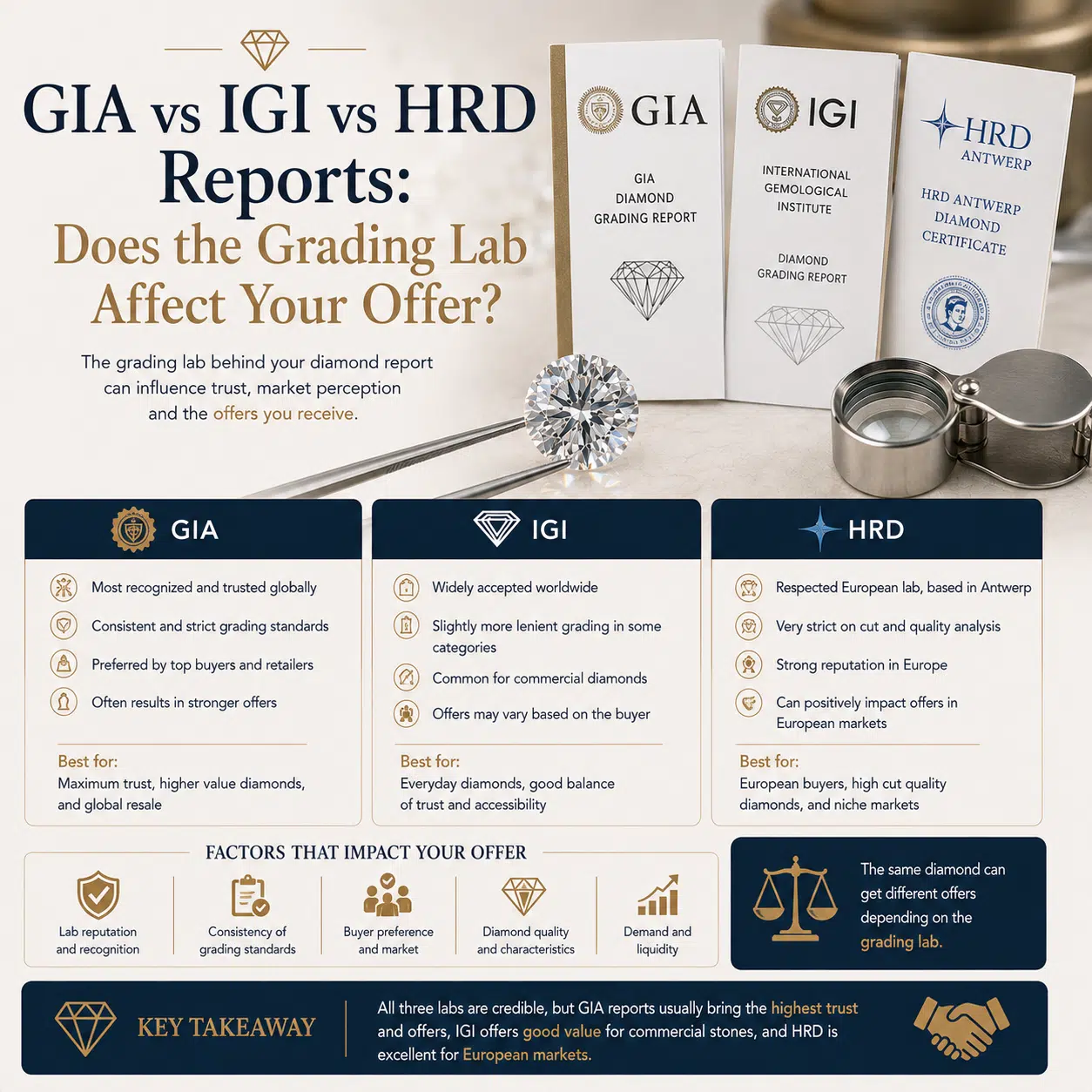
A diamond grading report can make a stone easier to identify, compare and sell. However, two reports displaying similar carat, colour and clarity information do not necessarily create identical resale offers.
Professional buyers consider which laboratory issued the report, what type of report it is, whether it can be verified and whether the physical diamond still matches the documented characteristics.
Market recognition also matters. A report familiar to the buyer’s intended resale market may reduce uncertainty and make the diamond easier to place. An unfamiliar, limited or unverifiable report may require additional testing or regrading before a final offer can be confirmed.
GIA, IGI and HRD Antwerp are all established laboratories offering diamond-report services. The relevant question is not simply which name is “best.” It is which report applies to the diamond, how the market interprets it and whether the documented results are supported by physical examination.
Quick Answer: Does the Grading Lab Affect Diamond Resale Value?
Yes. The grading laboratory can affect buyer confidence, market comparability and the cost or risk of verifying the diamond.
For many internationally traded natural loose diamonds, a verifiable GIA report provides broad market familiarity. IGI reports are widely encountered across natural, laboratory-grown and finished-jewellery categories. HRD Antwerp reports are familiar within Antwerp and many European diamond markets.
This does not mean that every GIA-graded diamond receives a higher offer than every IGI- or HRD-graded diamond. A current, verifiable report that accurately matches an attractive diamond may be more useful than an older report from another laboratory that no longer reflects the stone’s condition.
The report does not determine the purchase price. The physical diamond, its origin, quality, condition and current demand remain decisive.
What Is a Diamond Grading Report?
A diamond grading report records the gemological characteristics observed when a laboratory examined the diamond.
Depending on the laboratory and service, the report may state whether the diamond is natural or laboratory-grown and document its carat weight, colour, clarity, shape, measurements, cut, polish, symmetry and fluorescence. It may also contain a proportions diagram, clarity plot, comments, treatment information and laser-inscription details.
A grading report is not normally a monetary valuation. It describes the diamond but does not state what a buyer must pay for it.
The report also does not prove that the person holding it owns the diamond. Proof of ownership and transaction compliance are separate matters.
Diamond Certificate vs Grading Report
“Diamond certificate” is a common consumer search term, but “grading report” is usually more precise.
A certificate can sound like a guarantee of quality, authenticity or value. A laboratory report records the findings from an examination performed under the laboratory’s procedures and equipment.
GIA specifically describes its documents as reports rather than certificates, valuations or appraisals. Other organisations may use certification language in their marketing, but sellers should still understand the document’s actual purpose and limitations.
The important questions are what was examined, what conclusions were recorded and whether the report matches the current diamond.
GIA vs IGI vs HRD Report Comparison
The table below summarises typical report roles. Exact services and formats can change, so the individual document must always be read and verified.
| Laboratory | Common report coverage | Typical resale consideration |
| GIA | Natural loose-diamond reports, coloured-diamond reports and distinct laboratory-grown assessment services | Broad international familiarity, especially for natural loose diamonds; exact report type and date remain important |
| IGI | Natural and laboratory-grown loose-diamond reports, jewellery reports and specialised report services | Frequently encountered in natural, laboratory-grown and finished-jewellery markets; buyers verify the report and physical stone |
| HRD Antwerp | Natural and laboratory-grown diamond reports, jewellery reports and coloured-diamond services | Established familiarity in Antwerp and European markets; terminology and exact report format must be interpreted correctly |
This is not a quality ranking. Each offer depends on the actual report, diamond and intended resale channel.
How a Grading Laboratory Can Affect an Offer
A report allows the buyer to compare the diamond with market inventory. The easier that comparison is, the more confidently the buyer can estimate demand and resale potential.
If the laboratory is widely recognised by the intended market, the buyer may be less likely to require immediate regrading. This can reduce delay, shipping, laboratory fees and uncertainty.
If the buyer has concerns about report equivalence or whether the diamond still matches the document, the offer may include an allowance for additional verification.
The report can therefore affect the transaction, but it does not create intrinsic value. It influences how confidently the existing value can be described and marketed.
Does the Laboratory Change the Actual Diamond?
No. The physical diamond remains the same stone regardless of the report issuer.
A 1.00-carat natural diamond does not become heavier, brighter or cleaner because it is submitted to another laboratory.
What can change is the documented description and the market’s confidence in that description. If two laboratories assign different grades, buyers may use different comparison groups when calculating an offer.
This is why a report can influence value perception without physically changing the diamond.
Are GIA, IGI and HRD Grades Automatically Equivalent?
No. Identical-looking terminology should not be assumed to create perfect equivalence across every report.
Each laboratory uses its own procedures, report formats, equipment, quality-control systems and terminology. Some grade names correspond closely, while others require interpretation.
HRD reports, for example, may display terminology such as “Loupe Clean” or historical colour descriptions alongside familiar letter grades. Laboratory-grown report formats can also differ substantially between organisations.
A professional buyer should read the report legend and examine the diamond instead of comparing only the headline letters.
Can the Same Diamond Receive Different Grades?
It is possible for grading results to differ, particularly when a characteristic lies close to a grade boundary.
Colour and clarity grading involve controlled professional observations. Although laboratories use established procedures, borderline stones can be interpreted differently.
Report type and eligibility rules may also vary. One service may provide an overall cut grade for a particular shape or category, while another may present different cut-related information.
No seller should assume that regrading will automatically improve the results. The new report could confirm the existing grades, raise one characteristic, lower another or use a different reporting format.
Does a One-Grade Difference Affect the Offer?
It can, especially in larger or higher-value natural diamonds.
A difference between G and H colour or VS2 and SI1 clarity may change the inventory against which the buyer compares the stone. The financial effect depends on carat weight, shape, cut, condition and demand.
The difference becomes more important near commercial thresholds. A diamond that moves into or out of a highly requested quality combination may reach a different buyer pool.
There is no universal amount for a one-grade change. The buyer must calculate it using current comparable diamonds.
Understanding a GIA Diamond Report
A GIA natural-diamond grading report can identify the stone as natural and record its carat weight, colour, clarity, shape, measurements and other characteristics.
For qualifying standard round brilliant diamonds in the D-to-Z colour range, the report can include an overall cut grade. Polish, symmetry and fluorescence are also recorded.
GIA provides separate services for coloured diamonds and laboratory-grown diamonds. The exact report title matters because a natural-diamond report and a laboratory-grown assessment do not describe the same market category.
Report information can be checked through GIA’s online verification service. The buyer must still confirm that the physical diamond matches the online record.
Does a GIA Report Guarantee the Highest Offer?
No. A GIA report can support broad market comparability, but it does not guarantee value or a buyer.
A small, damaged or poorly cut GIA-graded diamond may receive a lower offer than a larger, more desirable diamond with a verifiable IGI or HRD report.
The report also cannot protect a diamond from changing market conditions. A quality combination with limited demand may remain difficult to sell even when accurately documented.
GIA describes the diamond. The market determines what a buyer is prepared to pay.
Understanding an IGI Diamond Report
IGI offers reports for natural and laboratory-grown loose diamonds, along with jewellery-report services.
A loose-diamond report may include the diamond’s origin, shape, measurements, carat weight, colour, clarity and cut-related information. Depending on the report type, it may also contain a clarity diagram, proportions graphic and laser-inscription details.
IGI jewellery reports can document a finished piece containing natural or laboratory-grown diamonds and gemstones. This can be useful when the item should not be dismantled merely to obtain loose-stone information.
IGI reports can be checked through the organisation’s online verification service. As with any laboratory, the physical item must still match the digital record.
Are IGI Reports Accepted for Resale?
Yes, many professional buyers accept verifiable IGI reports.
Acceptance depends on the diamond category, report type, buyer and target market. IGI reports are particularly common in the laboratory-grown diamond and finished-jewellery sectors, although the organisation also grades natural diamonds.
A buyer may still perform independent verification before issuing a final offer. This is standard risk control and does not automatically mean the report is being rejected.
The offer should be based on the verified diamond rather than a generic deduction simply because the report is IGI.
Understanding an HRD Antwerp Diamond Report
HRD Antwerp issues reports for natural diamonds, laboratory-grown diamonds, coloured diamonds and jewellery through its available services.
A natural-diamond grading report records authenticity and key characteristics such as carat, colour, clarity and cut-related information.
HRD terminology can differ from the terms used on another laboratory’s report. A buyer should interpret both the letter or numerical grade and the accompanying scale.
HRD Antwerp reports are particularly familiar within Antwerp and many European trade contexts. Recognition can vary in other markets, but a verifiable HRD report remains useful gemological documentation.
Are HRD Reports Accepted Outside Europe?
They can be. International buyers who understand HRD terminology may accept the report directly.
Some downstream customers may be more familiar with another laboratory. In that situation, a dealer may consider regrading before resale and reflect that possibility in the offer.
This is a question of market fit rather than a claim that the physical diamond is inferior.
Before accepting a deduction, ask whether the buyer intends to regrade the stone and how the expected cost or grade risk was calculated.
Which Is the Best Diamond Grading Lab for Resale?
There is no universal answer for every diamond and destination.
For a valuable natural loose diamond intended for broad international comparison, a GIA report is often selected because many buyers are familiar with its reporting system.
IGI may be especially practical for laboratory-grown diamonds or complete jewellery, depending on the report required. HRD Antwerp can be highly relevant when the diamond is being assessed or traded through Antwerp and European markets.
The best report is authentic, appropriate for the diamond category, sufficiently detailed, verifiable and accepted by the buyers most likely to purchase the stone.
Market Recognition vs Grading Accuracy
Market recognition and technical grading should not be treated as the same concept.
A laboratory may be familiar in one region or product category and less familiar in another. That difference can affect resale convenience even when the report contains detailed information.
Accuracy also depends on whether the report matches the physical diamond. An authentic document is not useful if it has been paired with the wrong stone or the diamond has been altered since grading.
A buyer must consider laboratory recognition, report integrity and physical consistency together.
Report Type Can Matter More Than the Laboratory Name
Every report from the same laboratory does not contain identical information.
A full natural-diamond grading report, a dossier, an identification report, a jewellery report and a laboratory-grown assessment serve different purposes.
A jewellery report may describe mounted stones within practical limitations. A loose-diamond report can normally provide more precise carat weight and measurements because the complete stone is accessible.
Before comparing laboratories, identify the exact document type. Comparing a mounted-jewellery report with a full loose-diamond report is not an equivalent comparison.
Loose-Diamond Reports vs Jewellery Reports
A loose diamond can be weighed and examined from every direction. This allows precise measurement and detailed grading.
A mounted diamond is partially concealed by metal. Its exact weight, colour, clarity, measurements or condition may be more difficult to establish.
Jewellery reports remain useful because they can document the entire piece without unnecessary dismantling. They are particularly relevant when brand, craftsmanship, design or period value may exceed the value of the loose components.
A buyer should not expect a mounted-jewellery report to provide every field available on a loose-diamond grading report.
Natural vs Laboratory-Grown Report Formats
Natural and laboratory-grown diamonds must be clearly distinguished because they participate in separate resale markets.
IGI and HRD offer report services that document laboratory-grown diamonds. Their exact grading terminology and report layouts should be read directly from the document.
GIA uses a distinct assessment format for qualifying colourless-to-near-colourless laboratory-grown diamonds, with Premium or Standard descriptions rather than treating the document as a natural-diamond report. Older GIA laboratory-grown reports may use earlier terminology and remain relevant if authentic.
Reporting practices can change. The buyer should rely on the report actually issued rather than assuming that every document from the same laboratory follows the latest format.
Does an Older Report Lose Its Value?
A grading report does not automatically expire, but age can affect how confidently it describes the current diamond.
The stone may have been chipped, abraded, repolished, recut or treated after grading. The report’s format may also provide less information than a modern service.
An older report can still be useful when it is authentic, verifiable and accurately matches the stone.
A new report should only be recommended when the expected improvement in marketability justifies the cost, handling risk and delay.
Does a Damaged Diamond Still Match Its Report?
The report may still help identify the stone, but its quality description may no longer be complete.
A chip can affect weight, clarity, symmetry or durability. Recutting can change dimensions, carat weight, polish and other grades.
A buyer must inspect current condition rather than relying solely on the historical document.
Any offer adjustment should relate to the actual damage and expected repair risk—not merely to the report’s age.
How to Verify a GIA, IGI or HRD Report
Begin with the official online verification service provided by the issuing laboratory.
Enter the report number and compare the returned record with the paper or digital document. Check the carat weight, shape, measurements, colour, clarity and date.
Then compare those details with the physical diamond. A professional may inspect the laser inscription and measure the stone.
Online verification confirms that a record exists. It does not, by itself, prove that the diamond in front of you is the stone described in that record.
Does a Laser Inscription Prove the Report Is Genuine?
A laser inscription can help connect the diamond with its report number, but it should not be used alone.
An inscription must be read correctly and compared with the laboratory database. Measurements and identifying characteristics should also correspond.
The absence of an inscription does not automatically invalidate a report because not every diamond is inscribed. An inscription can also become difficult to see when the stone is mounted.
Professional verification uses multiple matching characteristics rather than relying on one number.
Can a Genuine Report Be Used With the Wrong Diamond?
Yes. A real report could be presented with a different stone having broadly similar characteristics.
This is why online verification alone is insufficient. The buyer should match measurements, weight, shape, plotted characteristics and inscription where available.
High-value transactions may require specialised testing to confirm natural or laboratory-grown origin and detect treatments.
A reputable buyer will complete these checks before taking ownership or releasing final payment.
Does a Report Prove the Diamond Is Natural?
Only if the report type and wording state that the examined stone was identified as natural.
Never assume origin from the laboratory logo or the presence of a report number. Each document should clearly describe whether the diamond is natural or laboratory-grown.
Older terminology may differ, so the entire report must be read.
If origin is unclear or the document cannot be verified, additional screening or laboratory testing may be required.
How Treatments Affect Report Interpretation
Diamond treatments can alter colour or apparent clarity and may affect marketability.
A recognised report may disclose detected treatments according to the laboratory’s policies and service type. Sellers should submit the complete document, including comments and footnotes.
A cropped image displaying only the 4Cs can hide treatment information or other important limitations.
If treatment status is uncertain, the buyer may require further testing before confirming the offer.
Reports for Fancy-Colour Diamonds
Fancy-colour diamonds require specialised reporting because their value depends heavily on colour origin, hue, tone, saturation and distribution.
A standard D-to-Z report should not be used to market a pale yellow stone as Fancy Yellow unless the documented grading supports that description.
GIA, IGI and HRD offer different coloured-diamond services. The exact report type, natural or treated colour determination and terminology must be reviewed.
For an important coloured diamond, the target buyer’s familiarity with the report can significantly affect marketability.
Does the Laboratory Affect Cut-Grade Interpretation?
It can. Laboratories may have different report scopes and cut-grading methodologies.
GIA assigns an overall cut grade to qualifying standard round brilliant diamonds within the applicable range. Fancy shapes do not receive that standard overall GIA cut grade, although polish, symmetry and measurements are reported.
Other reports may present cut information or terminology differently. Buyers should not assume that every Excellent or Ideal description is directly interchangeable.
The physical diamond’s proportions and face-up appearance still require assessment.
Does the Laboratory Affect Colour and Clarity Interpretation?
It can influence how confidently buyers compare the documented grades with market inventory.
Colour and clarity grades occupy ranges. A diamond close to a grade boundary may be interpreted differently during a separate examination.
A buyer should not automatically claim that a report is “one grade too high” without inspecting the stone. Equally, a seller should not assume that identical letters from different reports guarantee identical market treatment.
The responsible approach is to verify the diamond and explain any material discrepancy.
Should You Send an IGI or HRD Diamond to GIA Before Selling?
Niet automatisch.
Regrading may be worthwhile for a valuable natural loose diamond if broader market recognition is likely to improve the net outcome. It may not make sense for a smaller diamond, mounted jewellery or a stone whose current report is already accepted by the intended buyer.
The process involves laboratory fees, professional removal where applicable, secure shipping, insurance and time. The new grades are not guaranteed to match or improve upon the existing report.
Obtain an initial offer first and compare the expected benefit with the complete cost and risk.
Should You Regrade an Older GIA Diamond?
Not automatically. An older, verifiable GIA report that matches an undamaged diamond may still provide sufficient information.
Updating may be useful if the report lacks information required by the target market or if the stone has been repolished or recut.
The financial benefit should be estimated before the diamond is removed, shipped or submitted.
A seller should not pay for a new report merely because a buyer makes an unsupported claim that every older report is unusable.
Can a Buyer Make an Offer Without Any Report?
Yes. A diamond can still be assessed without its original GIA, IGI or HRD document.
The buyer must confirm that the stone is a diamond and determine whether it is natural, laboratory-grown or treated. Its carat weight, colour, clarity, cut, shape and condition must then be assessed.
The initial estimate may be wider because less verified information is available. Physical inspection becomes especially important.
Read our guide to selling a diamond without a certificate for more detail.
Illustrative Example: Same Stated Grades, Different Reports
Imagine two fictional natural one-carat round diamonds. Both reports state G colour, VS2 clarity and Excellent cut.
One report was issued by GIA and the other by IGI. The buyer should not value the stones from the laboratory names alone.
Measurements, proportions, fluorescence, inclusion appearance, condition and actual market demand must be compared. If both reports are authentic and both diamonds verify correctly, each can receive a serious offer.
The final amounts may differ because of the physical stones and target markets—not merely because the logos differ.
Illustrative Example: HRD Diamond in Antwerp
Consider a fictional 1.50-carat natural diamond with a current HRD Antwerp report.
A professional Antwerp buyer may be familiar with the terminology and able to compare the stone directly with relevant market inventory.
A buyer serving a market where another laboratory is more commonly requested might include the possibility of regrading in the offer.
Neither approach proves that the HRD-graded diamond has changed. The difference concerns the buyer’s downstream market and transaction strategy.
Illustrative Example: Old Report and Current Damage
Imagine a diamond with a fifteen-year-old report stating 1.02 carats and VS2 clarity.
Physical inspection reveals a chip that occurred after grading. The online report is genuine, but it does not document the current condition.
A lower offer in this situation reflects damage, possible recutting and weight-loss risk. It should not be presented simply as a penalty for the laboratory or report age.
Illustrative Example: Laboratory-Grown Report Formats
Suppose two laboratory-grown diamonds have reports from different laboratories.
One report presents detailed colour and clarity grades, while the other uses a broader quality assessment. Comparing only the terminology would be misleading.
The buyer must confirm the origin, measurements, quality, condition and present laboratory-grown market demand. Report format cannot erase the broader pricing conditions within that market.
Illustrative Example: A Borderline Colour Grade
Consider a fictional natural diamond reported as G colour.
During inspection, a buyer believes the stone is close to the G–H boundary. That does not justify automatically pricing it as H without explanation.
The buyer should consider the existing report, physical comparison and whether regrading is genuinely planned. The written offer should identify any condition attached to the grade verification.
A transparent process separates a legitimate grading concern from an unsupported attempt to reduce the price.
How Buyers Use Reports to Calculate an Offer
The buyer first verifies the report and checks that the diamond matches its identifying data.
The documented carat, colour, clarity, cut, shape, fluorescence, polish and symmetry are then compared with current market demand. The buyer also examines physical condition, transparency and origin.
If regrading, recutting or further testing is needed, the expected cost and risk may be included in the offer.
Our pillar guide explains how diamond buyers calculate an offer.
How to Compare Offers Based on Different Lab Opinions
Ask every buyer to provide the verified grades used in the calculation.
If one buyer discounts the diamond because of the laboratory, request a clear explanation. Find out whether regrading is required, which laboratory would be used and whether the offer is conditional on the result.
Compare the amount you will receive after all deductions. A higher preliminary figure can become a lower net offer if fees or grading conditions are introduced later.
Use our guide to comparing diamond offers without being misled before accepting.
Veelgestelde vragen
Does the diamond grading laboratory affect resale value?
It can affect buyer confidence, comparison methods and whether regrading is considered. The physical diamond remains the main source of value.
Is GIA the best laboratory for diamond resale?
GIA reports have broad recognition, especially for natural loose diamonds. “Best” still depends on the diamond category and intended market.
Is IGI good for diamond resale?
Yes. Verifiable IGI reports are accepted by many professional buyers and are frequently encountered for natural, laboratory-grown and jewellery items.
Is HRD Antwerp good for diamond resale?
Yes. HRD Antwerp reports are established within Antwerp and European markets and can be accepted internationally by knowledgeable buyers.
Does a GIA report always produce a higher offer?
No. The diamond’s actual carat, colour, clarity, cut, origin, condition and demand determine the offer.
Is a GIA diamond worth more than an IGI diamond?
Not simply because of the report. The two physical diamonds and their target markets must be compared.
Is a GIA diamond worth more than an HRD diamond?
Not automatically. Report recognition may influence marketability, but the complete diamond controls value.
Are IGI and GIA grades the same?
They use familiar diamond-quality terminology, but grades should not be assumed perfectly interchangeable without examining the reports and stones.
Are HRD and GIA grades the same?
HRD and GIA reports may use different terminology and procedures. A professional should interpret the exact documents.
Which is stricter: GIA, IGI or HRD?
A blanket statement is unreliable. Borderline stones, report types and individual characteristics can produce different results.
Can an IGI diamond be sent to GIA?
Potentially, if it meets the relevant submission criteria. The new results are not guaranteed to match the IGI report.
Can an HRD diamond be sent to GIA?
Potentially. The financial benefit should be considered before paying for removal, shipping and grading.
Can a GIA diamond be sent to IGI or HRD?
Yes, subject to the chosen laboratory’s services. A second report is not automatically necessary.
Will regrading increase my diamond’s value?
Not necessarily. It may improve market comparability, but the new grades could remain the same or change.
Can regrading lower the documented grade?
Yes. A separate examination can produce a lower, higher or equivalent result.
Does a diamond report expire?
Reports do not normally have a simple expiry date, but the diamond’s condition and the report format can change in relevance over time.
Is an old GIA report still valid?
It can remain useful if authentic, verifiable and matched to an unchanged diamond.
Is an old IGI report still valid?
Potentially. Verify it through IGI and confirm that the diamond still matches.
Is an old HRD report still valid?
Potentially. Verify the report and have the physical diamond inspected.
How do I verify a GIA report?
Use GIA’s official Report Check service and compare the returned data with the document and physical stone.
How do I verify an IGI report?
Use IGI’s official online report-verification service and confirm that the diamond matches the record.
How do I verify an HRD report?
Use HRD Antwerp’s official report-check service and compare the record with the physical diamond.
Does online verification prove the diamond matches?
No. It proves a report record exists. Measurements, identifying features and inscriptions must also correspond.
Does a laser inscription prove authenticity?
It helps connect a diamond with a report but should be verified alongside measurements and other characteristics.
Can a laser inscription be fake?
A number alone should never be trusted without checking the laboratory’s database and matching the diamond.
Can a genuine report accompany the wrong diamond?
Yes. This is why professional matching is necessary.
Is a grading report proof of ownership?
No. It describes an item but does not establish legal title or authority to sell it.
Is a diamond certificate the same as an appraisal?
No. A grading report describes gemological characteristics, while an appraisal normally states a monetary purpose-specific value.
Does a GIA report state diamond value?
No. It is not a cash valuation or guaranteed purchase price.
Does an IGI report state resale value?
Its diamond reports document quality characteristics rather than guaranteeing what a buyer will pay.
Does an HRD report state resale value?
A grading report describes the diamond’s characteristics. Current resale value requires a separate market assessment.
Does the original retail invoice prove the grades?
No. Use the laboratory report and physical examination to verify the diamond.
Does an insurance appraisal replace a grading report?
No. An appraisal may rely on estimated or documented grades, but its main purpose is generally replacement valuation.
Can a mounted diamond have a report?
Jewellery-report services can document mounted items. Exact loose-diamond grading may require removal.
Is a jewellery report as detailed as a loose-diamond report?
Not always. The setting can restrict access to weight, measurements, colour, clarity and condition.
Should I remove my diamond for regrading?
Not before obtaining professional advice. Removal can damage the stone or setting and may reduce branded or antique value.
Can IGI grade complete jewellery?
IGI offers jewellery reports for pieces containing natural or laboratory-grown diamonds and gemstones.
Can HRD issue jewellery reports?
HRD Antwerp offers jewellery-report services within its current service range.
Does GIA issue jewellery reports?
GIA offers jewellery-report services, although these differ from a loose natural-diamond grading report.
Which laboratory is best for a natural diamond?
The answer depends on size, value, location and buyer market. GIA often provides broad international comparability, while IGI and HRD reports may also be accepted.
Which laboratory is best for a laboratory-grown diamond?
It depends on the desired report format and target buyer. IGI, HRD and GIA offer different laboratory-grown services.
Does GIA give D-to-Z grades to new laboratory-grown diamonds?
Its current colourless-to-near-colourless laboratory-grown quality assessment uses Premium or Standard descriptions. Older reports may contain previous terminology.
Are older GIA laboratory-grown reports invalid?
No. They can remain authentic and useful if matched to the diamond.
Does IGI identify natural vs laboratory-grown origin?
Its loose-diamond reports identify whether the examined diamond is natural or laboratory-grown.
Does HRD identify natural vs laboratory-grown origin?
HRD provides separate reporting for natural and laboratory-grown diamonds through its relevant services.
Can a laboratory mistake a simulant for a diamond?
Recognised laboratory procedures are designed to identify the material. The report should be verified and matched to the stone.
Do laboratories disclose treatments?
Appropriate reports may record detected treatments according to the laboratory and service. Read all comments and footnotes.
Does the lab affect fluorescence grading?
Laboratories document fluorescence according to their procedures and terminology. Buyers should read the actual report scale.
Does the lab affect cut grading?
Report scope and cut methodology can differ. Identical words should not automatically be treated as equivalent.
Why does HRD use terms such as Loupe Clean?
Laboratories can use different clarity terminology. The report scale should be read rather than comparing the abbreviation alone.
Can two reports exist for the same diamond?
Yes. A diamond may have been submitted to more than one laboratory at different times.
Which report should a buyer use if two reports disagree?
The buyer should verify the current stone, report dates and any intervening work. Re-examination may be required.
Can damage make an old report inaccurate?
Yes. Chips, abrasion, repolishing or recutting can change the characteristics documented previously.
Can a report be replaced if lost?
Laboratories may offer replacement, duplicate or update services depending on the report type and circumstances.
Can I sell a diamond without the original paper report?
Potentially. A digital record or professional assessment may be sufficient to begin, but physical verification remains necessary.
Should I pay for a new report before requesting an offer?
Usually not automatically. First obtain an initial assessment and ask whether a new report is likely to improve the net outcome.
Who pays for regrading?
That should be agreed before submission. Do not assume a laboratory or shipping cost without written terms.
Can a buyer deduct future grading costs?
Potentially, if regrading is genuinely necessary. The reason and amount should be explained in the written offer.
Can a buyer reject my report?
A buyer can choose its purchasing criteria, but should explain any grade adjustment or regrading requirement transparently.
What if a buyer says every IGI diamond is one grade lower?
That is an unsupported generalisation. The physical diamond and exact report should be assessed individually.
What if a buyer refuses an HRD report outside Europe?
Ask whether the issue is market familiarity, regrading policy or a concern about the specific diamond. Consider another qualified buyer before accepting an unexplained deduction.
Can an online buyer value all three reports?
A professional buyer may review GIA, IGI and HRD reports, subject to its current purchasing criteria and physical verification.
Will a report make the sale faster?
A current, verifiable report can reduce uncertainty and support comparison, but it does not guarantee immediate payment or a buyer.
Does a report guarantee a final online offer?
No. Online estimates are normally preliminary until the diamond and report match are physically confirmed.
How should I submit the report online?
Upload a clear image or PDF of every page. Do not crop comments, report numbers, treatment information or measurements.
Is it safe to share the report number?
It is generally needed for verification, but avoid publicly posting unrelated personal information from invoices or appraisals.
How do I compare offers based on different grading opinions?
Ask each buyer which verified grades were used, whether the offer is conditional and whether fees or regrading costs will be deducted.
Can Sothis review GIA, IGI and HRD reports?
Yes. Sothis can review available GIA, IGI and HRD Antwerp documentation and advise whether further verification is needed.
Receive an Offer Based on the Diamond—Not Just the Report Logo
A recognised grading report can improve confidence and comparability, but its laboratory name does not determine the complete resale value.
The report must be authentic, appropriate for the diamond category and consistent with the physical stone. Carat weight, colour, clarity, cut, shape, origin, condition and present demand must then be considered together.
Submit your complete GIA, IGI or HRD Antwerp report with clear photographs for a private initial review. If the original report is missing, you can still begin with the information available.
Following physical verification, Sothis Diamonds can provide a market-based offer that you remain free to accept or decline.
Vraag een gratis, vrijblijvende waardebepaling van uw diamant aan.
