


Selling Vintage or Antique Diamond Jewellery Without Losing Provenance Value

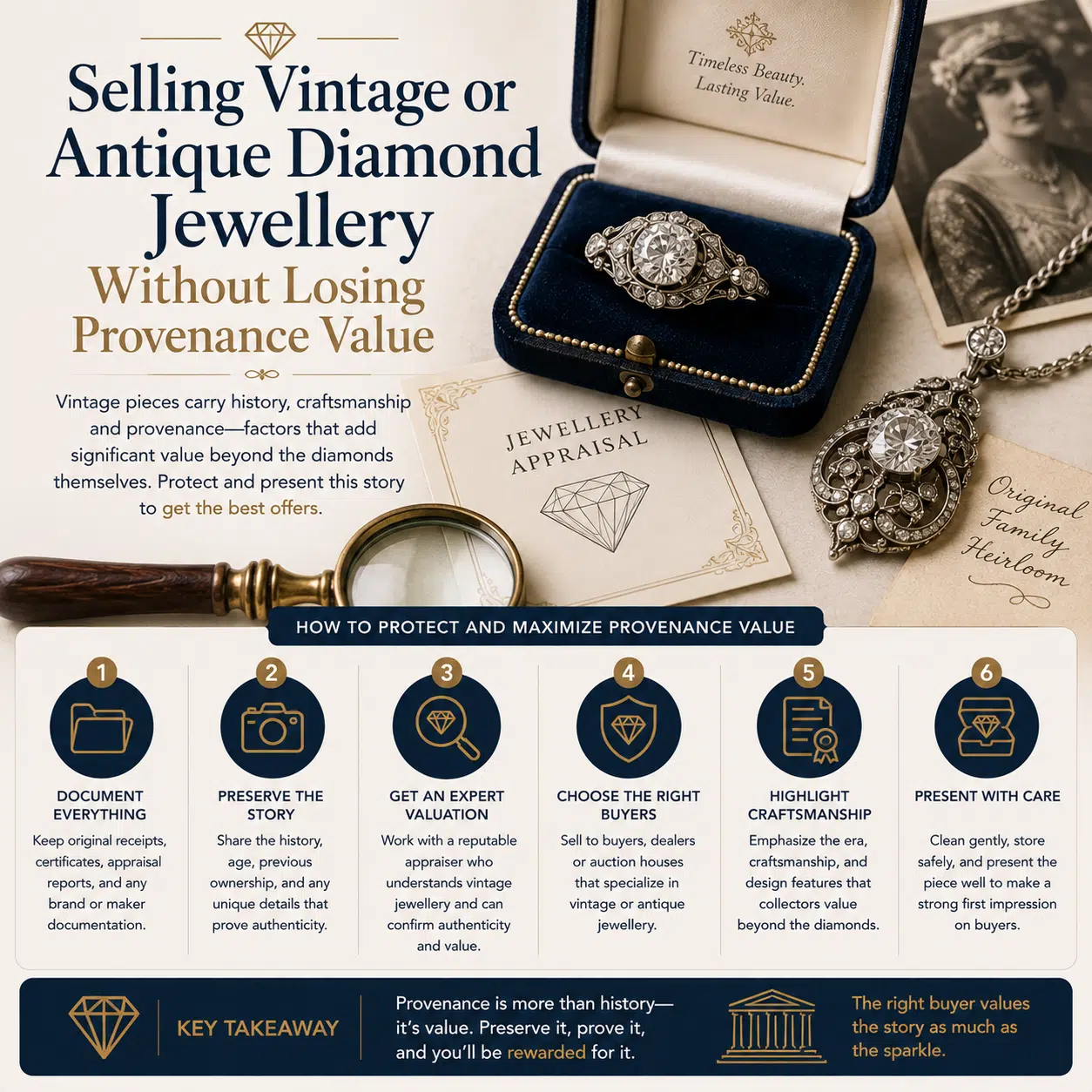
Selling antique diamond jewellery requires a different approach from selling an ordinary modern diamond ring. The centre diamond may be valuable, but it may represent only one part of the complete jewel’s market appeal.
An original setting, old-cut diamonds, period craftsmanship, a recognised maker, historical documentation and a traceable ownership history can all contribute value. Removing the stones, polishing away marks or carrying out an unsympathetic repair before valuation can permanently reduce that value.
The safest approach is to preserve the jewellery in its current condition, collect everything connected with it and obtain a specialist assessment of the complete piece before deciding whether any component should be separated.
Quick Answer: How Do You Sell Antique Diamond Jewellery Safely?
Begin by keeping the jewellery intact. Do not remove the centre diamond, recut an old stone, replace missing components or polish the metal before a specialist has examined it.
Collect old receipts, appraisals, wills, family photographs, insurance schedules, repair records, branded packaging and written ownership history. Photograph signatures, serial numbers and hallmarks without scraping or chemically cleaning them.
An appropriate valuation should consider the diamonds, gemstones, metal, craftsmanship, age, maker, condition, originality, provenance and current collector demand.
Only after that complete assessment should you compare a direct purchase, specialist auction, consignment or another selling route.
What Is Antique Diamond Jewellery?
The word “antique” is often used in the jewellery trade for items approximately 100 years old or more, while “vintage” usually describes later pieces from a recognisable past period. These are useful commercial descriptions rather than universal legal definitions.
Estate jewellery has a different meaning. It generally refers to jewellery that has been previously owned, regardless of whether it is antique, vintage or relatively modern.
A ring sold through an estate can therefore be only a few years old, while an antique ring may have passed through many owners without coming directly from an estate.
The words used by a family, seller or old appraisal do not prove the date. Construction, hallmarks, stone cuts, design, documented history and later alterations must be examined together.
What Does Provenance Mean?
Provenance is the documented history of an object’s ownership and movement from its creation to the present.
For jewellery, provenance may explain who commissioned or owned a piece, where it was purchased, how it passed through a family, whether it appeared in an exhibition or publication and when it was altered or repaired.
Most family jewellery does not have a complete ownership record extending back to the date it was made. Gaps are normal. The objective is to preserve and organise the evidence that exists rather than inventing a complete history.
A documented connection to a recognised owner, maker, event or collection can increase historical interest. However, a family story without supporting evidence should be presented as family tradition, not verified provenance.
Why Provenance Can Affect Antique Jewellery Value
Provenance can strengthen confidence that an antique jewel is what the seller claims it to be. It may help establish age, maker, original ownership and the circumstances in which the piece changed hands.
For an ordinary unsigned ring, family photographs and an old receipt may mainly support identification. For a rare signed jewel or historically significant piece, a strong chain of ownership could materially affect collector interest.
Provenance does not replace examination. A documented owner does not prove that every stone and component remains original. The jewellery must still be inspected for alterations, replacement stones, later repairs and misleading marks.
The best provenance combines physical evidence from the jewel with reliable documentary evidence.
Documents That Can Preserve Provenance
| Evidence | What it may help establish |
| Original receipt or jeweller’s invoice | Retailer, date, item description, maker or purchase history |
| Will, estate inventory or inheritance record | Transfer of ownership and connection to an estate |
| Old insurance schedule | Earlier description, measurements, photographs and condition |
| Family photographs | Evidence that the jewellery existed and was worn at a particular time |
| Repair and service records | Changes to stones, clasps, settings, size or condition |
| Auction catalogue or sale invoice | Previous public sale, attribution and ownership transfer |
| Letters, diaries or gift notes | Family history and possible circumstances of acquisition |
| Original box or fitted case | Retailer or maker association, subject to separate authentication |
| Published photograph or exhibition record | Public history and possible cultural significance |
| Grading report | Recorded characteristics of a particular diamond or gemstone |
Keep the original documents whenever possible. Do not write directly on them, laminate them or attach them permanently to the jewellery.
Create digital copies and record which document belongs to which item. If several pieces were stored together, avoid assuming that every box or appraisal matches the nearest jewel.
A Family Story Is a Starting Point, Not Proof
Many antique jewels come with stories: a ring belonged to a titled relative, a brooch was purchased in Paris, or a diamond came from a royal collection.
These stories may be true, partly true or gradually changed as they passed between generations. Presenting them honestly protects both the seller and the buyer.
Record who told the story, when they told it and what evidence supports it. A dated photograph, letter or estate inventory is generally more useful than an unsigned note created recently.
Do not add an unverified brand, owner or historical event to a sale description merely because the style appears similar. Incorrect provenance can damage credibility and complicate a later transaction.
Why the Complete Jewel Should Be Valued First
Antique diamond jewellery should not automatically be reduced to its diamonds and precious-metal weight.
The complete piece may have value from its design, craftsmanship, period, maker, originality and relationship between the stones and setting. Separating those elements can destroy evidence of how the jewel was made and worn.
A Georgian, Victorian, Edwardian or Art Deco ring may appeal to a buyer specifically because it remains intact. An old-cut diamond in its original hand-made mounting can be more interesting than the same stone placed in a generic modern setting.
In other cases, extensive damage, major replacement parts or limited collector demand may mean that the centre diamond and metal account for most of the value. That decision should follow examination rather than assumption.
Do Not Remove Old-Cut Diamonds Before Valuation
Old mine-cut and old European-cut diamonds were fashioned according to different equipment, lighting and aesthetic preferences from modern brilliant cuts.
Old mine cuts are generally associated with a soft, often squarish outline, high crown, small table and visible culet. Because they were shaped by hand, their symmetry and proportions can vary significantly.
Old European cuts are typically rounder, with broad facets, a high crown, small table and open culet. They became prominent during the late nineteenth and early twentieth centuries.
These characteristics are not simply cutting defects. They form part of the stone’s historical appearance.
Old-cut diamonds can also have very thin girdle areas. Removing them from tight or worn settings can create a chipping risk. Any removal should be justified, professionally performed and appropriately insured.
Do Not Recut an Antique Diamond Without Specialist Advice
Recutting can improve the symmetry or modern light performance of some diamonds, but it permanently changes the stone.
The process removes weight and may push the diamond below an important carat threshold. It can also eliminate an old cutting style that appeals to collectors.
A warmer old mine-cut diamond with an irregular outline may be desirable precisely because it retains its historical character. Converting it into a smaller modern brilliant could reduce the value of the complete antique jewel.
Before approving any recut, compare the potential value of the original stone and setting with the predicted result after weight loss, cutting risk and loss of historical character.
Hallmarks Can Reveal Important Information
Hallmarks and maker’s marks can help identify precious-metal fineness, assay location, sponsor, manufacturer or approximate period.
Their interpretation is not always straightforward. Marking systems vary between countries and periods, and some items were legitimately produced without the marks a modern owner expects.
A date letter may help date an item within a particular hallmarking system, but not every piece carries one. Marks can also appear on replacement components added during a later repair.
Hallmarks should therefore be considered alongside construction, design, wear, stone cuts and documentation. One mark rarely proves the entire history of a jewel.
Do Not Polish Away Signatures or Hallmarks
Old marks can be faint, shallow or partially worn. Aggressive polishing may make them more difficult to read or remove them entirely.
Do not scratch the metal to test it, deepen a faint signature or use abrasive products to make a mark clearer. These actions alter the physical evidence a specialist needs.
Photograph the marks using indirect light and several angles. A macro setting or magnifying lens may help, but digital enhancement should not be used to misrepresent what is actually visible.
If a mark is difficult to interpret, allow an experienced jewellery specialist or appropriate assay resource to examine it.
A Signature Does Not Automatically Prove the Maker
A recognised name inside a ring or on a brooch can be important, but signatures can be copied, added later or placed on components that did not begin together.
Authentication may involve typography, placement, serial numbers, construction methods, design archives, metal marks, stone-setting style and known production records.
An original box is useful but can become separated from its jewel. Likewise, an old receipt carrying a famous name must be shown to describe the exact item being sold.
Describe a piece as “signed” or “attributed to” only when the wording accurately reflects the available evidence. Do not advertise it as authenticated by a brand unless appropriate verification supports that claim.
Original Condition Does Not Mean Perfect Condition
Collectors often value originality, but that does not mean all damage should be ignored.
A loose diamond, broken clasp or severely worn setting can place the jewellery and its stones at risk. Necessary conservation may be appropriate, but the work should be minimal, documented and completed by someone experienced with antique jewellery.
Normal surface wear can support the history of an object. Excessive polishing may remove engraving, soften detail and change the form of the piece.
A good assessment distinguishes stable evidence of age from active damage that threatens the jewel.
Why Cleaning Antique Jewellery Can Be Risky
A diamond may tolerate cleaning methods that the rest of an antique jewel cannot.
Old jewellery can contain fragile solder, enamel, pearls, porous gemstones, foil-backed stones and closed settings that trap moisture. An ultrasonic or steam cleaner may loosen stones or damage vulnerable materials.
Even brushing can be unsafe when claws, hinges or decorative elements are fragile. GIA’s general diamond-cleaning advice specifically warns that brushing may be inappropriate for delicate estate jewellery.
Do not soak or chemically clean an unidentified antique piece. Store it dry and request professional advice before cleaning.
Preserve Old Boxes, Cases and Labels
A fitted case can provide useful context about a retailer, workshop or original presentation. Interior labels, addresses and typography may assist dating or attribution.
The case should still be authenticated separately from the jewel. Jewellery is frequently moved between boxes over generations, and antique cases are traded independently.
Do not discard a damaged case simply because it no longer closes properly. Photograph its exterior, lining, label, shape and how the jewellery fits inside.
Keep loose labels, handwritten notes and old packaging in separate protective sleeves rather than gluing them back into place.
Repair Records Can Increase Transparency
Repairs do not automatically destroy antique jewellery value. Clasps fail, rings are resized and worn settings require attention.
The important questions are what changed, when it changed and whether the work respected the original design.
A repair record may explain why a hallmark is incomplete, why one diamond appears different or why a section of metal has another colour. It can prevent a later alteration from being mistakenly represented as original.
If no documentation exists, a specialist may still identify differences in solder, construction, wear or setting style.
Replacement Stones Must Be Disclosed
Antique jewellery may contain diamonds and gemstones added at different times. A lost old-cut diamond may have been replaced with a modern brilliant, or a natural stone may have been substituted during a repair.
A replacement does not necessarily make the complete piece worthless, but it can affect originality, symmetry and collector demand.
Do not describe every stone as original without evidence. A professional review can compare cut styles, wear, setting techniques and gemmological characteristics.
Natural and laboratory-grown diamonds should also be screened appropriately. A recently added lab-grown diamond can look similar to an older natural stone but belongs to a different resale market.
How Antique Diamonds Are Valued
A diamond specialist considers the stone’s natural or laboratory-grown origin, approximate or exact carat weight, colour, clarity, cut style, fluorescence, condition and current demand.
Old diamonds should be evaluated within the context of their cutting period. Their deeper proportions, larger culets, warmer appearance and hand-shaped outlines should not be treated as failed attempts to create a modern brilliant.
At the same time, age alone does not guarantee a high price. A heavily damaged, poorly proportioned or commercially limited old-cut diamond may attract less demand than the owner expects.
The value of the complete jewellery must then be considered. Metal, side stones, workmanship, signature, period, condition and provenance can change the final result.
Estate Jewellery Appraisal vs Resale Offer
An estate jewellery appraisal may be prepared for probate, inheritance division, taxation, insurance or another stated purpose. The valuation date and definition used should appear in the document.
A retail replacement appraisal is not the same as a current resale offer. Replacement value may include the cost of locating or recreating comparable jewellery through a retail channel.
A resale offer reflects what a buyer will pay for the verified item under current market conditions. Auction estimates and private asking prices represent different information again.
When reviewing an old appraisal, check its date, purpose, item description and assumptions. Use it as evidence, not as a guaranteed selling price.
Should You Obtain a New Grading Report?
A recognised report can help describe an important loose diamond, but obtaining one is not automatically the best first action for antique jewellery.
Some diamond-report services require the stone to be removed from its setting. Removal can involve cost, insurance risk, damage to old claws and loss of value if the complete jewel is desirable intact.
Begin with a specialist examination of the jewellery. If laboratory grading would materially improve identification or marketability, the benefits and risks can then be discussed.
A grading report still does not establish the jewel’s monetary value or provenance. It describes the examined stone, not the complete ownership history.
How to Photograph Antique Jewellery for Valuation
Photograph the entire piece against a plain background in indirect daylight. Capture the front, back, sides, inside surfaces, clasp, hinges and any damaged areas.
Take separate close photographs of every hallmark, signature, serial number and inscription. If the jewellery has a fitted case, photograph the case and label separately.
Include old photographs and documents, but do not post complete addresses, identity records or report numbers publicly. Share sensitive information privately with a verified specialist.
Do not apply filters that change the colour of the metal or stones. The purpose is to communicate the item accurately rather than make it appear newly polished.
Choosing the Right Selling Route
A specialist antique jewellery buyer may provide a direct offer based on the complete piece, allowing the transaction to proceed without waiting for a future retail buyer.
A specialist auction can suit rare, signed, unusual or strongly provenanced jewellery. The possible hammer price must be considered alongside commission, photography, insurance, reserve terms, catalogue deadlines and the possibility that the item remains unsold.
Consignment can provide retail exposure, but the owner is paid only after the jewellery sells. The agreement should explain price reductions, insurance, return rights, repair authority and the duration of the consignment.
A general gold buyer may focus mainly on metal weight. That can be inappropriate for a period jewel whose diamonds, maker, craftsmanship or provenance create value beyond its melt price.
Private marketplaces offer direct access to buyers but require the seller to handle attribution, authentication, security, payment and shipping.
Compare Offers for the Same Property
Before comparing amounts, confirm what each buyer intends to purchase.
One offer may value the complete antique jewel. Another may include only the centre diamond and precious metal. An auction estimate may exclude seller’s commission and other charges.
Ask whether provenance, brand, old-cut stones, side stones and original packaging have been considered. Confirm whether the offer is preliminary or final and whether any costs will be deducted.
A lower headline figure can produce a better outcome if it is a direct net offer with clear payment and no uncertain commission. Use How to Compare Diamond Offers Without Being Misled.
Safe Shipping and Handover
Do not send antique jewellery using an ordinary parcel service without confirming that the item and declared value are covered.
Antique construction can create additional shipping risk. Hinges, detachable sections, old clasps and loose stones should be identified before packing.
Photograph the item immediately before handover and agree on packaging, insurance, tracking, inspection, custody and return arrangements in writing.
Cross-border shipment may involve customs declarations even when the jewellery is old. Do not assume that age creates an automatic customs or tax exemption, and never deliberately understate the contents or value.
Illustrative Provenance Examples
The following examples are fictional and demonstrate valuation principles. They are not actual Sothis Diamonds transactions.
Example 1: An Art Deco Ring With Family Photographs
A family inherits a geometric diamond ring believed to date from the Art Deco period. It has no receipt, but several dated family photographs show the ring being worn.
The photographs support the family ownership history but do not prove the exact maker. Examination of the construction, diamond cuts, platinum, hallmarks and later repairs is still required.
Example 2: An Old Mine-Cut Diamond in Its Original Setting
A seller considers removing and recutting a softly square old mine-cut diamond because it does not resemble a modern brilliant.
A specialist first evaluates the intact Victorian-style ring. Its old cut, setting and complete appearance create interest that could have been lost through recutting.
Example 3: A Signed Brooch in the Wrong Box
A diamond brooch carries a recognised signature but was stored inside a box from another jewellery house.
The box is preserved but not presented as proof. The brooch is authenticated through its marks, construction, serial number, design and available archive information.
Example 4: A Ring With a Replacement Diamond
A vintage ring contains several old European-cut diamonds and one modern brilliant added during a documented repair.
The replacement is disclosed. The ring still has market value, but the buyer considers its reduced originality and whether a suitable old-cut replacement would be required.
Example 5: An Insurance Appraisal With a High Figure
An estate appraisal describes an antique ring using a substantial insurance replacement value. The owner expects the same amount in cash.
The appraisal helps identify the ring, but the resale offer is based on present collector demand, condition, authenticity and transaction costs—not the old insurance figure.
Preparing Antique Jewellery for a Specialist Review
Keep every jewel separate so stones and components do not scratch each other. Use soft, dry storage and avoid improvised repairs.
Collect the complete documentary history and write down the known family story, identifying which parts are supported by evidence.
Photograph the piece, case and documents before moving or shipping them. If several items form a set, submit them together and do not separate matching earrings, bracelets, clips or convertible components.
State what is known and what remains uncertain. Honest gaps in provenance are better than an unsupported attribution.
Request a private, no-obligation antique jewellery valuation.
Foire aux questions
Can I sell antique diamond jewellery?
Yes. Antique rings, brooches, necklaces, bracelets, earrings and other diamond jewellery can be submitted for specialist review.
What is considered antique jewellery?
The trade often uses “antique” for jewellery around 100 years old or more, but definitions can vary. The date should be established through evidence rather than terminology alone.
What is vintage diamond jewellery?
Vintage generally describes jewellery from a recognisable earlier period that may not yet be antique. There is no single definition used in every country or marketplace.
What is estate jewellery?
Estate jewellery is previously owned jewellery. It can be antique, vintage or modern.
What is jewellery provenance?
Provenance is the documented history of who owned the jewellery and how it moved between owners from its creation to the present.
Does provenance increase antique jewellery value?
It can when the history is relevant, credible and supported by evidence. The effect varies with the importance of the owner, maker, event and item.
Does every antique jewel need complete provenance?
No. Complete ownership histories are uncommon. Preserve and present the evidence that exists without filling gaps through speculation.
Is a family story accepted as provenance?
It is useful background but may not be verifiable. Describe it as family history unless documents or other evidence support it.
Can family photographs help?
Yes. Dated photographs may demonstrate ownership and show the jewellery’s earlier condition, although they do not prove every attribution.
Can an old box prove the jewellery’s brand?
No. Boxes can become separated from their original jewellery. Keep the box, but authenticate the jewel independently.
Does a signature guarantee authenticity?
No. Signatures can be copied or added later. Construction, serial numbers, design, marks and documentation must also be examined.
Do hallmarks prove the jewellery’s age?
They can provide important evidence, but interpretation depends on the country, assay system, date and whether components were replaced.
What if the antique jewellery has no hallmark?
It may still be genuine and valuable. Some old jewellery was legitimately unmarked, and marks can be worn or lost during alterations.
Should I scratch the metal to test it?
No. Scratching damages the jewellery and may remove historical evidence. Professional testing should use an appropriate method.
Should I polish antique jewellery before selling?
No. Begin with the current condition. Polishing can remove surface detail, engraving, marks and evidence of age.
Can I clean an antique diamond ring at home?
Avoid cleaning an unidentified or fragile antique piece. The setting may contain enamel, foil-backed stones, pearls or weakened components.
Is an ultrasonic cleaner safe for antique jewellery?
Not automatically. Vibration can loosen stones or damage fragile settings and materials. Request specialist advice first.
Should I repair a broken antique clasp?
Secure the jewellery so nothing is lost, but do not replace or rebuild the clasp before valuation. The appropriate conservation approach should be discussed first.
Does damage remove all antique jewellery value?
No. The effect depends on its severity, location, repairability and the rarity of the piece.
Is patina valuable?
Natural surface ageing can support the appearance and history of some jewellery. It should not be removed automatically, but dirt and active damage are not the same as desirable patina.
Should I remove an old-cut diamond?
No. Submit the complete piece first. Removal can damage the diamond, setting and historical integrity.
Should I recut an old mine-cut diamond?
Not without comparing its current value and character with the predicted result after weight loss and cutting risk.
Are old mine-cut diamonds valuable?
They can be. Value depends on carat weight, appearance, colour, clarity, condition, setting and current demand—not age alone.
What is an old European-cut diamond?
It is an earlier round brilliant style generally associated with the late nineteenth and early twentieth centuries, often featuring broad facets, a high crown, small table and open culet.
Why does my old diamond have a hole in the centre?
The visible feature may be an open culet rather than damage. Open culets are found in many historical diamond cuts and should be professionally examined.
Why does my antique diamond look warmer?
Old cutting styles can reveal body colour differently from modern brilliants. The metal and closed setting may also influence its appearance.
Is a warmer antique diamond automatically low value?
No. Colour is one factor. Old-cut style, size, condition, setting, originality and market demand must also be considered.
Do antique diamonds have modern cut grades?
Not every historical cut fits modern cut-grading categories. A specialist should evaluate the stone according to its actual cutting style and market.
Can a replacement stone reduce provenance value?
It can reduce originality, especially when the replacement differs from the other stones. Proper disclosure and repair documentation help explain the change.
Could an antique ring contain a lab-grown diamond?
A later replacement could be laboratory-grown. The stones should be screened rather than assumed natural solely because the setting is old.
Can antique jewellery be sold without a diamond report?
Yes. Many antique diamonds predate modern grading reports. Additional examination may be required before a final offer.
Should I obtain a new grading report?
Not automatically. Certain reports may require removal of the diamond, which can create cost and risk. Request a specialist review first.
Is a grading report the same as provenance?
No. A report describes an examined gemstone. Provenance concerns the ownership and movement of the complete object.
Is an estate jewellery appraisal the selling price?
Not necessarily. The appraisal’s date, purpose and valuation basis must be considered. A purchase offer reflects the present resale market.
Is an insurance valuation the same as resale value?
No. Insurance valuations usually concern replacement cost and do not guarantee a cash selling price.
Les bijoux anciens valent-ils davantage lorsqu’ils restent intacts ?
It can be. Original construction, period design, craftsmanship, matching stones and provenance may create value beyond separate materials.
When should antique jewellery be separated for parts?
Only after a complete assessment shows that the individual stones and metal have stronger value than the intact jewel.
Is a gold buyer suitable for antique jewellery?
A gold buyer may value the metal but overlook diamonds, craftsmanship, brand, period and provenance. Obtain a specialist assessment before considering melt value.
Is auction the best place to sell antique jewellery?
It can suit rare, signed or strongly provenanced pieces. Review seller’s commission, reserve, insurance, timing and unsold-item terms.
Is consignment suitable for vintage jewellery?
Potentially. Confirm who insures the item, how long the agreement lasts, whether the price may be reduced and when payment occurs.
Can I sell antique jewellery privately?
Yes, but authentication, payment security, insurance and safe delivery become the seller’s responsibility.
Can I sell inherited antique jewellery?
Yes, once you confirm that you are authorised to sell it. Preserve all estate and family documents.
Should matching jewellery be sold together?
Have it valued together first. A matching pair or complete suite may attract more interest than separated pieces.
Can I sell one antique earring?
Potentially, but the remaining earring may have value as a conversion piece or source of matched old stones. Submit everything together.
What if part of the jewellery is missing?
Photographs, fitted cases and old descriptions may show what is absent. Do not commission a replacement until the original design and best selling route are understood.
Do previous repairs reduce value?
They can, but the result depends on quality, visibility and whether original material was preserved. Documented sympathetic repairs are different from major alterations.
Can resizing affect an antique ring’s value?
Yes. Resizing can disturb engraving, hallmarks, proportions and original construction. Existing resizing should be disclosed.
Should I remove a personal engraving?
Not before valuation. An engraving may support provenance, and its removal could alter the ring.
Can Sothis Diamonds assess jewellery with incomplete provenance?
Yes. Submit the evidence available and identify which parts of the history are uncertain. The final assessment remains subject to physical verification and current buying criteria.
Will every antique jewel receive an offer?
No. Age alone does not guarantee market value. Condition, materials, authenticity, quality and present demand must be considered.
How long does an antique jewellery valuation take?
The timeframe depends on complexity, documents, marks, stones and whether additional research or testing is required. Exceptional pieces may take longer to evaluate responsibly.
Is an online valuation final?
Usually not. Photographs can begin the process, but a final offer normally requires physical inspection and verification.
Can I ship antique jewellery internationally?
Potentially, but insurance, customs, carrier rules and return arrangements must be confirmed before dispatch.
How do I protect provenance during shipping?
Keep the jewellery and documents safely separated, create digital copies, photograph the packing process and use an agreed insured service with written custody terms.
Dernières réflexions
The greatest avoidable mistake when selling antique diamond jewellery is changing it before understanding what creates its value.
An old-cut diamond may be important, but so may the original setting, maker’s mark, fitted case, repair history and chain of ownership. Once a stone is removed, a hallmark polished away or an old diamond recut, that evidence may be impossible to restore.
Keep the piece intact, preserve every document and describe its history honestly. A specialist can then distinguish diamond value, jewellery value and genuine provenance value before you choose how to sell.
Request a private, no-obligation antique jewellery valuation.
