


Pouvez-vous vendre un diamant ébréché ou endommagé ? Options de réparation, de recoupe et de vente

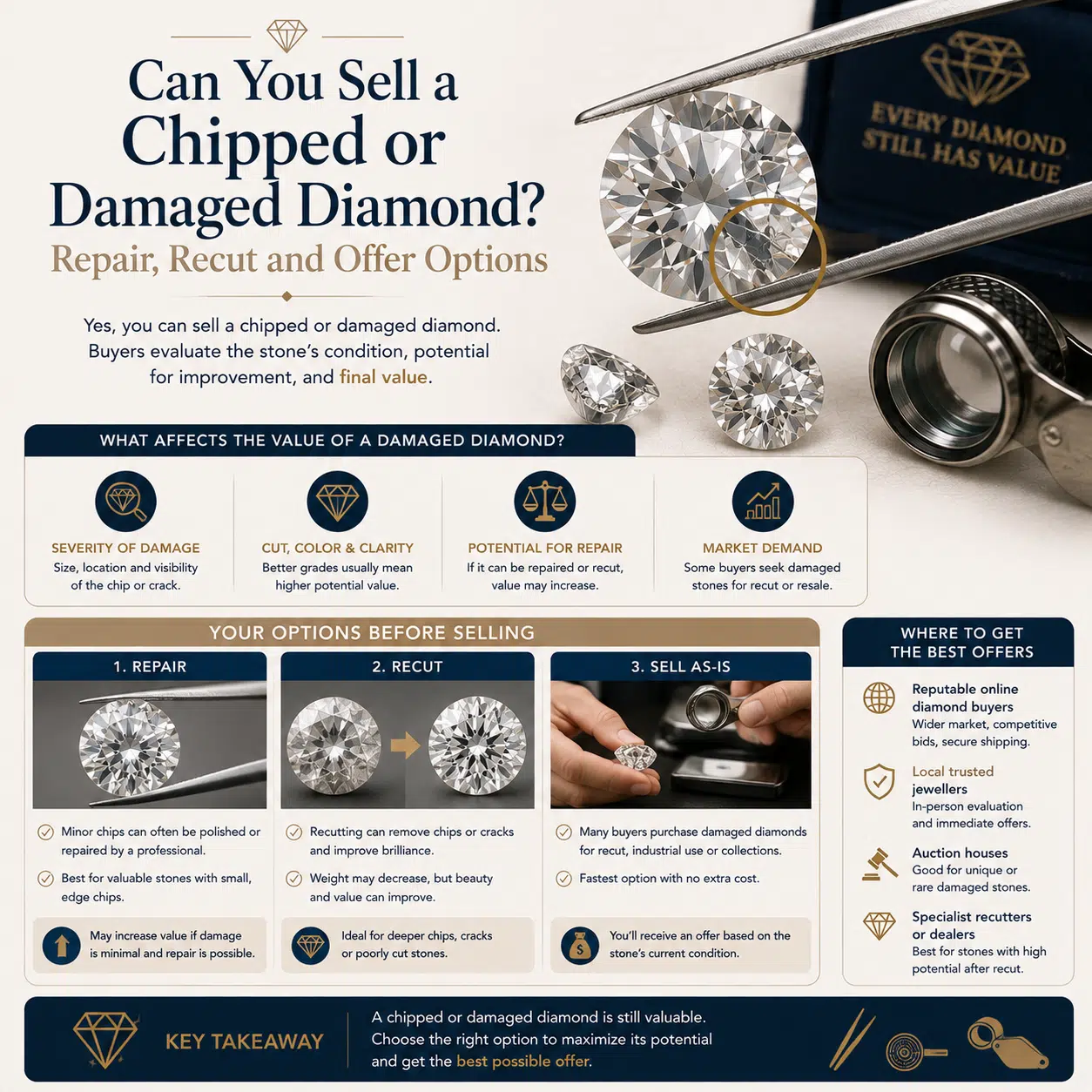
Un diamant ébréché ou endommagé peut toujours être vendu. L’offre dépendra de l’emplacement des dommages, de leur profondeur, de la solidité structurelle de la pierre et du poids utilisable qui pourrait être conservé après un repolissage ou une recoupe.
Une petite ébréchure près de la rondiste peut avoir un effet très différent d’une fracture qui traverse une grande partie du diamant. Dans certains cas, un tailleur peut éliminer la zone endommagée avec une perte de poids limitée. Dans d’autres, une recoupe rendrait le diamant beaucoup plus petit ou révélerait d’autres fragilités.
Ne faites pas réparer ou retailler la pierre avant d’avoir obtenu une estimation de sa valeur en l’état. Un spécialiste devrait comparer la valeur actuelle du diamant avec la valeur estimée, le coût et les risques de toute intervention proposée.
Réponse rapide : Peut-on vendre un diamant ébréché ?
Oui. Les acheteurs spécialisés peuvent s’intéresser aux diamants ébréchés, fracturés, abrasés ou autrement endommagés.
Une évaluation professionnelle doit déterminer le type et l’étendue des dommages, le poids et la qualité actuels du diamant, ainsi que la possibilité d’une recoupe commercialement rentable. Son origine naturelle ou synthétique, sa forme, sa couleur, sa pureté, son rapport d’expertise et la demande actuelle influenceront également l’offre.
Les trois principales options sont de vendre le diamant dans son état actuel, de repolir une petite zone endommagée ou de le retailler en un diamant plus petit. La meilleure option est celle qui permet d’obtenir le meilleur résultat net après prise en compte de la perte de poids, des coûts de taille et des risques — et pas nécessairement celle qui donne à la pierre l’apparence la plus neuve.
Demandez une estimation gratuite et sans engagement de votre diamant..
Les diamants sont durs, mais pas incassables
Le diamant est extrêmement résistant aux rayures, mais la dureté n’est pas la même chose que la résistance aux chocs. La ténacité décrit la capacité d’une pierre précieuse à résister à la casse, aux éclats ou aux fissures après un impact.
La structure cristalline du diamant comporte des directions selon lesquelles il peut se cliver plus facilement. Un choc violent à un endroit vulnérable peut donc provoquer des dommages, notamment près d’une rondiste fine, d’un angle pointu ou d’une inclusion atteignant la surface.
Les diamants en forme de poire, de marquise, de princesse et de cœur peuvent être particulièrement vulnérables au niveau de leurs pointes. Les diamants ronds et coussin n’ont pas de pointes, mais leur rondiste et les inclusions existantes peuvent tout de même être endommagées.
Un diamant peut également s’ébrécher lors du sertissage, du retrait, du port quotidien ou au contact d’un autre diamant.
What Kind of Damage Does the Diamond Have?
“Cracked diamond” is a common description, but several different features can create a cracked appearance.
| Damage or characteristic | What it generally means |
| Abrasion | Petites entailles ou traces d’usure le long des arêtes des facettes, pouvant parfois donner un aspect flou |
| Ébréchure | Ouverture superficielle causée par un dommage de surface, souvent près de la rondiste, du culasse ou de la jonction entre les facettes |
| Marque de choc | Point d’impact accompagné de petites plumes ressemblant à des racines sous la surface |
| Cavité | Ouverture angulaire résultant de la perte de matière ou de la chute d’un cristal atteignant la surface |
| Plume | Terme utilisé dans le commerce pour désigner une cassure ou une fissure interne, qui peut ou non atteindre la surface |
| Clivage ou fracture importante | Cassure plus grave pouvant présenter des problèmes de stabilité structurelle |
| Pierre desserrée | Mouvement causé par des éléments de sertissage endommagés ou usés, plutôt que par un dommage du diamant lui-même |
La saleté piégée sous la pierre, les reflets du sertissage et les inclusions normales peuvent également être confondus avec des fissures. Un diagnostic nécessite un examen à la loupe et une expertise professionnelle.
How Damage Affects Diamond Resale Value
Les dommages affectent la valeur en fonction de l’apparence, de la durabilité, du poids et de la facilité de commercialisation.
Une petite ébréchure dissimulée près d’une griffe peut avoir un effet visuel limité, mais l’acheteur doit tout de même tenir compte du risque que l’ébréchure s’étende lors du retrait, du nouveau sertissage ou de la recoupe.
Les dommages situés sous la table ou dans une position très visible lorsqu’on regarde la pierre de face peuvent être plus apparents. Une fracture profonde peut également rendre un futur acheteur réticent à porter ou à faire ressertir le diamant.
Le poids final potentiel après une recoupe est particulièrement important. Si l’élimination d’une ébréchure fait passer un diamant sous un seuil de poids en carats important, la perte de valeur peut être plus élevée que prévu.
L’acheteur tiendra également compte du diamant d’origine. Un gros diamant naturel présentant une couleur et une pureté recherchées peut justifier une recoupe spécialisée. Un petit diamant de laboratoire ou une pierre moins demandée peut ne pas prendre suffisamment de valeur pour couvrir le coût de l’intervention.
Une ébréchure est-elle différente d’une inclusion ?
Yes. An inclusion can form naturally inside the diamond, while a chip is surface damage that normally occurs after the stone has been cut.
However, the two can be connected. A surface-reaching feather near the girdle may make the diamond more vulnerable if that area receives a hard blow.
An older grading report may plot an inclusion that looks like damage to an untrained observer. Conversely, a chip that occurred after grading will not appear on the original report.
A specialist should compare the physical diamond with the report before assuming that a visible feature is new damage.
Le rapport de classification existant reste-t-il valable ?
A grading report remains useful for identifying the diamond and understanding its condition at the time of examination. It may no longer describe the stone’s current weight, clarity or measurements accurately if significant damage or recutting occurred later.
A minor chip may change the clarity assessment. Recutting will change the diamond’s weight, measurements and possibly its shape, cut, polish, symmetry or clarity grade.
After a material recut, a new report may be advisable for a diamond whose value justifies the expense. The buyer or cutter should discuss this before work begins.
Un diamant ébréché peut-il être réparé ?
A diamond cannot be healed in the way that metal can be soldered. The practical options involve changing its shape or hiding the damage.
A minor surface issue may be reduced through repolishing. A deeper chip may require partial or complete recutting. In a mounted diamond, a jeweller might reposition a prong or choose a protective setting, but this does not remove the underlying damage.
Fracture filling can make certain surface-reaching fractures less visible by introducing a glass-like material. It does not heal the diamond or improve its underlying structural condition. The treatment is not considered permanent, can be affected by heat and cleaning, and must be disclosed. GIA does not issue its standard grading reports for fracture-filled diamonds.
Fracture filling is therefore not a shortcut that restores an untreated diamond’s resale position.
Repolissage ou recoupe
Repolishing is the lighter intervention. It may remove abrasion, small scratches or very minor edge damage while preserving most of the original shape and weight.
Partial recutting changes one or more areas of the diamond to remove a localised chip. The finished stone may retain its general shape but lose weight or symmetry.
A full recut can create a substantially different diamond. It may improve appearance or remove serious damage, but it can also reduce carat weight, change the shape and require a new grading report.
The cutter should provide an estimated finished weight and explain whether the damage might extend farther than it appears. An estimate is not a guarantee because hidden features can become important once cutting begins.
Should You Recut the Diamond Before Selling?
Not automatically. Obtain both an as-is assessment and a recutting opinion first.
The basic commercial comparison is:
Expected value after recutting, minus cutting, grading, removal, resetting and insurance costs, compared with the strongest as-is offer.
Risk must also be considered. The diamond could finish below the predicted weight, reveal additional fractures or move below a commercially important carat threshold.
For example, a damaged diamond weighing slightly above one carat may require enough material removal to finish below one carat. Even if the resulting stone looks cleaner, the change in weight category can limit the financial benefit.
A reputable buyer may prefer to assume the cutting risk and purchase the stone as-is. That option can give the seller greater certainty.
When Recutting May Be Worth Considering
Recutting may make commercial sense when the diamond is large enough to retain a desirable finished weight, the damaged area is removable and the improvement in marketability is expected to exceed the costs.
It can also be considered when a chip threatens continued wear and the owner intends to keep the diamond rather than sell it.
A recut becomes less attractive when the stone is small, the damage extends deeply, the final weight is uncertain or the diamond has limited resale demand. Antique and fancy-colour diamonds require additional caution because recutting can remove historical character or change the face-up colour.
Should the Diamond Be Removed From Its Setting?
Have the complete ring examined first. A mounted inspection may reveal whether the damage is visible, whether the setting is secure and whether removal presents additional risk.
An improvised removal can enlarge a chip or cause a vulnerable diamond to break. If removal is necessary, it should be completed by an appropriately experienced professional under agreed insurance and responsibility terms.
The setting may also contribute value through its precious metal, side stones, craftsmanship or brand. Selling the centre diamond separately without evaluating the complete ring could overlook part of the item’s value.
What to Do Immediately After Discovering Damage
Stop wearing the jewellery until it has been examined. Continued movement inside a damaged setting can worsen a chip or cause the stone to fall out.
Place the ring or diamond in a small, padded container and keep it separate from other jewellery. Avoid ultrasonic or steam cleaning until a specialist has checked the damage and determined whether any treatments are present.
Take clear photographs and locate the grading report, invoice, appraisal and insurance policy. If the damage may be insured, contact the insurer before authorising removal, repair, recutting or sale. Altering the diamond first could affect the claim process.
Selling Options for a Damaged Diamond
A direct sale in the current condition is often the simplest option. The buyer assesses the damage, estimates the possible recut and incorporates the risk into the offer.
Repolishing or recutting before sale may improve the outcome when the expected benefit is clear and the cutter is appropriately experienced. All costs and risks remain with the owner unless another arrangement is documented.
Auction or consignment may suit an exceptional diamond or valuable signed piece, but damage must be disclosed. A general gold buyer may value the setting while failing to assess the centre diamond’s remaining potential.
When comparing offers, ask whether the buyer plans to keep, recut or dismantle the item and whether the quoted amount includes the setting and side stones.
Illustrative Examples
These examples are fictional and show how different damage can produce different decisions.
A Small Girdle Chip
A natural round diamond has a shallow chip near the girdle. A cutter believes it can be removed with modest weight loss, but the diamond would finish just below a major carat threshold.
The seller compares the lower post-recut weight and associated costs with an as-is purchase offer. Selling without recutting provides the better net result.
A Chipped Point on a Pear Shape
A pear-shaped diamond has damage at its point. Repair would shorten the outline and require new proportions.
Because the diamond is large enough to retain a marketable size, specialist recutting may improve its appearance and durability. The decision is made only after receiving an estimated finished weight.
A Fractured Diamond in a Branded Ring
A centre diamond has a visible fracture, but the signed platinum ring and side stones also hold value.
The complete piece is assessed before removal. The offer accounts for the damaged diamond, brand, setting and smaller stones rather than treating the ring only as scrap metal.
How to Request an Accurate Offer
Submit clear photographs of the complete jewellery and close images of the suspected damage. Include the grading report and explain when the damage was noticed.
Do not attempt to assign a new clarity grade from photographs. The buyer needs to inspect the feature’s type, depth, position and relationship to existing inclusions.
Ask for an explanation of the as-is offer and whether recutting could materially change it. If cutting is recommended, request the expected finished weight, shape, costs and responsibility for accidental loss.
Foire aux questions
Can a chipped diamond still have value?
Yes. Its remaining value depends on its origin, size, quality, damage and recutting potential.
Can you sell a cracked diamond?
Potentially. “Crack” can describe anything from a feather to a major structural break, so professional identification is required.
Can a diamond chip even though it is the hardest gemstone?
Yes. Hardness measures resistance to scratching, not resistance to breaking. A diamond can chip when struck in a vulnerable direction.
Where do diamonds most commonly chip?
Damage frequently occurs around girdles, pointed corners, culets and areas containing surface-reaching inclusions.
Does a chip lower the clarity grade?
It can. The effect depends on the chip’s size, position and visibility.
Can a jeweller hide a chip under a prong?
A protective setting may reduce visibility and help protect the area, but it does not repair the diamond. The damage should still be disclosed.
Can fracture filling repair a cracked diamond?
It can make a fracture less visible, but it does not heal the break. The treatment is not permanent and affects grading and resale.
Will GIA grade a fracture-filled diamond?
GIA states that it does not grade diamonds containing fracture-filling material.
How much weight will a diamond lose when recut?
There is no standard amount. Weight loss depends on the shape, position and depth of the damage and the intended finished cut.
Can a recut improve the diamond’s clarity?
Removing a chip or inclusion may improve the resulting clarity, but the finished diamond will weigh less and the outcome is not guaranteed.
Should I make an insurance claim before selling?
If the damage may be covered, contact the insurer before altering or selling the diamond. Policy conditions and documentation requirements vary.
Can Sothis Diamonds assess a damaged diamond?
Yes. Chipped and damaged diamonds can be submitted for an initial review, subject to physical inspection and Sothis Diamonds’ current buying criteria.
Dernières réflexions
A damaged diamond is not automatically unsellable, and recutting is not automatically the best solution.
The correct decision depends on what the damage is, how far it extends and what the diamond could become after material is removed. A small chip may allow a practical repolish, while a deeper fracture could make a recut risky or uneconomic.
Start by obtaining an as-is assessment. Compare that offer with the predicted net value after any proposed work, and do not authorise an irreversible recut without understanding the likely finished weight.
Demandez une estimation gratuite et sans engagement de votre diamant..
