


How to Read and Verify a Diamond Grading Report Before Selling

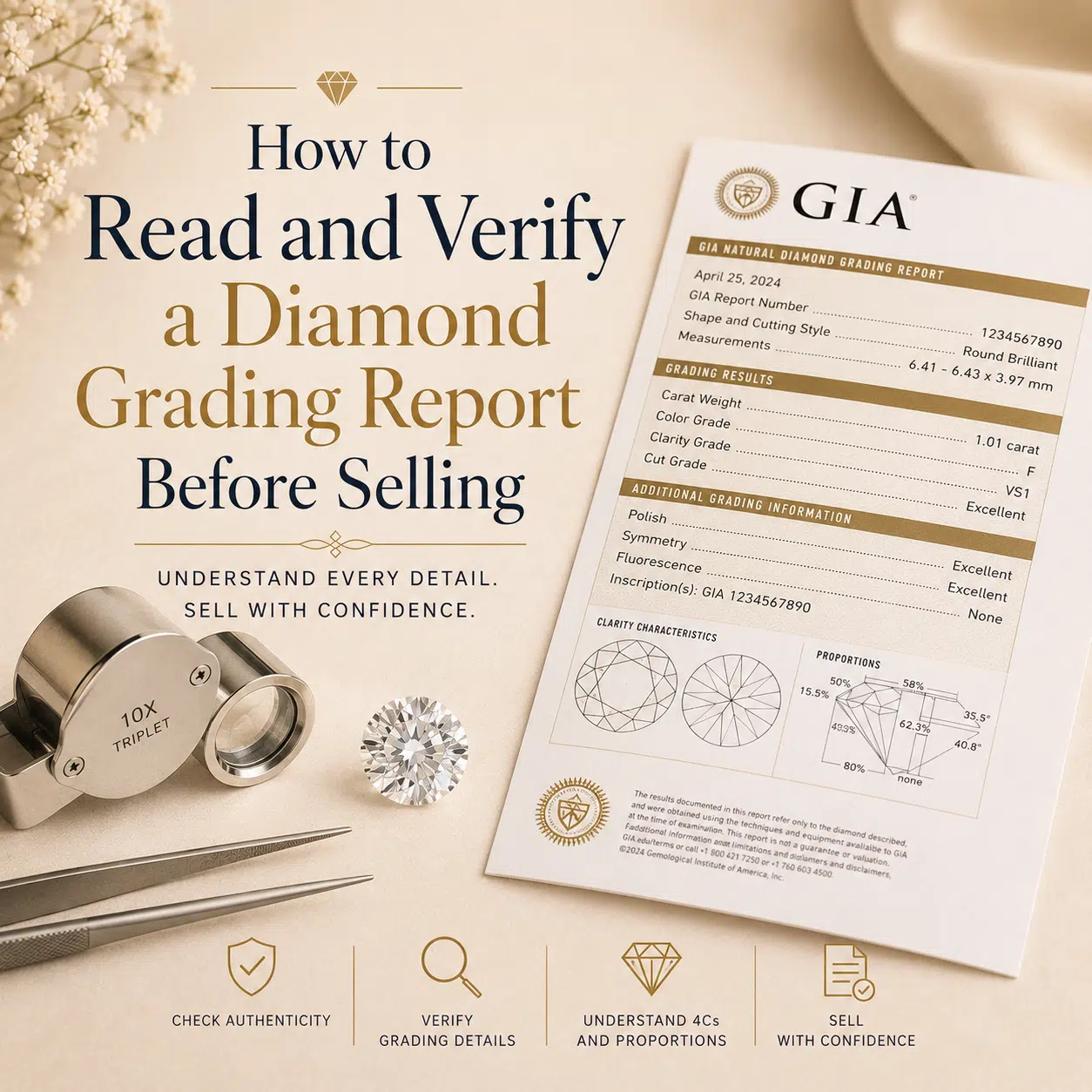
A diamond grading report contains much more than the four headline grades. It can identify whether the stone is natural or laboratory-grown, record its measurements and document characteristics that affect its appearance, marketability and resale value.
Before selling, you should verify that the report exists in the issuing laboratory’s official database. You must then establish that the physical diamond is the same stone described in that record.
These are separate checks. A genuine report number proves that a laboratory record exists. It does not prove that the ring or loose stone in front of you matches that report.
Shape, measurements, carat weight, clarity characteristics and any laser inscription can help connect the document with the diamond. Physical inspection is also needed to confirm that the stone has not been chipped, repolished, recut or treated since grading.
Quick Answer: How Do You Check a Diamond Certificate?
Find the issuing laboratory and unique report number on the document. Enter that number directly into the laboratory’s official report-verification website and compare the returned information with the paper or digital report.
Check the diamond’s natural or laboratory-grown description, shape, carat weight, measurements, colour, clarity, cut information and grading date. Any discrepancy should be investigated.
The physical diamond must then be matched to the record. A professional can inspect the laser inscription, measurements and clarity characteristics.
Do not rely only on a QR code, screenshot or report number. An authentic report can still be presented with the wrong diamond.
Diamond Certificate vs Diamond Grading Report
People commonly ask how to read a diamond certificate, but “grading report” is usually the more accurate term.
A grading report records findings from a laboratory examination. Depending on the service, it may describe the diamond’s origin, weight, quality characteristics, measurements, finish, fluorescence and known treatments.
It is not generally a guarantee of future value. It does not require a buyer to pay a specific amount, and it does not prove ownership.
An insurance appraisal, purchase invoice or jeweller’s valuation serves a different purpose. Those documents may contain a monetary figure, but they do not necessarily provide an independent laboratory grade.
Begin by Identifying the Issuing Laboratory
The report should clearly state which organisation examined the diamond. GIA, IGI and HRD Antwerp are examples of laboratories whose reports are commonly encountered in international diamond markets.
Check the exact name and official domain rather than trusting a similar-looking logo. Fraudulent documents can imitate laboratory branding.
Use the laboratory’s official website to access its report-check service. Type the address yourself or reach it through a trusted search result instead of depending exclusively on a QR code printed on an unfamiliar document.
Different laboratories use different terminology and formats. Read the scale and explanations printed on the report rather than assuming that every abbreviation has the same meaning.
Our separate guide compares GIA, IGI and HRD diamond reports.
Identify the Exact Report Type
A laboratory may offer several document types. A full natural-diamond grading report, dossier, digital report, jewellery report, coloured-diamond report and laboratory-grown assessment do not necessarily contain the same information.
Some reports contain a detailed clarity plot. Compact formats may not. Some services include a laser inscription, while others make it optional.
A loose-diamond report can normally provide more precise weight and measurements because the entire stone is accessible. A jewellery report may describe a mounted item within the physical limitations created by its setting.
Understanding the report type prevents you from treating an omitted field as evidence that the document is incomplete or false.
How to Read the Main Fields on a Diamond Report
Although layouts differ, these are the principal fields likely to affect identification and resale assessment.
| Report field | What it means | What to check before selling |
| Le numéro du rapport | Unique reference assigned by the laboratory | Confirm it through the laboratory’s official database |
| Report date | Date the diamond was examined | Consider whether damage, treatment or recutting occurred later |
| Description or origin | States whether the diamond is natural or laboratory-grown | Do not confuse growth origin with geographic mine origin |
| La forme et le style de taille | The outline and facet arrangement | Confirm the physical diamond has the same shape |
| Mesures | Dimensions recorded in millimetres | Compare with professional measurements of the stone |
| Le poids en carats | Exact weight of the loose diamond | Mounted stones cannot normally be weighed precisely without removal |
| La gradation de couleur | Position on the applicable colour scale | Check the laboratory, scale and whether the colour is natural or treated |
| La gradation de pureté | Assessment of inclusions and blemishes | Review the plot and comments where available |
| La qualité de taille | Overall cut assessment where applicable | Confirm whether the shape is eligible for that grading system |
| Polijsting en symmetrie | Quality of facet surfaces and alignment | Check for later wear, damage or repolishing |
| Fluorescence | Reaction to long-wave ultraviolet light | Consider intensity, colour and the diamond’s actual transparency |
| Comments and treatments | Additional information not captured by the headline grades | Read every comment before estimating value |
| L’inscription laser | Microscopic number or wording on the girdle | Have it compared with the report under magnification |
The report must be interpreted as one connected description. No single field establishes authenticity or value by itself.
How to Use the Diamond Report Number
The diamond report number is the starting point for verification.
Enter it exactly as printed, including any leading zeros, letters or separators required by the laboratory. A typing error can produce a false “not found” result.
The online record should display information corresponding with the report. Compare the carat weight, shape, colour, clarity, measurements and date instead of stopping when the number produces a result.
A report number is not a serial number proving ownership. It identifies a laboratory record associated with an examined item.
How to Verify a GIA Report
Open GIA’s official Report Check service and enter the report number.
Compare the online result with every major field on the document. The report type, issue date, shape, measurements, carat weight, colour, clarity and cut-related information should correspond.
Some GIA services provide a downloadable digital report or additional images. Available features depend on the report type and date.
If the record differs from the document, stop and investigate. Do not assume that a paper containing a valid GIA number is authentic simply because the number exists.
How to Verify an IGI Report
Use IGI’s official report-verification page and enter the unique report number. Some reports may also contain a QR code, but the official database should remain the reference point.
Compare the returned record with the report’s description, shape, measurements and 4Cs information.
Confirm whether the report describes a natural diamond, laboratory-grown diamond or complete jewellery item. Those categories must not be treated as interchangeable.
Where a laser inscription is stated, it can support physical matching under magnification.
How to Verify an HRD Antwerp Report
Use HRD Antwerp’s official report-check service and enter the report number shown on the document.
Review the returned report data and compare it with the physical document. Pay attention to the colour and clarity scales because HRD terminology can differ from that used on another laboratory’s report.
Confirm whether the report covers a natural diamond, laboratory-grown diamond, coloured diamond or jewellery item.
If the record cannot be located, check the number carefully and contact the laboratory or a qualified professional before concluding that the document is false.
Why Online Verification Is Not Enough
Online verification confirms that a laboratory has a record under that number. It does not prove that the stone being offered is the diamond described.
A genuine report can be copied. Its number can also be inscribed fraudulently onto another stone or placed on an imitation document.
The buyer should match the physical diamond using several characteristics. Shape, measurements, weight, clarity features and inscription provide stronger evidence when considered together.
For a valuable diamond, specialist origin and treatment testing may also be required. Visual inspection alone cannot always distinguish a natural diamond from a laboratory-grown diamond or detect sophisticated treatments.
How to Read the Report Date
The report date shows when the laboratory examined the diamond. It is not an expiry date.
A diamond’s inherent carat, colour and clarity characteristics are generally stable, but its physical condition can change. The stone may be chipped, abraded, repolished or recut after grading.
Treatments may also have been applied after the original examination. A setting can be changed, and the report may become separated from the item it originally described.
An older report can still be useful when it is authentic and matches an unchanged stone. Physical inspection determines whether its description remains accurate.
Natural vs Laboratory-Grown Description
One of the most important report fields is the description of the diamond’s growth origin.
The document should indicate whether the laboratory identified the stone as natural or laboratory-grown. Never infer origin from appearance, price or a seller’s verbal statement.
A laboratory-grown diamond is a real diamond, but it participates in a different resale market from a natural diamond.
“Natural” in this context does not necessarily identify the country or mine where the diamond originated. Geographic origin requires specific evidence and, in some cases, a dedicated origin-report service.
How to Read Shape and Cutting Style
Shape describes the diamond’s face-up outline, such as round, oval, cushion, emerald, pear, radiant or marquise.
Cutting style describes the arrangement of facets. A report might use descriptions such as round brilliant, oval brilliant or emerald cut.
The physical diamond should clearly correspond with this field. A report for a round brilliant cannot belong to an oval stone even if the carat, colour and clarity appear similar.
For unusual or antique cuts, the description may differ from everyday jewellery terminology. A professional can explain how the laboratory classified the stone.
How to Read Diamond Measurements
Diamond measurements are recorded in millimetres.
A round diamond is normally described using its minimum diameter, maximum diameter and depth. Fancy shapes are generally recorded through length, width and depth.
Measurements help distinguish one stone from another and reveal how the carat weight is distributed. Two one-carat diamonds can have different face-up dimensions.
A mounted diamond can be measured approximately, but the setting may obstruct the girdle or pavilion. Small tolerances are possible, so professional interpretation is important.
A substantial measurement mismatch is a warning sign that the report may not belong to the stone.
How to Read Carat Weight
Carat is a measure of weight. One metric carat equals 0.20 grams.
Laboratories weigh loose diamonds using precise equipment. A report might record 0.99, 1.00, 1.01 or another exact weight.
A mounted diamond cannot normally be weighed separately without professional removal. An appraiser may estimate its weight from measurements, but that estimate is not equivalent to a laboratory weighing.
Do not remove a diamond merely to confirm carat weight before obtaining professional advice. The setting may have independent brand, antique or craftsmanship value.
How to Read Diamond Colour Grade
For natural diamonds in the standard colour range, D represents colourless, with increasing traces of yellow, brown or grey towards Z.
Each letter represents a narrow range rather than an exact point. The report’s laboratory and scale must be considered when interpreting the grade.
Fancy-colour diamonds use a separate system involving colour hue, intensity and distribution. A Z-colour diamond should not automatically be described as Fancy Yellow.
The report comments should be checked for colour treatment. A treated diamond should not be compared directly with a naturally coloured diamond based only on appearance.
Read our guide to how colour grade affects diamond resale value.
How to Read Diamond Clarity Grade
Clarity evaluates the relative absence of internal inclusions and surface blemishes.
The GIA scale ranges from Flawless through Internally Flawless, VVS, VS and SI to Included grades. Other laboratories may use different abbreviations, so consult the scale on the report.
Clarity is assessed under controlled conditions and magnification. An SI diamond may appear clean without magnification, while another stone with the same grade may contain a more visible inclusion.
The plot and report comments can explain why the grade was assigned. The physical inclusion appearance and current condition still require examination.
Our detailed guide explains how clarity and inclusions affect diamond resale value.
How to Read the Clarity Plot
A clarity plotting diagram maps important internal and external characteristics.
On many GIA plots, red symbols indicate internal characteristics, while green symbols represent external features. Always use the legend printed on the report because colours and symbols can vary by laboratory.
The plot can help identify the diamond because no two stones are expected to have the same pattern of characteristics in precisely the same positions.
A plot is not always a complete microscopic map. Some characteristics may be described in comments, and some compact report types may omit the plot entirely.
Professional matching requires the plotted features to be located in the physical diamond under magnification.
How to Read the Cut Grade
Cut grade evaluates aspects of a diamond’s proportions, light performance and workmanship where an applicable grading system exists.
On a standard GIA report, an overall cut grade applies to qualifying round brilliant diamonds in the D-to-Z range. Fancy shapes do not receive that same overall GIA cut grade.
Do not assume that an oval or emerald diamond is poorly cut because the field is absent. Its proportions, polish, symmetry, outline and appearance must be evaluated differently.
Similarly, the word “Excellent” should be interpreted within the issuing laboratory’s system rather than treated as a universal guarantee.
Read more about how cut grade affects diamond resale value.
How to Read Polish and Symmetry
Polish describes the quality and condition of the facet surfaces. Symmetry describes the precision of the outline and facet arrangement.
These grades commonly range from Excellent to Poor, although terminology can vary.
A diamond with Excellent cut may have Very Good polish or symmetry. Triple Excellent means that the overall cut, polish and symmetry grades are all Excellent on an applicable round-brilliant report.
Current condition matters. Abrasion or later repolishing may mean an old report no longer fully describes the stone.
How to Read Fluorescence
Fluorescence describes the diamond’s reaction to long-wave ultraviolet light.
Common intensity descriptions include None, Faint, Medium, Strong and Very Strong. Blue is the most frequently encountered fluorescence colour.
Fluorescence does not change the laboratory colour grade. Its effect on appearance and market demand can be positive, negative or neutral depending on the diamond.
Strong fluorescence does not automatically mean the stone is hazy. Transparency must be examined physically.
Our guide to fluorescence, polish and symmetry resale value explains these characteristics further.
How to Read the Proportions Diagram
A proportions diagram shows information about the diamond’s physical design.
Depending on shape and report type, it may include table percentage, total depth, crown angle, pavilion angle, girdle thickness and culet information.
These numbers help a buyer understand weight distribution and potential appearance. They should not be interpreted independently.
There is no single measurement that proves a diamond is beautifully cut. The angles, percentages, finish and physical appearance work together.
Why the Girdle Description Matters
The girdle forms the outer edge between the crown and pavilion.
A very thin area may be more vulnerable to damage, while a very thick girdle can retain weight without increasing face-up size. Girdle thickness can also vary around the stone.
The laser inscription, when present, is generally placed on the girdle. A setting may conceal it.
The girdle description contributes to cut and durability assessment but does not determine value alone.
How to Read Culet Information
The culet is the small facet or point at the bottom of the pavilion.
Many modern diamonds have no culet or a very small one. Larger culets can be intentional in antique diamonds and may be visible face-up.
A large culet does not automatically indicate damage. In an old European or old mine diamond, it may be part of the historical cutting style.
The buyer should interpret it according to the diamond’s age, shape and market.
Why Report Comments Are Important
Report comments can disclose information not fully represented in the headline grades or plotting diagram.
They may refer to laser inscriptions, treatments, internal graining, clouds, clarity characteristics not shown, additional facets or other identifying observations.
A comment can materially affect resale interpretation. Never submit only a cropped image of the 4Cs.
Upload every page and keep the comments legible. A buyer should explain any value adjustment based on a report comment.
How Treatments Appear on a Report
Appropriate laboratory reports may disclose detected colour or clarity treatments according to the laboratory’s policies.
Examples include laser drilling, HPHT processing, irradiation or other treatment. Fracture-filled and coated diamonds may require different report services or identification documents.
Treatment information can appear in the description, results or comments. It should never be hidden when requesting an offer.
A natural diamond with treated colour is not equivalent to an untreated natural diamond of similar visible colour.
How to Check a Laser Inscription
A laser inscription is microscopic wording or a number placed on the diamond’s girdle.
It is not normally visible without magnification. A professional can rotate the diamond under a loupe or microscope to locate and read it.
Compare the inscription exactly with the report and official online record. The measurements and other identifying characteristics should also match.
A missing inscription does not automatically invalidate a report because not every report service includes one. A setting can also hide part of the girdle.
Why an Inscription Alone Cannot Prove Identity
A report number can be copied or fraudulently inscribed.
The inscription must therefore be supported by the correct shape, measurements, quality characteristics and, where available, clarity plot.
Professional verification may also include testing the material and confirming whether it is natural or laboratory-grown.
Treat the inscription as one useful identifier—not as complete proof.
Paper Reports vs Digital Reports
Some laboratories issue paper reports, while others provide digital-only documents for certain services.
A digital report is not automatically less legitimate. Its authenticity depends on whether it is available through the issuing laboratory’s official system and matches the diamond.
A paper report is not automatically genuine. Printing quality, logos and security features can be imitated.
The official database and physical diamond match are more important than whether the document is printed.
Security Features on a Paper Report
Laboratory reports may include holograms, microprinting, security screens, specialised paper or other anti-counterfeit features.
These features vary by laboratory, report type and issue date. Do not reject an older document because it lacks a feature used on newer reports.
Security features can support authenticity, but they should not replace online verification.
If the document appears altered, has inconsistent fonts or contains information that differs from the online record, request professional review.
What If the Report Number Cannot Be Found?
First, re-enter the number carefully. Check for leading zeros, letters, spaces or confusion between similar characters.
Confirm that you are using the correct laboratory’s official verification service. A number from an appraisal or retailer is not necessarily a laboratory report number.
Older reports or unusual services may require direct contact with the issuing laboratory.
Until the document is verified, treat its grades as unconfirmed. Do not advertise the diamond using unsupported laboratory claims.
What If the Online Record Differs From the Paper?
Stop the transaction until the discrepancy is explained.
A minor formatting difference may result from an updated digital presentation, but the identifying and grading data should correspond.
Differences in carat, shape, measurements, colour or clarity are significant. The paper could be altered, paired with the wrong report number or associated with another diamond.
Contact the laboratory or obtain independent professional inspection before proceeding.
How to Match Measurements With a Mounted Diamond
A professional can often estimate or partially measure a mounted diamond, but metal may obstruct some dimensions.
The reported shape and visible measurements should still be broadly consistent. A large mismatch is not explained simply by the setting.
Exact weight cannot normally be confirmed while the diamond remains mounted. If removal becomes necessary, it should be performed professionally after evaluating the setting.
Do not damage a branded or antique ring merely to conduct a check that may be completed through other identifying characteristics.
How to Match a Clarity Plot With the Diamond
A gemologist uses magnification to locate the inclusions and blemishes represented on the report.
The position, type and relationship of these characteristics can create an identifying pattern. A central crystal, feather near the girdle or group of pinpoints may support the match.
The process requires skill because facet reflections can make one inclusion appear multiple times.
A plot mismatch can indicate the wrong diamond, later recutting or an incomplete interpretation. It should be investigated rather than ignored.
Does the Report Still Apply After Recutting?
Usually not in its original form.
Recutting can change carat weight, measurements, shape, cut, polish, symmetry and clarity. The laser inscription may also be removed.
Even limited repolishing can alter dimensions or surface characteristics.
A diamond that has undergone material alteration may require an updated report before the old grades are used in a sale.
Does the Report Still Apply After Damage?
It can remain useful for identification, but it may not describe current quality accurately.
A new chip can affect clarity, weight and durability. Abrasion may change polish or condition.
The buyer should distinguish between an authentic historical report and the stone’s present state.
Any offer adjustment should be based on the actual damage and likely repair consequences.
Grading Report vs Insurance Appraisal
A grading report describes gemological characteristics. An insurance appraisal generally estimates replacement value.
The appraisal figure may be substantially different from the amount available through resale. It can also include the setting, taxes, retail margins and replacement considerations.
A grading laboratory does not normally state what a buyer must pay.
When selling, the relevant figure is the current market offer for the verified diamond or jewellery—not the insurance replacement amount.
Grading Report vs Purchase Receipt
A receipt shows what someone paid at a particular time and may help establish provenance.
It does not prove current value, condition or grading accuracy. The retail price may include taxes, design, brand, store costs and services.
The grading report provides more useful quality information, but it also does not establish resale value alone.
Submit both documents when available, but understand their different purposes.
Does a Grading Report Prove Ownership?
No. A report follows the diamond’s identifying characteristics, not the identity of its legal owner.
A seller may still need identification, proof of ownership, inheritance information or other transaction documents.
A report number should never be treated as authority to sell an item.
Read our guide to documents needed to sell a diamond.
Does a Verified Report State the Diamond’s Resale Value?
No. Verification confirms the report record and helps identify the diamond.
The buyer must still calculate value using the verified grades, physical condition, origin and current demand.
Two diamonds with the same grades can receive different offers because of inclusion appearance, proportions, shape, fluorescence or condition.
Our pillar guide explains how diamond buyers calculate an offer.
Illustrative Example: Valid Number, Wrong Measurements
Imagine a fictional report for a 1.01-carat round diamond measuring approximately 6.4 millimetres across.
The online record is genuine, but the diamond presented with it measures significantly less and has different proportions.
The valid report number does not resolve the mismatch. The buyer should stop and determine whether the wrong stone or document has been supplied.
Illustrative Example: Correct Report, Later Chip
Consider a fictional oval diamond with a genuine, verifiable report.
The measurements and inscription match, but physical inspection reveals a chip near one end that is not documented on the older report.
The report still helps identify the diamond, but the final offer must account for current condition, possible repair and weight-loss risk.
Illustrative Example: A Hidden Inscription
Imagine a diamond ring whose verified report states that the girdle carries a laser inscription.
The inscription cannot be seen because a prong covers that part of the girdle. This does not automatically prove a mismatch.
A professional may use measurements and clarity characteristics first. Removal should only be considered if required for the final verification.
Illustrative Example: Natural vs Laboratory-Grown Confusion
Suppose a seller uploads a report and describes the diamond as natural.
The document’s description actually states that the stone is laboratory-grown. The carat, colour and clarity fields cannot be used to value it as a natural diamond.
The origin field must be read before any price comparison is made.
Illustrative Example: A Missing Clarity Plot
A compact report contains colour, clarity, carat and measurements but no plotting diagram.
The absence of a plot does not automatically make the report invalid. The selected service may not include one.
The buyer can use the report number, inscription, measurements and physical examination to establish whether the diamond matches.
Preparing a Report for an Online Valuation
Scan or photograph the complete report in clear, neutral light. Include every page, comment, scale, barcode and report number.
Do not obscure the characteristics required for verification. You can remove unrelated personal information from invoices or appraisals before uploading them.
Photograph the diamond or complete jewellery item from the front, side and underside. Include the inside of the band if it contains hallmarks, serial numbers or signatures.
An online review can establish useful preliminary information. A final offer may still require physical verification.
Foire aux questions
How do I check whether a diamond certificate is real?
Verify the report number through the issuing laboratory’s official website and compare the record with both the document and physical diamond.
Where is the diamond report number?
It is normally printed prominently near the top of the report. Its position depends on the laboratory and document format.
Is the report number the same as a serial number?
It identifies the laboratory record. It does not prove ownership or automatically identify the jewellery setting.
Can I verify a GIA report for free?
GIA provides an official online Report Check service for report verification.
Can I verify an IGI report online?
Yes. IGI provides an official report-verification service.
Can I verify an HRD report online?
Yes. HRD Antwerp provides an official report-check service for supported reports.
Does a valid report number prove my diamond is genuine?
No. It proves the record exists. The physical diamond must still match it.
Can a fake diamond have a genuine report number?
A valid number could be copied or fraudulently inscribed onto another material or stone. Professional matching is essential.
Can someone copy a diamond certificate?
A document or number can be copied. That is why database and physical verification are both required.
Should I trust a report QR code?
Use it cautiously and confirm that it leads to the laboratory’s official domain. You can also type the official address manually.
Is a screenshot of a report enough?
No. Verify the number independently and request the complete document.
Is a digital diamond report genuine?
It can be. Some laboratory services are digital-only. Verify it through the official database.
Is a paper certificate automatically genuine?
No. Paper documents can be altered or counterfeited.
What information should match the online report?
The report type, date, shape, measurements, carat, colour, clarity and other grading fields should correspond.
What if one field does not match?
Stop and investigate. A material discrepancy may indicate an altered document or mismatched diamond.
Can two diamonds have the same carat, colour and clarity?
Yes. Those grades alone cannot prove identity.
Can two diamonds have identical measurements?
They can have similar measurements. Clarity characteristics and inscriptions provide additional identification.
Is a laser inscription visible without magnification?
Usually not. It is normally read using a loupe or microscope.
Where is the laser inscription?
It is generally placed on the diamond’s girdle.
Does every certified diamond have a laser inscription?
No. Availability depends on the laboratory, report type and selected service.
Can a setting hide the inscription?
Yes. A prong or bezel may cover part of the girdle.
Can a laser inscription be removed?
Repolishing or recutting can remove or alter an inscription.
Does an inscription guarantee the diamond’s value?
No. It helps with identification but does not state monetary value.
Can a report be verified without an inscription?
Yes. Measurements, weight, shape and clarity characteristics can also support matching.
What does the report date mean?
It is the date the laboratory examined the diamond. It is not necessarily an expiry date.
Do diamond grading reports expire?
They do not usually have a simple expiry date, but condition or report relevance can change.
Is a twenty-year-old GIA report still useful?
Potentially. It should be verified and the diamond’s current condition should be inspected.
Should I update an old report before selling?
Not automatically. Obtain an initial assessment and compare the expected benefit with the fee, time and risk.
What does “natural diamond” mean on the report?
It means the laboratory identified the examined stone as naturally formed rather than laboratory-grown.
Does natural origin identify the mine?
No. Geographic origin requires separate evidence or a specialised origin-report service.
How can I tell whether the report is for a lab-grown diamond?
Read the description and report title. Do not infer origin from the 4Cs alone.
Can natural and lab-grown reports look different?
Yes. Laboratories may use distinct formats or terminology to differentiate them.
What does carat mean?
Carat measures weight. One carat equals 0.20 grams.
Can I confirm exact carat weight while the diamond is mounted?
Normally not without professional removal. Measurements can only support an estimate.
What do the three diamond measurements mean?
For a fancy shape, they generally represent length, width and depth. A round normally uses minimum diameter, maximum diameter and depth.
Why do two one-carat diamonds have different measurements?
Carat measures weight, and that weight can be distributed differently through the diamond.
What does D colour mean?
D is the highest colourless grade on the standard D-to-Z scale.
Is Z a fancy-yellow diamond?
No. Z remains within the D-to-Z range. Fancy colour uses a separate grading system.
What does VS2 clarity mean?
It indicates minor inclusions within the relevant grading system. Actual inclusion type and position still matter.
What is a clarity plot?
It is a diagram mapping important inclusions and blemishes.
Does every report include a clarity plot?
No. Some compact or digital report types may omit it.
Does the clarity plot show every inclusion?
Not necessarily. Some characteristics may be described in comments or omitted from the simplified plot.
What do red and green marks mean on a GIA plot?
Red commonly represents internal characteristics and green represents external features. Always check the printed legend.
Can a clarity plot identify a diamond?
It can support identification when its characteristics are matched under magnification.
What does Excellent cut mean?
It is the highest grade within an applicable cut-grading system. It does not guarantee a particular resale value.
Why does my oval report have no cut grade?
Standard GIA reports do not assign the same overall cut grade to fancy shapes such as oval.
What are polish and symmetry?
Polish assesses facet-surface quality, while symmetry assesses outline and facet alignment.
What is Triple Excellent?
It describes a qualifying round brilliant with Excellent cut, polish and symmetry.
What does None fluorescence mean?
It means the reaction falls within the laboratory’s None category under its standard testing conditions.
Is Strong fluorescence bad?
Not automatically. Transparency, body colour and actual appearance must be evaluated.
What is the proportions diagram?
It records measurements and relationships such as table, depth, crown, pavilion, girdle and culet where applicable.
What does a thick girdle mean?
It indicates greater thickness around the diamond’s outer edge. Its effect depends on the complete proportions.
What does “culet: none” mean?
It means there is no additional flat facet of reportable size at the pavilion’s bottom.
Why are report comments important?
They can disclose treatments, inscriptions, graining or characteristics not fully shown elsewhere.
Where are treatments listed?
They may appear in the description, grading results or comments, depending on the laboratory and report.
Can a treated diamond still have a report?
Some treated diamonds can receive an appropriate report, while others may receive an identification document rather than a standard grading report.
Does a certificate show the diamond’s price?
A grading report normally does not state current resale value.
Is the price on my appraisal the resale value?
Usually not. Insurance appraisals generally estimate replacement cost.
Does a purchase receipt prove current value?
No. It shows a historical transaction, not present market value.
Does a grading report prove I own the diamond?
No. Ownership and authority to sell require separate evidence.
What if the paper report is lost?
The online record may still be available. A buyer can also assess a diamond without the original report.
Puis-je vendre un diamant sans certificat ?
Yes. Additional physical testing and grading may be needed before a final offer is confirmed.
Should I pay for a replacement report?
Only when the expected improvement in the sale outcome justifies the expense and risk.
Can a buyer reduce the offer if the report does not match?
Yes. A mismatch creates uncertainty and may require additional testing. The buyer should explain the issue.
Can damage make the report inaccurate?
Yes. A later chip, abrasion or recut can change the diamond’s documented condition or grades.
Should I remove the diamond to check the report?
Not yourself. Professional removal should only be considered when necessary.
Can a mounted diamond still be verified?
Often, yes. The report number, visible measurements, inscription and clarity features may provide sufficient initial evidence.
How should I upload my report for a valuation?
Upload every page clearly and include the report number, comments, measurements and scales.
Should I crop the report number from my submission?
No. A professional buyer needs it for verification. Remove only unrelated personal information from other documents.
Can Sothis verify my diamond report?
Sothis can review your report, check available laboratory records and compare the documented information with the diamond during physical verification.
Verify Your Report and Request a Market-Based Offer
A grading report is useful only when it is authentic, complete and correctly matched to the physical diamond.
Begin by submitting the full report and clear photographs of the diamond or jewellery. Sothis Diamonds can review the report number, origin, grades, measurements, comments and available identifying information.
If the original document is missing or cannot be verified, you can still request an assessment using the information available. Following physical inspection, you can receive a market-based offer that you remain free to accept or decline.
Demandez une estimation gratuite et sans engagement de votre diamant.
