


Are Small Diamonds, Melee and Pavé Stones Worth Selling?

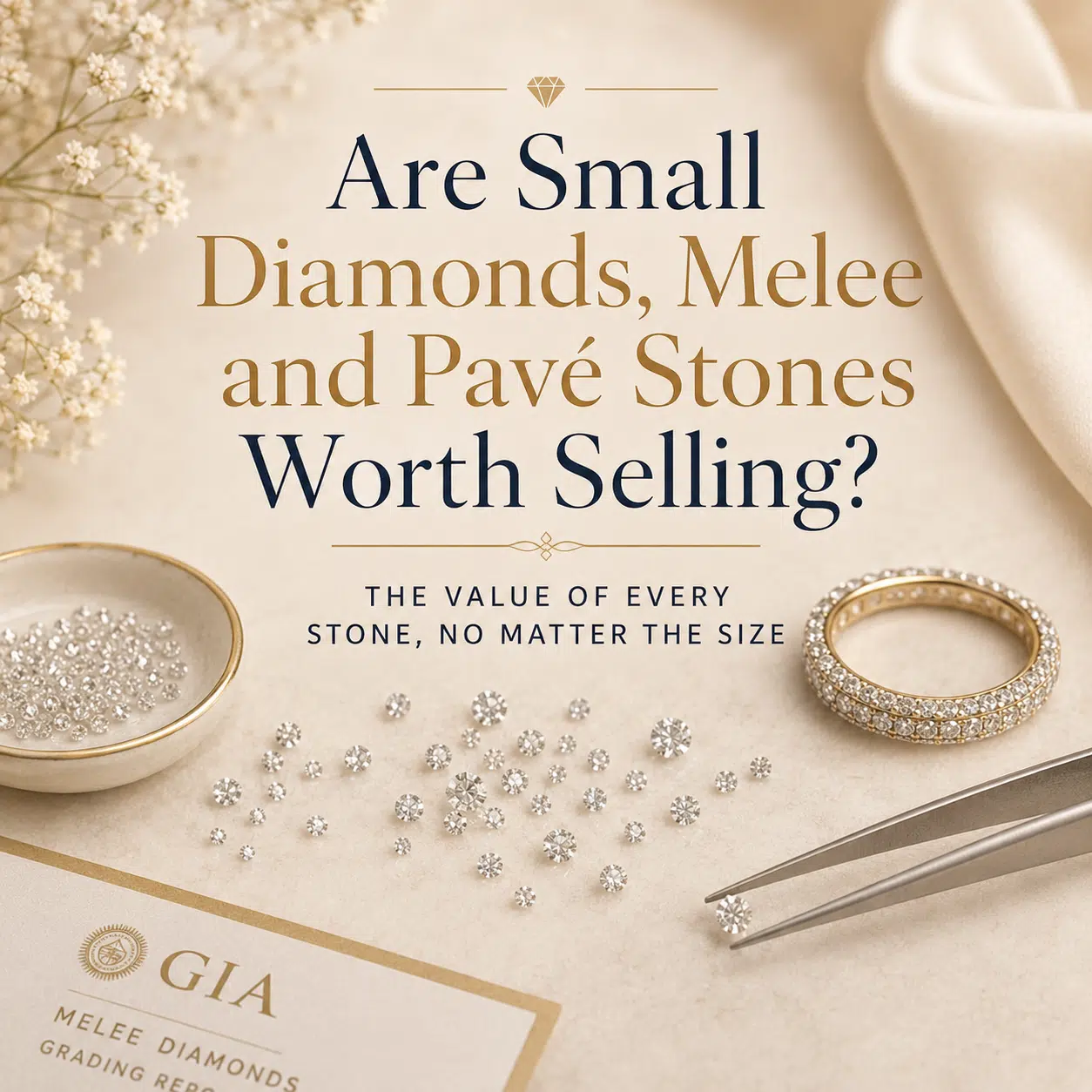
Small diamonds are not automatically worthless. However, the best way to sell them depends heavily on whether you have one tiny loose stone, a matched parcel of melee diamonds or a complete pavé-set piece of jewellery.
A single very small diamond may have limited standalone resale demand because a buyer must identify, measure, test, grade and market it. When dozens of similar stones form a clean, matched parcel, their combined commercial value may be more meaningful. Pavé diamonds set in a ring, bracelet or necklace are often best assessed as part of the complete jewel.
The practical answer is therefore:
Yes, small diamonds, melee and pavé stones can be worth selling—but they are usually more valuable as an organised parcel or within desirable jewellery than as individual unidentified stones.
If you have loose small diamonds or pavé jewellery, request a free, no-obligation valuation before separating, repairing or altering anything.
What Are Melee Diamonds?
“Melee” is a trade term for small polished diamonds. GIA commonly defines melee as diamonds weighing less than 0.20 carat, although the exact size range used by dealers and manufacturers can vary.
Melee diamonds can be extremely small. They are widely used as accent stones in engagement rings, wedding bands, earrings, bracelets, watches and decorative jewellery. Most are round, but small baguette, marquise, pear, princess and other fancy-shaped diamonds may also be traded as melee.
Despite their size, melee diamonds still have characteristics that influence marketability. Their origin, dimensions, colour, clarity, cut quality and condition all matter. The difficulty is that assessing each stone individually can cost more in time and labour than the commercial benefit it creates.
For this reason, melee is commonly bought and sold in parcels rather than as individually certified diamonds.
What Does Pavé Mean?
Pavé—often written as “pave” in online searches—is a setting style, not a type or quality of diamond. Numerous small stones are set close together so that very little metal is visible between them. The result is a continuous surface of sparkle.
Micro-pavé uses especially small stones and fine setting work, while other pavé designs may use larger accent diamonds. The terminology is not always applied consistently, so the actual stone count, dimensions, setting quality and total diamond weight are more useful than the label alone.
A pavé ring may contain natural diamonds, laboratory-grown diamonds, simulants or even a mixture introduced through previous repairs. Visual appearance alone may not establish what every small stone is.
Are Small Diamonds Worth Anything?
Small natural diamonds can have resale value, but size alone does not determine whether selling them is commercially practical.
A buyer considering a 0.01-carat loose diamond must account for testing, handling, sorting and possible resale. That work may be disproportionate to the value of one ordinary stone. The situation changes when the seller has a larger quantity that can be sorted into a consistent parcel.
The following comparison explains how different forms of small diamonds are normally approached:
| What you have | How it may be assessed | Usually the most practical route |
| One or two unidentified tiny stones | Origin, size, condition and marketability | Submit for an initial review, but expect limited standalone demand |
| A parcel of loose melee | Total weight, dimensions, matching, origin and quality range | Sell as a sorted or commercially reusable parcel |
| Pavé-set jewellery | Diamonds, precious metal, workmanship, brand and condition | Assess the complete jewel before considering removal |
| Broken or incomplete jewellery | Recoverable stones, metal and potential repair cost | Compare intact, repair and component values |
The strongest offer is not always produced by removing every diamond. Sometimes the complete piece has greater resale potential because its design, craftsmanship and precious-metal setting already give the stones a usable commercial form.
Why One Tiny Diamond May Receive a Limited Offer
The resale economics of a small stone are different from those of a larger certified diamond.
Before a buyer can resell a loose small diamond, the stone may need to be cleaned, tested, measured, weighed and matched with other stones. If its origin is uncertain, additional screening may be required. It then needs to be stored securely and eventually matched with a jewellery manufacturing or repair requirement.
These costs do not mean the diamond has no material value. They mean that converting one tiny stone into a saleable product can require more work than a seller expects.
A small diamond becomes more commercially useful when it matches other stones in diameter, shape, colour and appearance. A jeweller replacing a lost pavé stone, for example, normally needs a close dimensional and visual match—not simply any diamond of roughly the same weight.
When a Parcel of Melee Is More Valuable
If you want to sell loose small diamonds, presentation and consistency can influence the assessment.
A parcel containing stones of similar shape, diameter, colour and clarity is easier to reuse than a mixed bag of unrelated stones. Matching is particularly important for earrings, eternity rings, tennis bracelets and pavé designs, where differences can be visible when stones are placed beside one another.
Buyers may consider:
- The number and combined weight of the stones
- Origen natural o creado en laboratorio
- Whether simulants or treated stones are present
- Shape and dimensional consistency
- Colour and clarity range
- Cutting quality and visual matching
- Chips, abrasions or previous setting damage
- Current demand for that size and quality
These factors work together. A larger parcel is not necessarily stronger if it contains mixed origins, inconsistent sizes or heavily damaged stones.
Total Carat Weight Is Not the Weight of Each Diamond
Jewellery descriptions frequently use “total carat weight”, “carat total weight”, “ctw” or “tcw”. This represents the combined weight of multiple diamonds, not the weight of every individual stone.
A ring described as containing 0.50 carat total weight could have fifty 0.01-carat stones, ten 0.05-carat stones or another combination. Those arrangements do not necessarily have the same resale value because the size, quality and commercial usefulness of the individual diamonds differ.
When pavé stones remain mounted, their individual weights may need to be estimated from measurements and setting information. A precise combined loose weight is only available after removal, which is rarely justified solely to obtain an initial valuation.
What Determines Melee Diamond Resale Value?
The first major factor is origin. Natural and laboratory-grown diamonds are physically similar, but they operate in different resale markets. Professional testing may be needed when paperwork is absent or when stones have been mixed over time.
Size is also important. Larger melee is generally easier to examine and may have broader individual applications than extremely small stones. Nevertheless, matching can sometimes be more important than the weight of one stone. A consistent group required for a jewellery project may be more marketable than several larger but unrelated diamonds.
Colour, clarity and cutting affect appearance, but tiny mounted stones are not normally assessed with the same level of individual grading detail as an important centre diamond. Buyers may instead place them into practical quality ranges.
Condition also matters. Stones removed from old jewellery may have chips, abraded facet edges or damage hidden beneath the setting. Removal itself creates additional risk, particularly in delicate pavé work.
Natural, Laboratory-Grown or Simulant?
Do not assume every colourless stone in a pavé setting is a natural diamond.
Laboratory-grown diamonds can be used as melee, and simulants such as cubic zirconia may look similar in small sizes. Previous repairs can also introduce replacement stones that do not match the original group.
Specialist screening services can separate natural diamonds from laboratory-grown stones and simulants in suitable parcels. This is more practical for larger quantities than obtaining a full grading report for every tiny diamond.
If an invoice, manufacturer’s description or valuation identifies the stones, include it with your request. Documents can guide the assessment, but the actual stones may still require verification.
For a more detailed explanation of the two resale markets, read Natural vs Lab-Grown Diamond Resale Value.
Is Pavé Jewellery Worth More Intact?
Frequently, yes.
A complete pavé ring or bracelet can contain value from its diamonds, gold or platinum, design, craftsmanship, condition and brand. Removing the stones eliminates the wearable form and can destroy part of the workmanship for which the original jewellery was purchased.
Signed designer jewellery, antique pieces and well-made pavé settings may be especially dependent on remaining complete. Original boxes, invoices, certificates and service records can also support provenance.
Even unsigned jewellery may be more marketable intact if it is attractive, wearable and in good condition. Conversely, a broken, severely worn or poorly repaired item might be assessed partly for recoverable stones and precious metal.
The correct approach is to compare the item’s complete-jewellery value with its potential component value before authorising any alteration.
Should You Remove Pavé Diamonds Before Selling?
Do not remove pavé stones yourself.
These diamonds are small, easily lost and often held by fine beads or miniature claws. Improvised removal can chip the stones, deform the setting and eliminate any possibility of selling the jewellery intact.
Professional removal also involves labour and risk. It may be justified when a piece is beyond repair or when particular stones have sufficient separate value, but it should follow an assessment rather than precede one.
Take clear photographs of the entire item, hallmarks, damaged areas, missing stones and any visible brand signature. Submit the complete piece first and let the buyer determine whether removal is commercially sensible.
Do Small Diamonds Need Individual Certificates?
Most ordinary melee diamonds do not have individual grading reports. The cost and effort of grading each tiny stone would often be disproportionate to its resale value.
Instead, professional buyers may assess parcels through measurement, screening and commercial quality ranges. Laboratories also provide specialised melee-analysis services for qualifying parcels, although their submission requirements differ from those used for individual diamond grading reports.
A larger small diamond with unusual quality, colour or provenance may justify more detailed laboratory work. However, sellers should not automatically pay for certification before establishing whether it is likely to improve the net result.
If your documents are missing, read Can You Sell a Diamond Without a Certificate?.
Three Realistic Selling Examples
Consider a person who finds one tiny colourless stone after an old ring is repaired. The stone may be a diamond, a laboratory-grown diamond or a simulant. Even if it is a natural diamond, its standalone value may not justify extensive testing. The seller can still submit it for review, but expectations should remain realistic.
A second seller has a parcel of 80 round stones removed professionally from a damaged bracelet. The stones are similar in diameter and appearance, and an old invoice describes them as natural diamonds. This parcel is more commercially useful because it can be screened, weighed and sorted as a group.
A third seller owns a signed platinum pavé ring with two missing stones. Removing the remaining diamonds would probably destroy the design value. The better approach is to assess the brand, workmanship, condition, repair feasibility, precious metal and diamonds together.
These examples are illustrative, but they show why the same question—“Are my small diamonds worth selling?”—can produce very different answers.
How to Prepare Small Diamonds for a Valuation
If the diamonds are mounted, leave them in the jewellery. Photograph the complete piece from several angles and include close images of hallmarks, signatures and damaged areas. Provide the total item weight only if you already know it; do not rely on a household scale for carat measurements.
For loose stones, keep them in a sealed diamond parcel, gem jar or small secure container. Avoid mixing separate groups if you know they came from different items. Label each group with any available information, such as the approximate stone count, original jewellery item and supporting document.
You do not need to assign your own colour or clarity grades. Clear photographs, approximate measurements, known origin and existing paperwork are more useful than an unsupported grade estimate.
To begin, submit the stones or complete jewellery through the Sothis Diamonds valuation form. Whether an item can receive an offer will depend on verification and current buying criteria.
Preguntas frecuentes
Can I sell one small diamond?
You can request an assessment, but a single tiny diamond may have limited standalone demand. Its origin, size, condition and the cost of testing or handling will influence whether a buyer can make an offer.
Are tiny diamonds worthless?
No. Tiny diamonds have commercial uses in jewellery manufacturing and repair. However, their individual value can be modest, and they are often more practical to sell as a matched parcel.
What is a melee diamond?
Melee is a trade term for small polished diamonds. GIA commonly describes melee as diamonds below 0.20 carat, although exact trade definitions can vary.
Is pavé a type of diamond?
No. Pavé is a setting method in which multiple small stones are positioned closely together. The stones may be natural diamonds, laboratory-grown diamonds or, in some jewellery, simulants.
What is melee diamond resale value based on?
It depends on total weight, origin, size, shape, colour, clarity, cutting, condition and how consistently the stones match. Current buyer demand and the work required to test and sort the parcel also affect the offer.
Can I sell loose small diamonds without certificates?
Yes. Small diamonds commonly lack individual reports. A buyer may measure, screen and sort them, although unidentified or mixed parcels can require additional work.
Are small lab-grown diamonds worth selling?
They can be submitted for review, but laboratory-grown melee has a different and generally more selective resale market. Identification and separation from natural stones are essential.
Should I remove pavé stones from a ring before selling it?
No. The complete ring may be worth more than its separated components, and removing tiny stones can damage both the diamonds and the setting.
Can I sell a pavé ring with missing stones?
Potentially. Missing stones reduce condition and may create repair costs, but the remaining diamonds, precious metal, design, brand and overall jewellery value should still be assessed.
How are mounted pavé diamonds weighed?
Their weight may be estimated using measurements, stone count, setting information and any available manufacturer documentation. Exact loose weight normally requires removal.
Does a recognised jewellery brand affect pavé value?
It can. A signed and authentic piece may have value from its design, workmanship, provenance and collector demand in addition to its diamonds and metal.
Can mixed small diamonds be sold together?
They can be submitted, but a parcel containing different sizes, shapes, origins or simulants may need to be separated. A consistent, verified parcel is usually easier to value and remarket.
Final Answer: Is It Worth Selling Small Diamonds?
Small diamonds are worth investigating, but the format in which you sell them matters.
One unidentified tiny stone may have limited standalone resale potential. A matched parcel of natural melee can be commercially useful, while a pavé-set piece may derive its strongest value from remaining complete. Brand, workmanship, metal, stone condition and documentation can be just as important as total diamond weight.
Before removing stones or paying for individual reports, request a professional review of what you already have.
