


How Colour Grade Affects Diamond Resale Value

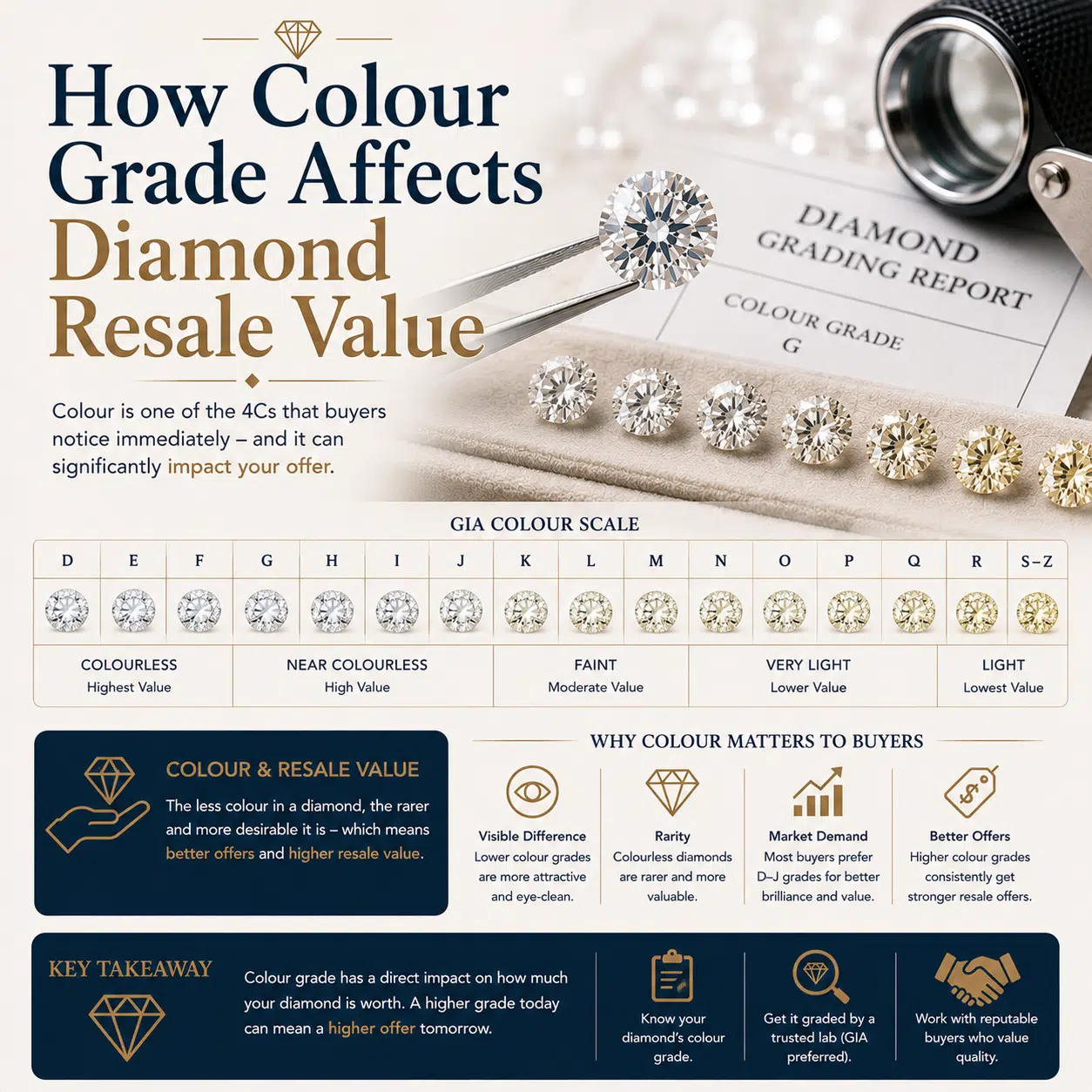
Colour can have a significant effect on diamond resale value, but a single letter never determines the complete offer.
Within the D-to-Z diamond colour scale, D represents the highest degree of colourlessness. As the scale moves towards Z, increasing traces of yellow, brown or sometimes grey become more noticeable. All else being equal, a diamond closer to D will generally be rarer and more valuable than a comparable diamond further down the scale.
Real diamonds are rarely identical in every other respect, however. A beautifully cut G-colour diamond may have stronger resale demand than a poorly cut D-colour diamond. A two-carat J-colour stone may be worth more than a one-carat F-colour diamond because carat weight, cut, clarity, shape, origin and condition all influence the final result.
The effect of colour also changes with the size, shape and setting of the diamond. That is why a buyer should assess the complete stone rather than applying an automatic deduction for each letter grade.
Quick Answer: Does Colour Grade Affect Diamond Resale Value?
Yes. Within the standard D-to-Z range, diamonds with less visible colour generally have stronger resale positioning when carat weight, clarity, cut, shape, origin and condition are comparable.
D-to-F diamonds are described as colourless, while G-to-J diamonds are near-colourless. Near-colourless diamonds can retain healthy resale demand because many appear colourless during normal face-up viewing, particularly when they are well cut and appropriately set.
There is no fixed percentage difference between adjacent grades. The price difference between G and H, for example, depends on the diamond’s size, shape, grading laboratory, fluorescence, other quality factors and current buyer demand.
What Does a Diamond Colour Grade Measure?
A diamond colour grade measures the relative absence of colour within the D-to-Z range. It does not measure brightness, sparkle or fire.
Professional colour grading is conducted under controlled lighting and precise viewing conditions. The diamond is compared with reference stones of established colour. Each letter represents a narrow range rather than one exact colour appearance.
A correctly graded D diamond is considered colourless. As the grades move towards Z, traces of yellow, brown or grey become progressively more apparent.
Colour must not be confused with fluorescence. Fluorescence describes a diamond’s reaction to ultraviolet light and is reported separately. It does not change the laboratory colour grade.
Understanding the D-to-Z Diamond Colour Scale
The D-to-Z scale contains 23 letter grades organised into five broader categories.
| Colour range | Category | General resale interpretation |
| D–F | Colourless | Scarce and potentially valuable, especially in larger, high-quality natural diamonds |
| G–J | Near-colourless | Broad commercial demand and often a strong balance between appearance and marketability |
| K–M | Schwache | Noticeable warmth may reduce mainstream demand but can appeal in suitable cuts, settings or period jewellery |
| N–R | Very Light | Visible body colour generally narrows the buyer pool within the standard D-to-Z market |
| S–Z | Light | Clear yellow, brown or grey appearance, but not necessarily strong enough to receive a fancy-colour grade |
These categories are useful, but they are not resale price bands. A diamond’s exact letter grade and complete characteristics still determine its market position.
Why Higher Colour Grades Can Produce Stronger Offers
Colourless diamonds are less common than diamonds containing visible traces of yellow or brown. That rarity can support higher prices.
Buyers also consider search demand. Many professional and private buyers filter inventories by colour grade. A natural round brilliant in the D-to-H range may fit a larger number of purchasing requirements than an otherwise similar diamond in a visibly warmer range.
However, higher colour does not guarantee faster resale. A rare D-colour diamond with an unusual size, weak cut, low clarity or very high price may require a specialised buyer.
Rarity and liquidity are related, but they are not identical. The offer must reflect both the diamond’s quality and the realistic market available for it.
Does Every Lower Colour Grade Mean a Lower Offer?
Not necessarily.
A lower-colour diamond can be larger, better cut, cleaner or more desirable in shape than a higher-colour alternative. Those advantages may outweigh the colour difference.
Warm colour can also be part of a diamond’s visual character. K-to-M diamonds may complement yellow or rose gold, antique settings and old-style cuts. Some buyers actively prefer this appearance.
The key question is not whether one colour grade is always worth more than another. It is how the grade affects demand for that specific combination of carat, shape, cut, clarity, origin and condition.
D, E and F Colour Diamond Resale Value
D, E and F diamonds fall within the colourless category. Differences between adjacent grades can be difficult to recognise without controlled comparison, but the grades still affect rarity and professional pricing.
D is the highest grade on the scale. It can attract a premium when paired with substantial carat weight, high clarity, excellent cut and natural origin. The premium reflects rarity and report positioning rather than a dramatic visual difference that every observer will notice.
E and F diamonds are also colourless and can have excellent resale potential. An F-colour diamond with stronger cut, measurements or clarity may receive a better offer than a D-colour diamond with weaker overall characteristics.
The difference between D, E and F should therefore be based on comparable market evidence, not on a standard percentage.
G, H, I and J Near-Colourless Diamond Resale Value
G-to-J diamonds are classified as near-colourless. This category represents an important part of the commercial diamond market.
G- and H-colour diamonds often appear colourless during ordinary face-up viewing, particularly when well cut. They can offer broad resale demand without requiring the rarity premium associated with D colour.
I- and J-colour diamonds may show more warmth depending on size, shape, cut and lighting. Their appearance can also be influenced by the setting.
Near-colourless does not mean low quality. These diamonds can be highly marketable, especially when their carat, clarity and cut match common buyer preferences.
Is G Colour Better for Resale Than H Colour?
When two diamonds are genuinely equivalent in every other respect, G colour will normally have the stronger colour-based market position.
The difference may be subtle to the unaided eye, but the report grade influences inventory comparisons and the amount professional buyers are prepared to pay.
That does not mean every G diamond is more valuable than every H diamond. A better-cut H-colour stone may be brighter and more attractive than a poorly proportioned G-colour diamond.
Carat weight can also reverse the result. An H-colour diamond above an important weight threshold may be worth more than a smaller G-colour diamond.
Is I or J Colour Good for Resale?
I- and J-colour diamonds can have good resale potential when the stones are attractive, well cut and competitively positioned.
In smaller round brilliant diamonds, the warmth may be difficult for an untrained observer to recognise face-up. In larger stones or shapes that reveal more body colour, it may be easier to see.
Buyer demand also depends on setting and design. A J-colour antique diamond in an original period ring may appeal to a different market from a modern loose J-colour round brilliant.
An I or J grade should not be treated as a defect. It is one characteristic within the complete valuation.
K-to-M Diamond Resale Value
K, L and M diamonds fall within the Faint colour category. They usually display more warmth than near-colourless diamonds.
This increased colour may reduce demand among buyers seeking a colourless appearance. Nevertheless, these diamonds can remain attractive and valuable, particularly in larger sizes, antique cuts or yellow and rose-gold settings.
A well-cut K-colour diamond can display strong brightness and fire despite its warm body colour. Cut and colour describe different qualities.
The offer will depend on whether the warmth is attractive and evenly presented or whether it contributes to an undesirable appearance for the intended resale market.
N-to-Z Diamond Resale Value
N-to-R diamonds are described as Very Light, while S-to-Z diamonds fall within the Light category.
Their body colour is more readily visible, and mainstream demand can be narrower than for colourless and near-colourless diamonds. Carat weight, clarity, cut and origin still contribute to value.
A diamond near the end of the D-to-Z scale must not automatically be advertised as a fancy-colour diamond. Fancy-colour grading uses a separate system, and a yellow appearance alone does not prove that a diamond qualifies.
Professional assessment is particularly important near the boundary between the D-to-Z and fancy-colour markets.
Why Adjacent Colour Grades Can Have Different Values
The visual difference between two adjacent grades can be extremely subtle. Nevertheless, each grade occupies a distinct position in professional price comparisons.
A buyer considering two otherwise similar diamonds may have a larger resale audience for the higher grade. Online inventory filters and trade purchasing requirements can reinforce those distinctions.
The financial difference is not consistent across every size. Moving from H to G in a small diamond may have a different market effect from the same change in a three-carat natural diamond.
Differences can also become more significant where colour combines with exceptional clarity, cut or rarity.
How Carat Weight Changes the Importance of Colour
Larger diamonds tend to reveal body colour more readily because there is more material through which the colour can be observed.
A small J-colour round diamond may appear nearly colourless during normal wear. A three-carat J-colour diamond is more likely to display noticeable warmth.
Size also changes rarity. A large natural diamond combining substantial weight with D, E or F colour can be significantly scarcer than a smaller diamond with the same colour grade.
Consequently, the effect of moving one colour grade can become financially more important as carat weight increases.
For additional context, read our guide to 3-carat and large diamond resale value.
How Diamond Shape Affects Colour Appearance
Different shapes and facet patterns can display body colour differently.
Round brilliant diamonds are designed to produce extensive light return and visual activity. This can sometimes make modest body colour less noticeable face-up.
Step-cut diamonds, including emerald and Asscher cuts, have broader, open facets. These shapes can reveal body colour more clearly, particularly in larger stones.
Elongated shapes such as oval, pear and marquise may show more colour near their points or ends. The visibility depends on the diamond’s proportions, cut quality and colour distribution.
Two diamonds with the same colour grade can therefore present differently because of shape and faceting.
How Cut Quality Interacts With Diamond Colour
Cut and colour are separate grading factors, but they work together in the diamond’s appearance.
A well-cut diamond returns light effectively, which can make it appear bright and lively. That brightness may reduce how strongly an observer focuses on slight body colour.
A poorly cut diamond may appear dark or dull, making warmth more noticeable. Excellent cut does not change the official colour grade, but it can improve overall marketability.
This is why a lower-colour diamond with excellent proportions may receive a stronger offer than a higher-colour stone with a weak cut.
Learn more in our guide to how cut grade affects diamond resale value.
Does Clarity Change How Colour Affects Value?
Colour and clarity are graded independently, but their combination affects rarity and market demand.
A D-colour diamond with Included clarity does not automatically have a stronger resale value than a G-colour diamond with VS clarity. The buyer must evaluate the complete combination.
At exceptional sizes, combinations such as colourless grades and very high clarity can be particularly rare. That rarity may appeal to specialist buyers or collectors.
For ordinary commercial diamonds, buyers often seek a balanced combination rather than paying for one exceptional grade alongside several weaker characteristics.
Our separate guide explains how clarity and inclusions affect diamond resale value.
How the Setting Affects Perceived Diamond Colour
Diamonds reflect their surroundings. The colour of the prongs, bezel, band and nearby gemstones can therefore influence how the centre diamond appears.
White metals can emphasise a colourless or near-colourless appearance. Yellow or rose metal can introduce warm reflections, although the precise effect varies with the design and the amount of metal surrounding the stone.
A setting may also conceal part of the pavilion, making exact colour assessment more difficult. Laboratory colour grading is performed on loose diamonds under controlled conditions.
Do not remove the diamond yourself. A professional buyer can first review the complete ring and determine whether removal is necessary for a final valuation.
Can Jewellery Design Add Value to a Warmer Diamond?
Yes. A diamond should not automatically be separated from its jewellery.
An antique diamond’s warm colour may complement its original gold or silver-topped setting. The complete piece may have value through its age, craftsmanship, maker, design or provenance.
Removing the stone could damage the setting or eliminate part of its historical appeal. Branded jewellery can present a similar issue because the maker’s identity may add value beyond the loose materials.
A responsible buyer should assess the complete item before deciding whether separate component values are more appropriate.
How Lighting Changes the Way Colour Appears
Diamond colour can look different under daylight, warm household bulbs, office lighting and jewellery-store spotlights.
Surrounding colours also matter. Clothing, walls and the holder’s skin can be reflected by the facets.
For this reason, photographs taken under warm indoor lighting cannot establish a reliable colour grade. Camera processing, white balance and screen settings can further distort the result.
Clear photographs in neutral, indirect lighting can support an initial review, but a final grade requires controlled examination.
How Fluorescence Affects Colour and Resale Value
Fluorescence is the visible light emitted by some diamonds while exposed to ultraviolet radiation. Blue is the most common fluorescence colour.
It is reported separately as None, Faint, Medium, Strong or Very Strong. It is not part of the D-to-Z colour grade.
Blue fluorescence may make some diamonds with yellowish body colour appear whiter under lighting containing ultraviolet energy. In rare cases, very strong fluorescence can be associated with a hazy or oily appearance.
The effect on resale value is not universally positive or negative. Buyers consider the diamond’s colour grade, fluorescence strength, transparency, appearance and current market preferences together.
Is a Diamond Without Fluorescence More Valuable?
Nicht automatisch.
Some buyers prefer None or Faint fluorescence in high-colour diamonds, while others may find fluorescence neutral or visually attractive. Medium or Strong blue fluorescence can also complement the face-up appearance of some warmer diamonds.
The presence of fluorescence does not mean the diamond is defective. It does not damage the stone or alter the laboratory colour grade.
Any price effect should be based on the particular diamond rather than a standard deduction.
Natural Colour, Treated Colour and Laboratory-Grown Colour
A colour grade does not explain the diamond’s origin by itself.
Natural diamonds, laboratory-grown diamonds and colour-treated diamonds participate in different resale markets. A D-colour result cannot make these origins financially equivalent.
Some diamonds undergo high-pressure, high-temperature processing, irradiation, annealing or other treatment to alter their colour. Coatings may also change apparent colour but can be less stable.
The presence of treatment should be disclosed on an appropriate report. Specialised testing may be required because colour treatment cannot always be detected visually.
How Colour Treatments Affect Resale Value
Colour treatment can improve a diamond’s appearance, but it generally changes how the stone is marketed and valued.
A treated diamond should not be compared directly with a naturally occurring diamond of similar visible colour. The buyer considers the type and stability of treatment, documentation and current demand.
Some stable treatments can be documented by recognised laboratories. Unstable or reversible treatments may require different identification reporting and handling instructions.
Sellers should provide the entire report, including comments, rather than stating only the headline colour grade.
Natural vs Laboratory-Grown Colour Grades
Natural and laboratory-grown diamonds can both be colourless or near-colourless, but their resale markets are separate.
Grading terminology may differ according to the laboratory and report date. Some laboratory-grown reports contain D-to-Z letter grades, while other assessment formats use broader quality categories.
Older reports do not become invalid simply because a laboratory later changes its reporting terminology. The buyer should identify the issuing laboratory, date, origin and exact assessment system.
A laboratory-grown D-colour diamond must not be priced by applying natural-diamond comparisons. Origin, supply and current resale demand must be considered first.
How Fancy-Colour Diamonds Are Different
Fancy-colour diamonds are not valued by rewarding the absence of colour.
Once a diamond qualifies for fancy-colour grading, stronger and more attractive colour can increase rarity and value. Hue, tone, saturation, distribution and whether the colour is natural become essential.
Natural pink, blue, green, orange and red diamonds can be extremely rare. Yellow and brown diamonds also have their own fancy-colour markets when their colour is strong enough to qualify.
A D-to-Z resale guide should not be used to value a fancy-colour diamond. The two categories follow different grading and market principles.
Is a Z-Colour Diamond the Same as a Fancy Yellow Diamond?
Nein.
Z is the final grade on the D-to-Z scale. A Z-colour diamond has visible light yellow, brown or grey body colour but remains within the standard colour range.
A diamond with colour beyond the D-to-Z range may qualify for a fancy-colour grade. Its report may then describe the hue and intensity using terminology such as Fancy Light, Fancy, Fancy Intense or Fancy Vivid.
The boundary must be established by professional grading. Sellers should not describe a Z-colour stone as fancy yellow without supporting documentation.
Does Brown or Grey Colour Affect Resale Differently From Yellow?
Potentially. Buyers may respond differently to yellow, brown and grey undertones, even when diamonds occupy a similar broad part of the D-to-Z range.
Some warm brown diamonds complement antique or rose-gold jewellery, while an uneven or undesirable tint may narrow demand. Grey can produce a distinctive appearance but may appeal to a more specialised market.
The laboratory grade, colour description, overall appearance and buyer demand must be considered together.
Colour modifiers should not be guessed from photographs because lighting and reflections can create misleading impressions.
Does the Grading Laboratory Affect Colour Value?
Yes. Buyers consider which laboratory issued the grade and the standards it applied.
A G-colour grade from one laboratory should not automatically be assumed equivalent to a G from every other laboratory. The buyer may inspect the diamond and compare its appearance against trusted grading standards.
This does not mean every non-GIA report is unreliable. It means the report issuer forms part of the valuation.
When comparing offers, confirm that every buyer is using the same verified colour grade rather than silently adjusting it.
Can an Old Colour Grade Still Be Trusted?
A legitimate older report can remain useful if it matches the diamond and has not been altered.
Unlike clarity or condition, a natural diamond’s inherent body colour does not usually change through ordinary wear. However, later treatments, coatings or incorrect report matching can create problems.
The buyer should verify the report number, measurements and identifying characteristics. A laser inscription can assist but does not establish value by itself.
Updated grading should only be recommended when its likely benefit justifies the cost, time and shipping risk.
Can a Mounted Diamond Receive an Exact Colour Grade?
A mounted diamond can be estimated, but the setting may influence perceived colour.
Metal reflections, restricted viewing angles and limited access to the pavilion make exact comparison difficult. An official loose-diamond laboratory grade should not be replaced by a casual mounted estimate.
If a recognised report already exists and matches the diamond, professional removal may not be necessary for the initial valuation.
Where removal is required, it should be performed by a qualified professional after the setting’s condition and potential independent value have been considered.
Does Diamond Colour Change With Age?
A natural diamond’s inherent colour does not normally change simply because the jewellery is old.
Dirt, oil and residue can make the stone appear duller or warmer. Yellowing adhesive, worn metal or changes to the setting can also influence appearance.
Cleaning may improve the visible appearance, but it does not change the laboratory colour grade.
Treatments and coatings require separate consideration because their stability can vary.
Can Cleaning Make a Diamond Look More Colourless?
Cleaning can remove surface contamination that causes a dull, greasy or yellowish appearance.
It does not remove the diamond’s natural body colour. A clean J-colour diamond remains J colour.
Avoid aggressive home cleaning if the diamond is treated, damaged, antique or mounted insecurely. A professional can select a suitable method.
The diamond does not need to be professionally polished before submitting photographs for an initial valuation.
Illustrative Example: G Colour vs H Colour
Consider two fictional natural round brilliant diamonds. Both weigh 1.00 carat, have VS2 clarity, Excellent cut and reports from the same respected laboratory.
One is G colour and the other is H. If their proportions, condition and fluorescence are also comparable, the G-colour diamond will generally have the stronger colour-based market position.
The difference should not be converted into an automatic percentage. If the H-colour diamond has more attractive measurements or the G-colour diamond has an undesirable condition issue, their actual offers could be closer or reversed.
Illustrative Example: D Colour vs Better Cut
Imagine a fictional D-colour diamond with Good cut and an otherwise comparable G-colour diamond with Excellent cut.
The D stone has the rarer colour grade, but the G stone may display stronger brightness, better proportions and broader demand among buyers prioritising light performance.
The D-colour diamond is not automatically worth more. A buyer must assess how the combination of colour and cut affects resale marketability.
Illustrative Example: Colour vs Carat Weight
Suppose a fictional 0.90-carat F-colour diamond is compared with a 1.01-carat H-colour diamond of similar clarity and cut.
The F diamond has the higher colour grade. The H diamond crosses the one-carat threshold and may appeal to buyers prioritising size.
Depending on market demand and the stones’ exact characteristics, the larger H-colour diamond could receive the stronger offer. Colour and carat cannot be separated from the complete calculation.
Illustrative Example: J Colour in Different Shapes
Imagine two fictional two-carat natural diamonds graded J colour. One is a round brilliant and the other is an emerald cut.
The round’s facet pattern may make its warmth less noticeable face-up. The emerald cut’s broad step facets may reveal more body colour.
Although the report grade is the same, the market may interpret their colour appearance differently. Shape, cut quality, clarity and measurements must also be considered.
Illustrative Example: Z Colour vs Fancy Yellow
Consider a fictional Z-colour diamond and a separate diamond graded Fancy Light Yellow.
The Z-colour stone remains within the D-to-Z system, where greater colourlessness is generally rewarded. The Fancy Light Yellow diamond has crossed into a different grading system where the presence and quality of colour become positive factors.
The stones should not be priced using the same assumptions, even if they appear broadly yellow to an untrained observer.
How to Read Colour Information on a Diamond Report
Begin by confirming whether the diamond is natural or laboratory-grown and whether the report uses the D-to-Z or fancy-colour system.
Review the exact colour grade, fluorescence description and report comments. Check for any statement concerning treatment or colour origin.
Confirm that the measurements, shape and laser inscription correspond with the physical diamond. The report describes quality characteristics but does not state a guaranteed resale value.
If your report has been lost, read our guide to selling a diamond without a certificate.
How Colour Fits Into the Complete Resale Offer
A buyer uses colour together with carat, clarity, cut, shape, proportions, origin, fluorescence, condition, documentation and present demand.
The valuation may also consider whether the diamond is loose or mounted and whether the complete jewellery item has brand, period or craftsmanship value.
The offer reflects the market in which the buyer expects to resell the item. It may therefore differ from the original retail price or an insurance appraisal.
Our pillar guide explains how diamond buyers calculate an offer.
How to Obtain an Accurate Colour-Based Valuation
Provide the complete grading report, including comments and any treatment information. Do not submit only a cropped image showing the letter grade.
Photograph the diamond or jewellery against a neutral background in indirect light. Include front, side and underside views, but understand that photographs cannot confirm an exact colour grade.
State whether the diamond is natural or laboratory-grown if known and disclose any treatment, repair or replacement history. If information is missing, say that it is unknown rather than estimating it.
A final offer may require physical verification to confirm the report match, origin, colour, condition and complete quality characteristics.
Häufig gestellte Fragen
Does diamond colour affect resale value?
Yes. Within the D-to-Z range, more colourless diamonds are generally rarer and can command stronger offers when all other characteristics are comparable.
What diamond colour has the best resale value?
D is the highest D-to-Z colour grade, but it does not guarantee the highest overall offer. Carat, clarity, cut, origin and condition remain important.
Is D the best diamond colour?
D represents the highest degree of colourlessness on the D-to-Z scale. Whether it provides the best financial outcome depends on the complete diamond and the market.
Why does the colour scale begin with D?
The D-to-Z system was created to replace inconsistent older terminology, including various uses of A, B and C. Starting with D separated the standard from those earlier descriptions.
How many D-to-Z colour grades are there?
There are 23 letter grades, beginning with D and ending with Z.
Is E colour noticeably different from D?
The difference is usually subtle and may require controlled side-by-side comparison. The report distinction can still affect rarity and professional pricing.
Is F considered colourless?
Yes. D, E and F make up the colourless category.
Is G colour considered colourless?
G is officially near-colourless. It may appear colourless during normal face-up viewing, particularly in a well-cut diamond.
Is H colour good for resale?
Yes. H-colour diamonds can have broad resale demand when their other characteristics are attractive.
Is I colour too yellow?
Not necessarily. Colour visibility depends on size, shape, cut, setting and lighting. Many I-colour diamonds appear near-colourless face-up.
Is J colour valuable?
A J-colour diamond can be valuable based on its carat weight, clarity, cut, shape, origin and condition.
Are near-colourless diamonds easy to sell?
They can be highly marketable because they often combine an attractive appearance with a different price position from D-to-F diamonds.
Does G colour sell better than H?
When all other factors are equivalent, G generally has stronger colour-based positioning. The actual offer difference varies.
Is D always worth more than G?
No. A larger, cleaner or better-cut G-colour diamond may be worth more than a D-colour stone with weaker overall characteristics.
Does one colour grade create a fixed price difference?
No. Price differences vary by carat weight, shape, clarity, cut, laboratory, origin and market demand.
Can two G-colour diamonds look different?
Yes. Each letter covers a narrow range, and cut, shape, fluorescence, setting and lighting can affect face-up appearance.
Is colour easier to see in a large diamond?
Generally, yes. Larger diamonds tend to display body colour more readily.
Does diamond shape affect visible colour?
Yes. Step cuts and some elongated shapes may reveal body colour more readily than round brilliant diamonds.
Which diamond shape hides colour best?
Round brilliants can make modest body colour less noticeable because of their light return and facet pattern. Individual proportions and size still matter.
Do emerald-cut diamonds show more colour?
They can. Their broad, open step facets often reveal body colour more clearly.
Can cut make a diamond look whiter?
Strong light return can make a diamond appear bright and reduce attention to slight warmth. Cut does not change the official colour grade.
Does clarity affect colour grade?
No. They are graded separately, although the combination affects rarity and value.
Does fluorescence change the colour grade?
No. Fluorescence is reported separately and does not alter the assigned D-to-Z grade.
Can fluorescence make a diamond appear whiter?
Blue fluorescence may make some warmer diamonds appear whiter under ultraviolet-containing light. The effect varies by stone and lighting.
Is Strong fluorescence bad for resale?
Not automatically. Buyers consider fluorescence strength, colour grade, transparency and appearance together.
Does fluorescence damage a diamond?
No. Fluorescence is an identifying characteristic, not structural damage.
Can Very Strong fluorescence make a diamond cloudy?
Rarely, some diamonds with very strong fluorescence may appear hazy or oily. The actual stone must be examined.
Does the ring’s metal change the colour grade?
No. The metal can influence perceived colour, but it does not change the laboratory grade.
Is yellow gold good for a warmer diamond?
It can complement warmer colour, but the effect depends on the design, prongs and buyer preference.
Can a mounted diamond be colour graded?
Its colour can be estimated, but an exact laboratory grade generally requires controlled examination of a loose stone.
Should I remove the diamond before selling?
No. Submit the complete jewellery item first and allow a professional to decide whether removal is necessary.
Can dirt make a diamond look more yellow?
Yes. Oil and residue can change its visible appearance, although they do not alter the actual grade.
Does cleaning improve a colour grade?
No. Cleaning improves surface appearance but does not change inherent body colour.
Does diamond colour change with age?
Natural body colour does not normally change through age or ordinary wear. Surface contamination or treatment stability may affect appearance.
Can a colourless diamond become yellow?
Normal wear does not turn a natural colourless diamond yellow. Dirt, surrounding metal, lighting or certain coatings may create that impression.
Is K colour bad for resale?
No. K-colour diamonds have visible warmth but may remain attractive in appropriate cuts, sizes and settings.
Are warm diamonds valuable?
They can be. Value depends on the exact grade, carat, cut, clarity, origin, jewellery context and buyer demand.
Is an antique warm-colour diamond worth less?
Not necessarily. Its historic cut, original setting, maker and period character may add value.
Is Z colour a fancy yellow diamond?
No. Z remains within the D-to-Z range. Fancy yellow uses a separate grading system.
When does a yellow diamond become fancy yellow?
It must display sufficient colour to fall outside the D-to-Z scale and receive a fancy-colour grade through professional assessment.
Is more colour better in a fancy-colour diamond?
Stronger, attractive colour can increase value in the fancy-colour market. Hue, tone, saturation, distribution and natural origin all matter.
Does this D-to-Z guide apply to pink or blue diamonds?
No. Pink, blue and other fancy colours require specialised grading and valuation.
Do brown diamonds have resale value?
Yes. Natural brown diamonds can have value based on colour appearance, size, clarity, cut, origin and demand.
Does grey colour reduce value?
It can influence demand, but distinctive grey diamonds may appeal to specialised buyers. The complete stone requires assessment.
Can a diamond’s colour be treated?
Yes. Processes such as HPHT, irradiation, annealing and coating may alter colour. Treatment must be disclosed.
Does treated colour have the same value as natural colour?
Generally not. Natural and treated colours participate in different markets and should not be compared as equivalent.
Can a buyer detect colour treatment by looking at the diamond?
Not always. Advanced laboratory testing may be required.
Does a grading report disclose colour treatment?
A recognised laboratory report should state detected treatments according to its reporting policies. Review the entire report and comments.
Can a laboratory-grown diamond be D colour?
Some laboratory-grown reports use D-to-Z terminology, while other assessment systems use broader categories. Origin must still be considered separately.
Does a laboratory-grown D diamond have the same value as a natural D diamond?
No. They belong to different resale markets with different supply and demand conditions.
Are older laboratory-grown reports with letter grades still valid?
They can remain valid if authentic and matched to the diamond. The buyer should consider the laboratory, report date and assessment system.
Does the grading laboratory affect colour value?
Yes. Buyers consider the issuing laboratory and do not automatically treat grades from every organisation as equivalent.
Can photographs confirm a colour grade?
No. Photographs can support an initial review, but lighting, camera processing and screens can distort colour.
Can an online valuation estimate colour?
A preliminary range may be possible from a verified report. An exact assessment without reliable documentation normally requires physical examination.
Does an appraisal prove the diamond’s colour?
An appraisal may record an estimated or report-based grade, but it is not necessarily an independent laboratory grading report.
Does an insurance value equal the colour-based resale value?
No. Insurance appraisals normally concern replacement cost rather than the amount a buyer will pay in the resale market.
Can an old report still establish colour?
Potentially. The buyer must confirm that the report is authentic, matches the diamond and has not been superseded by later treatment or identification findings.
Should I obtain a new report before selling?
Not automatically. The expected improvement in valuation should justify the grading fee, time and shipping risk.
Can a buyer lower an estimate after checking colour?
Yes. A preliminary estimate may change if physical inspection reveals a different grade, origin, treatment, condition or report mismatch. The adjustment should be explained.
How should I compare offers for a high-colour diamond?
Compare written net offers based on the same verified report and physical stone. Review any fees, conditions, payment timing and return terms.
What should I submit for a colour-based valuation?
Provide the complete grading report, neutral photographs and any information about origin, treatments, repairs or the setting.
Can Sothis value a near-colourless diamond?
Yes. The assessment can consider its exact grade, carat, clarity, cut, shape, fluorescence, origin, condition and present market demand.
Receive a Market-Based Offer for Your Diamond
Your colour grade is an important part of the valuation, but it cannot determine the resale offer by itself.
Sothis Diamonds can assess the documented grade alongside the diamond’s carat weight, clarity, cut, shape, fluorescence, origin, condition and current buyer demand.
Submit clear photographs and your complete grading report, if available, for a private initial review. Following physical verification, you can receive a market-based offer that you remain free to accept or decline.
Fordern Sie eine kostenlose, unverbindliche Bewertung Ihres Diamanten an.
