


Wie lange dauert es, einen Diamanten zu verkaufen und bezahlt zu werden?

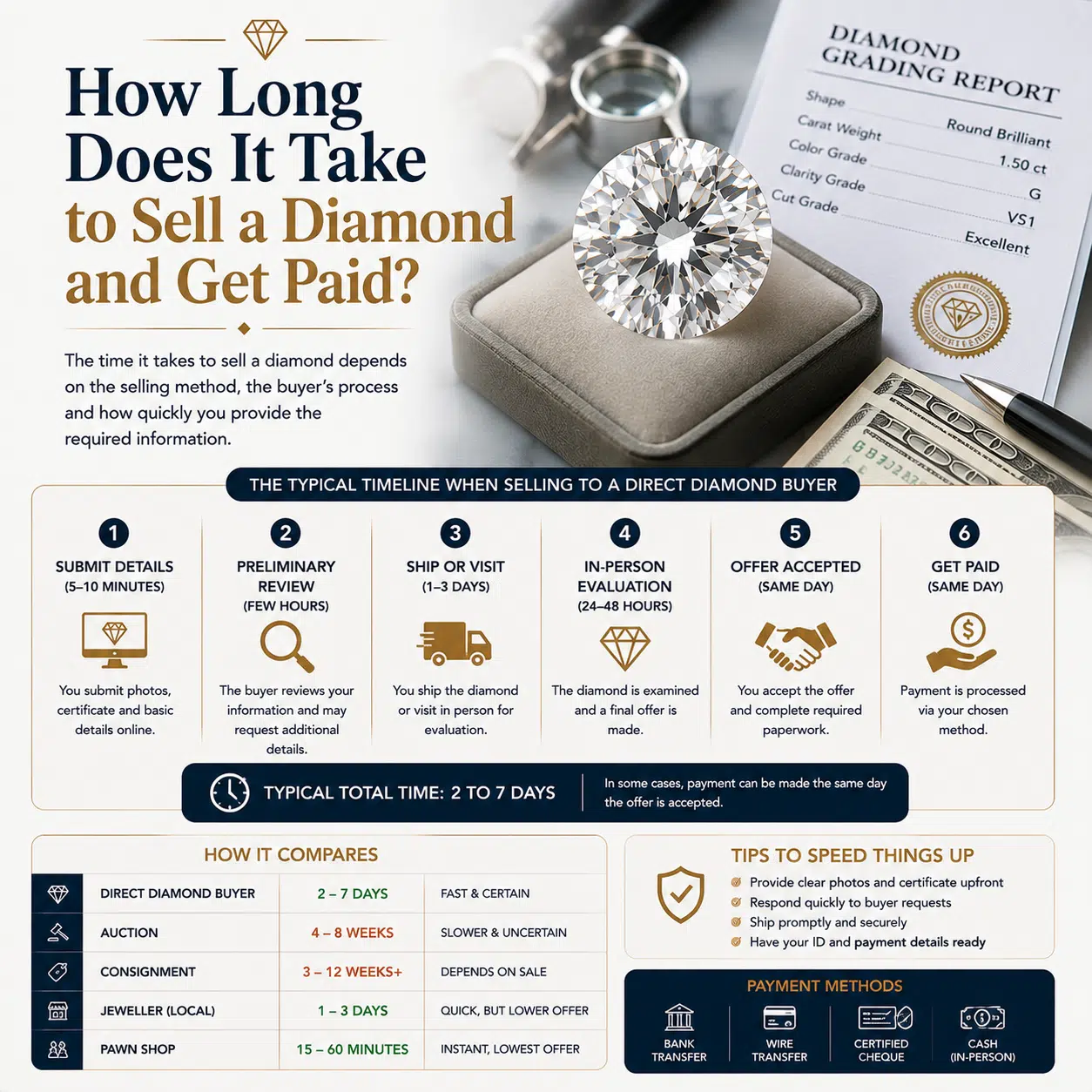
Selling a diamond can take anywhere from a single appointment to several months. The timeline depends mainly on how you sell, whether the diamond has reliable documentation, whether it must be shipped or laboratory tested and how quickly the buyer can complete identity, ownership and payment checks.
A direct sale to a professional diamond buyer is generally the fastest structured route. A straightforward diamond with clear photographs, a verifiable grading report and complete seller information may progress from initial review to inspection and payment within days. That is a planning estimate, not a guaranteed turnaround time.
An auction usually takes longer because the diamond must be accepted, catalogued, marketed and offered on a scheduled sale date. Even after a successful auction, seller proceeds may not be released for several weeks.
Consignment has the least predictable timeline. The diamond remains available until a buyer is found, which could take weeks, months or longer.
The most important distinction is between receiving an initial estimate, receiving a final offer, accepting the sale and having cleared funds in your account. These are separate stages.
Quick Answer: What Is a Realistic Diamond Sale Timeline?
A realistic timeline depends on the selling channel:
| Selling method | Time before a sale can happen | Payment timing | Overall predictability |
| Direkter Diamantenkäufer | Potentially days after submission and physical inspection | After final offer, acceptance and completed checks | Usually the most predictable |
| Local jeweller or dealer | Same-day assessment may be possible, but specialist review can take longer | Potentially the same day or within several business days | Relatively predictable |
| Auktion | Commonly several weeks or months before the scheduled auction | Often several weeks after a successful sale, subject to buyer payment and terms | Predictable calendar, uncertain sale |
| Kommissionsverkauf | No guaranteed buyer date; potentially weeks or months | After the item sells and contractual conditions are satisfied | Least predictable |
| Private marketplace sale | Depends on when a suitable buyer appears | Depends on the payment method and verification | Highly variable |
These are general planning ranges. They are not service guarantees. Before transferring your diamond, ask the buyer or selling platform to confirm its current inspection, decision, return and payment timeframes in writing.
The Difference Between an Estimate, Offer, Sale and Payment
Many sellers believe their diamond is sold as soon as they receive an online valuation. It is important to understand the four separate milestones.
Initial estimate
An initial estimate is based on the photographs, measurements, grading report and description you provide. It helps determine whether the diamond is of interest and whether physical inspection should be arranged.
Unless clearly stated otherwise, it is not usually a final purchase offer.
Final offer
A final offer can normally be confirmed after the buyer has physically examined the diamond and verified its identity, origin, quality, condition and documentation.
If information supplied online does not match the physical item, the final offer may differ from the initial estimate.
Accepted sale
The sale moves forward when you accept the final offer and complete any required sale agreement, identity verification and payment instructions.
Acceptance procedures vary. Some buyers require a signed agreement, while others may record acceptance electronically or during an appointment.
Cleared payment
The transaction is financially complete when the agreed net amount reaches your account according to the payment terms.
A screenshot, payment instruction or message saying that payment was initiated is not the same as independently verified funds in your account.
The Seven Stages of a Diamond Sale Timeline
A professional diamond transaction normally moves through seven stages:
- Preparing photographs and documents
- Requesting an initial valuation
- Arranging an appointment or insured shipment
- Completing physical inspection
- Conducting any additional verification
- Receiving and accepting the final offer
- Processing and verifying payment
A delay at one stage affects the whole timeline. Understanding each stage makes it easier to estimate when you may actually receive your money.
Stage 1: Preparing the Diamond and Documents
Preparing a complete submission can take a few minutes if your diamond is already certified and photographed. It may take longer if you need to locate an old report, identify the laboratory or clarify inherited ownership.
Useful information includes:
- Klaren Fotos des vollständigen Schmuckstücks
- Face-up and side views
- Hallmarks, engravings and brand signatures
- Grading report or certificate
- Purchase invoice
- Insurance appraisal
- Repair or service history
- Explanation of how you acquired the item
- Valid identification when requested
- Payment-account information at the appropriate stage
Incomplete documentation does not automatically prevent a sale, but it can increase the time required for testing and verification.
If you are unsure what to prepare, use the diamond-selling document checklist.
Stage 2: Receiving an Initial Online Valuation
An initial review may be relatively quick when the form includes clear photographs and a complete grading report.
The response may take longer when:
- Images are blurred or incomplete
- The carat weight is unknown
- Only part of the certificate is uploaded
- The report number cannot be verified
- The diamond is mounted
- The item contains several diamonds
- The jewellery may be signed or antique
- Natural or laboratory-grown origin is uncertain
- The buyer needs additional information
- The item falls outside the buyer’s normal criteria
The first response may be a request for more information rather than an estimate. This is not necessarily a delay tactic. A responsible buyer may need enough evidence to avoid providing a misleading figure.
To save time, photograph the front, sides, underside, hallmarks and visible damage. Upload every page of the grading report.
Stage 3: Appointment or Insured Shipping
Sellers near a professional diamond centre may be able to arrange an in-person appointment. The timing then depends on appointment availability, travel and whether the appropriate specialist is present.
A remote sale includes additional time for:
- Confirming the shipping or collection method
- Verifying insurance
- Preparing the parcel
- Carrier collection
- Transport
- Delivery
- Secure intake
Domestic shipments may arrive relatively quickly, but international or cross-border shipments can take longer. Customs inspections, incorrect declarations, weather, weekends and carrier restrictions can all affect delivery.
Do not select an unsafe or uninsured service merely to save one day. A diamond sale is not complete if the parcel never reaches the buyer.
Lesen Sie Wie Sie ein Diamantgutachten vor dem Verkauf lesen und überprüfen. how to ship a diamond safely before arranging transport.
Stage 4: Physical Inspection
Physical inspection is the stage at which the buyer checks whether the submitted diamond matches its description.
A straightforward loose diamond with a reliable report may be assessed more quickly than a mounted, uncertified or complex jewellery item.
The inspection can include:
- Confirming that the stone is a diamond
- Screening for natural or laboratory-grown origin
- Checking for treatments
- Measuring dimensions
- Verifying carat weight where possible
- Assessing colour and clarity
- Examining cut and proportions
- Checking fluorescence
- Looking for chips, abrasions or other damage
- Reading a laser inscription
- Comparing the stone with its grading report
- Assessing the setting and smaller stones
- Checking brand signatures and construction
A same-day appointment does not guarantee same-day completion. If the item requires another specialist, equipment, secure removal from its setting or laboratory analysis, more time may be needed.
Stage 5: Additional Testing or Laboratory Grading
Additional verification is one of the main reasons a diamond sale takes longer than expected.
Laboratory examination may be considered when:
- The diamond has no grading report
- Its report cannot be verified
- Natural or laboratory-grown origin is unclear
- A treatment requires investigation
- The diamond appears to have been altered since grading
- A fancy colour must be classified
- The report and physical diamond do not match
- Exact grading could materially affect marketability
- The diamond must be removed from a setting
- A rare or high-value stone needs specialist review
Laboratory grading can add days or weeks depending on the laboratory, service selected, transport and current workload.
Do not assume that paying for the fastest grading option will always produce a better financial outcome. The likely improvement in sale certainty or value should justify the cost and delay.
No optional laboratory, removal or third-party service should be ordered without your agreement and a clear explanation of the expected timeframe and expense.
Stage 6: Final Offer and Seller Decision
Once inspection is complete, the buyer can decide whether to make a final offer.
The seller should then receive enough information to understand:
- The amount offered
- The currency
- Whether any fees will be deducted
- Whether approved third-party costs apply
- How long the offer remains open
- How acceptance is recorded
- When payment will be initiated
- What happens if the offer is declined
- How and when the diamond will be returned
Your own decision time is part of the overall selling timeline. You may accept immediately, compare the offer with another proposal or decide not to sell.
A professional buyer should not use an artificial deadline of a few minutes to prevent you from reviewing the offer. Genuine market conditions can affect how long a price remains valid, but the validity period should be clearly communicated.
For an apples-to-apples comparison, review Bei einem verantwortungsvollen Vergleich sollten Sie prüfen, ob jedes Angebot vorläufig oder endgültig ist, ob Gebühren abgezogen werden, wann die Zahlung erfolgt und wie der Diamant zurückgesendet wird, wenn Sie das Angebot ablehnen. Nutzen Sie den Leitfaden zum Vergleichen von Diamantenangeboten, bevor Sie sich zwischen mehreren Angeboten entscheiden..
Stage 7: Payment Processing
After you accept the final offer, payment may still depend on:
- Signed sale documentation
- Completed identity checks
- Ownership confirmation
- Correct bank details
- Matching seller and account-holder names
- Internal payment approval
- Banking cut-off times
- Weekends and public holidays
- Currency conversion
- Correspondent banks
- Fraud or sanctions screening
- Transfer limits
- The receiving bank’s processing time
The buyer should tell you when it expects to initiate payment and which payment method will be used. Your bank controls when the transfer is displayed and available in your account.
Do not confuse a fast payment system with a guaranteed fast diamond sale. Even if the final bank transfer can move within seconds, inspection and compliance must be completed first.
How Long Does a Direct Diamond Sale Take?
A direct sale can be the fastest route because the buyer purchases the diamond rather than waiting for another customer or auction bidder.
A straightforward timeline might involve:
- Submitting photographs and the grading report
- Receiving an initial response
- Attending an appointment or arranging insured delivery
- Completing physical inspection
- Receiving a final offer
- Accepting the offer
- Completing identification and payment checks
- Receiving payment
If the diamond is already in Antwerp, has a verifiable report and can be examined during a scheduled appointment, the process may be significantly shorter than a remote international transaction.
An uncertified, inherited, mounted or unusually valuable diamond may require more time.
No direct buyer should promise a universal turnaround without first considering the item, seller’s location, documentation and verification requirements.
Can You Sell a Diamond and Get Paid on the Same Day?
Potentially, but not every diamond or transaction qualifies for same-day completion.
Same-day payment is most realistic when:
- The appointment was arranged in advance
- The appropriate specialist is available
- The diamond is straightforward to verify
- A recognised grading report matches the stone
- No additional laboratory work is needed
- The seller’s identity and ownership are clear
- The final offer is accepted promptly
- Payment information is accurate
- The bank transfer is initiated before relevant cut-offs
- No enhanced review is triggered
Even then, “payment initiated on the same day” and “funds visible in the seller’s account on the same day” are not always identical.
Before an appointment, ask whether same-day inspection is expected and when an accepted offer would normally be sent for payment. Treat the response as an estimate unless it is contractually guaranteed.
How Long Does an Auction Take?
An auction normally takes considerably longer than a direct sale.
The diamond must first be reviewed and accepted. The auction house then decides which sale, date and location are appropriate. Photography, cataloguing, condition reporting, marketing and viewing may happen before bidding begins.
A simplified auction timeline is:
- Submission and specialist review
- Provisional estimate
- Consignment agreement
- Delivery and examination
- Cataloguing and photography
- Marketing and previews
- Scheduled auction
- Buyer invoicing and payment
- Seller settlement
The wait for the correct auction can be several weeks or months. A highly specialised jewellery sale may not be scheduled immediately.
After the hammer falls, the seller does not necessarily receive payment straight away. The winning bidder must pay the auction house, and the auction house then follows its contractual settlement schedule.
Current terms published by several major international auction businesses show seller-payment windows of approximately five or six weeks after a successful auction, provided the auction house has received the buyer’s funds and no other contractual issue applies. Terms vary by company, country and sale.
If the diamond does not meet its reserve, receives no bid or the buyer fails to pay, the timeline may extend further without producing a completed sale.
This article focuses on timing. For fees, reserves and transaction certainty, read direct diamond buyer vs auction vs consignment.
How Long Does Diamond Consignment Take?
Consignment does not create an immediate sale. The seller places the diamond or jewellery with a dealer, platform or gallery, which attempts to find an end buyer.
The sales period may be:
- A fixed number of days
- Several months
- Open-ended until cancelled
- Linked to a particular exhibition or private-sale campaign
A desirable signed jewel may attract a buyer quickly. A loose commercial diamond competing with many similar stones may remain unsold for much longer.
Payment normally becomes due only after:
- An end buyer purchases the item
- The end buyer’s payment has cleared
- Any inspection or return period has passed
- Commission and expenses have been calculated
- The consignor’s payment details have been approved
Ask the consignee for the average—not merely the fastest—selling time for comparable items. Also ask what happens if the diamond remains unsold.
A statement that an item “should sell quickly” is not a payment date.
How Long Does a Local Jeweller or Pawnshop Take?
A local jeweller, second-hand dealer or pawnshop may be able to inspect an item and make an offer during one visit.
However, speed depends on whether the business has the expertise, testing equipment and authority to purchase that type of diamond. Some shops send valuable stones to a central office or external specialist, which adds time.
A same-day offer may also be conditional on further verification.
Choosing the fastest counter offer is not necessarily the same as achieving the best net result. If you are still deciding where to sell, review the broader guide to the best place to sell a diamond.
How Long Does a Private Diamond Sale Take?
A private sale has no standard timeline.
You may find a buyer quickly, but high-value diamonds often require more trust and verification than ordinary marketplace goods. Time may be spent answering messages, arranging meetings, negotiating, verifying payment and dealing with people who never complete the purchase.
A private buyer may also need an independent appraisal or laboratory report before committing.
Do not shorten the process by accepting a payment screenshot, unverified cheque, unfamiliar escrow link or last-minute courier request. Read the guide to diamond selling scams before using a general marketplace.
Diamond Payment Times in Europe
A European diamond buyer may pay by an ordinary SEPA credit transfer or, where available and appropriate, a SEPA instant credit transfer.
Instant euro payments can make funds available rapidly after the payment instruction is actually submitted. However, that does not mean every diamond purchase will use instant payment or that every amount, bank and account is eligible.
The buyer may still need to complete:
- Identity and ownership verification
- Final internal approval
- Payment-account checks
- Anti-fraud screening
- Currency and transaction-limit checks
An ordinary transfer initiated late in the day, before a weekend or on a public holiday may reach the account later than an instant payment.
International transfers involving a non-euro account may pass through correspondent banks and take longer.
Diamond Payment Times in the United States
US buyers may use a wire transfer, ACH credit, business cheque or another agreed method.
A domestic wire can be fast once initiated, but bank cut-offs and review procedures still apply. ACH credits can settle on the same business day, next banking day or later according to the payment instruction and participating institutions.
The seller should ask:
- Which payment rail will be used?
- When will the buyer submit the instruction?
- Will payment be same-day ACH, standard ACH or wire?
- Are weekends excluded?
- Will fees be deducted?
- Does the account-holder name need to match the seller exactly?
- Who should be contacted if the transfer does not arrive?
A cheque appearing in an account balance does not always mean it has been finally verified. Do not release a diamond based only on apparent cheque availability.
Why Bank Transfers Can Take Longer Than Expected
A delay does not automatically mean the buyer has failed to pay.
Common banking delays include:
- Incorrect IBAN, routing number or account number
- Name mismatch
- Payment sent after the bank’s cut-off
- Weekend or bank holiday
- First-time high-value recipient review
- Currency conversion
- Intermediary bank processing
- Transfer-limit approval
- Compliance screening
- Receiving-bank account restriction
- Technical outage
Ask the buyer for the payment date, amount, currency and transaction reference. Then contact your bank through an official channel.
Do not pay a fee through an emailed link to “release” an incoming diamond payment. That is a common fraud warning sign.
What Can Delay a Diamond Inspection?
The physical inspection may take longer when the item is more complex than the original submission suggested.
Typical causes include:
- Diamond is mounted
- Report is missing
- Report number cannot be verified
- Measurements do not match the report
- Laser inscription is difficult to read
- Setting blocks accurate observation
- Stone may be laboratory-grown
- Treatment requires further testing
- Diamond has a chip or cavity
- Jewellery contains several important stones
- Fancy colour requires specialist analysis
- Brand authenticity needs research
- Ownership documents are incomplete
A delay caused by a clearly explained technical issue is different from an unexplained delay combined with pressure or missing communication.
Does Selling Without a Certificate Take Longer?
It can.
Without a grading report, the buyer must establish more information directly from the diamond. The time required depends on whether the stone can be assessed internally or needs independent grading.
A loose, straightforward diamond may be relatively accessible for examination. A mounted stone can take longer because the setting limits exact weighing and observation.
Do not order a new report automatically. Start with an initial review and ask whether the likely commercial benefit justifies the additional time and cost.
Does a Mounted Diamond Take Longer to Sell?
It may.
A mounted diamond cannot always be weighed or graded as precisely as a loose stone. Prongs, bezels and surrounding diamonds can obstruct the specialist’s view.
However, you should not remove the diamond yourself. Premature removal can chip the stone, damage the setting or reduce the value of desirable branded or antique jewellery.
A buyer may first assess the complete item and then discuss whether professional removal is necessary.
Do Inherited Diamonds Take Longer?
An inherited diamond may require extra time if the certificate, receipt or ownership history is incomplete.
The buyer may need to understand:
- Who inherited the item
- Whether an executor is involved
- Whether multiple heirs have an interest
- Whether the seller is authorised to proceed
- Whether old insurance or appraisal records are available
- Whether the stone matches the family description
Gathering estate documents before the valuation can prevent delays later.
What Happens If the Final Offer Is Declined?
If you reject a direct buyer’s offer, the diamond should be returned according to the agreed terms.
The return timeline depends on:
- When the rejection is recorded
- Secure packaging
- Carrier collection
- Insurance arrangements
- Weekends and holidays
- Domestic or international transport
- Customs where applicable
Before sending the diamond, confirm who pays for an insured return and how quickly dispatch should occur after rejection.
At auction, an unsold item may remain with the auction house until collection or return is arranged. Under consignment, cancellation and return timing depends on the contract and any minimum term.
How to Sell a Diamond Faster Without Taking Unnecessary Risks
The best way to shorten the timeline is to remove preventable uncertainty before the buyer receives the diamond.
Submit complete, accurate information. Upload the grading report in full, including comments and report number. Disclose chips, repairs, replacement stones and uncertainty about origin.
Also:
- Photograph the item clearly
- Verify your contact information
- Respond promptly to reasonable questions
- Prepare valid identification
- Resolve ownership issues
- Confirm that your bank account can receive the payment
- Use an account in the seller’s name
- Arrange appointments in advance
- Agree on shipping and insurance in writing
- Ask about laboratory requirements before sending
- Read the offer and return terms
- Avoid changing payment instructions at the last minute
Speed should come from preparation, not from removing security checks.
When Is a Delay a Warning Sign?
A legitimate delay should have a clear reason and an updated expectation.
Be cautious if the buyer:
- Stops communicating after receiving the diamond
- Refuses to confirm secure intake
- Repeatedly changes the inspection explanation
- Demands a fee to release your payment
- Claims payment was made but provides only a screenshot
- Will not return the item after you decline
- Introduces an undisclosed return fee
- Changes the company or payment identity
- Requests your banking password or verification code
- Pressures you to accept a reduced offer immediately
- Refuses to document the revised timeline
Ask for the status in writing. Preserve messages, tracking records, intake confirmations and offer documents.
If the diamond or payment may be at risk, contact the carrier, bank, platform or appropriate authorities promptly.
Four Illustrative Diamond Sale Timelines
These fictional scenarios show why the same advertised process can produce different timelines. They are not actual customer transactions or guarantees.
Scenario 1: Certified loose diamond at an appointment
The seller submits a clear GIA report and photographs. A private appointment is scheduled in Antwerp. The report number, inscription and physical diamond correspond, and no further testing is needed.
The buyer provides a final offer after inspection. The seller accepts and completes the required documents. Payment is then initiated using the agreed method.
This represents a relatively fast direct-sale scenario, but appointment availability, checks and banking time still determine the final completion date.
Scenario 2: Uncertified inherited ring
The seller submits an inherited mounted ring without a report. The item must be screened, the seller’s estate authority must be clarified and the setting prevents exact grading.
The buyer discusses professional removal or laboratory analysis. The seller approves additional verification after understanding the cost and timing.
This process takes longer because the item and ownership history require more evidence.
Scenario 3: Diamond placed at auction
The auction house accepts a valuable signed diamond jewel but places it in a specialist sale scheduled several months later.
The item sells successfully. The winning bidder then completes payment, and the auction house pays the seller according to the consignment agreement.
The auction succeeds, but the seller waits much longer than they would normally wait for a direct offer.
Scenario 4: Open-ended consignment
A dealer accepts a diamond ring on a six-month consignment. Several potential customers view it, but no one purchases during the first three months.
The seller cannot know the payment date because there is no completed sale. If the item eventually sells, the contractual payment period begins only after the end buyer satisfies the required conditions.
Questions to Ask About Timing Before You Sell
Before transferring the diamond, ask:
- How quickly are initial valuation requests normally reviewed?
- Is the first figure an estimate or a final offer?
- When will physical inspection begin after delivery?
- How will secure receipt be confirmed?
- How long does a standard inspection normally take?
- What situations require laboratory testing?
- Will additional work require my approval?
- When will I receive the final offer?
- How long will I have to decide?
- When is payment initiated after acceptance?
- Which payment method will be used?
- Are weekends and holidays excluded?
- What can delay payment?
- What happens if I reject the offer?
- When will an unsold or rejected diamond be returned?
A written answer gives you a more reliable expectation than phrases such as “instant sale” or “fast cash.”
Frequently Asked Questions About Diamond Sale Timelines
1. How long does it take to sell a diamond?
A direct sale may be completed within days when the diamond and documentation are straightforward. Auctions and consignment commonly take weeks or months.
2. What is the fastest way to sell a diamond?
A direct sale to a professional buyer is generally the fastest structured option because it does not require waiting for an auction date or retail customer.
3. Can I sell my diamond on the same day?
Potentially, particularly at a pre-arranged appointment. Same-day completion depends on inspection, documentation, acceptance and payment processing.
4. Can I get paid for a diamond immediately?
Payment may be initiated promptly after an accepted final offer and completed checks. The time funds take to reach your account depends on the payment method and banks.
5. Does an online diamond valuation mean my diamond is sold?
No. An online valuation is normally preliminary. A final offer usually follows physical inspection and verification.
6. How quickly can I receive an online diamond estimate?
It depends on the buyer’s workload and the quality of your submission. Complete photographs and a full grading report can reduce avoidable follow-up.
7. Why has the buyer asked for more photographs?
The original images may not show the setting, hallmarks, condition, report number or other information needed for a meaningful initial assessment.
8. How long does physical diamond inspection take?
A straightforward inspection may be completed relatively quickly. Complex, mounted, uncertified or unusual stones may require additional specialists or testing.
9. Can a loose diamond be assessed faster than a mounted one?
Often, yes. A loose diamond allows more direct measurement and observation, although further testing may still be necessary.
10. Should I remove the diamond from its setting to save time?
No. Improper removal can damage the diamond or setting. Let a specialist decide whether professional removal is necessary.
11. Does a diamond certificate make the sale faster?
A verifiable grading report can reduce uncertainty and make the initial review more precise, but the physical diamond must still be inspected.
12. Can I sell without a diamond certificate?
Potentially, yes. The process may take longer if additional testing or laboratory grading is needed.
13. How long does laboratory diamond grading take?
Turnaround varies by laboratory, location, service level, transport and workload. Ask for a current estimate before approving submission.
14. Is expedited laboratory grading worthwhile?
Only when the likely commercial benefit justifies the additional expense. Request an initial review before ordering new grading.
15. Why does a diamond buyer need my identification?
Identification supports transaction security, payment verification, record keeping and any applicable compliance checks.
16. Can incomplete ID delay payment?
Yes. An expired document, name mismatch or missing required information can prevent the buyer from completing the transaction.
17. Why must my bank-account name match my ID?
Matching names help confirm that payment is going to the verified seller and can reduce fraud and compliance concerns.
18. Can the buyer pay my spouse or relative instead?
Possibly not without additional documentation. Ask before accepting the offer rather than changing payment details later.
19. How long does a European bank transfer take?
It depends on whether the buyer uses an ordinary or instant transfer, the banks, currency, time and any checks. Instant payment capability does not guarantee instant approval by the buyer.
20. How fast is a SEPA instant payment?
Once an eligible instant euro payment is submitted, the payment system is designed to make funds available within seconds. Inspection and transaction approval occur before that stage.
21. Are all European diamond payments instant?
No. The buyer may use an ordinary SEPA transfer, international transfer or another method. Account eligibility and internal policies also matter.
22. How long does a US ACH diamond payment take?
ACH credits can settle on the same business day, the next banking day or according to the payment schedule used by the sender and institutions.
23. Is a wire transfer faster than ACH?
A domestic wire can be faster in some circumstances, but cut-offs, fees and bank reviews apply. Ask which method the buyer will use.
24. Can weekends delay diamond payment?
Yes. Ordinary banking operations, business approvals and carrier movements may pause or operate differently on weekends and public holidays.
25. Does an instant-payment screenshot prove that I was paid?
No. Verify the transaction through your own bank account. Screenshots and payment emails can be forged.
26. Should I pay a fee to release my diamond payment?
An unexpected request to pay money through a message or link to release incoming funds is a serious scam warning sign. Contact the payment provider independently.
27. Why is my bank holding a diamond payment?
The bank may be checking the transaction, account information, amount or fraud risk. Ask your bank directly through an official channel.
28. What happens if I provide the wrong IBAN or account number?
The payment may be rejected, returned or delayed. Verify all details before signing the sale documents.
29. How long does it take to sell a diamond at auction?
The complete process can take several weeks or months because the item must be accepted, catalogued, marketed and offered on a scheduled date.
30. When do auction houses pay diamond sellers?
The payment date is governed by the seller’s agreement and may depend on the winning bidder paying in full. Major auction-house examples commonly place seller settlement several weeks after the auction.
31. Does the auction house pay me when the hammer falls?
Usually not immediately. The bidder must pay, and the auction house then follows the settlement terms in the consignment agreement.
32. What happens if the auction buyer does not pay?
The auction house follows its contractual remedies. Seller payment may be delayed or the transaction may not complete.
33. What if my diamond does not sell at auction?
You may need to collect it, approve another sale attempt, revise the reserve or explore another channel. Return and storage terms should be checked before consignment.
34. How long does diamond consignment take?
There is no guaranteed duration unless the contract specifies one. It can take weeks, months or longer to find an end buyer.
35. When am I paid after a consignment sale?
Payment follows the consignment agreement and may occur after the customer has paid and any inspection or return period has ended.
36. Can I cancel a diamond consignment?
That depends on the agreement. Minimum terms, withdrawal fees, return costs or notice periods may apply.
37. Is a local jeweller always faster?
A local jeweller may provide a same-day assessment, but some items must be sent to another specialist or office.
38. Is a pawnshop the fastest option?
It may provide a rapid transaction, but speed should be considered separately from offer quality, fees and whether the transaction is a sale or loan.
39. How long does a private diamond sale take?
There is no standard timeline. It depends on finding and verifying a buyer, agreeing on price and safely completing payment and handover.
40. Do inherited diamonds take longer to sell?
They can if ownership records, grading documents or details about the item are missing. Preparing estate records can reduce delays.
41. Do branded diamond rings take longer?
Brand verification may add time, particularly when serial numbers, construction, service history and provenance need to be examined.
42. Do fancy-coloured diamonds take longer?
They may require specialist grading of colour origin and intensity, which can extend the process.
43. Does damage delay a diamond offer?
It can. Chips, fractures or possible recutting may require closer examination before a reliable offer can be made.
44. Can I speed up the sale by hiding damage?
No. Physical inspection is likely to reveal it, and incomplete information can make the preliminary estimate less accurate.
45. Can I accept an online estimate immediately?
You can express interest, but understand whether it is conditional on physical inspection. Do not treat a preliminary figure as guaranteed unless stated in writing.
46. How long should a final diamond offer remain valid?
There is no universal period. The buyer should state the validity period and explain any market reason for a short deadline.
47. Is a 30-minute offer deadline normal?
Extreme urgency should be treated cautiously, particularly if it prevents you from understanding a large price change or return terms.
48. What happens if I decline the final offer?
The diamond should be returned according to the previously agreed insured return process and timeframe.
49. How long does return shipping take?
It depends on secure dispatch, carrier service, location, weekends, insurance and customs. Confirm the process before sending the diamond.
50. When should I worry about an inspection delay?
Be concerned when the buyer cannot explain the delay, stops communicating, changes identities or refuses to return the diamond.
51. How can I check the status of my diamond sale?
Use the buyer’s verified contact details and request written confirmation of receipt, inspection status, outstanding requirements and expected next step.
52. Should I choose the buyer promising the fastest payment?
Not solely for that reason. Verify whether the offer is conditional, whether fees apply and when the payment commitment actually begins.
53. What is the difference between fast payment and a fast sale?
Fast payment describes the transfer after acceptance. A fast sale includes valuation, inspection, agreement and payment.
54. Can international sellers receive payment quickly?
Potentially, but currency conversion, correspondent banks, compliance and cross-border account details may add time.
55. Does Sothis guarantee a fixed payment time?
The timing depends on the diamond, documents, seller location, physical verification and payment requirements. Confirm the expected timeline for your specific transaction before sending the item.
56. How do I start the diamond-selling timeline?
Submit clear photographs, the grading report if available and accurate information about the diamond. The initial review can then determine the appropriate next step.
Start with an Initial Diamond Valuation
The fastest safe diamond sale begins with a complete and accurate submission.
Upload clear photographs, the grading report or certificate if available and any useful purchase, insurance or ownership records. Sothis Diamonds can review the initial information and advise whether a private Antwerp appointment or an agreed insured shipping process is appropriate.
The exact inspection and payment timeline will depend on the diamond and transaction. Request the expected timeframe in writing before transferring your jewellery.
