


Kann man einen beschädigten oder angeschlagenen Diamanten verkaufen? Möglichkeiten zur Reparatur, zum Neuschliff und zum Verkauf

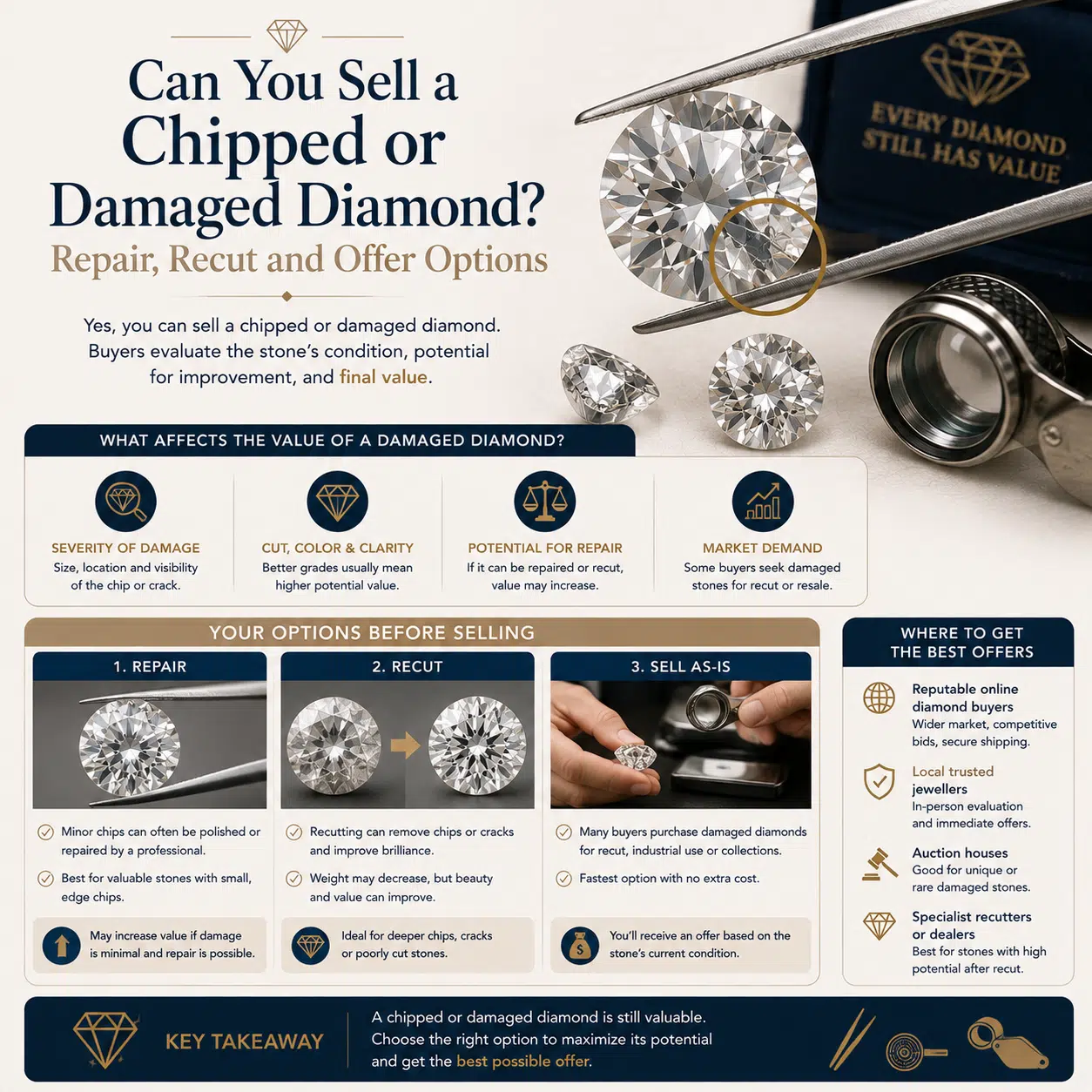
Ein angeschlagener oder beschädigter Diamant kann weiterhin verkauft werden. Das Angebot hängt davon ab, wo sich die Beschädigung befindet, wie tief sie reicht, ob der Stein strukturell stabil bleibt und wie viel nutzbares Gewicht nach einem Nachpolieren oder Neuschliff erhalten bleiben könnte.
Eine kleine Absplitterung an der Rundiste kann eine ganz andere Auswirkung haben als ein Riss, der sich durch einen großen Teil des Diamanten erstreckt. In manchen Fällen kann ein Schleifer den beschädigten Bereich mit einem begrenzten Gewichtsverlust entfernen. In anderen Fällen würde ein Neuschliff den Diamanten deutlich kleiner machen oder weitere Schwachstellen sichtbar machen.
Lassen Sie den Stein nicht reparieren oder neu schleifen, bevor Sie eine Bewertung im aktuellen Zustand erhalten haben. Ein Spezialist sollte den derzeitigen Wert des Diamanten mit dem voraussichtlichen Wert sowie den Kosten und Risiken der vorgeschlagenen Bearbeitung vergleichen.
Kurze Antwort: Kann man einen angeschlagenen Diamanten verkaufen?
Ja. Spezialisierte Käufer können angeschlagene, gebrochene, abgeriebene oder anderweitig beschädigte Diamanten in Betracht ziehen.
Eine professionelle Bewertung sollte Art und Ausmaß der Beschädigung, das aktuelle Gewicht und die Qualität des Diamanten sowie die Frage feststellen, ob ein wirtschaftlich sinnvoller Neuschliff möglich ist. Auch seine natürliche oder im Labor hergestellte Herkunft, Form, Farbe, Reinheit, das Gutachten und die aktuelle Nachfrage beeinflussen das Angebot.
Die drei wichtigsten Optionen sind, den Diamanten in seinem aktuellen Zustand zu verkaufen, einen geringfügig beschädigten Bereich nachzupolieren oder ihn zu einem kleineren Diamanten neu zu schleifen. Die beste Option ist diejenige, die nach Berücksichtigung des Gewichtsverlusts, der Schleifkosten und des Risikos das beste Nettoergebnis erzielt — nicht unbedingt die Option, die den Stein am neuwertigsten aussehen lässt.
Fordern Sie eine kostenlose, unverbindliche Bewertung Ihres Diamanten an..
Diamanten sind hart, aber nicht unzerbrechlich
Diamant ist äußerst kratzfest, aber Härte ist nicht dasselbe wie Zähigkeit. Die Zähigkeit beschreibt, wie gut ein Edelstein nach einem Aufprall dem Brechen, Absplittern oder Reißen widersteht.
Die Kristallstruktur eines Diamanten weist Richtungen auf, entlang derer er leichter spalten kann. Ein harter Schlag an einer empfindlichen Stelle kann daher Schäden verursachen, insbesondere in der Nähe einer dünnen Rundiste, einer spitzen Ecke oder eines bis an die Oberfläche reichenden Einschlusses.
Diamanten in Birnen-, Marquise-, Prinzess- und Herzform können an ihren Spitzen besonders empfindlich sein. Runde und Kissenschliff-Diamanten haben keine spitzen Enden, aber ihre Rundisten und vorhandenen Einschlüsse können dennoch beschädigt werden.
Ein Diamant kann auch beim Fassen, Herausnehmen, täglichen Tragen oder durch den Kontakt mit einem anderen Diamanten absplittern.
What Kind of Damage Does the Diamond Have?
“Cracked diamond” is a common description, but several different features can create a cracked appearance.
| Damage or characteristic | What it generally means |
| Abrieb | Kleine Kerben oder Abnutzung entlang der Facettenkanten, die manchmal ein unscharfes Erscheinungsbild erzeugen |
| Absplitterung | Eine flache Öffnung durch eine Beschädigung der Oberfläche, häufig in der Nähe der Rundiste, Kalette oder eines Facettenübergangs |
| Stoßstelle | Ein Aufprallpunkt mit kleinen, wurzelartigen Federn unterhalb der Oberfläche |
| Hohlraum | Eine kantige Öffnung, bei der Material abgebrochen ist oder ein bis zur Oberfläche reichender Kristall herausgefallen ist |
| Feder | Ein Fachbegriff für einen inneren Bruch oder Riss, der die Oberfläche erreichen kann, aber nicht muss |
| Spaltbruch oder größerer Bruch | Ein schwerwiegenderer Bruch, der strukturelle Bedenken verursachen kann |
| Lockerer Stein | Bewegung, die durch beschädigte oder abgenutzte Fassungsteile verursacht wird und nicht durch eine Beschädigung des Diamanten selbst |
Unter dem Stein eingeschlossener Schmutz, Reflexionen der Fassung und normale Einschlüsse können ebenfalls mit Rissen verwechselt werden. Für eine genaue Diagnose sind eine Untersuchung unter Vergrößerung und eine professionelle Begutachtung erforderlich.
How Damage Affects Diamond Resale Value
Beschädigungen beeinflussen den Wert hinsichtlich Aussehen, Haltbarkeit, Gewicht und Vermarktbarkeit.
Eine kleine, nahe an einer Fassung verborgene Absplitterung kann optisch nur geringe Auswirkungen haben. Der Käufer muss jedoch trotzdem das Risiko berücksichtigen, dass sich die Beschädigung beim Herausnehmen, erneuten Fassen oder Neuschleifen ausbreitet.
Schäden unterhalb der Tafel oder an einer von oben deutlich sichtbaren Stelle können stärker auffallen. Ein tiefer Bruch kann außerdem dazu führen, dass ein zukünftiger Käufer den Diamanten nur ungern trägt oder erneut fassen lässt.
Das mögliche Endgewicht nach einem Neuschliff ist besonders wichtig. Wenn das Entfernen einer Absplitterung dazu führt, dass ein Diamant unter eine wichtige Karatgrenze fällt, kann der Wertverlust größer sein als erwartet.
Der Käufer wird auch den ursprünglichen Diamanten berücksichtigen. Ein großer Naturdiamant mit begehrter Farbe und Reinheit kann einen spezialisierten Neuschliff rechtfertigen. Ein kleiner im Labor hergestellter Diamant oder ein Stein mit geringerer Nachfrage gewinnt möglicherweise nicht genug an Wert, um die Kosten der Bearbeitung zu decken.
Ist eine Absplitterung etwas anderes als ein Einschluss?
Yes. An inclusion can form naturally inside the diamond, while a chip is surface damage that normally occurs after the stone has been cut.
However, the two can be connected. A surface-reaching feather near the girdle may make the diamond more vulnerable if that area receives a hard blow.
An older grading report may plot an inclusion that looks like damage to an untrained observer. Conversely, a chip that occurred after grading will not appear on the original report.
A specialist should compare the physical diamond with the report before assuming that a visible feature is new damage.
Bleibt der bestehende Bewertungsbericht gültig?
A grading report remains useful for identifying the diamond and understanding its condition at the time of examination. It may no longer describe the stone’s current weight, clarity or measurements accurately if significant damage or recutting occurred later.
A minor chip may change the clarity assessment. Recutting will change the diamond’s weight, measurements and possibly its shape, cut, polish, symmetry or clarity grade.
After a material recut, a new report may be advisable for a diamond whose value justifies the expense. The buyer or cutter should discuss this before work begins.
Kann ein beschädigter Diamant repariert werden?
A diamond cannot be healed in the way that metal can be soldered. The practical options involve changing its shape or hiding the damage.
A minor surface issue may be reduced through repolishing. A deeper chip may require partial or complete recutting. In a mounted diamond, a jeweller might reposition a prong or choose a protective setting, but this does not remove the underlying damage.
Fracture filling can make certain surface-reaching fractures less visible by introducing a glass-like material. It does not heal the diamond or improve its underlying structural condition. The treatment is not considered permanent, can be affected by heat and cleaning, and must be disclosed. GIA does not issue its standard grading reports for fracture-filled diamonds.
Fracture filling is therefore not a shortcut that restores an untreated diamond’s resale position.
Nachpolieren oder Neuschleifen
Repolishing is the lighter intervention. It may remove abrasion, small scratches or very minor edge damage while preserving most of the original shape and weight.
Partial recutting changes one or more areas of the diamond to remove a localised chip. The finished stone may retain its general shape but lose weight or symmetry.
A full recut can create a substantially different diamond. It may improve appearance or remove serious damage, but it can also reduce carat weight, change the shape and require a new grading report.
The cutter should provide an estimated finished weight and explain whether the damage might extend farther than it appears. An estimate is not a guarantee because hidden features can become important once cutting begins.
Should You Recut the Diamond Before Selling?
Not automatically. Obtain both an as-is assessment and a recutting opinion first.
The basic commercial comparison is:
Expected value after recutting, minus cutting, grading, removal, resetting and insurance costs, compared with the strongest as-is offer.
Risk must also be considered. The diamond could finish below the predicted weight, reveal additional fractures or move below a commercially important carat threshold.
For example, a damaged diamond weighing slightly above one carat may require enough material removal to finish below one carat. Even if the resulting stone looks cleaner, the change in weight category can limit the financial benefit.
A reputable buyer may prefer to assume the cutting risk and purchase the stone as-is. That option can give the seller greater certainty.
When Recutting May Be Worth Considering
Recutting may make commercial sense when the diamond is large enough to retain a desirable finished weight, the damaged area is removable and the improvement in marketability is expected to exceed the costs.
It can also be considered when a chip threatens continued wear and the owner intends to keep the diamond rather than sell it.
A recut becomes less attractive when the stone is small, the damage extends deeply, the final weight is uncertain or the diamond has limited resale demand. Antique and fancy-colour diamonds require additional caution because recutting can remove historical character or change the face-up colour.
Should the Diamond Be Removed From Its Setting?
Have the complete ring examined first. A mounted inspection may reveal whether the damage is visible, whether the setting is secure and whether removal presents additional risk.
An improvised removal can enlarge a chip or cause a vulnerable diamond to break. If removal is necessary, it should be completed by an appropriately experienced professional under agreed insurance and responsibility terms.
The setting may also contribute value through its precious metal, side stones, craftsmanship or brand. Selling the centre diamond separately without evaluating the complete ring could overlook part of the item’s value.
What to Do Immediately After Discovering Damage
Stop wearing the jewellery until it has been examined. Continued movement inside a damaged setting can worsen a chip or cause the stone to fall out.
Place the ring or diamond in a small, padded container and keep it separate from other jewellery. Avoid ultrasonic or steam cleaning until a specialist has checked the damage and determined whether any treatments are present.
Take clear photographs and locate the grading report, invoice, appraisal and insurance policy. If the damage may be insured, contact the insurer before authorising removal, repair, recutting or sale. Altering the diamond first could affect the claim process.
Selling Options for a Damaged Diamond
A direct sale in the current condition is often the simplest option. The buyer assesses the damage, estimates the possible recut and incorporates the risk into the offer.
Repolishing or recutting before sale may improve the outcome when the expected benefit is clear and the cutter is appropriately experienced. All costs and risks remain with the owner unless another arrangement is documented.
Auction or consignment may suit an exceptional diamond or valuable signed piece, but damage must be disclosed. A general gold buyer may value the setting while failing to assess the centre diamond’s remaining potential.
When comparing offers, ask whether the buyer plans to keep, recut or dismantle the item and whether the quoted amount includes the setting and side stones.
Illustrative Examples
These examples are fictional and show how different damage can produce different decisions.
A Small Girdle Chip
A natural round diamond has a shallow chip near the girdle. A cutter believes it can be removed with modest weight loss, but the diamond would finish just below a major carat threshold.
The seller compares the lower post-recut weight and associated costs with an as-is purchase offer. Selling without recutting provides the better net result.
A Chipped Point on a Pear Shape
A pear-shaped diamond has damage at its point. Repair would shorten the outline and require new proportions.
Because the diamond is large enough to retain a marketable size, specialist recutting may improve its appearance and durability. The decision is made only after receiving an estimated finished weight.
A Fractured Diamond in a Branded Ring
A centre diamond has a visible fracture, but the signed platinum ring and side stones also hold value.
The complete piece is assessed before removal. The offer accounts for the damaged diamond, brand, setting and smaller stones rather than treating the ring only as scrap metal.
How to Request an Accurate Offer
Submit clear photographs of the complete jewellery and close images of the suspected damage. Include the grading report and explain when the damage was noticed.
Do not attempt to assign a new clarity grade from photographs. The buyer needs to inspect the feature’s type, depth, position and relationship to existing inclusions.
Ask for an explanation of the as-is offer and whether recutting could materially change it. If cutting is recommended, request the expected finished weight, shape, costs and responsibility for accidental loss.
Häufig gestellte Fragen
Can a chipped diamond still have value?
Yes. Its remaining value depends on its origin, size, quality, damage and recutting potential.
Can you sell a cracked diamond?
Potentially. “Crack” can describe anything from a feather to a major structural break, so professional identification is required.
Can a diamond chip even though it is the hardest gemstone?
Yes. Hardness measures resistance to scratching, not resistance to breaking. A diamond can chip when struck in a vulnerable direction.
Where do diamonds most commonly chip?
Damage frequently occurs around girdles, pointed corners, culets and areas containing surface-reaching inclusions.
Does a chip lower the clarity grade?
It can. The effect depends on the chip’s size, position and visibility.
Can a jeweller hide a chip under a prong?
A protective setting may reduce visibility and help protect the area, but it does not repair the diamond. The damage should still be disclosed.
Can fracture filling repair a cracked diamond?
It can make a fracture less visible, but it does not heal the break. The treatment is not permanent and affects grading and resale.
Will GIA grade a fracture-filled diamond?
GIA states that it does not grade diamonds containing fracture-filling material.
How much weight will a diamond lose when recut?
There is no standard amount. Weight loss depends on the shape, position and depth of the damage and the intended finished cut.
Can a recut improve the diamond’s clarity?
Removing a chip or inclusion may improve the resulting clarity, but the finished diamond will weigh less and the outcome is not guaranteed.
Should I make an insurance claim before selling?
If the damage may be covered, contact the insurer before altering or selling the diamond. Policy conditions and documentation requirements vary.
Can Sothis Diamonds assess a damaged diamond?
Yes. Chipped and damaged diamonds can be submitted for an initial review, subject to physical inspection and Sothis Diamonds’ current buying criteria.
Final Thoughts
A damaged diamond is not automatically unsellable, and recutting is not automatically the best solution.
The correct decision depends on what the damage is, how far it extends and what the diamond could become after material is removed. A small chip may allow a practical repolish, while a deeper fracture could make a recut risky or uneconomic.
Start by obtaining an as-is assessment. Compare that offer with the predicted net value after any proposed work, and do not authorise an irreversible recut without understanding the likely finished weight.
Fordern Sie eine kostenlose, unverbindliche Bewertung Ihres Diamanten an..
