


Which Diamond Shapes Have the Strongest Resale Demand?

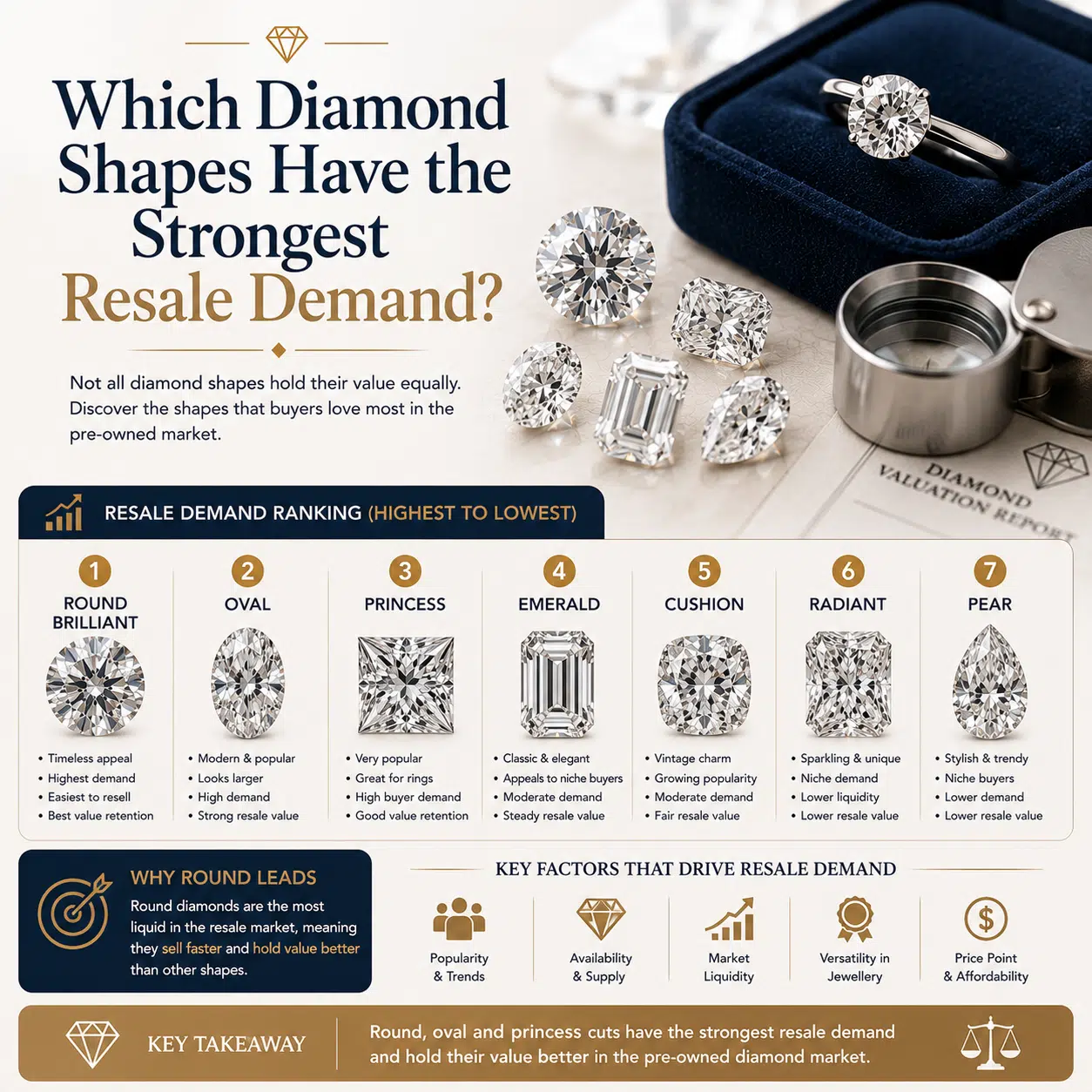
Diamond shape can influence resale demand, but the most popular shape does not automatically produce the highest offer.
Round brilliant diamonds generally have the broadest and most consistent buyer pool. Their familiar appearance, established grading framework and use in engagement rings, earrings and pendants make them relatively versatile in the secondary market.
Oval diamonds are among the strongest fancy-shape contenders, particularly when they have an attractive outline, balanced proportions and a limited bow-tie effect. Emerald, cushion and radiant diamonds can also have healthy demand, although buyers tend to examine their individual proportions more closely.
Shapes such as pear, marquise, princess, Asscher and heart can be valuable, but their demand may be more sensitive to changing style preferences, proportions and the condition of vulnerable corners or points.
Shape is only one component of the offer. Carat weight, colour, clarity, cut quality, origin, condition, grading report and current market demand must all be considered.
Quick Answer: Which Diamond Shape Has the Best Resale Value?
Round brilliant diamonds generally have the strongest overall resale demand because they appeal to a wide range of buyers and jewellery uses. If two natural diamonds are genuinely comparable in carat, colour, clarity, condition and report quality, the round stone may be easier to resell.
Oval diamonds can also have strong demand, especially in modern engagement-ring markets. Their resale performance varies more widely because outline, length-to-width ratio, bow-tie visibility and face-up dimensions are not summarised by a standard GIA overall cut grade.
No shape guarantees the best resale value. An attractive oval can receive a stronger offer than a poorly cut round, while a rare emerald cut or antique cushion may outperform both in the correct specialist market.
Shape Demand Is Not the Same as Diamond Value
Resale demand describes how many buyers may be interested in a particular shape and how readily the diamond might sell at a realistic price.
Diamond value is the amount supported by the complete stone. A popular shape can improve liquidity, but it cannot compensate for every weakness in colour, clarity, cut, condition or origin.
A less common shape may have a smaller buyer pool yet remain highly valuable because of exceptional size, rarity, provenance or quality. Conversely, a round diamond can have broad demand but still receive a modest offer if it is small, poorly cut, damaged or laboratory-grown within a heavily supplied category.
The strongest resale result normally comes from an attractive combination of shape and quality rather than shape alone.
Diamond Shape vs Diamond Cut
Shape describes the outline of a diamond when viewed face-up. Round, oval, pear, emerald, cushion and heart are examples of shapes.
Cut quality describes how successfully the diamond’s proportions, facet arrangement and workmanship produce an attractive appearance. People commonly use terms such as “oval cut,” but that does not mean an oval receives the same type of overall cut grade as a standard round brilliant.
On current GIA grading reports, an overall Excellent-to-Poor cut grade applies to qualifying standard round brilliant diamonds. Fancy shapes do not receive the same standard overall cut grade, although their reports can include measurements, polish and symmetry.
This distinction affects resale. A round diamond’s report provides buyers with a standardised cut-quality reference, while an oval, pear or cushion usually requires more individual visual analysis.
Typical Resale Demand by Diamond Shape
The following comparison describes the usual breadth of demand rather than guaranteeing a specific ranking or price.
| Diamond shape | Typical resale-demand profile | Important buyer considerations |
| Round brilliant | Broad and comparatively consistent | Overall cut grade, proportions, diameter, polish and symmetry |
| Oval | Strong among fancy shapes but proportion-sensitive | Outline, ratio, bow-tie, symmetry and face-up spread |
| Cushion | Established demand with many different styles | Outline, ratio, facet pattern, depth and antique or modern character |
| Emerald | Recognised specialist demand | Clarity, colour, windowing, contrast, ratio and step-facet appeal |
| Radiant | Healthy demand in selected markets | Outline, brilliance, depth, colour concentration and ratio |
| Pear | Recognisable but more style-sensitive | Symmetry, bow-tie, point condition and colour distribution |
| Marquise | Potentially strong when fashionable, but variable | Outline, bow-tie, symmetry, spread and condition of both points |
| Princess | Established square shape with trend-sensitive demand | Corner condition, depth, face-up size and light performance |
| Asscher | Smaller, specialist buyer pool | Symmetry, clarity, colour, depth and step-cut pattern |
| Heart | Narrow and highly specialised demand | Symmetry, cleft definition, size and emotional or design appeal |
Regional preferences, jewellery trends and diamond size can change how any of these shapes perform.
Why Round Brilliant Diamonds Usually Have the Broadest Demand
Round brilliant is the most established diamond shape in the modern jewellery market. It works in solitaire rings, halos, earrings, pendants and many other designs.
Its rotational symmetry also makes it easier to reset into a wide range of standard jewellery mountings. A buyer does not necessarily need to find a customer seeking a particular length-to-width ratio or asymmetrical outline.
The standard round brilliant is also the only shape receiving an overall GIA cut grade on applicable reports. Buyers can compare its cut category, measurements and proportions through an established grading framework.
These advantages generally support liquidity. They do not mean every round diamond achieves a premium or that sellers will recover the original retail price.
Does Round Shape Guarantee the Highest Offer?
No. Round diamonds are broadly popular, but the entire stone still determines value.
A round diamond with poor light performance, excessive depth or visible damage may attract a lower offer than a beautifully proportioned oval or emerald cut with otherwise comparable characteristics.
Carat weight can also change the result. A larger fancy-shaped diamond may be more valuable than a smaller round even if the round has broader demand.
Natural and laboratory-grown origin must be considered separately. Strong shape demand cannot eliminate the supply and pricing differences between those markets.
Round vs Oval Diamond Resale Value
Round diamonds generally offer the more consistent resale market. Their demand is broad, and their cut can be interpreted through a standard grading scale.
Oval diamonds can offer a larger-looking face-up appearance relative to their weight and have strong bridal appeal. An attractive oval may therefore achieve competitive demand, especially when its proportions fit current buyer preferences.
The challenge is that oval appearance varies considerably. Two ovals with identical carat, colour and clarity grades can have different outlines, bow-ties, dimensions and light patterns.
The round may be easier to compare and resell, but a well-proportioned oval can outperform an average round. There is no fixed percentage difference between the two shapes.
Why Oval Diamond Offers Can Vary Widely
An oval should have a balanced, pleasing outline. Uneven shoulders, flat sides or an awkwardly narrow or wide profile can reduce marketability.
Length-to-width ratio also affects demand. Some buyers prefer a classic oval, while others want a noticeably elongated shape. There is no single ratio that guarantees the best resale result.
Most ovals display some degree of bow-tie—a darker band across the centre created by the interaction of facets and light. A moderate bow-tie can be part of the shape’s appearance, but a strong dark area may reduce brilliance and buyer interest.
Carat weight alone cannot show whether an oval is attractive. Buyers need its measurements, photographs, video and physical inspection.
Cushion-Cut Diamond Resale Demand
Cushion diamonds have an established market, but “cushion” describes a broad family of outlines and facet patterns.
Some cushions are square with softly rounded corners, while others are rectangular or elongated. Their internal appearance can range from broad, chunky facets to more splintered patterns.
Antique cushion and old mine diamonds may appeal because of their age and distinctive character. Modern cushions are often assessed for brilliance, spread, outline and ratio.
Because cushion styles vary so much, the report description and carat weight are not enough. A buyer must understand which cushion market the stone fits.
Emerald-Cut Diamond Resale Demand
Emerald-cut diamonds have a recognised and enduring specialist appeal. Their step facets create broad flashes and a hall-of-mirrors appearance rather than the scintillation of a round brilliant.
These open facets can reveal colour and inclusions more readily. Buyers may therefore place greater emphasis on clarity, transparency and colour when comparing emerald cuts.
Outline and ratio are also important. Some buyers prefer a classic rectangular profile, while others seek a longer, more elongated shape.
A fine emerald cut can achieve strong demand, especially at larger carat weights. Its buyer pool may nevertheless be smaller than that of a comparable round brilliant.
Radiant-Cut Diamond Resale Demand
Radiant diamonds combine a square or rectangular outline with brilliant-style faceting. Their appearance can vary from relatively square to highly elongated.
They may appeal to buyers seeking the outline of an emerald cut with a more active, sparkling facet pattern. Radiants are also commonly used for some fancy-colour diamonds because their faceting can help concentrate visible colour.
Depth, face-up dimensions, corner shape, ratio and light distribution affect resale demand. A radiant carrying excessive weight below the girdle may appear smaller than expected.
An attractive radiant can receive a strong offer, but it should not be valued from carat weight and report grades alone.
Pear-Shaped Diamond Resale Demand
Pear diamonds combine a rounded end with a single point. Their distinctive teardrop shape can work in rings, pendants and earrings.
Symmetry is essential. The two shoulders should appear balanced, and the point should align appropriately with the rounded end.
A visible bow-tie or uneven colour distribution may affect demand. The pointed end also requires careful inspection because it is more vulnerable to chipping.
Pear shapes can be valuable and marketable, but the buyer pool may be narrower than for round or oval diamonds.
Marquise Diamond Resale Demand
Marquise diamonds have an elongated outline with points at both ends. Their face-up dimensions can make them appear large relative to their carat weight.
Demand for marquise diamonds can respond strongly to jewellery trends. An attractive marquise may become highly sought after when elongated and vintage-inspired designs are popular.
The outline, length-to-width ratio, bow-tie, symmetry and condition of both points are particularly important. Even a small chip can affect resale value or create a need for repolishing.
A marquise should therefore be inspected individually rather than given a generic fancy-shape discount.
Princess-Cut Diamond Resale Demand
Princess diamonds have a square or rectangular face-up outline with brilliant-style faceting. They became a widely recognised alternative to round diamonds and remain commercially familiar.
Their market position can be more trend-sensitive than the round brilliant. Depth and weight distribution also vary, meaning two princess diamonds of the same carat weight may have different visible sizes.
The pointed corners are vulnerable and are often protected by prongs. A mounted princess diamond may need careful inspection to confirm that damage is not concealed.
Strong proportions and intact corners can support resale demand, but shape popularity alone does not establish the offer.
Asscher-Cut Diamond Resale Demand
Asscher diamonds have a square step-cut outline with cropped corners. Their geometric pattern appeals to buyers seeking an Art Deco or architectural appearance.
Like emerald cuts, Asschers can reveal colour and inclusions more readily than many brilliant-style shapes. Buyers may prefer stronger clarity and colour combinations.
They can also carry substantial depth, making face-up dimensions important. A deep Asscher may look smaller than another diamond of equal weight.
The buyer pool is usually more specialised than for round, oval or cushion diamonds. A high-quality Asscher can nevertheless command a strong offer in the appropriate market.
Heart-Shaped Diamond Resale Demand
Heart-shaped diamonds have a highly specific emotional and design appeal.
A well-cut heart requires balanced lobes, a clearly defined cleft and a centred point. In smaller sizes, the shape can become difficult to recognise, which may reduce demand.
Because fewer customers actively search for heart-shaped centre stones, liquidity can be lower. However, important heart-shaped diamonds, matching pieces and high-quality fancy-colour hearts can have specialist value.
A narrow buyer pool should not be confused with no value. It means the diamond may require more targeted marketing.
Which Fancy Shape Has the Best Resale Value?
There is no universal winner, but oval frequently has one of the broadest buyer pools among fancy shapes.
Cushion, emerald and radiant shapes can also perform strongly when their proportions and quality suit current demand. Pear and marquise diamonds may benefit from interest in elongated designs, while Asscher and heart shapes tend to occupy more specialised markets.
Fancy-shape value varies more widely because reports do not capture every aspect of visual appeal. Outline, ratio, bow-tie, windowing, contrast and weight distribution can create substantial differences between diamonds with similar grades.
The best fancy shape for resale is therefore an attractive, properly documented stone that fits a real buyer market.
Why Fancy Shapes Do Not Have One Stable Ranking
Jewellery preferences change. An elongated shape may become especially popular for several years, while another shape becomes less prominent.
Shape demand also differs between countries and market segments. A style sought by engagement-ring buyers in the United States may have different liquidity among European dealers or collectors.
Larger diamonds can follow different patterns from smaller commercial stones. Rare, high-quality emerald cuts, cushions or pears may appeal to specialised international buyers even when another shape dominates mainstream retail.
An evergreen valuation should acknowledge these differences rather than claiming that one temporary trend will continue permanently.
How Length-to-Width Ratio Affects Fancy-Shape Value
Length-to-width ratio describes the relationship between a diamond’s length and width. It helps indicate whether a stone appears square, rectangular or elongated.
Ratio influences appearance but does not establish beauty by itself. Two ovals can have the same ratio while differing in shoulder shape, bow-tie and light distribution.
Buyer preferences may also vary. Some customers want a traditional outline, while others actively seek elongated cushions, radiants or emerald cuts.
A less common ratio may narrow demand without making the diamond worthless. The offer should reflect whether a suitable market exists.
How Face-Up Size Affects Shape Demand
Carat measures weight, not visible surface area.
Elongated shapes such as oval, pear and marquise can sometimes appear larger than round diamonds of similar weight because they cover more length on the finger. That visual spread can support demand.
However, excessive spread is not automatically positive. A very shallow diamond may suffer from light leakage or reduced durability.
Deep diamonds can carry hidden weight below the girdle and appear smaller than buyers expect. The valuation should consider both carat weight and measurements.
How Colour Interacts With Diamond Shape
Some shapes reveal body colour more readily than others.
Step cuts such as emerald and Asscher can make colour more visible because of their broad, open facets. Pear and marquise diamonds may show stronger colour near their points.
Round brilliants can sometimes make modest body colour less noticeable face-up because of their light return and facet pattern.
Fancy-colour diamonds follow different principles. Radiant, cushion and other fancy shapes may be selected specifically to intensify their face-up colour.
Read our guide to how colour grade affects diamond resale value for more detail.
How Clarity Interacts With Diamond Shape
Inclusions can be easier to see in shapes with broad step facets, including emerald and Asscher cuts.
Brilliant-style faceting in round, oval, cushion and radiant diamonds can make some inclusions less obvious. This does not change the laboratory clarity grade, but it may affect face-up appearance.
Inclusion position is also important near pointed corners and vulnerable edges. A feather or cavity in a structurally sensitive location may affect durability and the offer.
Our separate guide explains how clarity and inclusions affect diamond resale value.
How Shape Influences Cut Assessment
Standard round brilliant diamonds benefit from an established overall cut-grading system. Their brightness, fire, scintillation, proportions and workmanship can be summarised through the report’s cut grade and supporting measurements.
Fancy shapes have more variable facet patterns and outlines. Their polish and symmetry may be graded, but buyers must still examine their actual appearance.
An oval can have good polish and symmetry while displaying an undesirable bow-tie. An emerald cut can have technically acceptable measurements while showing excessive windowing. A cushion may carry too much hidden weight.
The absence of an overall cut grade does not mean cut quality is unimportant. It makes professional visual assessment more important.
Shape and Natural vs Laboratory-Grown Resale
Shape affects the appearance of both natural and laboratory-grown diamonds, but their resale markets are separate.
A popular oval shape does not eliminate the broader supply conditions affecting laboratory-grown diamonds. Similarly, a less common natural shape may retain substantial value because of its rarity, size and quality.
Buyers must establish origin before applying shape-based market comparisons.
A natural round and a laboratory-grown round with identical dimensions and visual quality should not be expected to receive equivalent offers.
Shape and Fancy-Colour Diamond Value
Round is not automatically the strongest shape for a fancy-colour diamond.
Fancy shapes may retain more weight from the original rough or concentrate visible colour more effectively. Radiant, cushion, oval and pear shapes are frequently encountered in coloured-diamond markets.
For a natural fancy-colour diamond, colour origin, hue, tone, saturation and distribution can outweigh mainstream shape preferences.
A rare Fancy Vivid coloured diamond in a less common shape may be more valuable than a colourless round diamond of similar weight. The two should not be valued through the same demand assumptions.
Does a Popular Shape Always Sell Faster?
No. Popularity can help, but sale timing depends on price, size, quality and channel.
A commercial one-carat round diamond may have a broad buyer pool. A rare ten-carat round diamond requires far greater funds and specialist expertise, making the transaction more complex.
An accurately priced oval may sell faster than an overpriced round. A desirable antique cushion in an original signed setting may attract a collector quickly.
Liquidity is the relationship between the item, its price and the available buyers—not shape alone.
Antique Diamond Shapes and Resale Demand
Old European, old mine, rose and other antique cuts should not be judged solely against modern shape preferences.
Their hand-cut proportions, broad facets and distinctive outlines can be part of their historical appeal. An old mine diamond may resemble a cushion, but its value cannot be determined by comparing it only with modern cushion inventory.
Original settings, maker’s marks and provenance can add further value. Recutting an antique stone into a modern round could remove weight and destroy its period character.
Antique diamonds should be offered to buyers who understand both the stone and the complete jewellery item.
Can a Branded Ring Change Shape-Based Resale Value?
Yes. A signed ring from a recognised jewellery house may have value beyond its loose centre diamond.
The original design, documentation, serial numbers, box and condition can affect collector demand. Removing the diamond could reduce the value of the complete piece.
A buyer should first assess the ring as branded jewellery before comparing the centre stone with generic loose diamonds of the same shape.
Brand value is not guaranteed, but it should never be discarded without investigation.
Matching Pairs and Shape Demand
Two matching diamonds can have additional value when they work as an earring or side-stone pair.
Matching requires more than sharing the same shape. Dimensions, colour, clarity, facet appearance and visual balance should correspond closely.
A single pear or trapezoid may have a limited market, while a well-matched pair can appeal to jewellery manufacturers and private buyers.
Keep matching stones and their reports together when requesting a valuation. Separating them can make their relationship harder to verify.
How Damage Affects Pointed Diamond Shapes
Pear, marquise, princess and heart-shaped diamonds contain points or corners that may be more vulnerable to impact.
Prongs can conceal small chips or abrasions. Damage may require repolishing or recutting, creating cost and carat-weight loss.
A chip does not make the diamond worthless, but its position and severity must be examined. The buyer may need to calculate the likely finished weight after repair.
Do not remove a pointed diamond from its setting yourself. Professional handling can reduce the risk of causing additional damage.
Should You Recut a Fancy Shape Into a Round?
Usually not without a detailed professional analysis.
Changing a fancy shape into a round can require substantial weight loss. The finished diamond may fall below an important carat threshold, change clarity or lose valuable historical character.
A fictional 1.40-carat marquise, for example, might produce a much smaller round after damaged points and excess material are removed. Broader round demand may not compensate for the lost weight and cutting cost.
A cutter should estimate the likely finished dimensions, carat, grades, risk and market value before any work begins.
Illustrative Example: Round vs Oval Diamond Resale
Consider two fictional natural diamonds. Both weigh 1.00 carat and have G colour, VS2 clarity and respected grading reports.
The round has Excellent cut and balanced measurements. The oval has an attractive outline, strong face-up size and only a mild bow-tie.
The round may attract a broader buyer pool because its cut is standardised and its shape is highly versatile. The oval may still receive a competitive offer because of its appearance and demand among buyers seeking elongated shapes.
There is no fixed round-versus-oval resale percentage. The result depends on the actual stones and buyer market.
Illustrative Example: Two Ovals With the Same Grades
Imagine two fictional 1.50-carat oval diamonds with identical colour and clarity grades.
The first has symmetrical shoulders, a pleasing ratio and balanced light distribution. The second has an uneven outline and a strong dark bow-tie.
Despite having the same headline grades, the first oval may receive a stronger offer because it will be easier to present to the next buyer.
This example shows why fancy-shape value cannot be calculated from the report’s 4Cs alone.
Illustrative Example: Round vs Emerald Cut
Suppose a fictional 2.00-carat round brilliant is compared with a 2.00-carat emerald cut of similar colour and clarity.
The round may have broader mainstream demand. The emerald cut may appeal to a smaller but established market seeking its step-facet appearance.
If the emerald cut has an elegant ratio, strong transparency and attractive contrast, it may achieve an excellent offer. If it has excessive windowing or hidden depth, demand may be weaker.
Shape popularity is only one part of the comparison.
Illustrative Example: Antique Cushion in Its Original Ring
Imagine an inherited cushion-like diamond in an early twentieth-century signed ring.
Valuing the stone solely against modern loose cushion diamonds could overlook its old-cut character, original mounting and maker.
Removing or recutting the diamond might reduce the total value. The appropriate buyer should examine the complete ring before deciding whether separate material values are relevant.
Illustrative Example: Fancy Yellow Radiant vs Round
Consider two natural fancy-yellow diamonds of similar weight and quality. One is radiant and the other is round.
The radiant’s facet pattern may strengthen its visible colour, which can support demand in the fancy-colour market. The round’s broader general popularity may be less important because colour intensity is central to this category.
This is one reason the “round always has the best resale value” rule should not be applied to every diamond market.
How to Read Shape Information on a Diamond Report
Review the shape and cutting-style description, carat weight and exact measurements.
For a round brilliant, examine the overall cut, polish and symmetry grades together with table, depth, girdle and other proportion information.
For fancy shapes, review polish, symmetry and measurements, but do not assume these fields establish total cut quality. Photographs, video and physical inspection may be needed to evaluate outline and light behaviour.
The report should be verified with the issuing laboratory and matched to the diamond. A report describes quality characteristics; it does not guarantee resale value.
How Shape Fits Into a Complete Diamond Offer
Shape influences demand, but the buyer must also consider carat, colour, clarity, cut, origin, fluorescence, condition, documentation and present market conditions.
For jewellery, the setting, metal, maker, age and craftsmanship may contribute additional value.
The final offer reflects the market in which the diamond can realistically be resold, together with verification, handling and transaction costs.
Our pillar guide explains how diamond buyers calculate an offer.
How to Obtain an Accurate Shape-Based Valuation
Submit the complete grading report and clear face-up, side and underside photographs. Fancy shapes should be photographed straight-on so their outline and symmetry can be considered.
Do not crop out the report measurements, comments or laboratory details. Include a short video if it can be recorded securely in neutral lighting.
State whether the diamond is loose or mounted and disclose chips, repairs, treatments or replacement history. Do not remove it from the setting solely to take better photographs.
A preliminary assessment can begin online, but a final offer may require physical verification of the diamond’s identity, origin, condition and appearance.
Frequently Asked Questions
Which diamond shape has the strongest resale demand?
Round brilliant generally has the broadest and most consistent buyer pool. The final offer still depends on the complete diamond.
What is the best diamond shape for resale?
Round is usually the most liquid mainstream shape. An exceptional fancy shape may still achieve a higher offer based on size, quality and rarity.
Do round diamonds hold value better?
They often benefit from broad demand and standardised cut grading. That does not guarantee recovery of the retail price or a higher offer than every fancy shape.
Is oval a good diamond shape for resale?
Yes. Oval diamonds can have strong demand, especially when they have an attractive outline, balanced ratio and limited bow-tie.
Is round or oval better for resale?
Round usually offers more consistent liquidity. Oval can be highly marketable but depends more heavily on individual appearance and current style preferences.
Are oval diamonds less valuable than round diamonds?
Not automatically. Their value depends on carat, colour, clarity, proportions, origin, condition and demand.
Which fancy diamond shape has the best resale value?
Oval often has broad demand among fancy shapes. Cushion, emerald and radiant diamonds can also perform strongly.
Do fancy shapes lose more value?
Not necessarily. Their buyer pools and proportions vary more widely, but a fine fancy shape can achieve a strong resale result.
What is considered a fancy-shaped diamond?
Any shape other than round is commonly described as a fancy shape. Examples include oval, cushion, emerald, pear, marquise, radiant, princess and heart.
Is a fancy shape the same as a fancy-colour diamond?
No. Fancy shape describes outline. Fancy colour describes a separate colour category.
Does diamond shape affect price per carat?
It can. Demand, cutting yield, rarity and market comparisons differ by shape. There is no permanent price-per-carat ranking for every quality category.
Does diamond shape affect sparkle?
Facet pattern and cut quality affect light performance. Brilliant-style shapes generally produce a different visual effect from step cuts.
Which shape sparkles the most?
A well-cut round brilliant is designed for strong brightness, fire and scintillation. Individual cut quality remains essential.
Do fancy shapes receive GIA cut grades?
Standard GIA reports currently assign an overall cut grade only to qualifying standard round brilliant diamonds. Fancy shapes still receive polish, symmetry and measurement information.
Does no cut grade mean a fancy shape is poorly cut?
No. It means the standard overall grading system does not apply. The stone still requires proportion and appearance assessment.
What is an oval bow-tie?
It is a dark bow-shaped area that may appear across the centre of an oval. Its strength varies and can influence demand.
Do all ovals have a bow-tie?
Many show some degree of bow-tie. The concern is whether it becomes distracting or significantly reduces the attractive appearance.
What oval ratio has the best resale value?
There is no universal best ratio. Balanced outline and market fit are more important than one number.
Are elongated ovals more valuable?
They can be popular, but excessive elongation or poor shoulders may reduce demand. The entire outline must be assessed.
Do cushion diamonds have good resale value?
They can. Demand depends on whether the cushion is square, rectangular, elongated, antique or modern and how attractive its facet pattern is.
Are elongated cushions good for resale?
They may attract strong interest when elongated designs are popular. Their proportions and outline remain important.
Do emerald-cut diamonds have good resale value?
Yes. Fine emerald cuts have established specialist demand, particularly in larger sizes and attractive colour-and-clarity combinations.
Are emerald cuts harder to sell?
Their buyer pool can be smaller than that of round diamonds, but a high-quality emerald cut can still be highly marketable.
Do radiant diamonds hold value?
They can. Resale demand depends on ratio, brilliance, depth, outline, colour and the complete quality profile.
Are pear-shaped diamonds good for resale?
Pear diamonds can have healthy demand, but symmetry, bow-tie, point condition and fashion preferences affect the result.
Do marquise diamonds have resale value?
Yes. Their demand can fluctuate, but an attractive marquise with strong spread and intact points can be valuable.
Are princess-cut diamonds still valuable?
Yes. They remain a recognised commercial shape, although demand may be more trend-sensitive than round.
Do Asscher diamonds have good resale value?
Fine Asschers can achieve strong specialist demand. Their colour, clarity, depth and geometric pattern are especially important.
Are heart-shaped diamonds difficult to sell?
They usually have a narrower buyer pool because the shape is highly specific. Important or exceptional heart-shaped diamonds can still be valuable.
Which diamond shape looks largest?
Oval, pear and marquise shapes can provide substantial face-up coverage for their weight. Measurements and depth must still be considered.
Does a larger-looking diamond receive a better offer?
Not automatically. Excessive spread can come with poor light performance or durability issues.
Does shape affect visible colour?
Yes. Step cuts and pointed shapes may reveal or concentrate colour differently from rounds.
Does shape affect inclusion visibility?
Yes. Emerald and Asscher cuts can reveal inclusions more readily because of their open step facets.
Is round best for a lower-colour diamond?
Round-brilliant faceting can sometimes make modest body colour less noticeable face-up. The exact stone still requires examination.
Is emerald cut best for high clarity?
Emerald cuts often benefit from stronger clarity because their broad facets reveal the interior. There is no mandatory grade for every stone.
Does shape matter more in a large diamond?
It can. Large fancy shapes may have more specialised buyer pools, and differences in outline or proportions become financially significant.
Are antique cuts less valuable than modern rounds?
Not necessarily. Old European and old mine diamonds can have collector and period-jewellery value.
Should an old mine diamond be recut into a round?
Not without specialist analysis. Recutting can cause substantial weight loss and destroy historical character.
Should I recut an unpopular shape before selling?
Usually not before receiving professional advice. The expected value improvement must exceed the weight loss, cost and risk.
Can a marquise be recut into an oval?
Potentially, but the process may cause significant weight loss. A cutter must model the likely finished diamond first.
Does a chipped corner reduce fancy-shape value?
It can. The offer may account for condition, durability and any expected repolishing or recutting.
Are pointed diamond shapes more fragile?
Their points and corners can be more vulnerable to impact. Protective settings and professional handling are important.
Does the setting affect shape resale value?
Yes. An attractive, branded, antique or original setting may add value. A damaged or highly personalised setting may contribute less.
Should I remove the diamond from its setting?
No. Submit the complete piece first and allow a professional to determine whether removal is necessary.
Can a branded fancy-shaped ring be worth more intact?
Yes. Brand, design, documentation and condition may add value beyond the loose diamond.
Are matching fancy-shaped diamonds more valuable?
A closely matched pair can have additional appeal for earrings or side stones. Keep the stones and reports together.
Does shape affect natural and laboratory-grown diamonds equally?
Shape affects appearance in both categories, but their resale markets and supply conditions differ substantially.
Is a laboratory-grown round easier to sell than another lab-grown shape?
Round may have broader shape demand, but the overall laboratory-grown resale market and current buying criteria remain more important.
Is round always best for fancy-colour diamonds?
No. Radiant, cushion, oval, pear and other shapes may strengthen or preserve visible colour more effectively.
Can photographs show whether a fancy shape is valuable?
They can support an initial review, but lighting and angle may conceal bow-ties, windowing, damage or poor proportions.
Why do two ovals with the same grades receive different offers?
Their outlines, ratios, dimensions, bow-ties, condition and light patterns may be different.
Why do two cushions with the same carat weight look different?
Cushions vary in ratio, depth, outline and facet pattern. Carat measures weight, not visible size.
Does a grading report state diamond shape value?
No. It describes the shape and quality characteristics but does not provide a monetary resale value.
Does an insurance appraisal reflect shape demand?
Not necessarily. Insurance appraisals generally estimate replacement cost rather than current resale liquidity.
Can shape trends change quickly?
Yes. Fancy-shape demand can respond to fashion, celebrity jewellery and regional preferences. An evergreen valuation should use current market evidence.
Is the most fashionable shape always the best to sell?
No. Fashion can increase short-term interest but may also change. Quality, pricing and access to suitable buyers remain important.
Does shape demand differ between Europe and the United States?
It can. Jewellery preferences, common ring styles, sizing and market inventories differ by region.
Which shape sells fastest?
A correctly priced round often has broad liquidity, but transaction speed depends on size, quality, price and selling channel.
Can a rare shape take longer to sell?
Yes. Rarity does not always create a large buyer pool. A specialised shape may require targeted marketing.
Can I sell a fancy-shaped diamond without a certificate?
Potentially. The buyer must verify its origin, weight, quality, condition and measurements before confirming an offer.
Should I obtain a report before selling a fancy shape?
Not automatically. The expected benefit should justify the grading fee, shipping risk and time.
How should I compare offers for different shapes?
Compare net written offers based on each verified diamond. Do not apply a generic round or fancy-shape percentage.
What should I submit for a shape-based valuation?
Provide the complete grading report, straight-on photographs, side views and any information about damage, treatments, brand or origin.
Can Sothis value any diamond shape?
Sothis can review round, oval, emerald, cushion, radiant, pear, marquise, princess, Asscher, heart and antique diamonds according to current buying criteria.
Receive a Market-Based Offer for Any Diamond Shape
Round brilliant diamonds generally offer the broadest resale demand, but shape is only one part of a fair valuation.
An attractive oval, cushion, emerald, radiant or other fancy shape may have substantial value when its proportions, carat weight, colour, clarity, origin and condition are considered correctly.
Submit clear photographs and the complete grading report, if available, for a private initial review. Following physical verification, Sothis Diamonds can provide a market-based offer that you remain free to accept or decline.
