


De diamant en de zetting samen of afzonderlijk verkopen? Waarde van goud, platina en de zetting

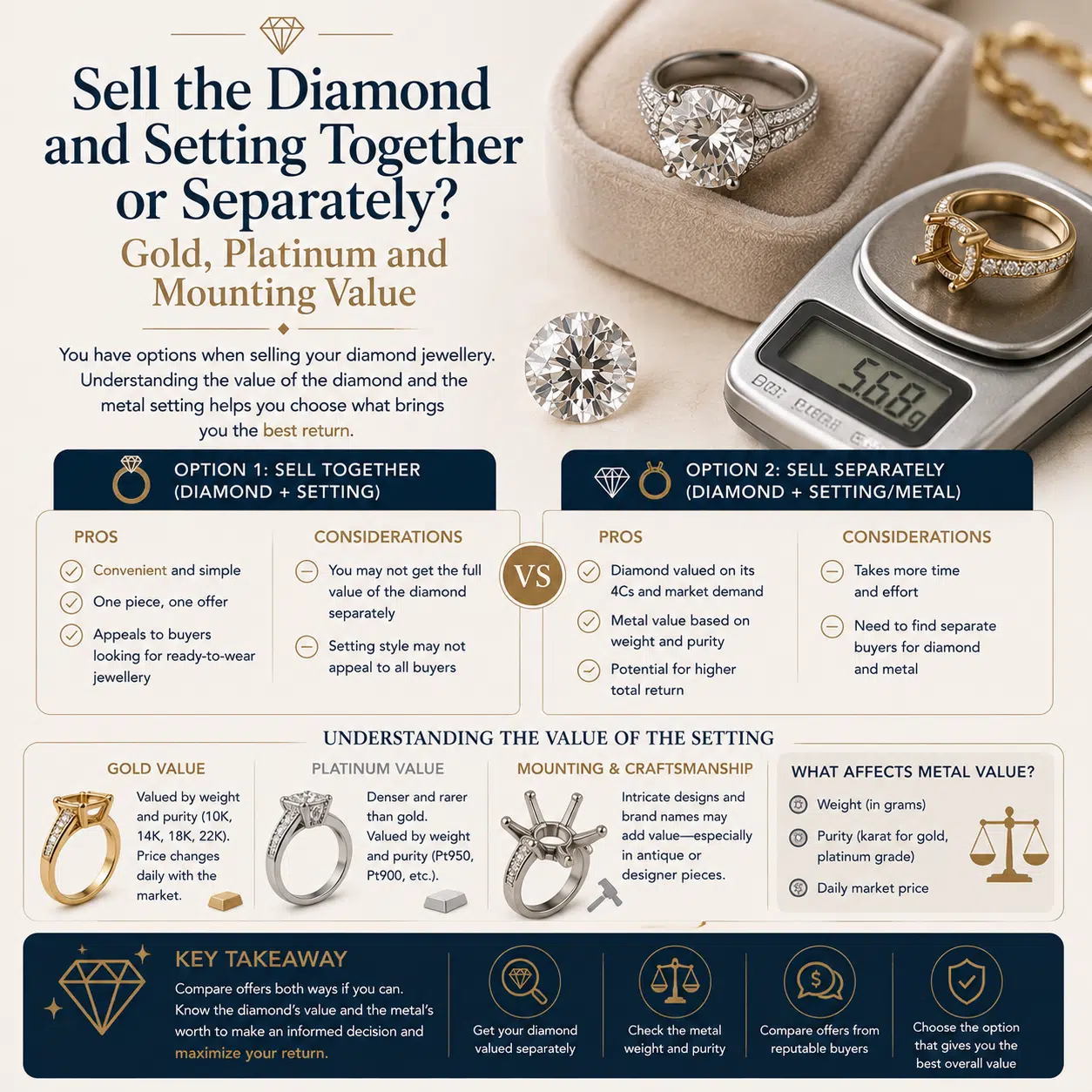
Should you sell a diamond and its setting together or separately? The correct answer depends on which route produces the stronger net result after removal, testing, grading, repair and selling costs.
A substantial natural diamond in an ordinary modern setting may have a strong individual market. A signed, antique or beautifully made ring may be more valuable intact. A worn, unbranded mounting might contribute mainly through its recoverable gold or platinum, while a complex pavé setting could contain workmanship and smaller diamonds that would be uneconomical to separate.
The practical rule is:
Do not remove a diamond before obtaining both a complete-jewellery assessment and, where appropriate, separate estimates for the centre stone and setting.
You can request a free, no-obligation valuation from Sothis Diamonds using photographs of the complete item and any available grading report.
The Three Ways a Setting Can Have Value
A ring setting does not have one universal type of value. Depending on the item, it may be valued as wearable jewellery, as a branded or collectible mounting, or primarily for its recoverable materials.
A wearable modern setting can be refurbished and fitted with another diamond. Its style, condition, size and centre-stone measurements influence whether reuse is commercially practical.
An antique or signed setting may carry value through design, craftsmanship, maker and provenance. In this situation, the mounting can be more than a container for the diamond.
A badly worn or generic setting may be assessed mainly for its gold or platinum, plus any reusable side stones. Even then, the amount is based on verified metal content and recoverable weight—not simply the total weight of the ring.
Understanding which category applies is the first step in deciding whether separation makes sense.
Compare Net Outcomes, Not Headline Offers
The decision should be based on what you receive after every relevant expense.
A separate-sale calculation can be expressed simply:
Separate net result = diamond offer + setting or metal offer − removal, grading, repair, shipping and selling costs
Compare this amount with the offer available for the complete piece.
A buyer offering more for the loose diamond may not produce the better overall result if professional removal, laboratory grading and a separate setting sale create significant costs. There is also a risk that the empty mounting attracts little demand after the centre stone has been removed.
The following situations provide a useful starting point:
| Jewellery situation | Best initial approach | Reason |
| Certified natural diamond in a generic solitaire setting | Compare intact and separate values | The centre diamond may have a strong independent market |
| Signed or antique ring in original condition | Assess intact first | Brand, period design and provenance may be lost through dismantling |
| Severely damaged unbranded setting | Compare component values | Repairing the complete ring may not be economical |
| Pavé, halo or cluster ring with many small diamonds | Assess intact first | Removing and sorting small stones creates labour and damage risk |
| Laboratory-grown centre diamond in a substantial setting | Consider complete-jewellery value | Metal, workmanship and design may represent an important part of the offer |
| Important diamond with no reliable documentation | Begin mounted, then consider removal | Loose grading may help, but only if its expected benefit exceeds the costs |
These are not automatic decisions. The item still needs to be examined individually.
When Selling the Diamond Separately May Make Sense
Separating the centre diamond can be commercially useful when the stone has a clear independent market and the setting has limited additional appeal.
This may apply to a sizeable natural diamond in a simple, unbranded mounting. If the diamond has a recognised grading report, the buyer can assess its recorded weight, colour, clarity, cut, proportions and other characteristics. The setting can then be valued independently as reusable jewellery or precious metal.
Separation may also make sense when the mounting is badly damaged, unfashionable or unsuitable for resale. A broken shank, extensively worn claws or structural repairs may make restoration more expensive than the finished ring can justify.
Another reason is the need for exact loose examination. A setting can hide part of a diamond, influence its apparent colour and prevent accurate weighing. If the diamond is important enough, professional removal and laboratory grading may improve confidence and marketability.
However, the possibility of better documentation does not mean removal is always worthwhile. The likely increase in the net offer must exceed the cost and risk of the work.
When the Diamond and Setting Should Stay Together
Complete jewellery may be stronger when the setting adds design, craftsmanship, brand or historical value.
A signed designer ring should normally be assessed intact. The signature, original centre stone, proportions and setting may form a recognisable model. Removing the diamond could leave a mounting that is difficult to authenticate, restore or resell.
The same principle applies to antique jewellery. An old-cut diamond in its original period setting may have a coherent provenance and appearance. Replacing the historic mounting with a modern one can erase part of the object’s character.
Complex rings can also be more practical to sell complete. Halo, cluster and pavé designs may contain many small diamonds. Removing, testing, weighing and sorting every stone is labour-intensive, while the empty setting may be damaged in the process.
A well-made, wearable ring already performs a commercial function. Breaking it into parts only makes sense when those parts produce a stronger combined net outcome.
How the Diamond’s Value Is Calculated
When the centre stone is commercially significant, its value may dominate the decision.
Buyers consider the diamond’s natural or laboratory-grown origin, carat weight, colour, clarity, cut, shape, proportions, fluorescence, condition, grading report and present demand. A grading report describes quality, but it does not set a guaranteed selling price.
Mounted assessment has limitations. Prongs and bezels can hide the girdle, inclusions or damage. Metal can also influence perceived colour, particularly when a near-colourless diamond is set in yellow gold or surrounded by bright white metal.
The diamond’s weight may be estimated from its dimensions when mounted. Exact carat weight is normally confirmed only after professional removal.
If the stone already has a grading report and laser inscription, it may be possible to verify much of its information before disturbing the setting. Submit the complete report during the initial valuation.
How Gold Setting Value Is Calculated
The value of a gold setting depends on its verified purity, recoverable weight and whether it has resale value as jewellery.
Gold is alloyed with other metals to improve durability and change its colour. An 18-karat gold item contains 18 parts gold out of 24, equivalent to 75% gold. A 14-karat item contains approximately 58.5% gold. European jewellery may instead use millesimal marks such as 750 or 585.
A hallmark is helpful, but professional testing may still be necessary. Marks can be worn, incorrect or associated with only one component of a repaired item.
The gross ring weight cannot simply be treated as pure gold. It includes the diamond, smaller stones and non-gold alloy metals. Certain settings may also contain springs, solder or components of different fineness.
A precious-metal offer may therefore consider:
verified purity × recoverable metal weight × applicable metal value, less refining and transaction costs
Because gold markets and commercial terms change, a static price chart would quickly become unreliable. A current assessment is more useful.
How Platinum Mounting Value Is Calculated
Platinum settings are assessed through metal testing, weight, condition and potential reuse.
A mark such as 950 may indicate a high proportion of platinum, but the complete hallmark and alloy should be examined. As with gold, the ring’s gross weight includes diamonds and possibly other materials.
Platinum rings can be substantial, so their material contribution may be meaningful. They may also contain skilled workmanship that creates more value than recycling alone.
Wear behaves differently in platinum than in gold, but a heavily worn platinum setting can still have stretched, damaged or weakened claws. Its condition influences whether it can be refurbished or should be valued mainly as recoverable metal.
Do not assume that platinum automatically makes the complete ring more valuable than the diamond. The relative contribution depends on the stone, setting weight, design and marketability.
Ring Setting Value Beyond Scrap Metal
Treating every empty setting as scrap can overlook legitimate jewellery value.
A high-quality mounting may be suitable for another diamond with similar dimensions. A buyer may consider the maker, style, metal, side stones, ring size and cost of refurbishing the piece.
Side diamonds and coloured gemstones can also contribute. Their size, origin, matching and condition determine whether they are commercially reusable. Tiny diamonds may be worth more within an attractive finished ring than after being removed and sorted individually.
Branded, vintage and unusual settings require particular care. Original paperwork, boxes, serial numbers and service history can support their value.
The relevant comparison is not simply “diamond vs gold value”. It is:
- The value of the complete wearable ring
- The diamond’s independent resale value
- The setting’s reusable-jewellery value
- The recoverable value of metal and side stones
- The costs required to realise each option
Why You Should Not Remove the Diamond Yourself
A diamond is hard, but it can still chip. Girdles, pointed corners and sharp tips are particularly vulnerable during improper handling.
Household tools can bend or break prongs, scratch the metal and apply pressure in the wrong direction. The diamond may also fall onto a hard surface or be lost after removal.
Professional removal is not risk-free either. A worn setting may release unpredictably, while a very thin girdle, existing chip or tension-style mounting can require specialised handling.
For this reason, removal should follow a commercial and technical assessment. If the stone needs to be taken out, ask who accepts responsibility for damage and whether the empty setting will be returned.
What Happens to Small Side Diamonds?
Small diamonds are not automatically worthless, but their resale economics differ from those of a larger centre stone.
The cost of removing, cleaning, testing, measuring and matching tiny stones can reduce the benefit of selling them separately. In pavé and cluster rings, some stones may also be damaged during removal.
A consistent parcel of reusable natural diamonds can have value. One or two tiny unidentified stones may attract limited standalone interest.
Before dismantling the ring, compare the value of its small diamonds in the complete design with their likely net parcel value after labour. Our guide to selling small diamonds, melee and pavé stones explains this distinction in more detail.
Natural vs Laboratory-Grown Centre Diamonds
Origin can change the balance between the diamond and the setting.
Natural diamonds generally have a more established secondary market, although their offers still vary according to quality and demand. A significant natural centre diamond may represent most of a simple ring’s value.
Laboratory-grown diamonds have a different and more selective resale market. In some laboratory-grown rings, the gold or platinum setting, side stones, brand and finished design may form a larger share of the recoverable value.
This does not mean every laboratory-grown ring should stay intact. It means that separating the centre stone without considering the complete jewellery could remove one of the item’s more marketable features.
Three Illustrative Examples
Consider a modern ring containing a certified 1.50-carat natural round diamond in a lightweight, unbranded 18-karat gold solitaire setting. The centre diamond may be the main value driver. Comparing an intact offer with separate diamond and gold-setting offers would be reasonable.
A second ring contains an old European-cut diamond in a signed platinum Art Deco mounting. The setting, small calibrated stones, workmanship and provenance may create meaningful value. Removing the centre diamond before specialist review could weaken the overall result.
A third ring has a laboratory-grown centre stone surrounded by numerous small diamonds in a substantial gold halo setting. The centre stone, accent diamonds, gold and complete design should all be considered. Selling only the centre diamond may leave the seller with a difficult-to-market empty mounting.
These examples are illustrative rather than price predictions. The stronger route depends on the net outcome for the actual item.
How to Compare Offers Properly
Ask the buyer to explain what is included.
An intact offer should identify whether the setting, side stones and precious metal have been considered. If the buyer is interested only in the centre diamond, ask whether the mounting will be returned and who pays for removal.
For a split comparison, obtain the diamond offer, setting offer and expected expenses in writing. Include removal, possible laboratory fees, insurance, shipping and selling commissions.
Avoid comparing an offer for the entire ring with a second offer that covers only the diamond. The headline amounts may appear similar even though the first buyer is also taking the metal and side stones.
The decision should be made using the amount you receive after every component and cost has been accounted for.
Veelgestelde vragen
Is it better to sell a diamond ring together or separately?
It depends on the net results. Important diamonds in ordinary settings may benefit from separate comparison, while signed, antique or complex jewellery may be stronger intact.
Should I remove the diamond before selling?
No. Request an assessment of the complete ring first. Removal should take place only when its commercial benefit justifies the cost and risk.
Does an empty ring setting have value?
It can. The setting may have value as reusable jewellery, branded or antique design, precious metal or a source of side stones.
How is ring setting value calculated?
A buyer considers metal purity and weight, condition, workmanship, brand, side stones, size and whether the mounting can be reused or resold.
Is the diamond always worth more than the gold?
No. A substantial natural diamond may dominate one ring, while the gold, design and side stones may represent much of another ring’s value.
Does a platinum setting have resale value?
Yes. Platinum content, weight, condition and workmanship can contribute. The setting may be valued as jewellery or recoverable metal.
Can a jeweller remove my diamond safely?
A trained professional can reduce the risk, but no removal is entirely risk-free. Existing chips, thin girdles and delicate settings require special care.
Will removing the diamond improve its grading accuracy?
Loose examination allows exact weighing and unobstructed grading. However, the cost and expected commercial benefit should be considered before removal.
What happens to the small diamonds in the setting?
They may be valued within the complete ring or, when practical, as a recoverable parcel. Removal and sorting costs can make separation uneconomical.
Should an antique ring be dismantled?
Not before a specialist jewellery assessment. Original design, provenance and craftsmanship may be worth more than the separated components.
Can I sell a setting after keeping the diamond?
Potentially. Demand depends on its metal, condition, brand, style and the dimensions of the stone it was made to hold.
Will a buyer return my setting?
Policies differ. Confirm in writing whether an offer covers the complete ring or only the diamond and whether the mounting will be returned after removal.
Can Sothis compare intact and component value?
You can submit the complete jewellery and available documents for an initial review. The assessment can determine which components are likely to drive its current market value.
Make the Decision Using the Complete Net Value
Separating a diamond and setting can be the right choice, but it should never be the automatic choice.
First establish the value of the complete jewellery. Then compare the diamond’s independent offer, the setting or metal value and every cost required to sell the components separately.
Preserve antique, signed and complex settings until their broader value has been considered. For ordinary or damaged mountings, separation may be practical when an important centre diamond has a stronger independent market.
Request a free, no-obligation assessment of your diamond and setting.
