


How to Ship a Diamond Safely: Packaging, Tracking and Insurance

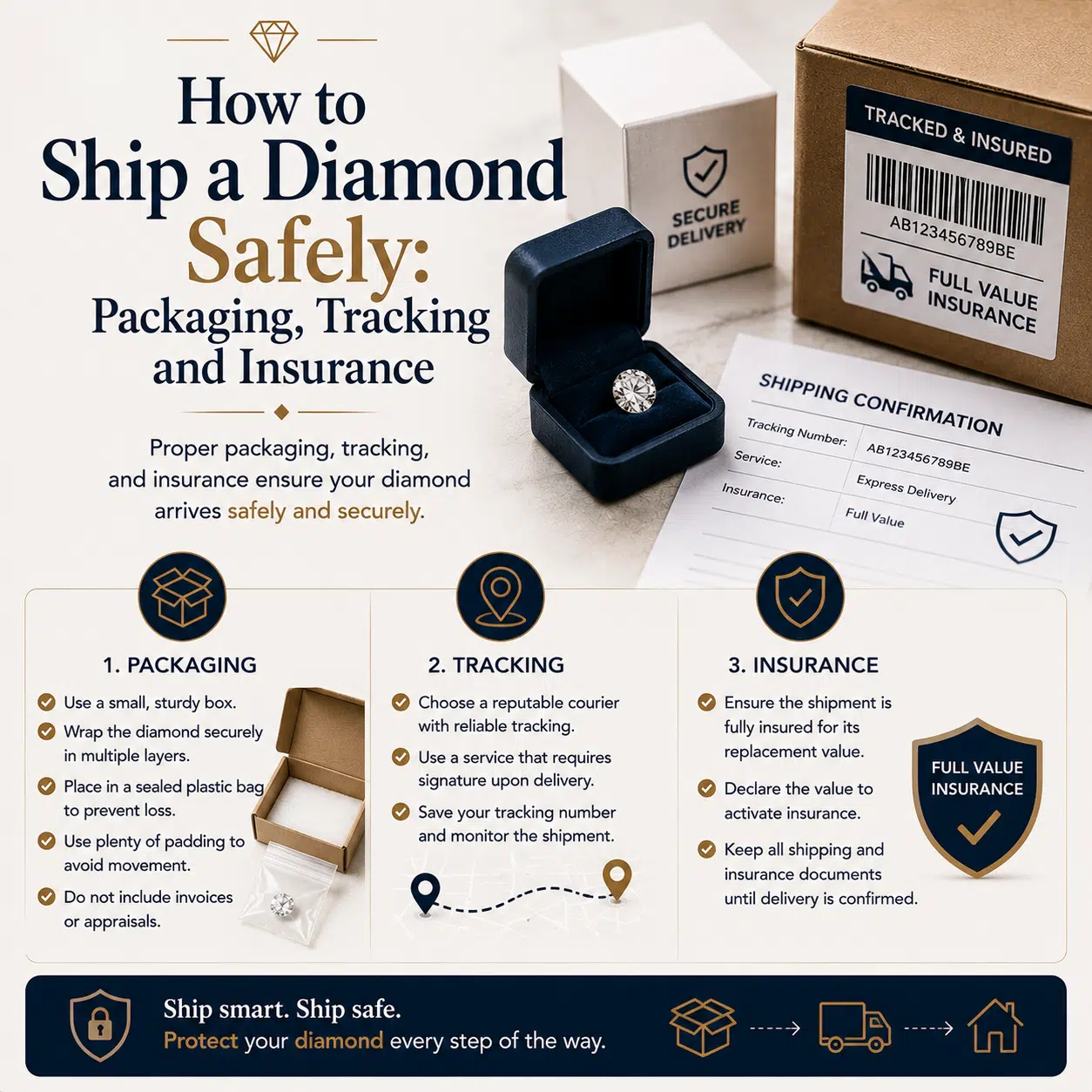
A diamond is small, valuable and difficult to replace. Shipping one safely therefore requires more than placing the stone in a jewellery box, purchasing an ordinary courier label and adding a tracking number.
The safest method combines secure double-box packaging, an approved carrier service, adequate transport coverage, accurate declared values, signature-controlled delivery and a documented chain of custody.
Most importantly, do not mail a diamond to a buyer until the buyer has reviewed the item and provided or approved written shipping instructions. A carrier may accept ordinary parcels while restricting loose diamonds, jewellery or high-value shipments. Eligibility can also depend on the origin, destination, account type, service and declared value.
Quick Answer: How Do You Ship a Diamond Safely?
To ship a diamond safely, first confirm that the buyer is ready to receive it and that the selected carrier and service permit your specific item on the intended route. Agree in writing who arranges the shipment, who holds the insurance or transport coverage, what value is covered and what happens if the diamond must be returned.
Photograph and describe the diamond before packing it. Secure a loose stone in a closed diamond container, parcel or gem jar; protect mounted jewellery from movement; place the item in a sealed inner box; and cushion that box inside a larger, rigid outer carton.
The outside of the parcel should not advertise that it contains a diamond. However, customs and carrier documents must describe and value the contents accurately.
Use end-to-end tracking, retain proof of handover and request the strongest appropriate signature or restricted-delivery option available for the route. Monitor the parcel until the buyer confirms receipt.
The First Rule: Do Not Ship Before Receiving Instructions
You should not ship a diamond simply because an online form has been submitted or a preliminary estimate looks attractive.
The buyer must first confirm that it is interested in physically inspecting the item. The buyer should then provide or approve instructions covering the carrier, service, address, packaging, declared value, tracking, coverage and return arrangements.
This matters because the buyer may maintain a specialist transport policy or approved account that is unavailable to an individual sender. Using your own ordinary courier account could result in different liability limits or exclusions.
Before releasing the diamond, obtain written answers to these questions:
- Which carrier and exact service should be used?
- Does that service accept loose diamonds or diamond jewellery?
- Who creates and pays for the label?
- What value will be declared?
- What type of coverage applies?
- Who owns the coverage and submits a claim?
- When does the buyer assume responsibility?
- Who pays for an insured return if the offer is declined?
If the answers are unclear, do not dispatch the parcel.
For the stages that take place before shipping, read what happens after requesting an online diamond valuation.
Tracking, Declared Value and Insurance Are Not the Same
One of the most common shipping mistakes is treating tracking, declared value and insurance as interchangeable.
They perform different functions.
| Term | What it generally means | What it does not automatically mean |
| Tracking | Records scans and movement through the transport network | Full financial protection against loss |
| Signature service | Requires an eligible recipient to acknowledge delivery | Proof that the parcel contained the submitted diamond |
| Declared value for carriage | May increase the carrier’s contractual liability up to an allowed limit | A separate all-risk cargo insurance policy |
| Customs value | Value reported for import or export purposes | The carrier’s maximum compensation |
| Transport or cargo insurance | Coverage subject to a policy, limits, evidence and exclusions | Automatic payment of every claim |
| Purchase offer | Amount the buyer may pay after verification | The value necessarily recoverable from a carrier |
A tracked parcel can still have little or no compensation for jewellery. A parcel can also show a high declared value while the carrier’s terms restrict compensation for diamonds, precious stones or jewellery.
Before shipping, ask for confirmation that the coverage specifically applies to your item category and route. The word “insured” by itself is not enough.
Declared Value Is Not Automatically Shipping Insurance
Declared value often establishes a carrier’s maximum contractual liability if a covered loss or damage occurs. It does not necessarily mean that the carrier has sold you a comprehensive insurance policy.
Some carriers distinguish clearly between declared value and cargo insurance. Others make specialist high-value programmes available only to approved account holders. Limits may differ for domestic and international shipments, and loose stones may be treated differently from finished jewellery.
Ask the buyer or carrier:
“If this exact parcel is lost while using this exact service, what amount could be claimed, under which policy or contractual term, and who is entitled to file the claim?”
The response should identify more than the number printed on the label.
It should also clarify:
- Whether loose diamonds are covered
- Whether mounted diamond jewellery is covered
- Whether theft, loss and damage are all included
- Whether unattended collection is excluded
- Whether packaging requirements must be followed
- Whether a signature is required
- Whether customs delays or seizures are excluded
- Whether proof of value is required
- Whether the return journey receives equivalent protection
If the buyer has arranged the collection under its own policy, ask when that coverage starts. It may begin when an authorised driver scans the parcel, when the carrier takes possession or at another defined point.
Actual Value, Offer Value and Replacement Value
A diamond can have several different value figures attached to it.
The original retail price may include taxes, brand positioning, warranties and retail overhead. An insurance appraisal may estimate replacement cost. A buyer’s preliminary offer represents a possible resale transaction. The amount recoverable after a shipping loss depends on the applicable transport contract, policy and proof.
Do not choose a declared value by guessing or automatically copying the highest number available.
Ask which evidence will be accepted if a claim becomes necessary. Useful evidence may include:
- A grading report
- Original invoice
- Recent appraisal
- Preliminary written offer
- Photographs
- Ownership documents
- Previous purchase or estate records
The declared value should be accurate and supportable. Inflating the figure does not guarantee a larger claim and may create customs, premium or documentation problems.
Step 1: Confirm the Recipient and Delivery Address
Before packing, verify the recipient’s legal business name and the exact address where the diamond will be inspected.
Do not rely on an address copied from a social media message or an old email thread. Confirm it through the buyer’s official communication channel.
Ask whether the address is:
- The buyer’s inspection office
- A secure receiving facility
- A courier service point
- A third-party logistics location
- Another approved destination
The buyer should explain if the recipient name differs from the purchasing company. There may be a legitimate relationship between a buyer and its logistics provider, but that relationship should be established before dispatch.
Do not redirect the parcel after shipment unless the buyer and carrier have verified the change securely. Unplanned address changes can disrupt tracking, coverage and custody records.
Step 2: Document the Diamond Before Packing
Create a clear record of what you are sending and its condition.
Photograph the diamond or jewellery against a plain background. For a ring, capture the front, both sides, underside, centre stone, hallmarks and any existing wear. For a loose diamond, photograph the stone from several angles without handling it over an open floor or sink.
Include the complete grading report and photograph the report number. When a laser inscription is visible and can be photographed safely, include it without risking damage to the stone.
Also record:
- Item type
- Number of diamonds or jewellery pieces
- Grading laboratory and report number
- Approximate or documented carat weight
- Precious metal and hallmark
- Existing chips, scratches or repairs
- Boxes and documents included
- Date of packing
A short packing video can support the record by showing the item entering the inner container and the parcel being sealed. It does not replace the carrier’s official handover receipt, but it may help resolve a disagreement about what was sent.
Do not publish these photographs publicly while the parcel is in transit.
Step 3: Package a Loose Diamond Correctly
Never place a loose diamond directly inside an envelope, jewellery pouch or large box.
A loose stone can cut through weak material, become trapped under a box flap or disappear into cushioning. It must first be immobilised in an appropriate inner container.
A professional loose-diamond package may begin with a diamond parcel, sealed gem jar, secure stone box or another buyer-approved container. The correct choice depends on the stone and the receiver’s instructions.
The stone should not be able to escape if the first container is turned upside down. That container should then be placed in a second small box or tamper-evident pouch and secured so it cannot move.
If you are shipping several loose diamonds, keep them separated. Label each item and match it to the correct grading report. Allowing loose stones to touch can cause scratching or edge damage.
Example: One Certified Loose Diamond
A seller is invited to send a documented 1.10-carat loose diamond for physical verification.
The seller photographs the stone and report, secures the diamond in an approved stone container and places that container inside a padded inner box. A copy of the shipment reference—not the original grading report unless requested—is placed in the inner package.
The sealed inner box is then suspended in cushioning inside a larger outer carton. Nothing moves when the package is gently tilted.
The seller does not arrange an ordinary label independently. The parcel is handed over using the buyer-approved service, and proof of acceptance is retained.
Step 4: Package a Diamond Ring or Jewellery Item
Mounted jewellery requires protection from impact, movement and contact between components.
Close any clasp and prevent chains from tangling. Wrap separate pieces individually so they cannot strike or scratch each other. Protect delicate prongs, raised settings and antique components without applying pressure directly to them.
A soft pouch may protect the finish, but it should not be the only packaging. Place the wrapped jewellery inside a rigid, snug inner box. Fill empty space with appropriate cushioning so the item cannot move.
Avoid relying on a decorative ring box alone. Presentation boxes are not necessarily designed to withstand automated sorting, drops or compression.
The inner jewellery box must then be sealed and placed inside a larger shipping carton with cushioning on every side.
If the jewellery contains a loose stone or visibly damaged setting, tell the buyer before shipping. Movement could worsen the condition.
Step 5: Use an Inner Box and an Outer Box
Double-boxing makes the contents harder to identify and provides a second physical barrier.
The inner box protects and immobilises the diamond. The outer box absorbs handling and conceals the size and shape of the inner container.
Use a rigid, good-quality corrugated carton without old labels, holes, crushed corners or weakened seams. A small item in an oversized carton can move excessively, while a tiny parcel may be easier to lose. Follow the buyer’s approved dimensions when provided.
Place cushioning below, above and on every side of the inner box. When the outer package is closed, the inner box should not touch an exterior wall directly.
Gently tilt the package. If anything moves or rattles, reopen it and add appropriate cushioning.
Do not use only:
- A paper envelope
- A lightly padded mailer
- A reused gift bag
- A presentation box with a label attached
- An unsealed pouch
- A box with empty internal space
Strong packaging reduces damage risk, but it does not override a carrier restriction or insurance exclusion.
Step 6: Seal the Parcel Securely
Seal all exterior seams with strong pressure-sensitive packing tape. A common method applies tape across the centre seam and along both edge seams on the top and bottom of the carton.
Do not use string, ribbon, decorative wrapping or masking tape. These can catch on equipment or provide weak closure.
Tamper-evident tape or numbered seals may create an additional record when they are permitted by the buyer and carrier. Photograph the sealed parcel and any seal number before handover.
Do not make the package unnecessarily difficult for customs or authorised security personnel to examine. A parcel may be opened lawfully during screening or customs clearance. Coverage and repacking rules should be checked for such situations on international routes.
Step 7: Use Discreet Exterior Labelling
The exterior should not advertise that it contains diamonds, precious stones or valuable jewellery.
Avoid using unnecessary words such as “diamond,” “jewellery,” “gem,” “gold” or “high value” in the recipient line or visible handling notes. Use the verified legal or trading name and address supplied by the buyer.
Discretion does not mean making a false customs declaration.
The carrier and customs authorities must receive an accurate description when one is required. A neutral but truthful commercial description should be agreed with the buyer or customs professional. Never describe a diamond as “documents,” “samples” or “costume jewellery” merely to reduce attention, customs charges or shipping costs.
The exterior label, customs declaration and transaction documents serve different purposes. Follow the applicable requirements for each.
Step 8: Place Identification Inside the Parcel
Exterior labels can become damaged or detached. Place a secondary identification document inside the outer box unless the buyer instructs otherwise.
It may contain:
- Sender’s name
- Buyer’s name and address
- Valuation or transaction reference
- Item count
- Kontaktdaten
- Copy of the shipping label
Do not include unnecessary bank details, passwords or identity documents.
Ask whether the original grading report should travel with the diamond. In some cases, a clear copy or digital report is sufficient for initial inspection, allowing the original document to remain safely with the seller.
If the original report must be sent, place it in a protective sleeve and record that it was included.
Step 9: Choose the Exact Approved Service
A carrier’s general ability to deliver parcels does not mean every service accepts diamonds.
Acceptance can vary according to:
- Country of origin
- Destination
- Domestic or international route
- Loose stone or finished jewellery
- Individual or business account
- Declared value
- Collection or staffed drop-off
- Service speed
- Contractual approval
- Third-party insurance
Ask for the exact service name, not merely the carrier’s name.
For example, saying “send it by express courier” is insufficient if only an approved high-value service or contractual account can carry the item with the intended protection.
Carrier rules and value limits change. Verify them for the origin and destination immediately before creating the label. Do not reuse instructions from an earlier shipment without confirmation.
Why Buyer-Arranged Collection Can Be Safer
A specialist buyer may be able to arrange collection through an approved account, established carrier relationship or separate transport policy.
This can reduce ambiguity about which service to select and who manages a claim. It also allows the buyer to supply a pre-addressed label connected to the valuation reference.
Buyer-arranged collection is not automatically insured. The seller must still confirm the coverage, value, item eligibility and responsibility in writing.
Ask:
“Does your coverage apply from the moment the approved carrier scans and accepts the parcel at my address or service point?”
Also ask what evidence you must obtain from the driver or service point. An unattended doorstep collection without an acceptance scan may create a gap in the chain of custody.
Step 10: Create a Documented Chain of Custody
Chain of custody means being able to show who controlled the parcel at each stage.
A strong record begins before the package leaves your possession and continues until the buyer confirms receipt.
| Stage | Record to keep |
| Before packing | Photographs, video, item description and report details |
| After sealing | Images of the carton, seal and label |
| Handover | Dated receipt, acceptance scan and service-point or driver details |
| Transit | Tracking events and delay notifications |
| Delivery | Recipient name, signature or collection confirmation |
| Buyer intake | Written confirmation that the parcel and item arrived |
| Return, if required | New label, coverage confirmation, tracking and receipt |
Whenever practical, hand the parcel directly to an authorised employee at a staffed facility or to the approved collection driver. Avoid unattended boxes, ordinary letter slots or leaving the package outside.
Do not leave until the parcel has been scanned and you have received proof of acceptance.
Step 11: Use End-to-End Tracking
Tracking should begin when the carrier accepts the parcel and continue through delivery.
Save the tracking number independently rather than relying on the label attached to the box. Send it to the buyer through the established communication channel.
Monitor the parcel instead of waiting for the expected delivery date. A missed scan does not always mean loss, but an unexplained delay should be investigated promptly.
Check for:
- Origin acceptance
- Movement to the sorting facility
- Customs status when applicable
- Arrival in the destination area
- Out-for-delivery status
- Delivery confirmation
- Recipient signature or name where available
Avoid publicly sharing the full tracking number. It can reveal the route, expected delivery and other sensitive information.
Step 12: Require Controlled Delivery
Use the strongest appropriate delivery control offered for the route and accepted by the buyer.
This may include a signature, named-recipient delivery, adult signature, restricted delivery or collection at an approved facility. Availability and terminology differ between carriers and countries.
Confirm that the parcel will not be left:
- Outside a building
- With an unknown neighbour
- In an unsecured lobby
- In an ordinary parcel locker
- At an alternative address without approval
A signature proves that someone acknowledged delivery. It does not by itself prove the contents or condition. That is why the buyer should also confirm intake after opening and recording the package.
Should You Ship Before a Weekend or Holiday?
Try to reduce avoidable storage time.
A parcel sent immediately before a weekend or public holiday may sit longer in a facility or arrive when the buyer’s office is closed. Customs and local closures can also extend an international shipment.
Coordinate the collection date with the buyer. Confirm that someone authorised will be present to receive the parcel during the expected delivery window.
An expedited service can reduce transit time, but it does not eliminate the need for coverage, correct packaging or recipient availability.
Domestic vs International Diamond Shipping
Domestic shipping normally avoids an international customs border, but carrier restrictions and insurance conditions still apply.
International shipping adds another layer of requirements. The parcel may require accurate customs descriptions, values, origin information, transaction documents and import or export declarations.
Moving an item between two European countries is not always the same as moving it within the European Union. The United Kingdom, Switzerland and other European locations may involve customs procedures that do not apply to a movement between two EU member states.
Similarly, sending a diamond to or from the United States may require documentation determined by its value, origin, transaction type and whether the stone is loose, mounted, polished or rough.
Do not copy customs information from another seller’s shipment. Ask the buyer, approved carrier or qualified customs representative which documentation applies to your exact route.
Never deliberately understate the value or misdescribe the contents. Incorrect information can lead to delays, penalties, seizure or denial of a transport claim.
Natural Polished Diamonds vs Rough Diamonds
Most private sellers own polished diamonds, either loose or mounted in jewellery.
Rough diamonds may be subject to additional legal controls, including origin and certification requirements. Do not ship an uncut or rough diamond under instructions written for ordinary polished jewellery.
Tell the buyer exactly what you have before arranging transport. If the item may be rough, obtain specialist legal, customs and carrier guidance.
Shipping Several Diamonds Together
Multiple diamonds create additional identification and damage risks.
Each loose stone should have its own secure container. Label the containers so every stone remains connected to its report, photographs and valuation reference.
Create an inventory showing:
- Item number
- Forma
- Weight
- Número del informe
- Container or seal number
Do not place several loose stones in the same pouch or parcel. Diamonds can damage one another, and mixed stones can create disputes about identity.
Ask whether the transport coverage applies per item, per package or per shipment. A limit for one parcel may not multiply merely because the box contains several diamonds.
What Happens If Tracking Stops Updating?
A tracking pause can result from delayed scanning, customs processing, weather, operational disruption or an incorrect routing event. It does not always mean the parcel is lost.
Contact the buyer and carrier through verified channels. Provide the tracking number, handover receipt and shipment reference. Do not publish the route or contents online while seeking help.
Keep a record of:
- Time the delay was noticed
- Tracking status
- Carrier case number
- People contacted
- Instructions received
- Any requested documents
Follow the coverage provider’s notification deadlines. Waiting too long can complicate a claim even if the parcel eventually becomes formally classified as lost.
What Happens If the Parcel Arrives Damaged?
The recipient should photograph the unopened exterior, damaged areas, labels and seals before opening the package.
The packaging and cushioning should be retained. Throwing away the carton may remove evidence needed to determine how the damage occurred.
The buyer should compare the item with the pre-shipment photographs and record any new damage. Both parties should then follow the carrier or insurer’s notification procedure.
Do not authorise repair, repolishing or removal of the diamond before the condition and claim requirements have been documented.
Preparing for a Possible Claim
A claim usually requires more than a tracking number.
Prepare a secure file containing:
- Proof of carrier acceptance
- Shipping label
- Tracking history
- Photographs of the item
- Photographs of the packaging
- Proof of value
- Grading report
- Purchase or valuation documents
- Buyer correspondence
- Coverage confirmation
- Packaging receipts when relevant
- Damage photographs
- Police or other report if required
Confirm in advance whether the seller or buyer must submit the claim. The person who paid for the label is not always the same person who owns the relevant insurance policy.
Also ask how and when the seller would be compensated if the buyer controls the claim.
Plan the Return Before Sending the Diamond
Safe shipping does not end when the buyer receives the parcel.
Physical inspection may produce a final offer that you choose not to accept. The diamond then needs an equally secure return journey.
Before outbound dispatch, confirm:
- Your right to reject the final offer
- Who creates the return label
- Who pays the return cost
- What value will be declared
- Whether the return is insured
- Who packages the item
- Which address will be used
- Whether signature-controlled delivery applies
- How quickly the item will be dispatched
- What happens if the return is lost or damaged
Do not assume that coverage for the outbound parcel automatically continues during the return. A separate label, policy confirmation or transaction record may be required.
What to Do When a Returned Diamond Arrives
Inspect the exterior before accepting or opening it. If the carton is visibly damaged, photograph it immediately and follow the carrier’s delivery procedure.
Record the opening of the parcel and compare the returned diamond with your original photographs, grading report, inscription and condition notes.
For a jewellery item, check:
- Centre stone
- Side stones
- Prongs and setting
- Hallmarks
- Clasp or mechanism
- Existing and new scratches
- Documents and boxes
Report any discrepancy promptly. Retain all packaging until you are satisfied that the correct item has returned in its original condition.
Common Diamond-Shipping Mistakes
Many losses begin with an assumption rather than a packaging failure.
A seller may assume that a high declared value equals full insurance, that every courier accepts loose diamonds or that a buyer’s outbound policy includes the return. Another may use a tracked envelope but have no proof that the carrier accepted the stone.
Other mistakes include sending before the buyer requests inspection, placing the word “diamond” on the exterior, dropping the parcel into an unattended box and failing to photograph the item before sealing it.
Packaging cannot correct an ineligible service. Tracking cannot correct inadequate coverage. Insurance may not respond when required procedures were ignored.
The safest shipment is one in which every important condition is confirmed before handover.
A Complete Pre-Shipping Checklist
Use this checklist immediately before dispatch.
Buyer and Route
- The buyer has invited physical inspection
- The legal business and address have been verified
- The exact carrier and service are confirmed
- The item is eligible on the origin-to-destination route
- International documentation has been checked where applicable
Coverage
- The actual and declared values are recorded
- Loose diamonds or jewellery are specifically eligible
- The type and limit of coverage are documented
- The policyholder and claim process are known
- The return journey has been addressed
Packaging
- The item has been photographed
- A loose stone is secured in a closed inner container
- Jewellery is protected from movement
- The inner box is sealed
- The inner box is cushioned inside a rigid outer carton
- Nothing moves when the parcel is tilted
- All exterior seams are taped
- The outside does not advertise valuable contents
Handover and Delivery
- The tracking number has been saved
- The parcel will receive an acceptance scan
- A handover receipt will be obtained
- Signature-controlled delivery is arranged
- The buyer will be available
- The expected inspection and return process are known
Request Insured Diamond-Shipping Instructions
Do not select a carrier or send a diamond before the item and route have been reviewed.
Start by submitting photographs, your location and any available grading report. If the diamond meets Sothis Diamonds’ current buying criteria, the appropriate next step may be a private Antwerp appointment or an agreed collection or shipping arrangement, subject to availability for your country and item.
Request a free valuation and insured shipping instructions.
Confirm the carrier, service, declared value, coverage, packaging, tracking and return terms in writing before releasing the parcel.
Preguntas frecuentes
What is the safest way to ship a diamond?
Use an approved high-value or buyer-arranged service that expressly permits the diamond on the intended route. Secure the item through double-box packaging, confirm coverage in writing, retain proof of handover and require controlled delivery.
Can I mail a diamond to a buyer?
Yes, when the buyer has requested the physical inspection and the selected carrier, service and coverage permit the item. Do not mail it using ordinary postage without confirming eligibility and liability.
Can I ship a loose diamond?
Potentially, but some services treat loose precious stones differently from mounted jewellery. Confirm that loose diamonds are accepted on the exact route before dispatch.
How should I package a loose diamond?
Immobilise the stone in an approved diamond parcel, gem jar or secure stone container. Place that container inside a sealed inner box and cushion the inner box inside a rigid outer carton.
Can I put a loose diamond in a jewellery pouch?
A pouch alone is insufficient. A loose stone can escape or cut through weak material. It should be held in a closed, rigid or professionally approved inner container.
How should I package a diamond ring?
Protect the ring with soft wrapping, prevent it from moving and place it inside a rigid inner box. Cushion that box inside a larger outer shipping carton.
Should I use the original ring box?
It can form part of the inner packaging if it holds the ring securely, but it should not be used as the shipping carton. Protect it inside a sealed inner and outer package.
Why should I double-box a diamond?
Double-boxing protects against impact, makes the contents less obvious and prevents the item from escaping if one layer is damaged.
Can I ship a diamond in a padded envelope?
Do not assume that a padded envelope is sufficient or eligible. A rigid outer carton offers better protection and may be required by the carrier, buyer or coverage provider.
Should the parcel say that it contains a diamond?
The exterior should not advertise valuable contents. Customs and carrier documents must still contain the accurate description required by law and the approved service.
Can I describe the diamond as a gift or sample?
Only when that description is factually and legally correct. Never use a false description to reduce customs charges or avoid carrier restrictions.
Should I declare the full value of the diamond?
Use an accurate, supportable value according to the buyer, carrier and customs requirements. Declaring an amount above a service limit does not necessarily increase protection.
Is declared value the same as insurance?
Not necessarily. Declared value may only establish the carrier’s maximum contractual liability. Ask whether separate cargo or transport insurance applies.
Is a tracked parcel automatically insured?
No. Tracking records the parcel’s movement. It does not establish the amount recoverable if a diamond is lost or damaged.
Does signature on delivery insure the diamond?
No. A signature provides delivery evidence. It does not create financial coverage or prove what was inside the parcel.
What does insured diamond shipping cover?
Coverage depends on the policy or carrier terms. Confirm whether it covers loss, theft and damage, whether diamonds are eligible and which exclusions and claim requirements apply.
Who should insure the diamond?
The buyer may arrange coverage through an approved shipping account, or the seller may need separate insurance. The responsible party and policyholder should be identified before handover.
When should shipping insurance begin?
Ideally, the written terms should identify the exact event that activates coverage, such as an acceptance scan by an authorised carrier. Do not assume coverage begins when the box is left outside for collection.
Is my home insurance enough?
Do not assume so. A household or jewellery policy may exclude commercial sale, international transit or unattended handover. Ask the insurer for written confirmation.
What proof of value might an insurer require?
Possible evidence includes a grading report, invoice, appraisal, purchase record, written buyer offer and photographs. Requirements depend on the policy.
Can sentimental value be insured?
Transport claims are generally based on an evidenced financial value under the applicable terms, not the owner’s emotional attachment. Confirm the valuation basis with the coverage provider.
Should the buyer provide the shipping label?
A buyer-provided label may simplify the process when it uses an approved account and coverage. You must still confirm what protection applies and when responsibility begins.
Is buyer-arranged collection automatically insured?
No. Ask for written confirmation of the item category, route, covered value, policyholder and claim process.
Should I use a courier drop box?
Avoid an unattended drop box unless the buyer and coverage provider expressly permit it. A staffed handover with an acceptance scan provides stronger custody evidence.
What proof should I get when handing over the parcel?
Obtain a dated receipt showing the tracking number, carrier, service and acceptance. Save it separately from the parcel.
Should I photograph the packing process?
Yes. Photograph the item, inner container, sealed inner box, cushioning, outer carton, label and final seals. A short video may provide additional context.
Should I include the original diamond certificate?
Ask the buyer. A digital copy may be enough for the review, while retaining the original reduces the risk of losing both the diamond and report in one parcel.
What should I put inside the package?
Include the transaction reference, sender details and receiver information. Add the original grading report only when requested and record that it was included.
Can I ship several diamonds in one box?
Potentially, if the buyer and coverage provider approve it. Separate every stone, label each container and check whether the coverage limit applies per item, parcel or shipment.
Can diamonds scratch each other?
Yes. Diamonds should not be allowed to move against one another during transport. Package loose stones separately.
Should I ship a diamond before the weekend?
Coordinate timing with the buyer. Avoid unnecessary storage periods and confirm that an authorised recipient will be available on the expected delivery date.
Is express shipping safer?
A shorter transit time can reduce the period in which the parcel is moving or stored. It does not replace correct packaging, coverage or custody controls.
What is chain of custody?
Chain of custody is the documented record of who possessed the parcel from packing through delivery. It can include photographs, an acceptance receipt, tracking scans, signature and buyer intake confirmation.
Who should sign for the diamond?
Use the strongest available delivery control suitable for the route. Ideally, the authorised buyer or an approved receiving representative should acknowledge delivery.
Can the carrier leave the diamond with a neighbour?
The delivery settings should prevent unapproved alternative delivery where possible. Confirm the recipient and permitted delivery options before dispatch.
Should I monitor tracking continuously?
Check the parcel regularly from acceptance through delivery. Contact the buyer and carrier promptly if an expected scan is missing or the parcel is delayed.
What if tracking stops updating?
Notify the buyer and carrier, open a trace when appropriate and preserve the handover receipt and shipment documents. Follow any policy notification deadline.
What if the package is lost?
The party responsible for the claim should notify the carrier or insurer promptly and provide the required proof of acceptance, value, contents and coverage.
What if the parcel arrives damaged?
Photograph the unopened package, seals and damaged areas. Retain all packaging and document the condition of the diamond before authorising repair or filing a claim.
Can customs open a diamond parcel?
Customs or authorised security personnel may inspect international shipments. Use packaging that can be documented and follow the applicable carrier and customs process.
Do I need customs forms within Europe?
That depends on the origin and destination. Shipping between EU member states differs from sending to or from a European country outside the EU customs territory.
Can I send a diamond from the UK or Switzerland to Belgium?
Potentially, but customs, carrier acceptance, declared value and insurance must be confirmed before dispatch because these routes cross an EU customs border.
Can I ship a diamond between EU countries?
Potentially. Even where no internal customs duty applies, the carrier’s commodity restrictions, value limits and coverage terms still need to be checked.
Can I ship a diamond between Europe and the United States?
Potentially, subject to carrier approval, customs requirements, valuation documents and applicable import or export rules. Obtain route-specific instructions before shipping.
Are rough diamonds shipped under the same rules?
No. Rough diamonds can be subject to additional controls and certification requirements. Obtain specialist guidance rather than using instructions intended for polished diamonds.
Should I pay customs charges before shipping?
Confirm the applicable arrangement with the buyer, carrier or customs adviser. Never pay an unexpected charge through an unverified message or link.
Who pays return shipping if I reject the offer?
The inspection terms should state this before the outbound shipment. The buyer may provide the return label, or the seller may be responsible for an agreed cost.
Is the return shipment automatically insured?
No. Confirm the return label, declared value, coverage and responsibility separately.
How should the buyer package a rejected diamond?
The buyer should protect and document the diamond to an equivalent professional standard, using secure inner packaging, a rigid outer carton, tracking and agreed coverage.
What should I do when my returned diamond arrives?
Photograph the exterior, record the opening and compare the diamond, report number, inscription and condition with your original records. Retain the packaging until the item has been checked.
Can I arrange an Antwerp appointment instead of shipping?
Potentially. A private appointment may be available and avoids an outbound shipment. Arrange it before travelling so the appropriate specialist is ready.
How do I request insured shipping instructions from Sothis Diamonds?
Submit photographs, your location and any available grading report through the Sothis Diamonds valuation form.
If the item meets the current buying criteria, Sothis Diamonds can explain whether an Antwerp appointment or an agreed collection or shipping method is available. Do not dispatch the item until the instructions and coverage have been confirmed.
