


How Clarity and Inclusions Affect Diamond Resale Value

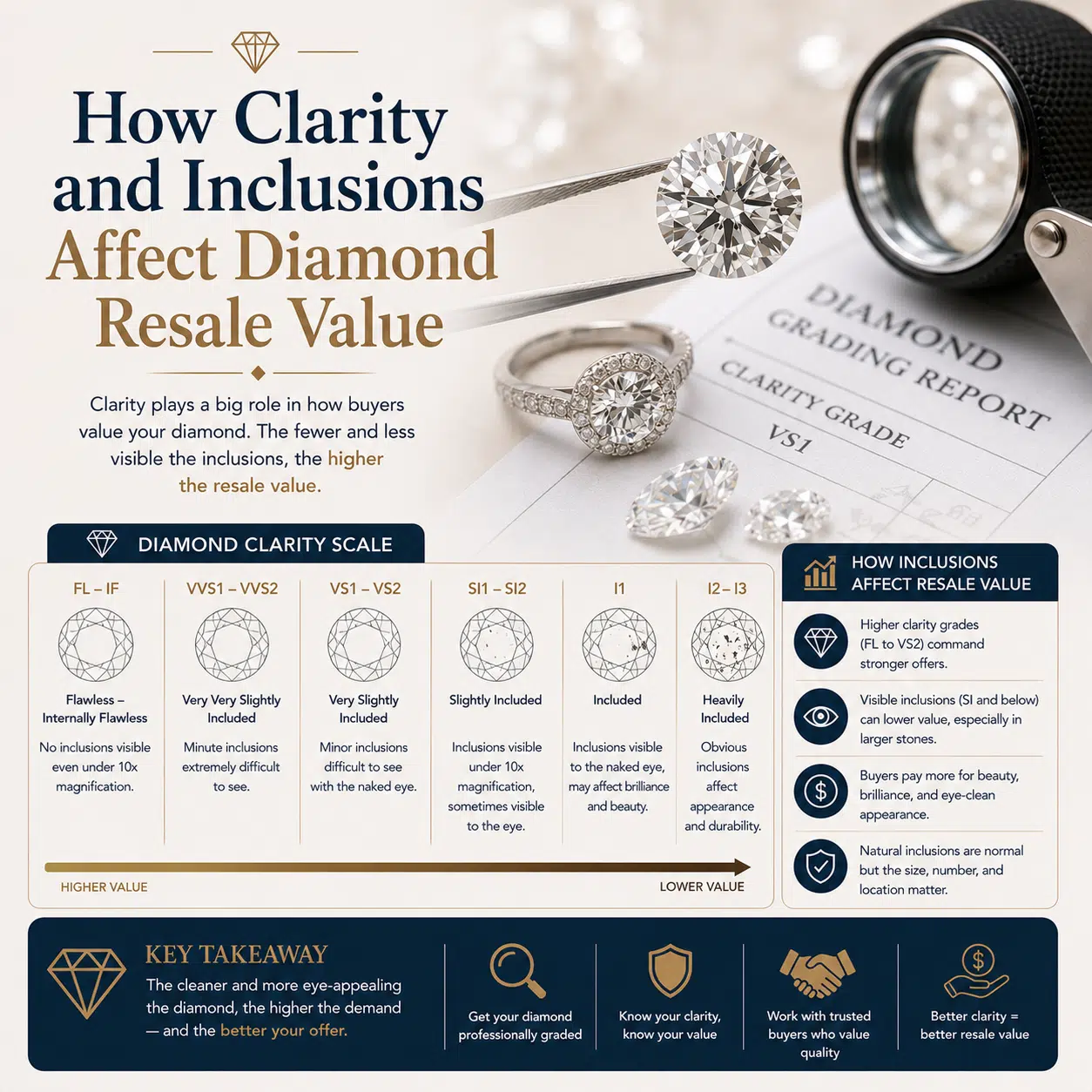
Diamond clarity can influence resale value, but the grade alone does not tell the complete story.
Two diamonds can both receive an SI1 clarity grade while looking very different. One may appear clean without magnification, while the other may contain a visible dark crystal beneath the table. A third SI1 diamond could have a surface-reaching feather near the girdle that raises a durability concern.
Buyers therefore assess more than whether the report says VVS, VS or SI. They consider the type, size, number, position and visibility of the inclusions, together with the diamond’s transparency, condition and structural security.
Clarity must also be considered alongside carat weight, colour, cut, shape, origin, grading report and present demand. A higher clarity grade generally supports a stronger market position when all other characteristics are equal, but it does not guarantee a higher offer than every lower-clarity diamond.
Quick Answer: How Does Clarity Affect Diamond Resale Value?
Higher-clarity diamonds are generally rarer and may command stronger resale offers when compared with diamonds of equivalent carat weight, colour, cut, shape, origin and condition.
The difference between clarity grades is not a fixed percentage. A VS2 diamond may have broader buyer demand than a comparable SI2 diamond, but an attractive, eye-clean SI1 can still be highly marketable. Conversely, a diamond with a technically respectable grade may receive a weaker offer if its main inclusion is dark, centrally positioned or associated with damage risk.
The buyer should examine the complete clarity profile rather than simply applying a standard deduction to the report grade.
What Is Diamond Clarity?
Diamond clarity describes the relative absence of internal characteristics called inclusions and external characteristics called blemishes.
Inclusions may have formed while the diamond crystal was growing or may have resulted from later geological forces and polishing. Examples include crystals, feathers, clouds, needles, pinpoints, twinning wisps, knots and cavities.
Blemishes are confined mainly to the surface. They can include scratches, polish lines, abrasions and extra facets. Some may be minor, while others can affect appearance or condition.
Professional clarity grading is performed under controlled conditions using 10× magnification. The resulting grade considers how noticeable the clarity characteristics are to a trained grader—not merely how many inclusions appear on the report.
Understanding the Diamond Clarity Scale
The GIA clarity scale contains 11 grades, ranging from Flawless to Included.
| Grado de pureza | General meaning and resale relevance |
| Flawless (FL) | No inclusions or blemishes visible to a skilled grader at 10×; exceptionally rare, but value still depends on the complete diamond |
| Internally Flawless (IF) | No inclusions visible at 10×, although minor surface blemishes may be present |
| VVS1 and VVS2 | Minute inclusions that are difficult for a skilled grader to locate; generally strong market positioning |
| VS1 and VS2 | Minor inclusions visible under magnification; often commercially desirable when appearance and condition are attractive |
| SI1 and SI2 | Noticeable inclusions under magnification; eye visibility and inclusion location can strongly influence the offer |
| I1, I2 and I3 | Obvious inclusions that may affect appearance, transparency or durability; require individual assessment |
The scale should not be treated as a price list. A one-grade difference may have a modest or significant effect depending on the diamond’s size, shape and complete quality profile.
How a Clarity Grade Is Determined
A clarity grade is based on five main characteristics: the size, number, position, nature and colour or relief of the inclusions and blemishes.
Size matters because a large inclusion will generally be easier to see than a pinpoint. Number matters, but several tiny scattered pinpoints may have less effect than one prominent feature.
Position can be especially important. An inclusion beneath the centre of the table may be more visible than a similar feature close to the girdle or hidden within the facet pattern. However, an inclusion near the girdle may require careful examination if it reaches the surface or creates a potential durability concern.
Nature refers to the type of clarity characteristic and how it formed. Colour or relief concerns how strongly the inclusion contrasts with the surrounding diamond. A dark crystal can be more noticeable than a colourless feature of similar size.
These factors interact. No single factor determines the grade or resale value in every diamond.
Why Two Diamonds With the Same Clarity Grade Can Receive Different Offers
A clarity grade represents a category, not an identical appearance.
Two VS2 diamonds may contain completely different inclusions. One might have a small feather near the edge that is difficult to see. The other might have a dark crystal positioned closer to the centre.
Both can meet the grading criteria for VS2, yet one may appeal to a broader group of buyers. The difference can become more noticeable when the diamonds are larger or have facet patterns that make internal features easier to see.
Buyers may also consider whether an inclusion is reflected by several facets. One dark crystal can appear multiple times around the diamond, making it look more prominent than its physical size suggests.
Consequently, an accurate resale assessment requires the grading report and the actual stone.
VS vs SI Clarity: Which Is Better for Resale?
When all other characteristics are equivalent, a VS diamond will generally have stronger resale positioning than an SI diamond. VS inclusions are normally less noticeable under magnification and are often invisible without magnification.
That does not mean every VS diamond will receive a dramatically higher offer. An eye-clean SI1 with favourable inclusion placement can still be attractive and commercially liquid. Some buyers deliberately seek diamonds that offer a good face-up appearance without paying for clarity features that cannot be seen in ordinary viewing.
The difference becomes more important when the SI inclusion is easily visible, dark, centrally positioned or associated with reduced transparency or durability. In those circumstances, the buyer may expect a smaller audience or a lower eventual selling price.
A VS-versus-SI comparison must therefore consider the actual inclusion rather than only the letters on the report.
What Does “Eye-Clean” Mean?
An eye-clean diamond has no inclusions that are readily visible to the unaided eye under the viewing conditions being used.
“Eye-clean” is not an official GIA clarity grade. It is a commercial description, and its meaning can vary depending on the observer, lighting, viewing distance, diamond size and whether the stone is viewed face-up or from the side.
A diamond can be eye-clean from the top but show an inclusion from the side. A feature hidden by a prong may become visible if the diamond is removed from its setting. Someone with sharp eyesight may also notice an inclusion that another person does not.
A reputable buyer should not use “eye-clean” as a substitute for the laboratory grade. It is an additional observation about the diamond’s practical appearance.
Does an Eye-Clean SI Diamond Have Good Resale Value?
Potentially, yes. An eye-clean SI1—and occasionally an SI2—can have healthy resale demand when its inclusions do not create transparency or durability concerns.
Such a diamond may offer an appealing balance between appearance and clarity grade. Buyers who focus on visible beauty rather than microscopic rarity may find it attractive.
However, being eye-clean does not erase the clarity grade. The report still affects market comparisons, inventory searches and the price buyers are prepared to pay.
The buyer must also verify why the diamond received the SI grade. A feature that is difficult to see without magnification could still be important if it reaches the surface or affects structural security.
When Higher Clarity Creates More Resale Value
Higher clarity tends to matter more when rarity is central to the diamond’s appeal. This may apply to large natural diamonds, exceptional colour grades, certain important fancy-colour diamonds or stones intended for collectors seeking uncommon quality combinations.
As carat weight increases, inclusions often become easier to see. A clarity difference that seems commercially modest in a small diamond can have a greater financial effect in a three-carat or five-carat stone.
Higher clarity can also improve liquidity because many professional buyers use specific report filters. A natural round brilliant with broadly desirable grades and VS clarity may fit more standard buying requirements than an otherwise similar stone with an obvious SI2 inclusion.
Nevertheless, rarity and liquidity are not identical. A Flawless diamond can be exceptionally rare but require a specialist willing to pay for that rarity.
Does Flawless Mean the Diamond Will Have the Highest Resale Value?
No. Flawless is the highest clarity grade, but clarity is only one value factor.
A smaller Flawless diamond can be worth less than a larger VS diamond. A Flawless stone with weaker colour or cut may receive a lower offer than a well-proportioned diamond with a lower clarity grade.
The origin also matters. A natural Flawless diamond and a laboratory-grown Flawless diamond participate in different resale markets.
Flawless clarity can support a rarity premium, particularly in important natural diamonds, but it does not override every other characteristic.
VVS Clarity and Resale Demand
VVS1 and VVS2 diamonds contain minute inclusions that are difficult for a skilled grader to see under 10× magnification. They generally occupy a strong market position because they combine high clarity with greater availability than Flawless or Internally Flawless diamonds.
The visible difference between VVS and VS may be impossible for many people to detect without magnification. The report distinction can still affect value because it reflects rarity and influences professional inventory comparisons.
Whether a seller recovers a substantial VVS premium depends on the rest of the diamond. Buyers may be more willing to pay for exceptional clarity when it is paired with desirable carat weight, colour, cut and origin.
A VVS grade cannot compensate for poor proportions, damage or weak demand for the diamond’s other characteristics.
VS Clarity and Resale Demand
VS1 and VS2 diamonds are widely considered commercially attractive because their inclusions are minor and are often not visible without magnification.
VS clarity can provide a useful balance between rarity, appearance and liquidity. Many buyers are comfortable purchasing a correctly graded VS diamond without requiring Flawless or VVS clarity.
Within the VS range, inclusion placement still matters. A small, pale inclusion near the edge may be less concerning than a dark feature in a visually sensitive position.
The difference between VS1 and VS2 does not generate a universal price gap. It must be evaluated within the complete diamond.
SI Clarity and Resale Demand
SI1 and SI2 diamonds require closer visual examination because inclusion appearance can vary considerably.
An attractive SI1 can appear clean without magnification and retain broad commercial appeal. Another SI1 may contain a visible crystal that narrows the potential buyer pool.
SI2 diamonds can vary even more. Some have inclusions that are difficult for an untrained observer to see, while others have obvious features or reduced transparency.
Buyers therefore inspect SI diamonds carefully instead of relying exclusively on the report grade. Visibility, durability and overall liveliness often determine how easily the stone can be resold.
Included Diamonds and Resale Value
I1, I2 and I3 diamonds contain obvious inclusions that may affect appearance, transparency, brilliance or durability.
These diamonds can still have resale value. A large natural diamond with a low clarity grade may remain valuable because of its carat weight, colour, shape or potential for recutting.
The buyer may need to account for a smaller resale audience or possible remedial work. If recutting is considered, the expected weight loss, cost, risk and resulting grade must be estimated before an offer is made.
An Included grade should never be treated as an automatic rejection. It indicates that the physical stone needs careful examination.
How Inclusion Position Affects Resale Value
An inclusion beneath the table is often more noticeable because it occupies a prominent viewing area. A dark crystal in this position may influence the offer more than a similar crystal close to the girdle.
An inclusion near the edge can sometimes be concealed by a setting, but concealment is not the same as removal. If the feature reaches the surface, the buyer must evaluate whether it presents a durability concern.
Facet reflections can also affect visibility. A single inclusion may be reflected around the stone, creating the impression of several dark features.
Position must always be considered with the inclusion’s size, nature, relief and the diamond’s facet pattern.
How Inclusion Colour and Relief Affect Value
Relief describes how strongly an inclusion contrasts with the surrounding diamond. A high-relief inclusion is easier to see.
Dark crystals may attract more attention than transparent or colourless features. A black crystal under the table can therefore affect marketability even when it is relatively small.
White or transparent inclusions may be less visible in ordinary viewing, although they can still influence the clarity grade. Some clouds or groups of pinpoints can reduce transparency when sufficiently concentrated.
The relationship is not absolute. Lighting, cut style, location and reflection all affect how prominent an inclusion appears.
Do Inclusions Reduce a Diamond’s Sparkle?
Not every inclusion affects sparkle.
A small inclusion that is invisible without magnification may have little practical effect on light performance. Diamond cut is usually the primary factor governing brightness, fire and scintillation.
Larger, numerous or strongly contrasting inclusions can affect transparency or interrupt the passage of light. This is more commonly relevant in lower clarity grades.
A cloudy or hazy-looking diamond requires physical examination because reduced transparency can result from inclusions, treatments, surface condition or another cause.
Can Inclusions Affect Diamond Durability?
Some inclusions can affect durability, but not every feather, crystal or cloud creates a structural problem.
Surface-reaching fractures, large cavities and certain features close to vulnerable areas may require closer inspection. Their importance depends on size, direction, position and the stresses created by the setting.
Included-grade diamonds are more likely to contain durability-related features, but the grade alone does not confirm that a stone is unsafe.
A professional should examine the diamond before recommending resetting, cleaning, shipping or recutting. Sellers should avoid diagnosing an inclusion from a magnified photograph alone.
Common Diamond Inclusions and Their Potential Effect
Crystals are minerals or other crystals enclosed within the diamond. Their impact depends on size, colour, relief and position. A tiny colourless crystal may be inconsequential, while a dark crystal beneath the table may be more visible.
A feather is a fracture or separation within the diamond. Many feathers are stable and minor, but a large surface-reaching feather in a vulnerable location may require additional attention.
Pinpoints are very small crystals. A few pinpoints may be difficult to locate, while concentrated groups can form a cloud.
Clouds consist of groups of pinpoints or other microscopic features. Some are harmless to appearance, while dense clouds can reduce transparency.
Twinning wisps are irregular features associated with crystal growth. Their effect varies according to how noticeable and extensive they are.
Cavities, knots and chips can reach the surface. These features may influence appearance, condition, setting security or the potential need for repolishing.
The inclusion name alone does not determine value. Its complete presentation within the diamond matters.
Why Diamond Shape Changes Inclusion Visibility
Different facet patterns reveal inclusions differently.
Round, cushion and radiant diamonds use brilliant-style faceting that can create enough reflections and visual activity to make some inclusions less obvious.
Emerald and Asscher cuts have broad, open step facets. Their clear internal views can make inclusions easier to notice, which often increases market preference for higher clarity in these shapes.
An inclusion may also be more noticeable in an elongated oval or pear if it falls within a quiet area of the facet pattern. Conversely, reflections may partly disguise it.
The same numerical clarity grade can therefore have a different practical appearance across shapes.
Why Carat Weight Changes the Importance of Clarity
Larger diamonds provide a larger viewing area. Inclusions can become easier to see, and the financial effect of a grade difference may increase.
A VS2 inclusion in a half-carat diamond may be difficult to locate. In a much larger stone, a VS2 feature may be more apparent, even though it remains within the same grade category.
Large natural diamonds are also rarer, and buyers may demand more detailed verification before committing significant funds.
Clarity should consequently be interpreted in relation to carat weight rather than as an isolated label.
Clarity in Fancy-Colour Diamonds
Clarity remains relevant in fancy-colour diamonds, but colour is often the dominant value factor.
A rare and attractive natural colour can support substantial value even when the diamond contains noticeable inclusions. Buyers may accept a lower clarity grade to obtain the desired hue, tone, saturation and size.
Durability remains important. An inclusion that threatens structural security can reduce value even when the colour is exceptional.
Fancy-colour diamonds require specialised assessment because colour origin, colour distribution, clarity, cut and rarity interact differently from the standard colourless-diamond market.
Clarity in Natural and Laboratory-Grown Diamonds
Both natural and laboratory-grown diamonds can receive clarity grades. Inclusions and growth features occur in both categories, although their types and patterns may differ.
A clarity grade does not establish origin. Laboratory testing and specialised instruments may be required to determine whether the diamond is natural or laboratory-grown.
The resale markets for the two origins are separate. A laboratory-grown VVS diamond should not be valued by applying the price of a natural VVS diamond.
The buyer must confirm origin before using clarity and the other quality characteristics to calculate an offer.
How Clarity Treatments Affect Resale Value
Some diamonds undergo treatments intended to make inclusions less visible.
Fracture filling introduces a glass-like substance into surface-reaching fractures. It can improve apparent clarity, but it does not remove or heal the fracture. The filling can also be affected by heat or jewellery-repair procedures.
Laser drilling creates a narrow channel to reach a dark inclusion so it can be altered or removed. Evidence of laser drilling may be recorded on an appropriate laboratory report.
Treatments must be disclosed because they affect identification, handling, durability considerations and market value. A treated diamond should not be compared directly with an untreated diamond based only on apparent clarity.
Can Cleaning Improve a Diamond’s Clarity Grade?
Cleaning can improve appearance, but it does not normally change the clarity grade.
Oil, lotion and dirt can make a diamond look dull or cloudy. Removing surface contamination may reveal more brightness and make an initial assessment easier.
Cleaning does not remove internal inclusions. Aggressive cleaning can also be risky for damaged, fracture-filled, antique or insecurely mounted diamonds.
If the condition is uncertain, allow a professional to select the appropriate cleaning method.
Does a Grading Report Guarantee the Diamond’s Current Clarity?
No. A grading report describes the diamond at the time it was examined.
A diamond can later become chipped, abraded or damaged. A treatment may also have been performed after the original report was issued.
The buyer must confirm that the physical stone matches the report and that its current condition has not materially changed.
A laser inscription can assist identification, but it does not by itself prove that the diamond is undamaged or establish its present value.
How Mounted Diamonds Are Assessed for Clarity
A setting can conceal part of the diamond. Prongs, bezels and decorative elements may hide inclusions, chips or identifying features.
The metal can also make it difficult to obtain exact weight and colour observations. Reflections from the setting may change how the diamond appears.
An initial valuation may still be possible from the report, photographs and a careful inspection. Professional removal should only be arranged if it is necessary to confirm the final offer.
Do not remove the diamond yourself. An unnecessary removal could damage the stone, setting or value of a branded or antique piece.
Should You Recut a Diamond With a Serious Inclusion?
Recutting can sometimes remove or reduce the effect of an inclusion, but it is not always financially sensible.
The process causes weight loss and may move the diamond below an important carat threshold. It can also reveal additional features or change the colour and clarity assessment.
Consider a fictional 1.03-carat diamond with a chip near the girdle. Removing the damage might produce a more attractive stone, but the finished diamond could weigh less than one carat. The loss of weight-category demand could outweigh the improvement in clarity and condition.
A cutter should estimate the likely finished weight, proportions, grade, risk and market value before any work begins.
Illustrative Example: VS2 vs Eye-Clean SI1
Imagine two fictional natural round brilliant diamonds. Both weigh 1.00 carat and have G colour, Excellent cut and reports from the same respected laboratory.
The first is VS2 with a small feather close to the edge. The second is SI1 with a transparent inclusion that is not visible face-up without magnification.
The VS2 diamond will generally have the stronger market position because of its higher report grade. However, the eye-clean SI1 may remain attractive to buyers seeking a visually clean diamond at a different price point.
The difference in resale offers cannot be predicted through a universal percentage. The buyer must inspect the inclusions, dimensions, condition and current demand for both stones.
Illustrative Example: Two SI2 Diamonds
Consider two fictional 1.50-carat SI2 diamonds with matching colour and cut grades.
The first has scattered, low-relief inclusions that are difficult to notice without close examination. The second contains a dark crystal beneath the table that is visible in ordinary viewing.
Although both reports state SI2, the first diamond may appeal to more buyers and achieve a stronger offer. This example illustrates why the clarity grade is a starting point rather than the entire valuation.
Illustrative Example: The Same Grade in Different Shapes
Suppose a fictional round brilliant and an emerald-cut diamond both receive VS2 clarity grades.
The round’s brilliant facet pattern may make its inclusion difficult to notice. The broad step facets of the emerald cut may provide a clearer view of a similarly graded feature.
The two diamonds should not be compared on clarity alone. Their shape, carat, colour, cut quality, measurements and complete appearance also influence demand.
Illustrative Example: VVS Clarity Versus Carat Weight
Imagine a fictional 0.90-carat VVS2 diamond and a 1.00-carat VS2 diamond with similar colour, cut and origin.
The VVS2 stone has the higher clarity grade, but the VS2 stone reaches the commercially significant one-carat category. If its inclusion is unobtrusive, its additional weight and category demand may produce the stronger offer.
Neither clarity nor carat automatically wins. The buyer considers the marketability of the complete combination.
How to Read Clarity Information on a Diamond Report
Begin with the clarity grade, but also review the report comments and plotting diagram when one is provided.
The plotting diagram can help identify the types and approximate positions of clarity characteristics. It is an identification aid rather than a complete explanation of appearance, durability or value.
Some report formats do not include a full plot. Others may use comments to describe characteristics that are not individually shown.
The report should be verified with the issuing laboratory, and the physical diamond should be matched to its documented measurements and identifying features.
How Clarity Fits Into the Complete Resale Offer
Clarity is one component of a larger valuation.
A buyer also examines carat weight, colour, cut, shape, proportions, fluorescence, origin, grading report, condition and present demand. Jewellery may carry additional value through its metal, maker, craftsmanship or period.
Selling costs, verification requirements and the buyer’s intended resale channel can also affect the net offer.
Our guide to how diamond buyers calculate an offer explains how these factors work together.
How to Obtain an Accurate Clarity-Based Valuation
Submit the complete grading report rather than sending only the page showing the clarity grade. Include clear face-up, side-view and setting photographs, but avoid publicly sharing personal information from invoices or appraisals.
Describe whether the diamond is loose or mounted and disclose known chips, treatments, repairs or replacement history. If the original report has been lost, submit the available information instead of guessing.
A preliminary online assessment may be possible, but a final offer normally requires physical verification. The specialist must confirm the stone’s identity, origin, clarity, condition and report match.
If you have no grading report, read our guide to selling a diamond without a certificate.
Preguntas frecuentes
Does diamond clarity affect resale value?
Yes. Higher clarity can increase rarity, buyer demand and resale value when the other characteristics are equivalent. The effect varies by diamond.
What clarity is best for diamond resale?
There is no single best grade for every seller. FL, IF and VVS grades offer rarity, while VS diamonds often combine strong appearance with broad commercial demand.
Is VS clarity good for resale?
Yes. VS1 and VS2 diamonds generally have minor inclusions and can have healthy resale demand when the remaining characteristics are attractive.
Is an SI1 diamond difficult to sell?
Not necessarily. An eye-clean, structurally sound SI1 can be highly marketable. Inclusion position, relief and visibility will influence the offer.
Is SI2 clarity bad?
SI2 covers a wide range of appearances. Some SI2 diamonds are attractive face-up, while others contain visible inclusions or transparency concerns.
Can an I1 diamond be sold?
Yes. Its value depends on size, colour, cut, origin, inclusion type, condition and whether the inclusions affect transparency or durability.
Are I2 and I3 diamonds worthless?
No. They may retain value through their carat weight, colour or potential for recutting, although obvious inclusions and structural concerns can substantially narrow demand.
What is the difference between an inclusion and a blemish?
An inclusion is internal or extends into the diamond. A blemish is generally confined to the surface.
Are all diamond inclusions natural?
Many inclusions form naturally during diamond growth, but polished diamonds can also contain treatment-related features, laser-drill channels or later damage. Origin and treatment require professional verification.
Do inclusions prove that a diamond is natural?
No. Natural and laboratory-grown diamonds can both contain inclusions or growth features. Appearance alone cannot conclusively establish origin.
Is an eye-clean diamond officially certified as eye-clean?
No. Eye-clean is a commercial description, not an official GIA clarity grade.
Can an SI2 diamond be eye-clean?
Potentially. Visibility depends on the diamond’s size, shape, inclusion position, relief and viewing conditions.
Can a VS2 inclusion be visible without magnification?
It can be in some circumstances, particularly in a large diamond or from certain angles. The grade is based on professional examination at 10× under standard conditions.
Is VVS always worth more than VS?
A comparable VVS diamond will generally have the stronger clarity positioning, but another VS diamond may be worth more because of its carat, colour, cut, shape or origin.
Is Flawless better than Internally Flawless?
Flawless is the higher clarity grade because no inclusions or blemishes are visible at 10×. Internally Flawless permits minor surface blemishes but no visible inclusions.
Does Flawless mean perfect?
It means no inclusions or blemishes are visible to a skilled grader at 10× under specified conditions. It does not mean the diamond is perfect at every magnification or in every value factor.
Why is my diamond graded SI if I cannot see an inclusion?
Clarity grading is performed under 10× magnification. Many inclusions that influence the grade are not readily visible without magnification.
Why can I see the inclusion listed as VS?
Diamond size, inclusion colour, viewing angle and eyesight can affect visibility. Reflections may also make a small inclusion appear in several locations.
Do black inclusions reduce resale value?
They can when they are visible or prominently positioned. Their effect depends on size, number, location and contrast.
Are white inclusions better than black inclusions?
White or transparent inclusions may be less noticeable, but colour alone does not determine impact. Size, position, nature and durability remain important.
Is a feather dangerous?
Not automatically. Many feathers are minor and stable. Large or surface-reaching feathers in vulnerable positions require professional assessment.
Does a cloud make a diamond look hazy?
A dense cloud can affect transparency, but many clouds do not create visible haziness. The physical stone must be examined.
Can a crystal inside a diamond lower its value?
Yes, particularly if it is large, dark, centrally positioned or reflected by several facets. Small low-relief crystals may have little practical effect.
Can inclusions make a diamond break?
Certain extensive or surface-reaching inclusions can affect durability. Most minor inclusions do not mean the diamond will break.
Does clarity affect sparkle?
Small inclusions may have no visible effect. Numerous or significant inclusions can reduce transparency, while cut remains the primary factor controlling light performance.
Are inclusions easier to see in larger diamonds?
Often, yes. Larger diamonds provide a larger viewing area, although actual visibility depends on the feature and facet pattern.
Are inclusions more visible in emerald-cut diamonds?
They can be. Broad step facets provide a clearer view into the stone than many brilliant-style facet patterns.
Does a prong hiding an inclusion improve the clarity grade?
No. A setting can conceal a feature from view, but it does not change the laboratory grade.
Can a mounted diamond receive an accurate clarity assessment?
A preliminary assessment may be possible, but the setting can hide inclusions or damage. Loose examination may be required for definitive grading or a final offer.
Should I remove my diamond from its ring before selling?
No. Submit the complete piece first and allow a professional to decide whether removal is necessary.
Can cleaning remove an inclusion?
No. Cleaning removes surface dirt and oil, not internal clarity characteristics.
Can polishing improve clarity?
Minor surface blemishes may sometimes be reduced through polishing, but the process removes material. Its financial benefit and weight-loss risk should be assessed first.
Can a diamond be recut to remove an inclusion?
Sometimes. Recutting may remove damage or an inclusion, but it causes weight loss and may change the diamond’s other grades.
Do clarity treatments affect resale value?
Yes. Fracture filling and laser drilling can affect marketability, handling and value. Treatments must be disclosed.
Is fracture filling permanent?
Fracture filling does not heal the fracture and can be damaged by heat or certain repair procedures. The treatment requires disclosure and appropriate care.
Can a fracture-filled diamond have a standard GIA grading report?
GIA does not issue its standard diamond grading report for fracture-filled diamonds. An appropriate identification document may describe the material and treatment.
What does “clarity enhanced” mean?
It generally indicates that a treatment has been used to alter the visibility of inclusions. The exact treatment should be identified rather than relying on the general phrase.
Does laser drilling mean the diamond is fake?
No. A laser-drilled diamond can still be a real diamond. The drilling is a treatment used to reach or alter an inclusion and should be disclosed.
Does fluorescence affect clarity?
No. Fluorescence is a separate characteristic, although strong visual effects or transparency concerns should be individually assessed.
Does the clarity plot show every inclusion?
Not necessarily. A plot helps identify important characteristics, but it should not be treated as a complete microscopic map of the diamond.
Can an old grading report still be used?
Yes, but the buyer must confirm that it matches the diamond and that the stone has not been damaged or treated since grading.
What if my diamond has no clarity grade?
It can still be submitted for assessment. Physical examination may be needed to estimate its quality and determine whether laboratory grading is worthwhile.
Does the grading laboratory affect clarity value?
Yes. Buyers consider the laboratory and its grading standards rather than assuming every VS2 or SI1 grade is directly equivalent.
Can photographs determine clarity?
Photographs can reveal obvious inclusions and support an initial review, but they rarely provide enough information for definitive grading.
Does a macro photograph make an inclusion look worse?
It can. Extreme magnification may make a tiny feature appear prominent even when it is invisible during normal wear.
Is an SI1 diamond always worth less than a VS2?
When all other factors are truly equivalent, VS2 generally has stronger clarity positioning. In real transactions, differences in size, cut, colour, appearance and condition can change the result.
Is clarity more important than carat weight?
Neither can be considered alone. A larger lower-clarity diamond may be worth more than a smaller high-clarity stone, depending on the complete quality combination.
Is clarity more important than cut?
Cut primarily controls light performance, while clarity concerns inclusions and blemishes. Their relative effect depends on the individual diamond.
Is clarity more important in a three-carat diamond?
It can have a greater financial impact because inclusions may be easier to see and large high-clarity natural diamonds are rarer.
Does clarity affect fancy-colour diamond value?
Yes, but colour is often the dominant factor. Durability-related inclusions can still reduce value significantly.
Does a high insurance appraisal prove strong clarity value?
No. An insurance appraisal generally concerns replacement cost. It does not guarantee a resale offer.
Will a buyer pay the amount shown on my appraisal?
Not necessarily. A resale offer reflects the verified diamond and current secondary-market demand, not the replacement figure stated for insurance.
Can a buyer change an online estimate after inspecting the inclusions?
Yes. A preliminary estimate may change if inspection reveals visible inclusions, damage, treatments or a mismatch with the submitted report. Any adjustment should be explained.
How should I compare clarity-based offers?
Compare written net offers and ask how the buyer treated the diamond’s grade, inclusion visibility, condition and any proposed recutting risk. Also compare fees, payment and return terms.
What should I submit for an online clarity assessment?
Provide clear photographs, the complete grading report and information about whether the diamond is loose or mounted. Disclose any known treatment, chip or repair.
Can Sothis value an eye-clean SI diamond?
Yes. The assessment can consider the laboratory grade, actual inclusion visibility, durability, complete quality characteristics and present buyer demand.
Receive a Market-Based Offer for Your Diamond
Your clarity grade is an important part of the valuation, but the letters on a report cannot reveal the entire market value.
Sothis Diamonds can assess the grade alongside the inclusions’ position and visibility, the diamond’s condition, origin, carat weight, colour, cut and present demand.
Submit clear photographs and any available grading report for a private initial review. After the diamond has been physically verified, you can receive a market-based offer that you remain free to accept or
Solicite una valoración gratuita y sin compromiso de su diamante.
