


Old Mine Cut vs Old European Cut: How Antique Diamonds Are Valued for Resale

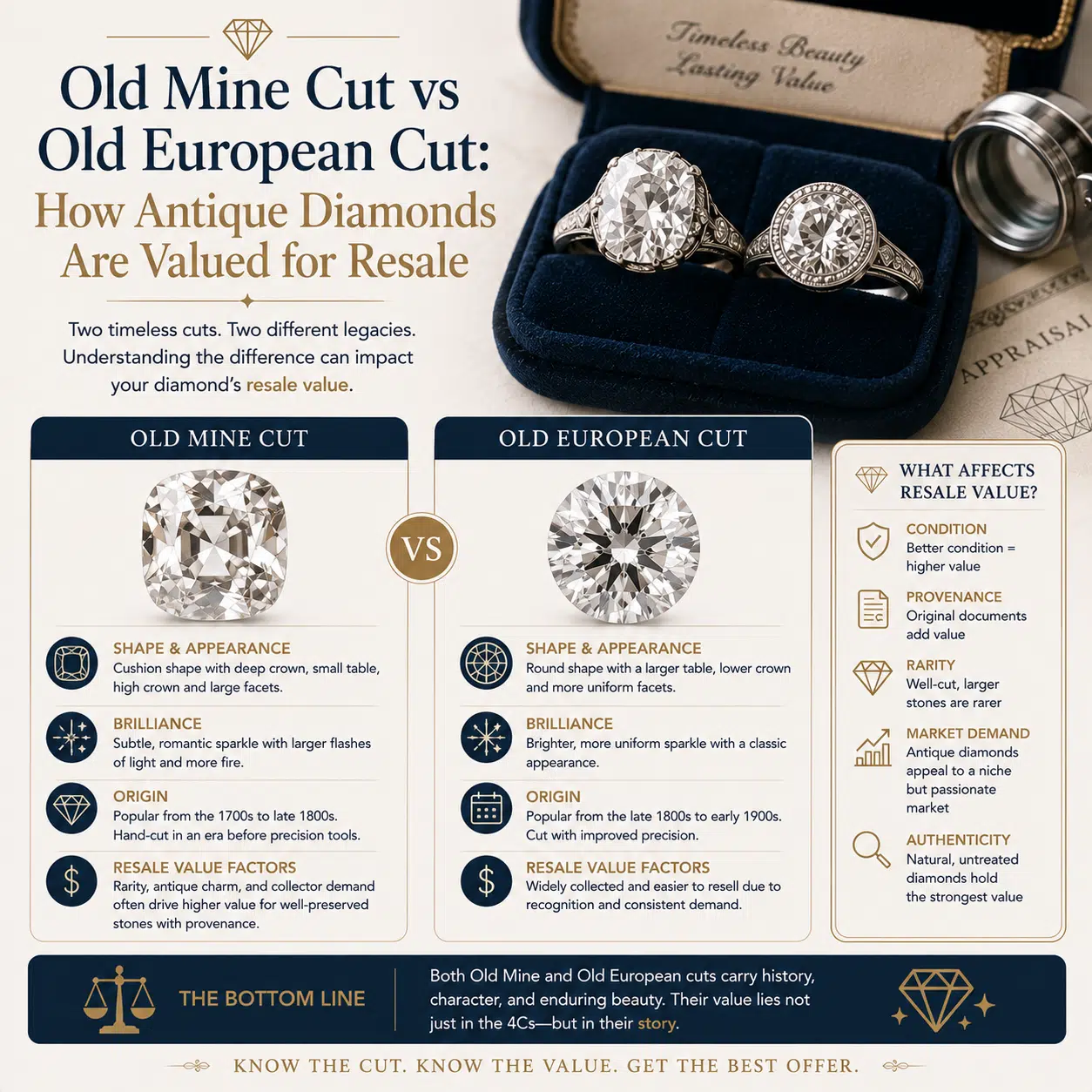
Old mine cut and old European cut diamonds were created before the modern round brilliant became the dominant diamond style. Their broad facets, high crowns, visible culets and individually shaped outlines give them a different appearance from modern precision-cut stones.
These differences can create collector demand, but the words “old mine cut” or “old European cut” do not automatically guarantee a high resale value.
A buyer must examine the diamond’s exact weight, colour, clarity, proportions, condition, natural origin and visual appeal. The original setting, age, maker and documented provenance may also make the complete antique jewel worth more than the diamond alone.
Before selling, keep the diamond in its existing setting and obtain an assessment that considers both the stone and the complete jewellery.
Quick Answer: Is an Old Mine Cut or Old European Cut More Valuable?
Neither cut is always more valuable.
Old European cut diamonds are generally rounder and closer in outline to modern round diamonds, which can make some examples easier to market. Old mine cut diamonds have softer, often squarish or cushion-like outlines that can attract buyers seeking a distinctive hand-cut appearance.
The final value depends on the individual diamond rather than its name. Carat weight, colour, clarity, face-up appearance, condition, girdle durability, documentation and current demand can all change the result.
A beautiful old mine cut can be worth more than a less attractive old European cut of similar weight. The reverse can also be true.
Old Mine Cut vs Old European Cut at a Glance
| Characteristic | Old mine cut | Old European cut |
| Typical outline | Soft square, cushion-like or irregular | Predominantly round |
| Historical association | Georgian and much of the Victorian period | Late Victorian, Edwardian and Art Deco periods |
| Crown | Usually high | Usually high |
| Table | Generally small | Generally small |
| Culet | Often large and clearly visible | Usually visible but commonly smaller |
| Facet appearance | Broad, individually proportioned facets | Broad facets with a more circular arrangement |
| Hüftgürtel | May be irregular and very thin in places | May also show irregular or thin areas |
| Face-up pattern | Chunky flashes with individual character | Broad flashes with a rounder pattern |
| Modern cut grade | Usually not directly comparable | Should not automatically be judged as a standard modern round brilliant |
| Resale value | Depends on the individual stone and market | Depends on the individual stone and market |
These are general characteristics. Historical diamonds were cut by hand, and individual stones may not fit every expected feature.
What Is an Old Mine Cut Diamond?
An old mine cut diamond is an early brilliant style commonly associated with jewellery from the Georgian period through much of the Victorian era.
It typically has a soft square or cushion-shaped outline, high crown, small table, broad facets and a large open culet. Many examples have deeper proportions and a girdle that varies considerably in thickness.
Old mine cut diamonds were shaped by hand, often following the natural form of the rough diamond. Cutters generally wanted to retain useful weight while producing an attractive stone using the tools and lighting available at the time.
As a result, two old mine cut diamonds of the same weight may have noticeably different outlines, facet arrangements and face-up dimensions.
The term is sometimes abbreviated to OMC. It should not be confused with every modern cushion cut, even when a new cushion diamond is designed to imitate an antique appearance.
What Is an Old European Cut Diamond?
An old European cut diamond is an early round brilliant style that became prominent in the late nineteenth and early twentieth centuries.
It generally has a circular outline, high crown, small table, deep pavilion and visible culet. Its broad facets can create slower, larger flashes of light than many modern round brilliant diamonds.
Advances in diamond-cutting equipment made it possible to create more consistently round girdles, although old European cut diamonds still show individual variation.
The style is commonly found in late Victorian, Edwardian and Art Deco jewellery. It is often abbreviated to OEC.
An old European cut is a historical stage in the development of the modern round brilliant, but it should not be treated as an incorrectly proportioned modern stone.
What Is the Main Difference Between OMC and OEC?
The easiest general distinction is the outline.
An old mine cut is normally soft-square, cushion-like or irregular, while an old European cut is more circular. The old mine cut also commonly has a larger culet and more individually shaped outline.
The old European cut represents a later stage in cutting development, with a rounder girdle and a somewhat more organised circular facet pattern.
However, historical diamond cutting developed gradually rather than changing on one specific date. Some diamonds display characteristics from more than one style.
For that reason, identification should not be based on a single feature such as the culet or table.
What Is a Transitional-Cut Diamond?
Transitional cuts sit between old European cuts and modern round brilliants. They reflect a period during which diamond cutters were moving towards more standardised proportions, facet arrangements and light performance.
A transitional diamond may have a round outline and some older features while displaying a smaller culet, larger table or more modern facet structure.
The term is applied inconsistently in the market. One seller may describe a stone as late old European, while another calls it transitional.
The precise label matters less than accurately describing the diamond’s measurable characteristics, visual appearance and condition.
Can You Identify an Old Cut From Photographs?
Photographs may support a preliminary opinion, but they cannot always confirm the cutting style.
Camera angle, lighting, reflections and the setting can change the apparent outline and size of the culet. A cushion-shaped stone may also be a modern cushion rather than an old mine cut.
A professional should examine the facet arrangement, table, crown, pavilion, girdle, culet and overall outline. Measurements can help distinguish between styles and reveal whether the diamond was later repolished.
When the stone remains mounted, parts of the girdle and pavilion may be hidden. The initial description may therefore remain provisional until closer physical examination is possible.
Does a Large Culet Mean the Diamond Is Damaged?
Not necessarily.
The culet is the facet or point at the bottom of the diamond’s pavilion. In many antique diamonds, the culet was polished into a visible facet rather than brought to a sharp point.
When viewed face-up, a large open culet can appear as a small dark circle or “hole” in the centre. This may be an original cutting characteristic rather than damage or a missing piece.
The culet should still be examined for abrasion or chipping. A historically appropriate open culet and a damaged pavilion are not the same thing.
How Old Mine Cut Diamond Resale Value Is Calculated
There is no fixed old mine cut diamond price per carat that applies to every stone.
A buyer begins by confirming that the stone is a natural diamond rather than a laboratory-grown diamond or simulant. The diamond’s weight, measurements, colour, clarity, cutting style, condition and face-up appearance are then assessed.
The buyer considers how appealing the outline and facet pattern are to current antique-diamond buyers. Some asymmetry can be expected in a hand-cut diamond, but an extremely unbalanced outline or distracting facet pattern may reduce marketability.
Girdle condition is particularly important. Old mine cut diamonds may have very thin areas that are vulnerable to chips. Existing damage and removal risk can materially affect the offer.
If the diamond remains in original jewellery, the setting, age, maker, craftsmanship and provenance should be considered before a separate stone value is calculated.
How Old European Cut Diamond Value Is Calculated
An old European cut diamond is also valued individually.
Its roundness, face-up spread, crown, table, culet, facet pattern and visual performance are considered alongside carat weight, colour, clarity and condition.
Some buyers prefer old European cuts with a recognisably antique appearance rather than examples that look close to modern round brilliants. Other buyers may prioritise a balanced circular outline and attractive face-up dimensions.
A deep old European cut can carry substantial weight in its depth while appearing smaller from above than a modern round brilliant of the same carat weight. The buyer must therefore consider both the weight and the visible size.
The diamond’s final market position depends on how its complete combination of features compares with current demand.
Why Carat Weight Matters
Carat measures weight, not face-up diameter.
Old mine and old European cut diamonds often have deeper proportions than modern diamonds. Two stones of identical weight may therefore appear different in size when viewed from above.
Important carat thresholds can affect market demand, but the buyer must use the diamond’s exact weight. A mounted-stone estimate may not be precise enough to establish whether the diamond is above or below a threshold.
Professional removal might provide an exact weight, but it should not happen automatically. The risk to an old diamond and setting must be considered first.
Why Face-Up Size Matters
Buyers do not evaluate carat weight in isolation. They also consider how much visual presence the diamond provides.
A deeply cut old European diamond may retain more weight below the girdle, producing a smaller face-up diameter. An old mine cut with an irregular outline may have different length and width measurements even when its weight is similar.
A smaller face-up appearance does not make the diamond undesirable, but it can affect comparisons with other available stones.
The proportions should also be considered as part of the diamond’s historical character. Applying a modern spread formula without context can undervalue what makes the stone distinctive.
How Colour Affects Antique Diamond Value
Colour remains an important value factor, but old-cut diamonds can show colour differently from modern round brilliants.
Their broad facets, open culets and deeper proportions may make body colour more noticeable. The colour of the setting can also influence how warm or colourless a mounted diamond appears.
Higher colour grades may support value, but many antique-diamond buyers appreciate warmer colours when they complement the cutting style and period setting.
A warm appearance should not automatically be marketed as “champagne,” “fancy colour” or another commercial term. Fancy-colour status requires appropriate gemmological assessment.
How Clarity Affects OMC and OEC Value
Clarity considers internal inclusions and external blemishes. Their size, type, position and visibility all matter.
Broad antique facets can make some inclusions easier to notice, particularly when they sit beneath the table. Other inclusions may be less distracting within the diamond’s slower pattern of light.
A lower clarity grade does not automatically make an antique diamond undesirable if the stone appears attractive and has no serious durability concern.
Buyers pay close attention to inclusions near thin girdle areas, open fractures and features that could worsen during removal or resetting.
Should Antique Diamonds Be Judged by Modern Cut Grades?
Not in the same way as standard modern round brilliant diamonds.
The GIA cut grade is provided for standard round brilliant diamonds that fall within the applicable system. Antique old mine cuts and old European cuts were fashioned using different proportions and objectives.
A historical diamond may therefore have colour, clarity, polish and symmetry information without receiving a modern Excellent-to-Poor cut grade.
The absence of a modern cut grade does not mean the diamond was badly cut or has no value. Its appearance, construction, historical style and market demand must be assessed directly.
Likewise, a seller should not describe an old European cut as “Excellent cut” merely because it looks attractive. Use the terminology shown on the grading report and explain the visual characteristics separately.
Do Polish and Symmetry Matter?
Yes, but they require context.
Historical hand-cut diamonds can have irregular facet junctions, asymmetrical outlines and variations that would be unusual in a precision-cut modern stone. Some variation contributes to their individual character.
Poor later polishing, severe abrasion or obvious facet damage can still reduce value. The buyer must distinguish original hand-cut variation from wear, damage or an unsuccessful alteration.
A highly symmetrical antique diamond is not automatically more valuable if repolishing removed too much weight or erased its historical appearance.
Why Girdle Condition Is Important
The girdle is the diamond’s outer edge. Old mine cuts can have exceptionally thin or irregular girdles, and old European cuts may also show vulnerable areas.
A chip near the girdle can affect weight, appearance, setting security and possible recutting options. Very thin sections can create additional risk during removal and resetting.
Examine the diamond before cleaning or handling it extensively. If the ring’s claws are worn, store the jewellery securely and avoid wearing it until the setting has been checked.
Do not attempt to push or rotate the stone inside its setting to inspect the girdle.
Does Fluorescence Affect Antique Diamond Value?
It can, but fluorescence should not be treated as automatically positive or negative.
The effect depends on its strength, colour, the diamond’s body colour, appearance and current buyer preferences. Some fluorescent diamonds appear completely normal in everyday lighting.
An ultraviolet reaction should not be used as a home test for age, natural origin or value. Natural and laboratory-grown diamonds can require more advanced identification methods.
A grading report may record fluorescence, but the buyer should still assess the actual stone.
Does a GIA, IGI or HRD Report Help?
A recognised grading report can make an old-cut diamond easier to describe and compare. It may confirm natural origin, exact weight, measurements, colour, clarity, polish, symmetry, fluorescence and other recorded characteristics.
The report does not state a resale value or prove the complete history of the jewellery.
Laboratory terminology may also differ from informal dealer language. A stone described by its owner as an old mine cut could receive a different formal shape and cutting-style description after examination.
The report number and diamond should be verified together. A report that describes a similar stone is not enough.
Should You Remove an Antique Diamond for Grading?
Not before the complete piece has been examined.
Certain full diamond-grading reports require a loose stone because a setting can obscure colour, clarity, weight, girdle condition and treatment evidence.
Removing an antique diamond can damage very thin girdle areas, old claws or a historically important mounting. It may also reduce the value of a complete signed or period jewel.
Begin with an assessment of the mounted jewellery. If the likely benefit of exact laboratory grading exceeds the removal cost and risk, professional removal can then be discussed.
Can a Mounted Old-Cut Diamond Be Valued?
Yes, although some characteristics may need to be estimated.
Measurements can support an approximate weight range, while visual examination can provide information about colour, clarity, cut style and condition. The setting may limit what can be seen.
An initial mounted assessment may be sufficient to decide whether further work is commercially sensible.
Any online or mounted estimate should state its limitations. A final offer may change if professional removal reveals a different weight, damage or characteristics hidden by the setting.
Does the Original Setting Increase Value?
It can.
An old mine or old European cut diamond in a period-appropriate setting may appeal as complete antique jewellery. Precious metal, side stones, craftsmanship, maker, condition and provenance can all contribute.
A simple or heavily altered setting may add mainly material value. A rare signed Art Deco ring or an intact Victorian jewel may have stronger value as a complete object.
Do not compare an offer for the loose centre diamond with an offer for the complete ring unless both buyers explain what is included.
For the complete preservation process, read Selling Vintage or Antique Diamond Jewellery Without Losing Provenance Value.
Does Provenance Affect the Diamond’s Value?
Provenance can affect the complete jewel’s collector value when it is credible, relevant and documented.
A connection to a recognised maker, owner, collection or historical event may attract additional interest. Ordinary family ownership history can also support age and authenticity, even when it does not create a large premium.
Provenance does not change the diamond’s physical grades. It adds context to the object in which the diamond appears.
A loose old-cut diamond without documentation may still have value, but claims about a famous origin should not be made without evidence.
Should an Old Mine or Old European Diamond Be Recut?
Recutting should only be considered after comparing the existing stone with the predicted result.
A recut may remove chips or improve symmetry, but it also removes carat weight. The finished diamond could fall below a commercially important weight threshold.
The process can erase the old-cut appearance that attracts antique-diamond buyers. It also carries a risk that an inclusion, fracture or thin girdle will cause an unexpected result.
Obtain an estimate of expected finished weight, shape, costs and value before approving the work. Compare that outcome with the current value of the intact diamond and setting.
Can a Recut Always Improve Resale Value?
Nein.
A damaged diamond with limited demand may benefit from a carefully planned recut. A beautiful, undamaged old-cut diamond could lose collector appeal if converted into a smaller modern brilliant.
An improvement in symmetry or brilliance does not automatically compensate for lost weight, cutting cost and lost historical character.
The decision should be based on the actual stone, not a general belief that modern cutting is always better.
Illustrative OMC and OEC Valuation Examples
The following examples are fictional and demonstrate valuation principles. They do not predict a particular selling price.
Example 1: Similar Weight, Different Condition
An old mine cut and an old European cut have similar estimated weights. The old European cut has a more regular outline, but it also has a significant girdle chip.
The old mine cut is warmer and less symmetrical but remains intact and visually attractive. Its condition and individual character may produce the stronger offer despite its less regular outline.
Example 2: A Deep Old European Cut
A one-carat-range old European cut has a high crown and deep pavilion. It appears smaller from above than a modern round diamond of comparable weight.
The buyer considers both its exact weight and face-up appearance. The deep proportions are not automatically treated as damage, but they influence its market comparison.
Example 3: An Old Mine Cut in a Signed Ring
A softly square old mine cut remains in a signed period ring with matching side stones and original documents.
Removing and selling the centre diamond alone could overlook brand, design and provenance value. The complete jewel is authenticated and valued before any separation is considered.
Example 4: A Diamond Described Incorrectly Online
A seller lists a modern cushion diamond as an old mine cut because it has a cushion outline.
Professional examination shows modern facet construction and no reliable antique provenance. The stone may still be valuable, but it should be marketed according to what it is rather than an unsupported historical description.
Example 5: A Proposed Recut
An old European cut has abrasion and a small chip. A cutter believes it can be converted into a cleaner modern round brilliant, but the predicted finished weight is substantially lower.
The owner compares the current antique-diamond offer with the estimated recut value after weight loss, fees and risk before making an irreversible decision.
How to Prepare an Antique-Cut Diamond for Valuation
Keep the diamond in its existing setting unless it is already loose. Do not polish, recut or reset it before the initial assessment.
Collect every grading report, appraisal, receipt, repair record, old photograph and fitted case. Photograph the ring or jewellery from the front, side and underside, including hallmarks and visible damage.
If the diamond is loose, keep it in an individually labelled gem container or folded diamond paper. Do not store several loose stones together where thin girdles can strike each other.
State whether “old mine,” “old European” or another description comes from a report, appraisal, family record or your own observation.
Request a private, no-obligation antique jewellery valuation.
Comparing Offers for an Antique-Cut Diamond
Ask each buyer how the cutting style was identified and whether the figure is for the diamond alone or the complete jewellery.
Determine whether the buyer considered exact or estimated carat weight, condition, setting, side stones, maker and provenance. Ask what remains to be verified before the offer becomes final.
Auction estimates, consignment asking prices and immediate purchase offers represent different transaction models. Compare commission, insurance, payment timing, return terms and the final amount you would receive.
Avoid buyers who treat an old-cut diamond only as an incorrectly proportioned modern stone or who propose recutting it before explaining the expected weight loss and commercial reasoning.
Häufig gestellte Fragen
What does OMC mean?
OMC is a common abbreviation for old mine cut.
What does OEC mean?
OEC is a common abbreviation for old European cut.
Is an old mine cut the same as an old European cut?
No. Old mine cuts are generally cushion-like or softly square, while old European cuts are predominantly round.
Which came first, OMC or OEC?
Old mine cutting is generally associated with an earlier period. Old European cuts became prominent later as cutting equipment allowed more consistently round girdles.
Are all old mine cuts antique?
Many genuine old mine cut diamonds are antique, but modern diamonds can be cut in an old-mine-inspired style. The facet style alone does not prove the date.
Are all old European cuts antique?
Many are antique or early vintage stones. However, historical style and actual age should not be assumed to be identical.
Which is more valuable, an old mine or old European cut?
Neither is always more valuable. The individual diamond’s weight, colour, clarity, condition, appearance and market demand determine the result.
Do old European cuts sell more easily?
Their round outline may appeal to a broad audience, but marketability still depends on the individual diamond and offer terms.
Are old mine cut diamonds rare?
Genuine examples are no longer produced as historical objects, but rarity and value depend on size, quality, condition and demand.
Are old-cut diamonds worth more than modern diamonds?
Not automatically. Some command collector interest, while others trade below comparable modern stones. Each diamond requires individual assessment.
Is an old mine cut a cushion cut?
It generally has a cushion-like outline and influenced modern cushion styles, but it should not be treated as identical to every modern cushion diamond.
Is an old European cut a round brilliant?
It is an early round brilliant style and predecessor of the modern round brilliant. Its proportions and appearance are typically different.
What is a transitional-cut diamond?
It is a style showing characteristics between old European cutting and the modern round brilliant. Usage of the term can vary.
Can a diamond be between OMC and OEC?
Yes. Historical cutting developed gradually, and some stones display characteristics associated with more than one category.
Can photographs confirm an old mine cut?
They may support an initial opinion, but physical examination and measurements may be required.
Why does my antique diamond have a dark centre?
A visible open culet can look dark from above. Lighting, dirt, proportions or damage can also affect the centre, so the stone should be examined.
Is an open culet bad?
No. It is a recognised characteristic of many antique cuts. Its size and effect on appearance still form part of the assessment.
Why does my old European cut look small for its weight?
Its deeper proportions may place more weight below the girdle, resulting in a smaller face-up diameter.
Do old mine cuts sparkle less?
They generally produce a different pattern of light, with broader flashes rather than the smaller, faster scintillation associated with many modern brilliants.
Are OMC diamonds designed for candlelight?
Historical old cuts are often associated with broader flashes that can look attractive in low or warm lighting. Their appearance should still be evaluated under several lighting conditions.
Does asymmetry reduce old mine cut value?
It can when distracting or extreme, but some hand-cut variation is expected and may contribute character.
Does colour affect old European cut value?
Yes. Colour remains an important factor, although some buyers appreciate warmer colours in antique cuts.
Are warmer old-cut diamonds valuable?
They can be. Value depends on the complete combination of colour, size, clarity, appearance, condition and demand.
Can I call a warm old-cut diamond “fancy colour”?
Not without appropriate grading. Ordinary D-to-Z body colour and fancy-colour diamond terminology are different.
Does clarity matter in old mine cuts?
Yes. Buyers consider inclusion visibility, durability and position. An attractive eye-clean appearance may be commercially important.
Do old cuts hide inclusions?
Not consistently. Broad facets can make some inclusions more visible, particularly beneath the table.
Do antique diamonds receive modern cut grades?
Not necessarily. Modern cut grading applies to qualifying standard round brilliant diamonds, not every historical cutting style.
Does no cut grade mean the diamond is poorly cut?
No. The diamond may fall outside the applicable modern cut-grading category.
Do polish and symmetry grades matter?
Yes, but they must be interpreted in the context of a hand-cut historical diamond.
Are very thin girdles common in old mine cuts?
They can occur. Thin areas require careful handling because they may be more vulnerable to chipping.
Can an old European cut also have a thin girdle?
Yes. Every old diamond should be examined individually for vulnerable areas.
Can a chipped antique diamond still be sold?
Potentially. The location and severity of the damage, recutting options and remaining market demand must be evaluated.
Should I repair a chipped diamond before selling?
Do not approve recutting or repolishing before receiving specialist advice and a predicted finished weight.
Should I remove the old-cut diamond from its ring?
No. Submit the complete ring first so setting, condition and provenance value can be considered.
Can an OMC or OEC be valued while mounted?
Yes, but weight and grades may be estimated. A final result may require closer examination or professional removal.
Do I need a GIA report to sell an old-cut diamond?
No. A recognised report can help, but many antique diamonds do not have modern documentation.
Will GIA call my diamond an old mine cut?
The formal shape and cutting-style description depends on the diamond’s observed characteristics and current laboratory terminology.
Does a grading report prove the diamond is antique?
No. It describes the stone but does not normally establish when it was cut or its ownership history.
Does a laser inscription reduce antique value?
It depends on the stone, inscription and market. An inscription can aid identification, but any proposed inscription should be discussed before altering a historically important diamond.
Can an old setting contain a modern diamond?
Yes. Stones can be replaced during repairs or redesign. The setting’s age does not prove the centre diamond’s age.
Can an antique setting contain a lab-grown diamond?
A laboratory-grown diamond could have been added later. Professional screening may be necessary.
Does provenance increase OMC or OEC value?
It can when credible documentation connects the stone or complete jewel to an important maker, owner, period or collection.
Is an old appraisal enough to establish value?
No. It may help identify the diamond, but the current resale value depends on verified characteristics and present demand.
Is insurance value the same as resale value?
No. Insurance value generally concerns replacement, while a resale offer reflects what a buyer will pay now.
Should I sell the diamond loose or in its antique setting?
Have both valued first. A period, signed or well-preserved setting may add important value.
Is a gold buyer suitable for an antique diamond ring?
A gold buyer may focus on metal weight and overlook old-cut diamond, craftsmanship and provenance value.
Is auction suitable for old-cut diamonds?
It may suit exceptional, large, signed or strongly provenanced items. Fees, timing, reserve terms and buyer demand must be considered.
Can I sell an old mine cut diamond online?
You can begin with photographs and documents, but a final offer usually requires physical verification.
How should I ship a loose antique diamond?
Use an agreed insured process and secure individual gem packaging. Do not allow the diamond to move freely or contact other stones.
Can Sothis Diamonds assess both OMC and OEC diamonds?
Yes. Old-cut diamonds and complete antique jewellery can be submitted for an initial review, subject to physical verification and current buying criteria.
Final Thoughts
Old mine cut and old European cut diamonds should be valued as historical cutting styles—not as unsuccessful modern diamonds.
An old mine cut’s soft outline and large culet can create strong individual character. An old European cut’s circular form and broad facet pattern can provide a different type of antique appeal.
Neither name guarantees a particular price. The most important factors are the actual diamond’s weight, colour, clarity, condition, appearance, documentation and present market demand.
Before selling or considering a recut, have the diamond and its complete setting assessed together. Once an old stone is removed or reshaped, its original historical context cannot always be recovered.
Request a private, no-obligation antique jewellery valuation.
