


Wiederverkaufswert von natürlichen und im Labor gezüchteten Diamanten: Was sollten Verkäufer erwarten?

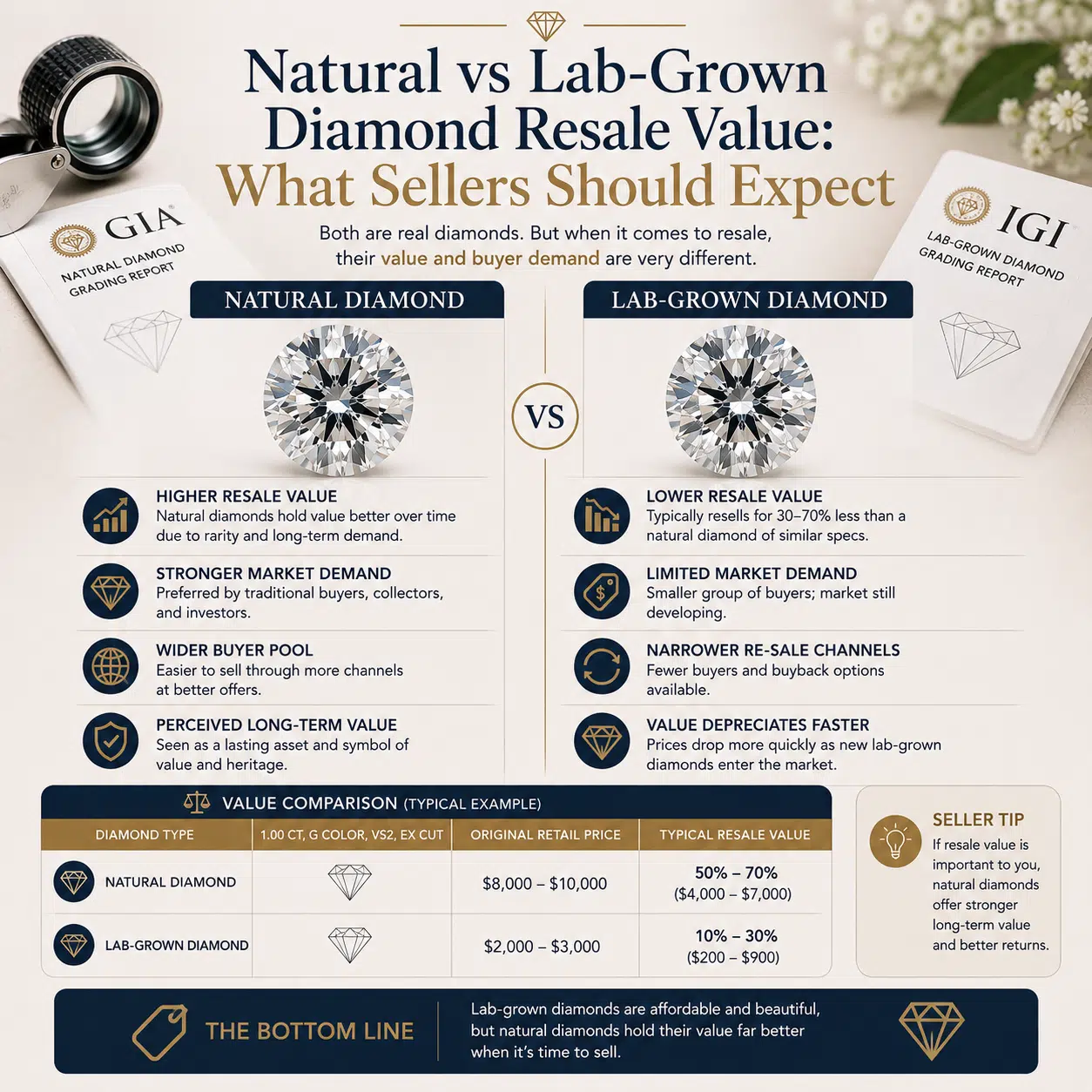
Natürliche und im Labor gezüchtete Diamanten können bei Betrachtung ohne spezielle Ausrüstung nahezu identisch aussehen. Beide können farblos und hervorragend geschliffen sein und mit einem anerkannten Bewertungsbericht geliefert werden. Ihre Wiederverkaufsmärkte sind jedoch nicht gleich.
Natürliche Diamanten verfügen im Allgemeinen über einen breiteren und etablierteren Sekundärmarkt. Auch im Labor gezüchtete Diamanten können verkauft werden, allerdings reagieren Wiederverkaufsangebote in der Regel stärker auf den Preis und die Verfügbarkeit vergleichbarer, neu hergestellter Steine.
Das bedeutet nicht, dass jeder natürliche Diamant einen hohen Wiederverkaufswert hat oder dass jeder im Labor gezüchtete Diamant wertlos ist. Der Betrag, den ein Verkäufer erhalten kann, hängt vom jeweiligen Diamanten, seiner Dokumentation, seinem Zustand, der Fassung und der Anzahl der Käufer ab, die derzeit an diesem bestimmten Schmuckstück interessiert sind.
Schnelle Antwort: Welcher Diamant hat den höheren Wiederverkaufswert?
Natürliche Diamanten behalten im Allgemeinen einen höheren Wiederverkaufswert als vergleichbare im Labor gezüchtete Diamanten. Ihre geologische Herkunft, ihre begrenzte natürliche Verfügbarkeit und der etablierte internationale Handelsmarkt sorgen in der Regel für einen größeren Kreis potenzieller Käufer.
Im Labor gezüchtete Diamanten befinden sich in einer anderen Wiederverkaufssituation. Die Produktion kann ausgeweitet werden, die Herstellungstechnologie entwickelt sich weiter und Käufer können häufig neu produzierte Steine zu wettbewerbsfähigen Preisen erwerben. Ein gebrauchter Labordiamant muss daher direkt mit leicht verfügbaren neuen Steinen konkurrieren.
Für keine der beiden Diamantarten gibt es einen garantierten Wiederverkaufsprozentsatz. Ein natürlicher Diamant kann dennoch deutlich unter seinem ursprünglichen Verkaufspreis verkauft werden, während ein gefragter im Labor gezüchteter Diamant oder ein vollständiges Schmuckstück ein echtes Angebot erhalten kann.
Wiederverkaufswert von natürlichen und im Labor gezüchteten Diamanten auf einen Blick
| Resale factor | Natural diamond | Laboratory-grown diamond |
| Vergleich | Natürlich im Erdinneren entstanden | Produced using HPHT or CVD technology |
| Supply | Restricted by geological availability and mining supply | Production can increase with technology and capacity |
| Einzelhandelspreis | Long-established international market | Newer and more selective market |
| Buyer availability | Generally broader specialist demand | Fewer professional buyers may actively purchase |
| Price comparison | More established trade references | Strongly affected by current new-production prices |
| Value retention | Generally stronger, depending on quality and demand | Generally more variable and often lower |
| Grading documentation | Important for confirming quality and treatments | Important for confirming origin, quality and treatments |
| Guaranteed resale value | Nein | Nein |
These are general market differences, not a valuation of any individual diamond. Size, cut, shape, colour, clarity, condition and current demand can still produce very different results within each category.
Are Lab-Grown Diamonds Real Diamonds?
Laboratory-grown diamonds are real diamonds. They have essentially the same chemical composition, crystal structure and optical properties as natural diamonds. They are not the same as cubic zirconia, glass or moissanite, which are diamond simulants made from different materials.
The principal difference is origin. Natural diamonds formed beneath the Earth over extremely long geological periods. Lab-grown diamonds are manufactured under controlled conditions using either High Pressure High Temperature, known as HPHT, or Chemical Vapour Deposition, known as CVD.
Because the two origins can look alike to the unaided eye, appearance alone is not a reliable way to identify them. Professional screening equipment, laboratory testing and grading documentation may be required to confirm whether a diamond is natural or laboratory-grown. The weaker resale position of many lab-grown diamonds is therefore not caused by them being “fake.” It is primarily the result of supply, production economics and differences in secondary-market demand.
What Does Diamond Resale Value Actually Mean?
Resale value is the amount an active buyer is prepared to pay for a diamond under current market conditions. It is not necessarily the amount shown on the original receipt, insurance appraisal or a similar online retail listing.
A retail price may include the diamond, jewellery manufacturing, shop overheads, branding, marketing, taxes, warranties and the retailer’s margin. These expenses are part of the original buying experience, but they are not automatically recoverable when the owner sells. An insurance appraisal usually estimates what it could cost to replace the jewellery through an appropriate retail channel. Its purpose is insurance coverage, not predicting a cash offer.
A resale buyer must consider what the diamond could realistically be sold for, how long that may take and what costs or commercial risks are involved. This is why a genuine purchase offer can be much lower than an insurance figure while still reflecting the current resale market. For a more detailed explanation, read Wiederverkaufswert eines Diamanten vs. Einzelhandelspreis vs. Versicherungsgutachten.
Why Natural Diamonds Usually Have a Stronger Resale Market
Natural diamonds have been traded internationally for generations. Specialist dealers, jewellers, manufacturers, auction businesses and collectors already participate in an established secondary market.
Natural supply cannot simply be increased through manufacturing when demand changes. Although not every natural diamond is rare, particular combinations of carat weight, colour, clarity, shape, cutting quality and provenance can be genuinely difficult to replace. A common small natural diamond with an unpopular specification may attract limited interest. By contrast, a larger natural diamond with a recognised report, desirable shape, strong visual appearance and good condition may be easier to place within the trade.
The important advantage is market depth. More buyers understand how natural diamonds are traded, and there are more established references for comparing their specifications and marketability. However, a stronger resale market does not turn every natural diamond into an investment. The original retail price may still be much higher than a current purchase offer, and market demand can change across different sizes and qualities.
Why Lab-Grown Diamond Resale Value Is More Variable
A buyer assessing a pre-owned lab-grown diamond must compare it with the current cost of obtaining a newly manufactured equivalent. As production becomes more efficient and supply expands, the price of comparable new stones can place pressure on pre-owned values.
This creates a difficult resale equation. A dealer may be able to obtain a new lab-grown diamond with current documentation at a competitive trade price. The used stone must therefore be attractive enough in price, specification, setting or design to justify purchasing it instead.
The secondary market is also less developed. Some diamond buyers review selected lab-grown stones, while others do not purchase them. Certain businesses may only consider complete jewellery, branded pieces, larger diamonds or items meeting specific quality requirements. Consequently, two buyers can respond very differently to the same lab-grown diamond. One may see a resale opportunity, another may value mainly the precious-metal setting, and a third may decline the item entirely.
Can You Sell a Lab-Grown Diamond?
Yes, a lab-grown diamond can be sold when a suitable professional or private buyer is willing to purchase it. The challenge is not proving that it is a diamond; the challenge is finding its current secondary-market demand.
An offer is more likely to be considered when the seller provides a recognised grading report, clear photographs, complete measurements and information about the jewellery setting. The buyer must still verify that the report belongs to the submitted diamond and that its origin and condition are accurately represented.
Because this question has its own transaction intent, the complete selling process is covered separately in Can You Sell a Lab-Grown Diamond?.
Why the Same 4Cs Do Not Produce the Same Resale Value
Consider a natural one-carat round diamond and a lab-grown one-carat round diamond with similar colour, clarity and cut grades. Their visible appearance may be close, but they do not have the same origin, supply structure or buyer market. The 4Cs describe important quality characteristics. They do not make origin irrelevant.
A professional buyer considers the 4Cs within the correct market category. A natural diamond is compared with other natural diamonds, while a laboratory-grown diamond is compared with current lab-grown supply. Applying the price of one origin to the other can create a seriously misleading expectation.
Even within the same origin, two diamonds with matching headline grades may receive different offers. Their measurements, proportions, visual inclusions, fluorescence, condition, report issuer, treatments and current shape demand can differ.
How Buyers Calculate an Offer for Each Diamond
The first question is whether the diamond is natural or laboratory-grown. Once origin is confirmed, the buyer examines its carat weight, dimensions, shape, colour, clarity, cut quality and general visual performance.
The grading report is checked against the diamond and any laser inscription. The buyer may also examine fluorescence, polish, symmetry, treatments, chips, abrasions and evidence of previous repairs.
Marketability is then considered. A specification that is technically impressive may still have limited resale demand, while an attractive commercial combination may be easier to place. Round brilliant diamonds often have a broad audience, but attractive oval, emerald, pear, cushion and other shapes can also perform well when demand is present.
Finally, the buyer accounts for verification, insurance, handling, possible recutting, resale time and commercial risk. The resulting figure is a market-based purchase offer rather than a percentage taken directly from the original receipt. You can explore these factors in How Diamond Buyers Calculate an Offer.
How Carat Weight Influences the Comparison
Carat weight matters in both markets, but a larger diamond is not automatically more valuable than a smaller one on a per-carat basis.
A poorly cut three-carat diamond can appear smaller or less lively than its weight suggests. Visible inclusions, undesirable colour, damage or unusual proportions may further reduce demand. A well-cut diamond of a lower weight may be more marketable. In the lab-grown market, larger stones can often be manufactured in quantities that would be unusual among natural diamonds. Size alone therefore does not create the same type of rarity.
For natural diamonds, certain larger sizes and quality combinations may be genuinely scarce. Nevertheless, the buyer must still consider whether there is active demand for that exact combination.
How Cut, Colour and Clarity Affect Both Origins
Cut influences how effectively a diamond handles light. A well-cut diamond can look bright and balanced, while poor proportions can reduce its visual appeal. For round brilliant diamonds, an Excellent or Very Good cut grade may support marketability, but the complete proportions and appearance still matter.
Colour is evaluated within the appropriate report and market category. Colourless and near-colourless diamonds often attract strong interest, although preference depends on the design, shape and buyer. Fancy-colour diamonds require a separate evaluation because hue, tone, saturation, origin and treatments become especially important.
Clarity describes internal inclusions and external blemishes. Buyers look beyond the grade to determine whether inclusions are visible, structurally concerning or positioned where they affect appearance. An eye-clean diamond can be commercially attractive even when it does not have the highest laboratory clarity grade.
These factors influence both natural and lab-grown diamonds, but they operate within different resale markets. A high clarity grade does not remove the supply-related pressures affecting a laboratory-grown stone.
Does the Grading Report Affect Resale Value?
A grading report can improve confidence by documenting the diamond’s origin and recorded characteristics. It may include its weight, measurements, colour, clarity, cut, polish, symmetry, fluorescence, treatments, growth method and laser inscription.
The report is not a monetary appraisal and does not guarantee that a buyer will make an offer. Its value lies in reducing uncertainty and making comparisons more reliable. The issuing laboratory, report format and issue date should all be examined. GIA, IGI and HRD use their own report services and terminology, and the buyer must interpret the document that actually accompanies the diamond.
Since 1 October 2025, GIA has used “Premium” and “Standard” overall quality assessments for qualifying colourless-to-near-colourless laboratory-grown diamonds submitted through its updated service. Older authentic GIA lab-grown reports may use different terminology. An older report is not automatically invalid, but its number, format and connection to the diamond should be verified.
Other laboratories may continue to describe lab-grown diamonds using detailed colour, clarity and cut grades. Sellers should therefore avoid assuming that reports from different services are directly interchangeable. Learn how to check a document in How to Read and Verify a Diamond Grading Report Before Selling.
Does HPHT or CVD Growth Affect the Offer?
HPHT and CVD are the two principal methods used to produce laboratory-grown diamonds. Either process can produce high-quality diamonds. The growth method alone does not determine the resale value. Buyers also examine the diamond’s appearance, report, treatment disclosures, colour, clarity, cut, condition and current demand.
Some CVD diamonds may receive post-growth treatment to improve colour, while HPHT treatment may also be used in certain circumstances. Any disclosed treatment must be considered as part of the complete evaluation. A seller should not describe an HPHT or CVD diamond as natural, untreated or more valuable without documentary evidence. Accurate origin and treatment disclosure is essential.
Does a Natural Diamond Always Sell for More?
A natural diamond does not automatically receive a high offer merely because it is natural.
Imagine a chipped natural diamond with weak cutting, visible inclusions and no grading report. Now compare it with a well-designed lab-grown diamond ring made from substantial platinum, accompanied by recognised documentation and kept in excellent condition. The most accurate statement is that natural diamonds generally have stronger resale demand—not that every natural diamond is worth more than every lab-grown piece of jewellery.
The natural centre stone may still have a stronger underlying diamond market, but the complete lab-grown ring could attract value from its setting, workmanship, side stones or brand. Each item must be evaluated as a whole.
The Jewellery Setting Can Change the Result
A diamond ring should not always be valued as a centre stone alone. Gold, platinum, side diamonds, coloured gemstones, craftsmanship and brand recognition can all contribute to the complete item. This can be particularly important for lab-grown jewellery. Even when the centre diamond has limited standalone demand, the precious metal and complete design may still hold value.
Signed jewellery from a recognised designer may require a specialist assessment. Original boxes, invoices, serial numbers and service records can support the identification of branded pieces.
Do not remove a diamond from its setting before requesting a valuation. Unprofessional removal can damage the stone, claws or surrounding jewellery. It can also destroy value if the piece is more desirable in its original condition.
Illustrative Resale Examples
The following examples are fictional and demonstrate valuation principles rather than predicting specific prices.
Example 1: Two Similar One-Carat Diamonds
One seller owns a natural one-carat round diamond with a recognised report. Another owns a laboratory-grown round diamond with similar headline grades.
Both diamonds may look attractive, but the natural diamond is compared with natural secondary-market supply. The lab-grown diamond is compared with readily available new lab-grown inventory. The natural diamond would generally be expected to attract broader buyer demand, although neither seller should assume a fixed percentage of the original price.
Example 2: A High-Quality Lab-Grown Diamond
A two-carat lab-grown diamond has excellent visual appearance and recognised documentation. Its quality helps make the item easier to assess, but it does not insulate it from current production prices.
A buyer may still make an offer, especially if the complete ring is attractive. That offer will reflect what comparable new lab-grown diamonds currently cost—not only what the owner originally paid.
Example 3: A Natural Diamond With Damage
An inherited natural diamond has a visible chip near the girdle. Although natural origin supports a more established market, the buyer must account for the risk and cost of repair or recutting.
The natural diamond’s offer may therefore be lower than the owner expects. Origin is important, but condition cannot be ignored.
Example 4: A Branded Lab-Grown Ring
A lab-grown centre diamond is mounted in a substantial signed platinum ring with side stones and original documents. The complete piece may have value beyond the centre diamond.
Separating the diamond from the ring before the valuation could overlook brand, design and jewellery value. The buyer should inspect the item intact.
Example 5: An Inherited Diamond With Unknown Origin
A seller inherits a loose diamond without a report and assumes it is natural because of its age. Appearance and family history are not conclusive proof of origin.
The diamond may require professional screening before it can be compared with the correct resale market. Quoting a value before confirming origin would be unreliable.
What Should You Prepare Before Requesting a Valuation?
Begin with the grading report, original invoice, previous appraisal and any branded documentation you possess. Missing paperwork does not always prevent an assessment, but available documents can help the buyer understand what needs to be verified.
Take clear photographs of the complete jewellery, centre diamond, side profile, hallmarks, maker’s marks and report. Photographs are useful for an initial review, although they cannot confirm every grading characteristic or reveal all damage.
Describe the item accurately. State whether the diamond is natural or laboratory-grown according to its report, and disclose any known treatments, repairs or damage. If origin is uncertain, say so rather than guessing. The buyer may provide an initial estimate based on submitted information, followed by a final offer after physical inspection and verification. An estimate should not be treated as guaranteed when important details remain unconfirmed.
How to Compare Natural and Lab-Grown Diamond Offers
Compare the final amount you would receive rather than focusing only on the largest headline number. Determine whether an offer is conditional, whether inspection can change it and whether shipping, insurance, commission or return costs will be deducted.
Payment method and timing also matter. A slightly higher offer may be less attractive if it involves uncertain payment, uninsured delivery or unclear return terms.
For laboratory-grown diamonds, ask whether the buyer is valuing the centre stone, complete jewellery or mainly the precious metal. For natural diamonds, confirm whether the offer reflects the recognised grading report and the complete setting. Whenever possible, obtain the terms in writing. Read How to Compare Diamond Offers Without Being Misled before accepting a sale.
Should You Wait for the Resale Market to Improve?
No one can guarantee that waiting will produce a better offer. Natural-diamond demand can change according to economic conditions, available inventory, consumer preferences and the specifications of the stone. Lab-grown diamond prices can be particularly sensitive to advances in production and the cost of comparable new supply.
The decision should consider your current offer, need for liquidity, insurance and storage costs, and willingness to accept future market uncertainty. A current written offer provides evidence. A prediction about a future price does not.
Requesting a Natural or Lab-Grown Diamond Valuation
A useful initial valuation should consider the correct origin, complete grading information, condition, setting and present buyer demand. Provide clear photographs, the grading report and any information about the ring or jewellery. If the diamond is laboratory-grown, it can be submitted for review subject to Sothis Diamonds’ current buying criteria and market demand.
Fordern Sie eine kostenlose, unverbindliche Bewertung Ihres Diamanten an..
Häufig gestellte Fragen
Do natural diamonds have better resale value than lab-grown diamonds?
Generally, yes. Natural diamonds usually have a broader, more established secondary market. The actual value still depends on the diamond’s quality, condition, report and current demand.
Can you sell a lab-grown diamond?
Yes, provided that you find a buyer whose current purchasing criteria include that type of diamond or jewellery. Not every jeweller or diamond buyer actively purchases pre-owned lab-grown stones.
Do lab-grown diamonds have any resale value?
Some do, but there is no universal value or guaranteed percentage. The offer depends on current new-stone prices, specifications, documentation, condition, setting and buyer demand.
Are lab-grown diamonds worthless after purchase?
No. Describing every lab-grown diamond as worthless is inaccurate. Some stones and complete jewellery pieces receive offers, although the market is generally more selective than the natural-diamond market.
Are lab-grown diamonds fake?
No. They are diamonds with essentially the same chemical, physical and optical properties as natural diamonds. Their difference is that they were manufactured rather than formed naturally.
Is moissanite a lab-grown diamond?
No. Moissanite and diamond are different materials. A laboratory-grown diamond is diamond, while moissanite is a separate gemstone that may be used as a diamond alternative.
Can a jeweller identify a lab-grown diamond by looking at it?
Not reliably in every case. Specialised screening equipment or laboratory testing may be necessary because natural and laboratory-grown diamonds can look alike.
Can a home diamond tester distinguish natural from lab-grown?
Many basic testers are designed to separate diamond from certain simulants. They may not reliably determine whether a genuine diamond is natural or laboratory-grown.
Does a grading report prove that a diamond is natural?
A genuine report should state the diamond’s origin. The report number and any laser inscription must still be verified to ensure that the document belongs to the submitted stone.
Does a GIA report increase lab-grown diamond resale value?
A GIA document can make the diamond’s identity and recorded characteristics clearer. It does not guarantee a buyer or a particular price.
Why does my older GIA lab-grown report show colour and clarity grades?
GIA changed its service for qualifying colourless-to-near-colourless laboratory-grown diamonds on 1 October 2025. Older authentic reports may use the previous detailed terminology, while newer assessments may use “Premium” or “Standard.”
Is an old lab-grown diamond report still valid?
Its age alone does not make it invalid. The report should be checked for authenticity, and the diamond must match its recorded measurements, inscription and characteristics. Damage or alteration after grading may require further examination.
Is an IGI lab-grown diamond report acceptable?
IGI issues reports for laboratory-grown diamonds, and these documents can provide useful identification and grading information. The buyer will still verify the report, stone and current marketability.
Can I sell a lab-grown diamond without a certificate?
It may be possible, but professional identification could be required before an offer is finalised. Ask a potential buyer whether obtaining a new report would be economically worthwhile before paying for one.
Does HPHT have better resale value than CVD?
Neither method automatically produces a higher resale value. Quality, treatments, report, condition and current demand are generally more important than the growth method by itself.
Do treatments reduce lab-grown diamond value?
They can affect how the buyer evaluates the stone. All known post-growth treatments should be disclosed and interpreted using the grading report.
Can a lab-grown fancy-colour diamond be resold?
Potentially, yes. Its colour, treatment history, origin, report, condition and buyer demand require specialist assessment. Fancy-colour value should not be inferred from a colourless-diamond comparison.
Does a one-carat natural diamond always sell for more than a one-carat lab-grown diamond?
Not in every possible comparison. Condition, quality, report and setting matter. However, a comparable natural diamond generally has a stronger secondary-market position.
Do larger lab-grown diamonds retain more value?
Not automatically. Larger size may attract attention, but abundant new supply, quality, shape and current replacement prices remain important.
Which diamond shape has the best resale demand?
Round brilliant diamonds generally have broad recognition, but demand also exists for oval, emerald, pear, cushion and other shapes. The strongest option depends on current market preference and the diamond’s complete specification.
Does Excellent cut guarantee a high resale offer?
No. Cut is only one factor. Origin, carat weight, colour, clarity, condition, report, proportions and demand must also be considered.
Does high clarity protect a lab-grown diamond from depreciation?
Not necessarily. High clarity can support desirability, but it does not remove competition from newly manufactured lab-grown diamonds with similar specifications.
Is a natural diamond always rare?
No. Natural origin does not make every quality combination rare. Genuine rarity depends on factors such as size, colour, clarity, cut, provenance and availability.
Are natural diamonds guaranteed investments?
No. Some exceptional diamonds may perform differently from ordinary commercial stones, but a natural diamond should not be treated as a guaranteed investment or profit-producing asset.
Why is my offer lower than the original receipt?
The receipt may include retail margin, taxes, setting, labour, branding and services. A resale offer reflects current market demand and what the buyer believes can realistically be recovered.
Why is the offer below my insurance appraisal?
Insurance appraisals commonly estimate retail replacement cost. They are not predictions of the amount available in a cash sale.
Can an online diamond calculator compare natural and lab-grown value?
Only approximately. Calculators may not reflect current buyer demand, report differences, condition, setting, brand or the rapidly changing supply of comparable lab-grown diamonds.
Is a loose diamond easier to value than a mounted diamond?
A loose diamond may be easier to measure and inspect, but a mounted diamond can still be assessed. The setting may also add value, so do not remove the stone without professional advice.
Is my lab-grown diamond ring worth more than the centre stone?
It can be. Gold, platinum, side stones, craftsmanship and brand recognition may contribute to the complete ring’s value.
Should I remove the diamond before selling it?
No, unless a qualified specialist advises you to do so. Unprofessional removal may damage the jewellery or diamond and could reduce the complete item’s value.
Do branded lab-grown diamond rings have resale value?
They may. A recognised brand, original design, documentation and condition can create jewellery value beyond the centre diamond. Brand authenticity must be verified.
Does the original box increase resale value?
A box alone rarely changes the underlying diamond value significantly, but original packaging and documents can support completeness and brand identification.
What if I inherited a diamond and do not know its origin?
Do not assume that it is natural or laboratory-grown based on appearance, age or family history. Submit the stone and any available documents for professional identification.
Can a damaged natural diamond be worth less than a lab-grown ring?
Yes. A chip, fracture, heavy abrasion or poor recut potential can reduce a natural diamond’s value. A complete lab-grown ring may also derive value from its metal, brand and design.
Should I sell my lab-grown diamond privately?
Private selling is possible, but the seller must manage authentication, buyer trust, negotiation, secure payment and delivery. Compare the potential return with the additional risk and time involved.
Should I wait before selling a lab-grown diamond?
Waiting does not guarantee improvement. Increasing production and lower new-stone costs could place further pressure on resale offers, although future prices cannot be predicted with certainty.
How many diamond offers should I compare?
There is no required number. Obtain enough credible written offers to understand the market, then compare net payment, conditions, security, timing and return terms—not only the headline amount.
Can Sothis Diamonds value both natural and lab-grown diamonds?
Natural diamonds and selected laboratory-grown diamonds can be submitted for an initial review. Every item remains subject to Sothis Diamonds’ current buying criteria, documentation, physical verification and market demand.
Final Thoughts
Natural and lab-grown diamonds share many physical and visual characteristics, but they should not be expected to behave identically in the resale market.
Natural diamonds generally benefit from limited geological supply, established trading systems and broader secondary-market demand. Lab-grown diamonds compete with expanding production and competitively priced new supply, making resale offers more variable.
These differences do not justify treating every natural diamond as valuable or every lab-grown diamond as worthless. A responsible valuation must examine the actual stone, its report, condition, setting and current marketability.
The most reliable way to understand your position is to obtain an item-specific offer based on verified information rather than applying a generic depreciation percentage.
Fordern Sie eine kostenlose, unverbindliche Bewertung Ihres Diamanten an..
