


How to Find a Reputable Diamond Buyer: 12 Checks Before You Sell

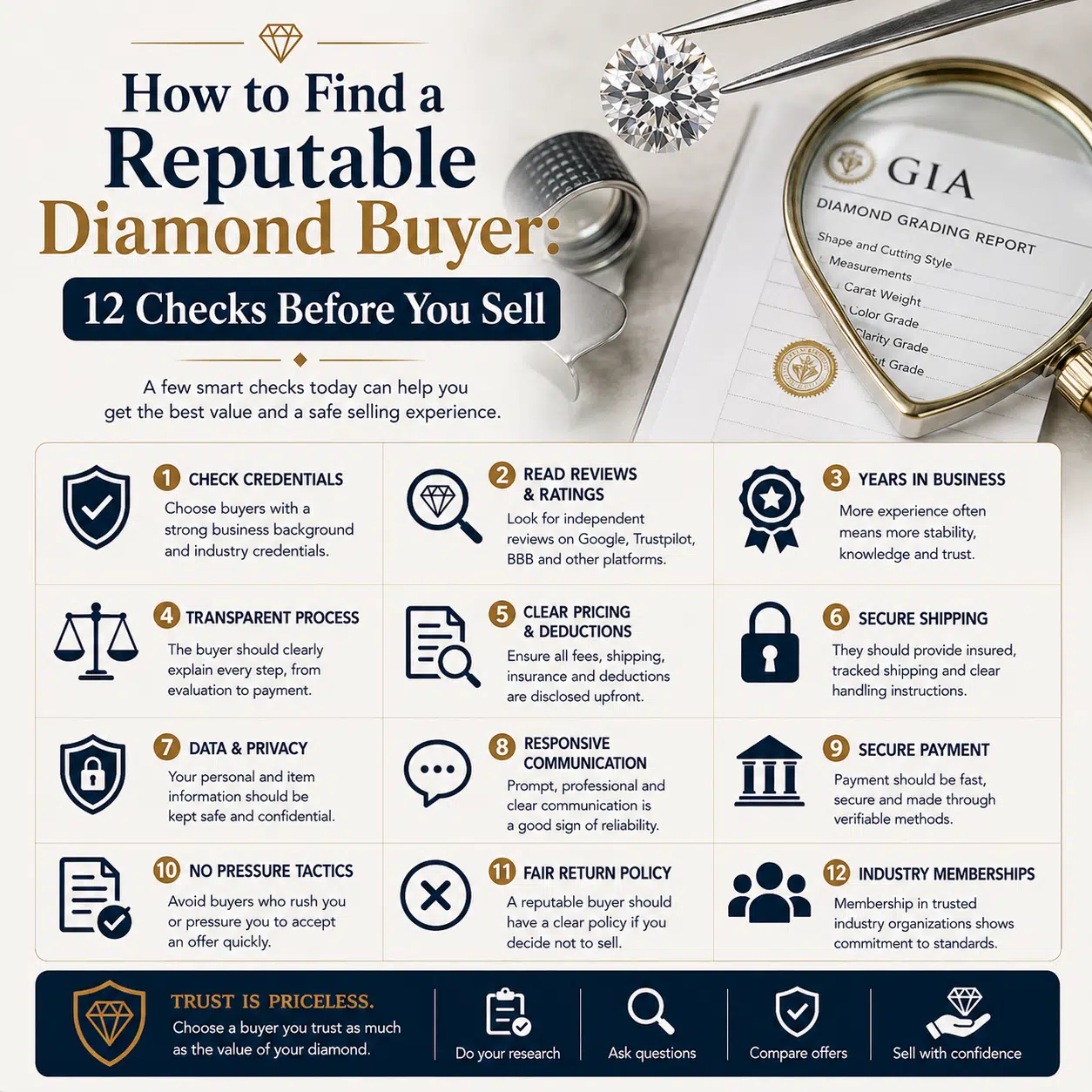
Finding someone willing to buy a diamond is easy. Finding a reputable diamond buyer who can verify the stone correctly, explain the valuation and complete the transaction securely requires more care.
The buyer may temporarily hold an asset worth thousands of euros or dollars. You may also need to provide identity documents, ownership information and bank details. A professional-looking website or an attractive preliminary quote is therefore not enough.
Before selling, verify the buyer’s legal identity, specialist knowledge, valuation process, written terms, insurance arrangements, reviews and payment procedure. You should be able to understand what will happen to your diamond from the first submission to either payment or safe return.
Quick Answer: How Can You Tell If a Diamond Buyer Is Reputable?
A reputable diamond buyer should be a verifiable business with a consistent trading identity, relevant diamond expertise and a transparent process. The buyer should explain whether an initial estimate is provisional, what happens during physical inspection, which costs may be deducted and how the diamond will be protected while in its possession.
Trusted diamond buyers do not need to pressure owners into making immediate decisions. They provide written terms, answer reasonable questions and allow the seller to accept or decline the final offer.
Use these 12 checks before releasing your diamond:
| Check | What you should verify | Warning sign |
| 1 | Legal company identity | Business name or registration cannot be confirmed |
| 2 | Real contact details | No verifiable address or working telephone number |
| 3 | Relevant diamond expertise | Vague claims with no named qualifications or experience |
| 4 | Accurate credential language | Claims that a grading laboratory “certifies” the buyer |
| 5 | Transparent valuation process | No explanation of how the offer is calculated |
| 6 | Provisional and final offer terms | An online estimate is presented as guaranteed |
| 7 | Fees and deductions | Unexpected charges appear after the diamond is submitted |
| 8 | Insurance and chain of custody | No written responsibility for loss or damage |
| 9 | Clear written agreement | Important conditions are communicated only verbally |
| 10 | Independent review history | Reviews are repetitive, vague or visible on one source only |
| 11 | Secure payment procedure | Payment comes from an unrelated person or account |
| 12 | No pressure or manipulation | Artificial deadlines, intimidation or refusal to return the item |
No single check proves that a buyer is trustworthy. The evidence should be consistent across the entire transaction.
Check 1: Verify the Buyer’s Legal Business Identity
Begin with the buyer’s exact legal company name. Do not rely only on a trading name, social media profile or website logo.
A legitimate business should be able to provide relevant details such as its registered name, company number, registered or trading address and tax identification information where applicable. Compare those details with the information shown on quotations, contracts, invoices, emails and payment instructions.
Use the official register available in the buyer’s country. For example, a seller may check:
- The Crossroads Bank for Enterprises when dealing with a Belgian business
- An applicable national or interconnected business register in the European Union
- Companies House for a company registered in the United Kingdom
- The relevant Secretary of State or state business register in the United States
- The equivalent official corporate register in another jurisdiction
A registry entry confirms that an entity exists or has been registered. It does not guarantee fair prices, diamond expertise or honest behaviour. Treat registration as the beginning of due diligence, not the end.
Be cautious if the website displays one company name while the contract uses another without explanation. The same applies when the bank account, email domain and return address belong to apparently unrelated businesses.
There can be legitimate reasons for associated companies or payment providers, but the relationship should be explained before the diamond changes hands.
Check 2: Confirm the Address and Contact Details
A reputable diamond buyer should provide contact information that can be independently checked. Look for a complete address, working telephone number, business email address and clear information about appointments or shipping.
Search the address separately. Does it correspond to the named company or a recognised commercial location? If it is a shared office, mailbox or third-party logistics facility, ask where the diamond will actually be inspected and stored.
An office in a famous diamond district can be reassuring, but location alone does not establish trust. A fraudulent business can mention Antwerp, New York, London or another recognised jewellery centre without maintaining a genuine operation there.
Contact the buyer through more than one method before sending anything valuable. A telephone conversation can help you confirm the process and identify inconsistencies that may not be obvious in an online form.
The person answering should be able to explain:
- Who will receive the diamond
- Where the inspection will take place
- How the item will be recorded on arrival
- How you will be contacted after inspection
- What happens if you reject the offer
- How and when the diamond will be returned
Be cautious if every question receives a vague answer such as “do not worry” or “everything is fully protected” without a written explanation.
Check 3: Look for Relevant Diamond Expertise
General jewellery experience and diamond-buying expertise are not always the same. A buyer who regularly purchases gold by weight may not have the market knowledge required to value a significant diamond, signed ring or antique jewel.
Ask who will evaluate the stone and what relevant education or professional experience that person has. Useful expertise may include formal gemmological education, practical diamond grading experience, specialist market knowledge and a history of purchasing comparable items.
Qualifications should be named precisely. “Trained gemmologist” is more useful when the buyer identifies the institution and qualification. “Diamond expert” without supporting information is only a marketing description.
Training is also not a substitute for market access. A person may understand how to identify and grade a diamond but still have limited knowledge of current resale demand. A credible buyer should be able to connect the diamond’s characteristics with the market in which it is likely to be resold.
For example, the valuation of a natural round brilliant diamond may depend on its laboratory report, proportions and international trade demand. A signed vintage ring may require additional knowledge of design, maker, provenance and condition. A laboratory-grown diamond must be considered within a different resale market from a comparable natural diamond.
The buyer should recognise these distinctions rather than applying one generic formula to every item.
Check 4: Examine Claims About Certification and Credentials
Many sellers search for a “certified diamond buyer,” but this phrase must be interpreted carefully.
There is no single universal certification that automatically makes every diamond buyer trustworthy. Requirements and professional titles differ between countries and organisations. A person may hold a gemmology diploma, belong to a trade organisation or operate a registered diamond business, but each claim should be verified separately.
Most importantly, a diamond grading laboratory’s name should not be used to suggest that the laboratory endorses the buyer.
A grading report relates to the diamond. An educational credential relates to the individual who completed the programme. Neither automatically certifies the purchasing company, guarantees its offers or proves that every employee is qualified.
For example, a buyer may accurately state that a team member completed a recognised gemmology programme. That is different from claiming that the business is “certified” or “approved” by the laboratory.
Ask for:
- The exact name of the qualification
- The name of the person who earned it
- The institution that issued it
- A way to verify the claim where available
- The relevance of the credential to diamond identification and valuation
Membership in a trade organisation can add another verifiable signal, but it should not replace your review of the contract, insurance and payment process. Confirm that the membership is active and determine what it actually represents.
Check 5: Ask How the Diamond Will Be Valued
A transparent buyer should be able to explain the factors considered without pretending that a precise final price can always be confirmed from a photograph.
For a loose diamond or the centre stone of a ring, the evaluation may consider:
- Ob es sich um einen natürlichen oder im Labor gezüchteten Diamanten handelt
- Karatgewicht
- Form und Schliffart
- Colour and clarity
- Cut grade, proportions, polish and symmetry
- Fluoreszenz
- Laboratory and report details
- Chips, abrasion, wear or other condition issues
- Current demand for comparable diamonds
- Potential recutting or repolishing risk
For complete jewellery, the buyer may also consider the brand, age, design, provenance, craftsmanship, precious-metal content and condition of the setting.
Ask the buyer to explain the difference between replacement value and resale value. An insurance appraisal may estimate what it would cost to replace the jewellery in a retail environment. It does not guarantee what a buyer will pay for the existing item.
The original receipt is also not a resale guarantee. A retail purchase price may include taxes, design, brand positioning, store overheads, warranties and services that are not fully recoverable when the item is sold.
A reputable buyer should be able to discuss these differences without dismissing your documentation or creating unrealistic expectations.
Check 6: Understand the Difference Between an Initial Estimate and a Final Offer
An online valuation can be useful, but it is normally based on information supplied by the seller. Photographs and report details may support an initial range or provisional offer; they cannot always reveal the diamond’s identity and full condition.
Physical inspection allows the buyer to confirm that the submitted diamond matches its description. Where applicable, the report number or laser inscription may be checked, and the stone may be examined for damage, treatments or other factors that affect value.
A trustworthy buyer should state clearly whether a figure is:
- An automated estimate
- A preliminary valuation range
- A provisional purchase offer
- A final offer after physical verification
Problems arise when a buyer deliberately uses an unrealistic preliminary figure to persuade the owner to surrender the diamond. Once the item is in the buyer’s possession, the offer is reduced sharply and the seller is pressured to accept.
A changed offer is not automatically evidence of misconduct. A reasonable adjustment may be necessary if the diamond does not match the submitted report, has an undisclosed chip or turns out to be laboratory-grown rather than natural.
The buyer should provide a specific explanation for any material change. “The market changed” or “our expert valued it differently” is not enough when the reduction is substantial and no evidence is provided.
A Practical Example
Suppose a seller submits a grading report for a 1.10-carat diamond and receives an attractive initial indication. During inspection, the buyer discovers that the report belongs to a different stone.
A revised or withdrawn offer would be understandable because the original figure was based on incorrect information.
Now consider a second situation. The diamond matches the report and no significant condition problem is identified, but the buyer reduces the offer dramatically and refuses to explain why. The seller is then told that rejecting the offer will create large, previously undisclosed return charges.
That combination is a serious warning sign. The difference is not simply that the offer changed; it is the absence of a documented reason and the use of unexpected costs to create pressure.
Check 7: Identify Every Fee and Deduction
Before submitting the diamond, request a clear explanation of all possible seller-paid costs.
A direct diamond buyer often makes an all-in purchase offer rather than charging a separate seller’s commission. However, there may still be costs relating to shipping, insurance, laboratory work, currency conversion, bank transfers or return delivery.
Ask whether the valuation is free and whether any optional service requires your approval. A buyer should not send the diamond for expensive third-party testing and deduct the cost later unless you agreed to it.
Calculate the amount you will actually receive:
Net seller proceeds = final accepted offer − every seller-paid fee or deduction
For example, a higher offer may be less attractive if substantial shipping and appraisal costs are deducted. A slightly lower offer with no deductions and a clear payment process could produce the stronger net outcome.
The written terms should answer four questions:
- What costs apply if you accept the offer?
- What costs apply if you reject it?
- What costs apply if the buyer declines the diamond?
- Can any new cost be incurred without your written approval?
If those questions cannot be answered before the diamond is released, pause the transaction.
Check 8: Confirm Insurance and Chain of Custody
The buyer should explain what happens to the diamond from the moment it leaves you until the transaction is completed or the item is returned.
This sequence is called the chain of custody. A strong process records who sent the item, who received it, where it was stored, who inspected it and when responsibility transferred.
If shipping is required, confirm:
- The approved carrier and service
- Who creates the shipping label
- The declared value
- When insurance begins and ends
- Whether loose diamonds and jewellery are covered
- Packaging requirements
- Signature and identity requirements at delivery
- What happens if the parcel is delayed, lost or damaged
Do not assume that standard parcel coverage protects a high-value diamond. Ask for written confirmation of the applicable arrangement and any exclusions.
Photograph the item before packing it. Include clear images of the stone, complete jewellery, hallmarks, grading report and existing wear. If possible, record the packing process and retain the tracking receipt.
If you deliver the diamond personally, request an intake receipt that identifies the item. “One ring received” is not an adequate description for an important jewel. The receipt should record the available report number, shape, estimated weight, setting and any visible condition details.
Check 9: Read the Written Terms Before Handing Over the Diamond
A reputable diamond buyer should make the transaction terms available before taking possession of the item.
The agreement does not need to be unnecessarily complicated, but it should identify the parties and explain the process. Look for provisions covering inspection, valuation, offer acceptance, return, insurance, fees, payment, ownership transfer, privacy and dispute handling.
Pay particular attention to when the sale becomes binding.
Submitting a valuation form should not automatically transfer ownership of your diamond. The contract should clarify whether acceptance occurs by signature, email confirmation, account selection or another documented action.
Read any clause that permits the buyer to dispose of, alter, unset or send the diamond to another party. If testing could be destructive or if a stone may need to be removed from its setting, your permission should be obtained in advance.
Save copies of the exact terms you accepted. Websites can change, so keep the confirmation email, quotation, shipping instructions and applicable conditions together.
Do not proceed if a representative says, “The contract is only a formality,” while refusing to explain a clause. In a high-value transaction, the formality is part of your protection.
Check 10: Evaluate Diamond Buyer Reviews Properly
Diamond buyer reviews can reveal how a business behaves when transactions do not proceed perfectly. However, star ratings should not be treated as proof by themselves.
Read reviews from more than one independent platform. Look at recent feedback as well as the longer history. Detailed reviews describing communication, inspection, offer changes, returns and payment are generally more informative than dozens of comments that simply say “excellent service.”
Patterns matter. One negative review may reflect a misunderstanding or an unrealistic valuation expectation. Repeated complaints about the same issue—such as unexpected deductions, unreturned items or reduced offers—deserve closer attention.
Look at how the buyer responds. A professional response can explain the process without exposing private customer information or attacking the reviewer. Aggressive, threatening or identical responses may indicate a poor approach to disputes.
Warning signs in a review profile include:
- A sudden burst of reviews within a short period
- Repetitive language across multiple accounts
- Reviews that mention no specific part of the transaction
- A perfect rating with no history of ordinary customer questions
- Testimonials visible only on the buyer’s own website
- Reviewer profiles that appear newly created or inactive
- Incentives that depend on leaving a positive rating
Reviews can be manipulated in both directions. Fake positive reviews may promote a business, while false negative reviews may target a competitor. Use reviews as one part of a broader verification process.
Check 11: Confirm the Payment Process and Ownership Transfer
Before accepting an offer, ask how payment will be made, which legal entity will send it and when it should reach your account.
The payment details should be consistent with the buyer’s verified company identity. If funds will come from an associated company, payment processor or another party, obtain a written explanation.
Never treat a payment screenshot as confirmation that money has arrived. Check your own account through your bank’s official website, application or customer service. Be cautious if the buyer claims to have overpaid and asks you to refund the difference or forward part of the money elsewhere.
The contract should also state when ownership transfers. Possible points include:
- When you accept the final offer
- When the buyer sends payment
- When cleared funds reach your account
- Another event defined in the agreement
Knowing this matters if payment is delayed or disputed. You should not be left uncertain about whether you still own the diamond while the buyer controls it.
If payment is in another currency, confirm the currency, exchange-rate method and transfer charges. A large difference between the quoted and received amount should not be hidden behind unexplained conversion costs.
Check 12: Watch for Pressure Tactics and Other Red Flags
A reputable diamond buyer may explain that market prices can change, but should not invent an immediate deadline to prevent you from checking the offer.
Pressure can take several forms. You may be told that the offer expires within minutes, that no other buyer will want the diamond or that rejecting the price will result in expensive return charges. Some sellers are discouraged from speaking with a family member, lawyer or independent adviser.
These tactics are especially concerning when the buyer already has physical possession of the item.
Other important red flags include:
- An offer that is guaranteed before the diamond’s basic details are known
- Refusal to provide a legal company name
- A contract that differs from verbal promises
- Requests to pay an unexpected release or processing fee
- Payment instructions involving an unrelated personal account
- No written insurance or return process
- Unverifiable qualifications or memberships
- Misuse of a grading laboratory’s name
- Refusal to explain a major offer reduction
- Requests for unnecessary personal or financial information
- Threats when you ask to retrieve the diamond
Trustworthy buyers understand that selling a diamond is a significant financial decision. They should make the process easier to verify, not harder.
Is a “Certified Diamond Buyer” Automatically Trustworthy?
No. The phrase “certified diamond buyer” may be used informally and does not necessarily refer to a government licence, independent audit or universal professional qualification.
Determine what the buyer is actually claiming. A named employee may have completed a gemmology diploma. The company may be registered to trade diamonds in its jurisdiction. It may hold membership in a professional organisation. These can all be useful facts, but they mean different things.
A grading laboratory may issue a report for a diamond or provide education to an individual. That does not mean it has certified the company’s honesty, prices or purchasing practices.
A buyer’s credibility should therefore be assessed through multiple forms of evidence:
Relevant education + verifiable business identity + transparent process + secure custody + written terms + consistent reviews
A logo or certificate displayed on a website should never replace those checks.
Reputable Buyer vs Attractive Offer: Which Matters More?
An attractive offer matters only if the buyer can complete the transaction safely and pay the agreed amount.
Imagine that one business provides the highest preliminary quote but will not explain insurance, final-offer adjustments or return costs. Another provides a slightly lower provisional range, clearly describes the inspection process and confirms that the seller remains free to reject the final offer.
The second proposal may be stronger even before the amounts are final because the risks are visible and controllable.
This does not mean you should automatically choose the lowest or most conservative buyer. It means you should compare offers at the same stage:
- Preliminary range against preliminary range
- Final inspected offer against final inspected offer
- Net proceeds against net proceeds
- Written terms against written terms
A dramatic estimate with unclear conditions is not more valuable than a transparent offer that can actually be completed.
Questions to Ask Before Sending Your Diamond
A brief conversation can expose important differences between buyers. Ask:
- What is your full legal company name and registration number?
- Who will evaluate my diamond, and what relevant experience do they have?
- Is the initial figure provisional or final?
- What could cause the offer to change?
- Is the valuation free and without obligation?
- Will any fee apply if I reject the offer?
- Who insures the diamond while it is being shipped and inspected?
- Where will the diamond be stored?
- How long will the inspection take?
- How will the diamond be returned if I decline?
- When does ownership transfer?
- Which company or account will send my payment?
The quality of the answers is as important as the answers themselves. A buyer who responds clearly in writing is easier to evaluate than one who relies on verbal reassurance.
What Documents Should You Prepare?
Good documentation can make the initial review more accurate and help prevent misunderstandings.
Provide a complete image of the grading report when one exists. Do not crop out comments, proportions or the report number unless there is a specific privacy reason to do so during an early enquiry.
Other useful material may include the original invoice, previous appraisal, brand paperwork, service history, provenance documents and clear photographs. For inherited jewellery, an old box, family photograph or repair receipt may help identify the item even when the original certificate has been lost.
Documentation supports the assessment, but it does not replace physical inspection. A grading report describes the characteristics of the diamond when it was examined. The buyer must still confirm that the report corresponds to the submitted stone and assess its present condition.
Should You Compare Several Diamond Buyers?
Comparing two or three credible buyers can help you understand the market, particularly for a significant natural diamond or valuable signed jewel.
Do not judge the businesses only by the largest number. Compare:
- Whether each figure is provisional or final
- The diamond characteristics used
- Any seller-paid expenses
- Shipping and insurance responsibilities
- Offer-validity periods
- Return conditions
- Payment timing and method
- The buyer’s verified identity and experience
If one final offer is materially different from the others, ask why. There may be a legitimate reason, such as stronger demand in that buyer’s network. There may also be a misunderstanding about the report, condition, natural or laboratory-grown status, setting or brand.
An explanation supported by the diamond’s characteristics is more useful than a buyer simply claiming that every competitor is dishonest.
How to Check a Buyer in Europe, the UK or the USA
The underlying checks remain the same, but the register and terminology should be localised.
For a Belgian company, compare its company information with the official Belgian enterprise register. A Belgian diamond business may also be subject to industry-specific formalities, depending on its activities. Verify the exact claim rather than assuming that every Antwerp address represents the same registration or membership status.
Within the European Union, use the relevant national register or interconnected company-search system. A VAT number may help confirm tax registration, but it does not prove diamond expertise or transaction quality.
In the United Kingdom, company information may be checked through Companies House. Remember that the presence of filed information does not amount to an endorsement of the business.
In the United States, business registrations are generally checked through the appropriate state authority. Consumer complaint resources and established review platforms can provide additional context, but no single rating should replace the legal, contractual and insurance checks.
Wherever the buyer is located, make sure you know which country’s law applies to the transaction and how the diamond would be recovered if a dispute occurred.
A Final Buyer-Due-Diligence Scorecard
Before proceeding, mark each item as “verified,” “needs clarification” or “not provided.”
| Due-diligence item | Status |
| Legal company name matches the contract | |
| Registration details independently checked | |
| Address and contact information verified | |
| Evaluator’s qualifications stated accurately | |
| Valuation method explained | |
| Initial and final offers clearly distinguished | |
| Fees and deductions disclosed | |
| Shipping, insurance and return terms confirmed | |
| Written agreement reviewed | |
| Reviews checked across several sources | |
| Payment and ownership transfer understood | |
| No unresolved pressure tactics or red flags |
Do not average a serious problem away. A buyer may pass ten checks but still be unsuitable if it cannot explain who insures the diamond or refuses to commit to returning it.
How Sothis Diamonds Approaches a Transparent Valuation
A transparent valuation should begin with the information you already possess. You can submit photographs, a grading report and relevant documentation for an initial review without committing to a sale.
If the item meets the buyer’s current criteria, the next step may involve a private appointment or an agreed insured shipping process. Physical verification is used to confirm the diamond’s identity, characteristics and condition before a final offer is made.
You should remain free to accept or decline that offer.
After completing the 12 checks in this guide, request a free, no-obligation diamond valuation. The purpose of the valuation is to provide a transparent offer you can evaluate—not to pressure you into an immediate decision.
Häufig gestellte Fragen
What makes a diamond buyer reputable?
A reputable diamond buyer has a verifiable legal identity, relevant diamond knowledge, clear valuation procedures, written terms, secure custody arrangements and a reliable payment process. Reviews and credentials can support the assessment but should not replace these fundamentals.
How can I verify a diamond buyer?
Check the company through the applicable official business register. Compare the registered name and address with the website, contract, email domain, shipping instructions and payment information.
You should also verify claimed qualifications, trade memberships and review history independently.
What does “certified diamond buyer” mean?
The phrase does not always refer to a standard qualification. Ask the buyer what certification is being claimed, who issued it, whether it belongs to an individual or company and how it can be verified.
Does GIA certify diamond buyers?
A GIA grading report relates to a gemstone, and GIA educational programmes provide training to individuals. A buyer should not imply that these automatically certify or endorse the purchasing business.
A person may accurately describe a named GIA qualification they have earned, but that is different from calling the entire company “GIA certified.”
Is a Graduate Gemologist automatically a qualified appraiser?
Not necessarily. Gemmological education and appraisal training are different areas. A person may have strong diamond-identification knowledge without offering formal independent appraisal services.
For a direct purchase, also consider the buyer’s practical market knowledge and transaction process.
Which credentials should a trusted diamond buyer have?
Relevant gemmological education, verifiable diamond-trade experience and applicable registrations can all be useful. No credential removes the need to examine insurance, written terms, offer transparency and payment security.
Is business registration proof that a buyer is trustworthy?
No. Registration helps confirm that a legal entity exists, but it does not guarantee expertise, solvency, fair offers or ethical behaviour.
Does a VAT number prove that a European diamond buyer is legitimate?
A valid VAT number may confirm that the entity is registered for VAT. It does not certify diamond knowledge or prove that a particular transaction will be safe.
Is an Antwerp address enough to trust a diamond buyer?
No. Antwerp is an important diamond-trading centre, but an address alone is not proof of expertise or integrity. Verify the company, office, evaluator, contract and custody process.
How should I evaluate diamond buyer reviews?
Use several independent sources. Read recent and older reviews, look for transaction-specific details and examine repeated complaint patterns.
Do not rely only on an average star rating or testimonials published by the buyer.
Can diamond buyer reviews be fake?
Yes. Positive and negative reviews can both be manipulated. Sudden review bursts, repetitive wording, vague praise and inactive reviewer profiles may justify additional caution.
Is one negative review a reason to reject a buyer?
Not automatically. Consider what happened, whether similar complaints appear repeatedly and how the business responded.
A detailed pattern involving lost items, unexpected fees or refused returns is more significant than a single disagreement about price.
Is a perfect five-star rating trustworthy?
It can be genuine, but it should still be examined. Read the reviews instead of relying on the rating. Check how long the history extends and whether the comments describe real parts of the transaction.
Is the highest diamond offer always the best?
No. Determine whether the figure is provisional or final and subtract every seller-paid cost. The strongest offer is the one that produces the best acceptable net result under secure, clearly documented terms.
Why would a diamond buyer change an initial offer?
A reasonable change may occur if physical inspection reveals that the diamond differs from its submitted description, does not match the report or has a condition issue that was not visible in photographs.
The buyer should explain any material reduction clearly.
Is a large offer reduction always a scam?
No, but an unexplained reduction is a warning sign. Ask for the exact reason and request the return of the diamond if the final offer is unacceptable.
Unexpected return charges or pressure to accept the reduced amount make the situation more concerning.
Can a buyer value my diamond from photographs?
Photographs and report information can support an initial assessment. A responsible final offer will usually require physical verification, particularly for a valuable diamond.
Should an online diamond valuation be guaranteed?
A valuation based only on seller-supplied information should normally be identified as provisional. Be cautious when a buyer guarantees a high final price before seeing the report, condition or even the diamond’s basic characteristics.
Should I pay for a diamond valuation?
Many direct buyers provide an initial valuation without charge or obligation. Confirm whether laboratory work, shipping, insurance or another third-party service could create a cost.
No optional expense should be incurred without your agreement.
Can I sell a diamond without a grading report?
Yes. You may be able to sell a diamond without a certificate, but the assessment will depend more heavily on physical examination.
Ask whether a new laboratory report is likely to increase the net selling result enough to justify its cost and delay.
Should I give the buyer my diamond report number?
A report number helps the buyer check grading information and prepare a more accurate initial assessment. Share documents through the buyer’s official, secure submission method and avoid sending unnecessary identity or financial information in an unprotected message.
Can a grading report prove that the submitted diamond is the same stone?
The report provides identifying information, but the stone must still be matched to it. A laser inscription, when present, and the diamond’s characteristics can support verification during physical inspection.
Should I remove a diamond from its setting before valuation?
Not without specialist advice. Removal creates a risk of damage and could reduce the value of branded, antique or well-designed jewellery.
Submit the complete piece first and ask whether removal is genuinely necessary.
How can I ship a diamond safely to a buyer?
Use only the agreed carrier, packaging method, label and insurance arrangement. Confirm the declared value, coverage period, signature requirement and return procedure in writing.
For more detailed precautions, read the guide to selling a diamond online safely.
Who is responsible if my diamond is lost during shipping?
Responsibility depends on the agreed shipping and insurance terms. Establish exactly when the buyer assumes risk and what evidence would be required for a claim before dispatching the parcel.
What proof should I receive when a buyer takes my diamond?
Request an intake receipt that identifies the item and records the date, recipient, report number where applicable, basic description and visible condition.
Can the buyer remove my diamond from its setting?
Only under the authority provided in your agreement. Ask whether removal is necessary, who will perform it and who is responsible for damage to the diamond or setting.
How quickly should a reputable buyer inspect a diamond?
Timelines vary with the item and any required testing. The buyer should provide a reasonable expected period and update you if the assessment is delayed.
What is the safest way to receive payment?
A traceable payment to an account you control is generally easier to document than an informal arrangement. Verify receipt through your own bank and confirm the sender matches the legal entity or disclosed payment provider.
Should I accept payment from a third party?
Ask why the payment is coming from another entity. Do not proceed until the relationship has been documented and you are satisfied with the explanation.
What is an overpayment scam?
An apparent buyer sends or claims to send more than the agreed amount and asks the seller to return the excess. The original payment may later fail or prove fraudulent, leaving the seller responsible for the returned funds.
Never refund a supposed overpayment without independently confirming the situation with your bank.
Should I send money to release my diamond payment?
An unexpected demand for tax, release, processing or verification money is a serious warning sign. Review the original written terms and contact the business through independently verified details.
When should ownership of the diamond transfer?
The agreement should define the transfer point clearly. It may occur when the final offer is accepted, when payment is sent or when cleared funds are received.
Do not leave this question unresolved.
Can a buyer keep my diamond if I reject the offer?
A direct buyer should return the item according to the agreed terms if you decline the offer and no sale has occurred. Confirm the return period, carrier, insurance and possible costs before submission.
Who pays return shipping if I decline?
This depends on the buyer’s written policy. Some buyers cover insured return shipping; others assign the cost to the seller. The answer should be disclosed before the diamond is sent.
How many diamond offers should I obtain?
Two or three credible evaluations may provide useful market context. Make sure each business is evaluating the same diamond information and compare final net offers rather than preliminary headline figures.
Should I tell one buyer about another offer?
You may choose to disclose a competing written offer, but you are not required to reveal every negotiation. Focus on obtaining an explanation of each valuation and confirming that the terms are comparable.
What personal information does a diamond buyer need?
A buyer may require identity, ownership and payment information to comply with legal and transaction requirements. The request should be proportionate and accompanied by a clear privacy process.
Be cautious about requests for passwords, card security codes or unrelated financial details.
Why does a buyer ask for proof of ownership?
A professional buyer may need to establish that you have the authority to sell the item. This is especially relevant for inherited property, jointly owned jewellery or transactions made on behalf of another person.
Can I sell an inherited diamond?
Yes, provided you have the legal authority to sell it. Preserve estate documents, old receipts, appraisals, photographs and other material that may help establish ownership and provenance.
Are laboratory-grown diamonds evaluated differently?
Yes. Natural and laboratory-grown diamonds have different supply conditions and resale markets. A transparent buyer should identify the diamond type before confirming the final offer.
What if the buyer says my natural diamond is laboratory-grown?
Ask what testing was performed and request a clear explanation. If the result is disputed, consider independent testing through an appropriate recognised laboratory before selling.
What are the biggest diamond buyer red flags?
Major red flags include an unverifiable company identity, misuse of credentials, guaranteed high offers without information, undisclosed fees, unclear insurance, pressure to accept a reduced price and refusal to return the diamond.
Should I trust a buyer who says the offer expires immediately?
Market-based offers can have reasonable validity periods, but an extremely short artificial deadline may be a pressure tactic. Ask why the deadline applies and request the condition in writing.
What should I do if I feel pressured?
Do not accept the offer until you understand it. Ask for your diamond to be returned according to the written terms and retain every message, contract, receipt and shipping record.
How do I compare two reputable diamond buyers?
Compare the final net amount, valuation explanation, insurance, return obligations, payment process and legal identity. The buyer offering the highest headline price may not provide the strongest overall transaction.
Can I request an offer without committing to sell?
Yes. A no-obligation valuation allows you to understand the potential market price before making a decision. Make sure “no obligation” also means you can reject the offer and recover your diamond under clearly stated terms.
What is the best first step?
Gather your grading report, photographs and available ownership documents. Verify the buyer using the 12 checks above, then request a transparent, no-obligation valuation.
