


Selling an Inherited Diamond: Documents, Valuation and Safe Options

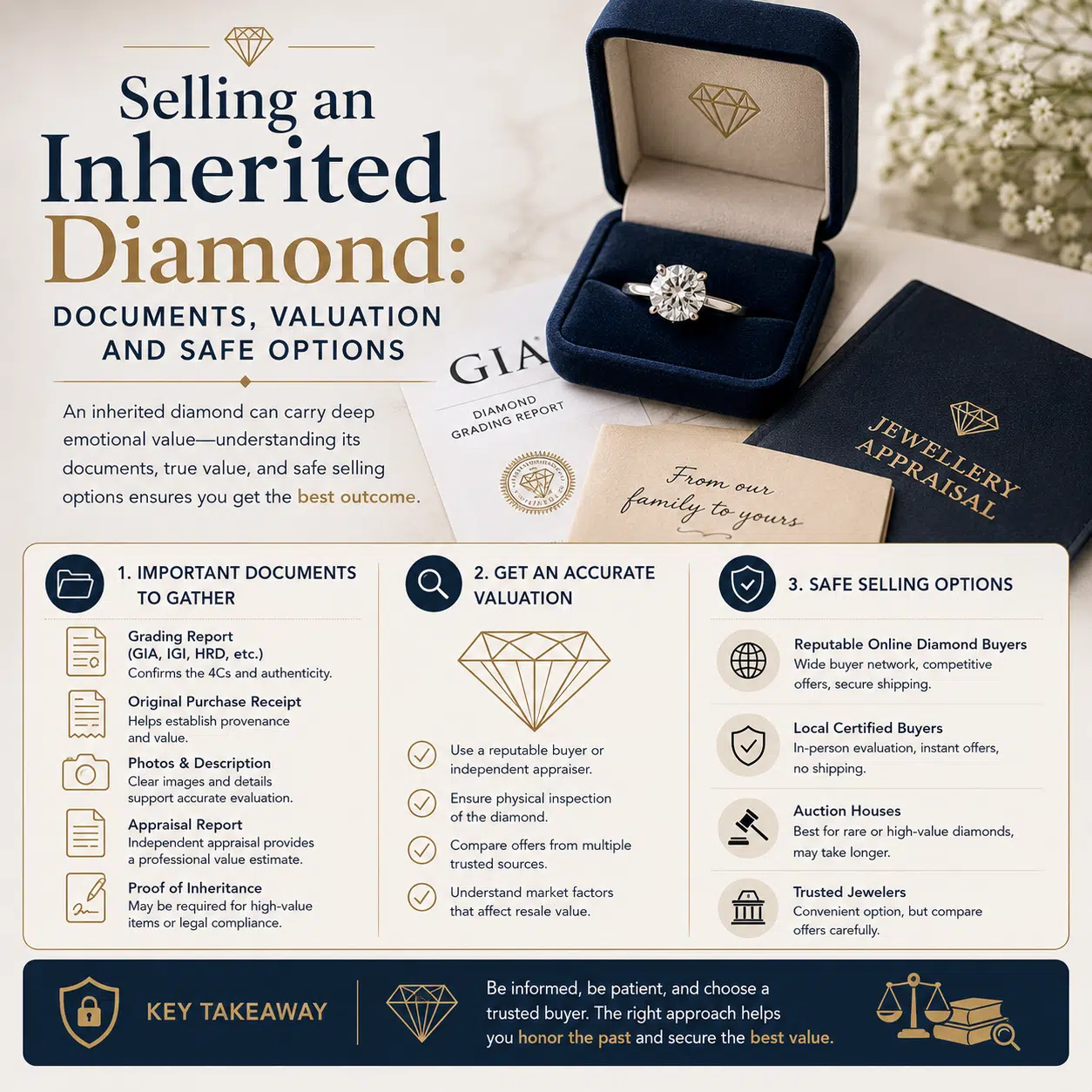
Inheriting a diamond can create practical and emotional questions. You may not know when it was purchased, whether the paperwork is complete, whether the stone is natural or laboratory-grown, or whether the ring is worth more as jewellery than as separate materials.
You may also be unsure whether you are legally authorised to sell it—particularly when the estate is still being administered or several relatives have an interest in the jewellery.
The good news is that inherited diamonds can usually be professionally assessed even without an original receipt or grading report. The safest approach is to confirm your authority to sell, preserve everything found with the jewellery and obtain an item-specific market valuation before accepting an offer.
Quick Answer: How Do You Sell an Inherited Diamond?
Before selling an inherited diamond, confirm that the jewellery has legally passed to you or that you are authorised to act for the estate. Gather the will, estate inventory, inheritance documents, grading report, appraisal, receipt and branded packaging when available.
Do not worry if some or all of these documents are missing. A professional buyer can begin with photographs and an honest description, although physical inspection or laboratory testing may be needed before a final offer is confirmed.
The diamond’s value will depend on its origin, carat weight, colour, clarity, cut, shape, condition, grading report and current buyer demand. The precious-metal setting, side stones, age, craftsmanship and brand may also add value.
Is the Diamond Yours to Sell?
The first question is not how much the diamond is worth. It is whether you currently have the authority to sell it.
If the estate has been completed and the jewellery was transferred to you, the position may be relatively straightforward. Keep the inheritance or distribution record with your other documents.
If the estate remains open, the diamond may still belong to the estate rather than to an individual beneficiary. Depending on the applicable law, an executor, administrator, personal representative or notary may control whether estate property can be valued, distributed or sold.
The rules are not identical across Europe, the United Kingdom and the United States. They may also change when a person lived in one country, held assets in another or named several beneficiaries.
Do not sell estate jewellery based only on having physical possession of it. If ownership is uncertain, ask the executor, notary, probate professional or local legal adviser to confirm who can authorise the transaction.
What If Several People Inherited the Diamond?
A diamond ring may be left jointly to several beneficiaries, or it may form part of an estate that has not yet been divided. In that situation, one person should not privately sell it and distribute the money later without confirming that everyone with authority has agreed.
A written record can prevent misunderstandings. It should identify the jewellery, explain whether it will be sold or retained, and record how the proceeds will be handled. For a valuable item or a disputed estate, obtain appropriate legal guidance rather than relying on an informal family agreement.
A professional valuation can still be requested before the final decision. This may help the family compare a sale with alternatives such as one beneficiary keeping the jewellery and compensating the others.
What Documents Can Help When Selling an Inherited Diamond?
Not every document is mandatory, and different buyers may request different information. However, each surviving record can answer part of the diamond’s story.
| Document or record | How it may help |
| Will or inheritance record | May help establish how the jewellery passed to you |
| Probate, administration or estate document | May identify the person authorised to manage estate property |
| Estate inventory | May connect the jewellery to the deceased owner’s estate |
| Original purchase receipt | May identify the retailer, date, item description or brand |
| Diamond grading report | Records the diamond’s assessed characteristics and origin |
| Insurance appraisal | May provide an older description, measurements and photographs |
| Repair or service record | May reveal alterations, resizing, replacement stones or condition history |
| Branded box and papers | May support the identification and completeness of a designer piece |
| Family photographs | May help document how long the jewellery has been owned |
| Written provenance | May record previous ownership, although important claims still require verification |
These documents do not all serve the same purpose. A grading report describes gemmological characteristics, while an appraisal discusses value for a stated purpose. A receipt records a previous transaction, and an inheritance document may help establish authority to sell.
For general buyer identification and transaction requirements, see Quali documenti sono necessari per vendere un diamante?.
Can You Sell Inherited Jewellery Without Papers?
Yes. Inherited jewellery is frequently submitted without its original receipt, grading report or insurance schedule.
The absence of paperwork does not prove that the diamond has no value. It simply means that more of its identity and quality must be established through examination.
Preserve everything found with the item, even if a document looks old or incomplete. A handwritten repair note, faded invoice, photograph or branded box may contain useful information.
Do not create certainty where none exists. If the family believes the ring contains a two-carat natural diamond but no report confirms that description, present it as family information rather than a verified fact.
A buyer may provide an initial view from photographs, followed by physical verification of the diamond’s origin, weight, quality and condition. Learn more in How to Sell a Diamond Without a Certificate.
A Grading Report Is Not a Valuation
A diamond grading report and a monetary valuation are different documents.
A grading report may record whether the diamond is natural or laboratory-grown, along with its carat weight, measurements, colour, clarity, cut, polish, symmetry, fluorescence and treatments. It supplies technical information that can help a buyer assess the stone.
It does not normally state what the diamond is worth or guarantee a future selling price.
A valuation or appraisal assigns a monetary amount for a particular purpose and date. An insurance appraisal may estimate replacement cost through a retail channel, while a probate, estate or tax valuation may use a legally defined valuation basis.
A current purchase offer answers a different question: what is a buyer prepared to pay for this item now?
Does an Old Insurance Appraisal Show the Selling Price?
Di solito, no.
An insurance appraisal may use a retail replacement figure designed to help replace the jewellery after loss, theft or damage. That figure can be substantially different from the amount available in a resale transaction.
An older appraisal may still be useful because it can contain measurements, metal descriptions, photographs, gemstone details and information about the jewellery before later damage or alteration.
Treat it as supporting evidence, not a guaranteed cash value. The difference is explained further in Valore di rivendita di un diamante vs prezzo al dettaglio vs valutazione assicurativa.
How Is an Inherited Diamond Valued?
The fact that a diamond was inherited does not create a separate resale formula. Buyers evaluate the same physical, documentary and market factors that apply to other diamonds.
Origin is established first. Natural and laboratory-grown diamonds operate in different resale markets, even when their visible appearance and quality grades are similar.
The buyer then considers carat weight, shape, measurements, colour, clarity, cut quality, polish, symmetry, fluorescence and treatments. Condition matters because chips, fractures, abrasions and previous repairs may affect appearance, durability or recutting potential.
The grading laboratory and report must be checked. The buyer may compare the report number, recorded measurements, clarity characteristics and laser inscription with the submitted diamond.
Finally, the buyer considers current demand. A technically impressive diamond does not automatically produce a strong offer if few buyers want that particular shape or quality combination.
Can You Estimate Value From Carat Weight Alone?
No. Carat weight describes weight, not overall quality or resale value.
Two inherited rings may each be described by the family as containing a one-carat diamond, yet their values can be very different. One may contain a well-cut natural diamond with attractive colour, clarity and a recognised report. The other may contain a damaged stone, a laboratory-grown diamond, a simulant or a diamond with less desirable proportions.
Mounted stones can also be difficult to weigh precisely. Measurements and setting style may support an estimate, but the exact weight may not be confirmed until the diamond is loose or matched to a reliable report.
Avoid accepting an offer based only on a buyer briefly looking at the ring and estimating its size.
Could the Diamond Be Laboratory-Grown?
Yes, particularly if the jewellery was purchased more recently. Age and family belief should not be treated as conclusive proof of origin.
Natural and laboratory-grown diamonds can look alike to the unaided eye. Professional screening or laboratory analysis may be needed to separate them confidently.
A recognised report should disclose origin, but the report must belong to the submitted stone. The number can be checked against the issuing laboratory’s records, and any laser inscription should be professionally matched to the diamond.
If origin is unknown, state that clearly when requesting a valuation. Do not advertise the stone as natural until its origin has been verified.
Could the Stone Be Moissanite or Another Simulant?
It is possible. Some inherited jewellery contains cubic zirconia, moissanite, white sapphire, glass or another colourless material rather than diamond.
This does not necessarily mean anyone intended to deceive the family. Stones may have been replaced during repair, family descriptions can become confused, or the original owner may simply have referred to the item as a “diamond ring.”
Home tests involving scratching, heat, fog, water or ultraviolet light are unreliable and may damage the jewellery. A professional examination is safer.
How Do You Check an Old Diamond Report?
Begin by locating the report number and checking it through the issuing laboratory’s official verification service when one is available.
A matching database entry is useful, but it does not by itself prove that the paper belongs to the diamond in your possession. The buyer should compare the stone with the report’s measurements, plotted characteristics and laser inscription.
Altered or fraudulent inscriptions are possible, which is why a number visible on the girdle should not be accepted without further comparison.
If the report cannot be found online, it may be old, issued under a previous system or produced by another organisation. Ask a qualified buyer or gemmologist to examine it before assuming it is genuine or worthless.
Read How to Read and Verify a Diamond Grading Report Before Selling.
Should You Pay for a New Grading Report?
Not automatically.
A new report can be useful for certain loose diamonds, especially when the expected improvement in buyer confidence is greater than the cost, time and risk involved. For a small, damaged or commercially limited stone, the report may not improve the final result enough to justify the expense.
Some laboratory services only accept loose diamonds. Removing a stone can involve professional labour, setting damage and additional security concerns.
Request an initial specialist review first. The buyer can advise whether further laboratory grading is likely to help or whether the diamond can be assessed through the existing information.
Is an Antique Ring Worth More Than Its Diamond?
Sometimes.
An inherited ring may have value as a complete antique, vintage or period jewel. Age alone does not make jewellery valuable, but original design, craftsmanship, condition, provenance and market interest can create value beyond the centre diamond.
An old European-cut, old mine-cut or transitional-cut diamond should not automatically be compared with a newly cut modern round brilliant. Recutting it could remove weight, change its character and reduce the value of the original piece.
Victorian, Edwardian, Art Nouveau, Art Deco and later jewellery can require specialist evaluation. The buyer should examine the construction, settings, metal, hallmarks, wear and whether the piece remains substantially original.
Does a Recognised Brand Affect the Value?
A genuine signed jewel may be worth more as a complete branded item than as a collection of diamonds and metal.
Maker’s marks, serial numbers, original receipts, service documents and branded packaging can support identification. However, a box or unsigned family story does not prove that the jewellery was made by the brand named on it.
Do not polish away marks, replace components or remove the centre stone before a specialist has inspected the piece. An alteration that appears minor could affect authenticity and resale interest.
Should You Sell the Complete Ring or the Loose Diamond?
Request a valuation of the complete item first.
A simple, damaged or low-demand setting may contribute mainly its precious-metal value. In another ring, the craftsmanship, side stones, age or brand may make the complete jewel more valuable than its separated materials.
Removing a diamond without professional equipment can chip the stone, damage the claws or make it more difficult to establish that the diamond belonged to the documented ring.
A specialist can determine whether the strongest market is likely to be for the complete jewellery, the loose centre diamond or the separate components.
Should You Clean Inherited Jewellery Before Valuation?
A gentle professional cleaning may make inspection easier, but aggressive home cleaning is unnecessary and can be risky.
Older jewellery may contain fragile settings, foil-backed stones, enamel, pearls or repaired components that react badly to chemicals, heat or ultrasonic cleaning. A diamond may be durable, but the surrounding jewellery may not be.
Use a soft, dry storage method and let the valuer decide whether cleaning is appropriate. Never attempt to improve an antique piece by polishing, repairing or resetting it before obtaining specialist advice.
Safe Ways to Sell an Inherited Diamond
A specialist diamond buyer can offer a relatively direct route from valuation to payment. The buyer should explain how the diamond is assessed, whether the initial figure is conditional and when the final offer becomes binding.
A jeweller may offer a direct purchase, exchange credit or consignment. These are different arrangements, so ask whether you will receive cash, store credit or payment only after another customer buys the item.
Auction or specialist consignment may suit exceptional, branded or historically interesting jewellery. The possible selling price must be considered alongside commission, photography, insurance, reserve terms, unsold-item charges and the time required to complete the sale.
Private marketplaces provide direct access to individual buyers but require the seller to manage authentication, personal safety, payment verification and delivery. Expensive jewellery should not be handed over because a banking screenshot or payment email appears convincing.
How to Choose a Safe Diamond Buyer
A reputable buyer should have a verifiable business identity, clear contact details, a professional valuation process and written transaction terms.
Before sending the jewellery, confirm who carries the risk during transport, how declared value is handled and what happens if you reject the offer. General carrier tracking does not necessarily mean the parcel is insured for the diamond’s full value.
Ask how the buyer verifies identity, grading reports and ownership. Reasonable compliance questions are not automatically a warning sign; professional buyers may need to understand who is selling the item and whether that person is authorised.
Warning signs include pressure to decide immediately, refusal to put the offer in writing, unexplained fees, requests to misdescribe the parcel and payment claims that cannot be confirmed independently.
Use the checks in How to Find a Reputable Diamond Buyer.
How to Compare Offers Fairly
Compare written net offers rather than verbal headline amounts.
Determine whether the figure is preliminary or final, what must be verified and whether any commission, shipping, insurance, laboratory or return cost will be deducted. Confirm what happens if the physical inspection produces a lower offer.
An offer for the centre diamond cannot be compared directly with an offer for the complete ring unless both buyers explain what they are purchasing. One may include the gold, side stones and brand, while another may value only the main diamond.
Payment timing also matters. A slightly higher amount may be less attractive if payment depends on a future consignment sale or involves an uncertain private purchaser.
Read How to Compare Diamond Offers Without Being Misled.
Illustrative Inherited-Diamond Examples
The following examples are fictional and explain common valuation situations. They do not predict a particular selling price.
Example 1: An Inherited Ring Without Papers
A woman inherits her grandmother’s ring but finds no receipt or grading report. The ring can still be reviewed from photographs and then physically examined.
The buyer determines whether the centre stone is diamond, confirms its origin and assesses its approximate specifications. Missing paperwork may create additional verification work, but it does not automatically remove the item’s value.
Example 2: A High Insurance Appraisal
A family finds an appraisal prepared several years earlier with a high replacement figure. They expect a buyer to pay the same amount.
The appraisal helps identify the ring but does not represent a guaranteed resale price. The current offer is based on today’s market, the verified diamond and the complete jewellery—not the old insurance figure.
Example 3: Jewellery Shared by Three Beneficiaries
Three siblings inherit a diamond ring as part of an unsettled estate. One sibling has physical possession and wants to sell it quickly.
Before proceeding, the family confirms who is authorised to act and records the agreement between the beneficiaries. The valuation can then be used either to support a sale or to help one sibling retain the ring while the others receive an agreed share.
Example 4: A Signed Vintage Ring
An inherited ring bears a maker’s mark and remains in its original box. Selling it only for the centre diamond and metal could overlook the design and brand.
The complete piece is inspected before any stone is removed. Its authenticity, condition and supporting documents become part of the valuation.
Example 5: A Family “Diamond” That Is Not a Diamond
An heir is told that a large colourless stone is a valuable diamond. Professional testing identifies it as another gemstone.
The surrounding gold or platinum and any genuine side stones may still have value. The testing prevents the heir from relying on an inaccurate family description or unintentionally misrepresenting the item.
Probate, Tax and Date-of-Death Valuations
A current purchase offer is not always interchangeable with a valuation required for probate, inheritance reporting or taxation.
The required valuation date and definition of market value depend on the country and circumstances. In some systems, estate jewellery must be valued as of the date of death rather than the later date on which it is sold.
A later sale could also have tax-reporting consequences. For example, United States rules commonly use a date-of-death fair market value when establishing the basis of inherited property, subject to exceptions and individual circumstances. European inheritance and capital-gains treatment differs between countries.
Sothis Diamonds can provide a current market-based purchase assessment, but this should not be treated as country-specific probate, legal or tax advice. Keep estate valuations and sale records, and consult a qualified local professional when reporting may be required.
How to Prepare an Inherited Diamond for Review
Keep the jewellery in its current condition and collect every related document, box and note. Photograph the entire item from the front, back and side, followed by close images of the centre stone, hallmarks, maker’s marks and visible damage.
Photograph both sides of any grading report or appraisal. Avoid publishing complete report numbers, addresses or estate documents on public marketplaces.
Tell the buyer what is known and what remains uncertain. If the jewellery is still part of an estate, explain who is authorised to act. If several people own it, have the required consent available before the transaction is completed.
An online review can provide an initial indication, but a final offer normally depends on physical verification of the item.
Request an Inherited Diamond Valuation
Inherited diamonds can be submitted with complete documentation, partial records or no original paperwork.
Provide clear photographs, any available grading report and information about the jewellery’s history, metal, brand and condition. If the item meets Sothis Diamonds’ current buying criteria, the next step can be explained before you commit to a sale.
Every final offer remains subject to verification of the diamond, documentation, ownership authority and current market demand.
Ricevi una valutazione gratuita e senza impegno del tuo diamante..
Frequently Asked Questions
Can I sell an inherited diamond?
Yes, if the diamond has legally passed to you or you are authorised to sell it for the estate. Confirm ownership or estate authority before completing the transaction.
Can I sell inherited jewellery before probate is completed?
That depends on the applicable law and the authority granted to the executor, administrator or other representative. Do not assume that physical possession gives you the right to sell estate property.
What if several heirs own the diamond?
The sale may require agreement or action by the legally authorised representative. Obtain written confirmation before accepting an offer or transferring the item.
Can an executor sell an inherited diamond?
An executor may be able to sell estate assets when authorised under the will and applicable law. The exact powers and procedures vary, so local probate advice may be necessary.
Do I need the deceased owner’s receipt?
Not necessarily. The receipt may help identify the item, but an inherited diamond can often be assessed without it.
Do I need a diamond grading report?
No. A report can make the initial assessment more precise, but an uncertified diamond can still be examined.
Can I sell an inherited diamond without any paperwork?
Potentially, yes. The buyer may require additional identification, ownership information and physical testing before confirming an offer.
Is an inheritance document proof of the diamond’s quality?
No. It may help establish ownership, but it does not confirm the stone’s carat weight, colour, clarity, cut or origin.
Is a grading report proof of ownership?
No. A grading report describes a diamond and can help identify it, but it does not normally establish who owns it.
Is an old jewellery appraisal still useful?
Yes. It may contain descriptions, photographs and measurements. Its monetary amount should not automatically be treated as the current selling price.
Is an insurance appraisal the same as resale value?
No. Insurance appraisals commonly concern replacement cost, whereas resale value concerns what an active buyer will pay in the current market.
Does GIA state how much a diamond is worth?
No. GIA grading reports describe identifying and quality characteristics; they are not monetary appraisals.
Can I verify an old GIA report online?
Many GIA report details can be checked using the official Report Check service. The diamond must still be matched to the report.
Does a matching report number guarantee authenticity?
No. The stone’s measurements, characteristics and inscription should be professionally compared with the archived report information.
Should I get the diamond certified before selling?
Not automatically. Request a buyer’s initial opinion first because grading costs and stone-removal risks may not be justified for every diamond.
How do I know whether the inherited stone is natural?
Check a verifiable grading report or request professional testing. Appearance and family history alone cannot reliably establish origin.
Can an inherited diamond be laboratory-grown?
Yes. Recently purchased jewellery may contain a lab-grown diamond, and professional testing may be required when no reliable report is available.
Can I sell an inherited lab-grown diamond?
It can be submitted for review, but lab-grown diamonds are assessed within their own resale market and the buyer’s current purchasing criteria.
What if the inherited stone is moissanite?
The surrounding jewellery may still have value. The stone and setting should be accurately identified before being offered for sale.
How much is an inherited one-carat diamond worth?
There is no standard one-carat price. Origin, exact weight, cut, colour, clarity, shape, report, condition and current demand all affect the offer.
Does the age of a diamond increase its value?
Not automatically. The diamond’s cut style, rarity, condition and market demand matter more than age alone.
Are old-cut diamonds valuable?
Some old mine, old European and transitional-cut diamonds attract specialist demand. Their value depends on weight, appearance, condition and the complete jewellery.
Should an old diamond be recut before selling?
Not without specialist advice. Recutting removes weight and can reduce the historical character of an antique jewel.
Is antique jewellery worth more intact?
It can be. Original design, craftsmanship, side stones, maker and provenance may create value beyond the separate materials.
Does a branded box prove who made the ring?
No. A branded box supports completeness but does not authenticate unsigned jewellery. Marks, serial numbers, construction and records must be checked.
Should I remove the diamond from its ring?
No, unless a specialist recommends professional removal. The setting, brand and complete design may contribute value.
Should I clean inherited jewellery before valuation?
Gentle professional cleaning may help, but aggressive chemicals and ultrasonic cleaning can damage fragile or antique settings.
Can I sell a chipped inherited diamond?
Potentially. The chip’s position and severity will affect value, durability and possible recutting options.
What if I cannot find a hallmark?
The item can still be tested. Hallmarks may be worn, altered or absent, and a missing mark does not prove that the metal has no value.
Can I sell only one diamond from inherited earrings?
Potentially, but a matched pair may be more marketable together. Have both earrings valued before separating them.
Should I divide inherited jewellery before valuation?
Usually not. First identify complete sets, matching pieces and branded collections. Separating them prematurely may reduce their combined value.
Can family photographs help establish provenance?
They can support ownership history and show how long the jewellery has been in the family. Important historical or brand claims still require stronger verification.
Will sentimental value increase the offer?
Sentimental importance is real to the family, but professional purchase offers are based on market factors. Consider whether you are emotionally ready before selling an irreplaceable item.
Is a pawnshop the safest place to sell an inherited diamond?
Not necessarily. Compare specialist buyers, jewellers, auction services and other appropriate channels. The safest option is transparent, verifiable and properly insured.
Can I sell an inherited diamond online?
Yes, but an online estimate is usually preliminary. Confirm buyer identity, shipping insurance, inspection terms, returns and payment before sending the item.
Should I post the grading report on a public marketplace?
Avoid displaying complete report numbers, addresses or estate documents publicly. Share necessary information privately with verified buyers.
Is tracked shipping enough for an inherited diamond?
Not necessarily. Tracking and insurance are different. Confirm that the carrier or collection service covers jewellery and diamonds for the agreed value.
How do I avoid inherited-jewellery scams?
Verify the buyer independently, obtain written terms, use properly insured handover and confirm funds through your own bank. Do not trust screenshots or emailed payment notices alone.
Can a buyer reduce the offer after inspection?
A preliminary estimate may change if the diamond’s identity, quality, origin or condition differs from the submitted information. The inspection conditions and return process should be disclosed in advance.
Do I have to accept a valuation offer?
No. A no-obligation offer should allow you to accept or decline after reviewing the verified amount and transaction terms.
How quickly can an inherited diamond be sold?
A direct sale may be completed relatively quickly after ownership and physical verification. Auctions and consignment generally take longer. Avoid any absolute timeline unless the buyer guarantees it in writing.
Could selling an inherited diamond create a tax obligation?
Possibly. Rules differ by country and may depend on estate value, date-of-death value, sale proceeds and the seller’s circumstances. Keep all records and obtain local tax advice.
What records should I keep after selling?
Retain the inheritance documents, valuation, written offer, sale agreement, buyer’s details, payment evidence and any relevant shipping or handover record.
Can Sothis Diamonds assess inherited jewellery without papers?
Yes. You can begin with clear photographs and the information available. Any final offer remains subject to physical verification, ownership authority and Sothis Diamonds’ current buying criteria.
Final Thoughts
Selling an inherited diamond should begin with clarity rather than urgency.
First establish who is authorised to sell. Then preserve the complete jewellery, documents, packaging and family records until a specialist has determined what contributes value.
Missing paperwork does not make an inherited diamond unsellable. It means its identity, origin and quality may require additional verification. Similarly, an old insurance appraisal or family estimate should not be mistaken for a current cash offer.
A transparent buyer should explain how the diamond and complete jewellery were assessed, what the offer includes and what must happen before payment.
When you are ready, submit the item for a private, no-obligation review.
Ricevi una valutazione gratuita e senza impegno del tuo diamante..
