


How Diamond Necklaces and Pendants Are Valued When You Sell Them

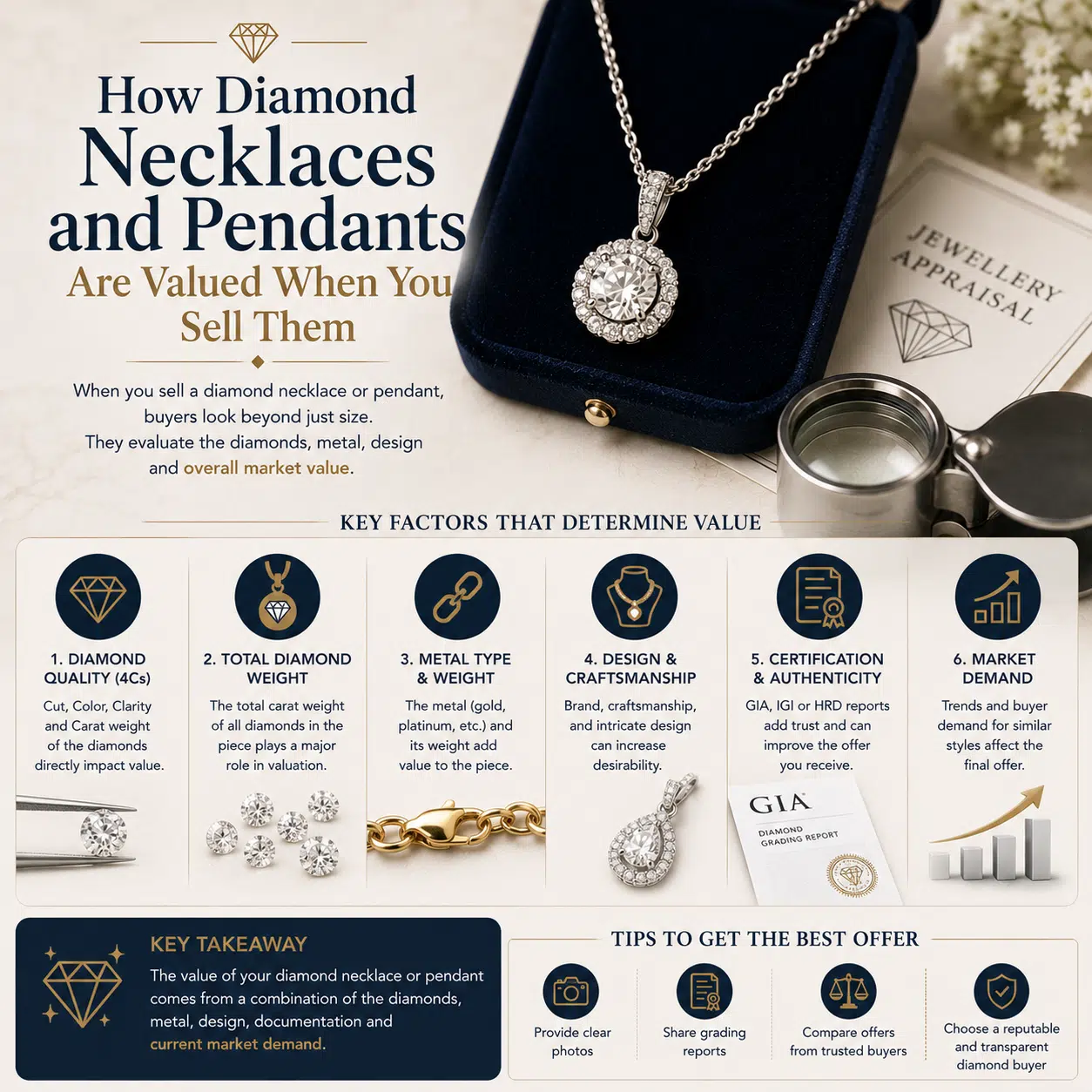
When you sell a diamond necklace, its value is not calculated from total carat weight alone. A buyer must understand how that weight is distributed, whether the diamonds are natural or laboratory-grown, the quality of the important stones and whether the necklace has value as a complete piece of jewellery.
A solitaire diamond pendant may derive most of its value from one centre diamond. A tennis or rivière necklace can depend on the combined quality and consistency of dozens of matched stones. An antique or designer necklace may also carry value through its craftsmanship, provenance and brand.
La risposta diretta è:
Diamond necklaces and pendants are valued by assessing their important diamonds, smaller stones, precious metal, construction, condition, documentation and current resale demand.
Before removing a diamond or separating the necklace into components, request a free, no-obligation valuation from Sothis Diamonds.
What Part of a Diamond Necklace Creates the Most Value?
The answer depends on the design.
In a solitaire pendant, the centre diamond is usually the main value driver. Its carat weight, colour, clarity, cut, shape, origin, grading report and condition can account for most of the offer. The chain and setting may contribute additional gold or platinum value.
A halo pendant divides its total weight between the centre diamond and numerous smaller stones. In this case, the size and quality of the centre remain important, but the accent diamonds, setting and finished appearance must also be considered.
A line, tennis or rivière necklace contains a continuous sequence of diamonds. The buyer considers the total weight, individual stone sizes, graduation, matching and overall construction. One unusually large diamond may be important, but much of the necklace’s appeal comes from the consistency of the complete arrangement.
| Necklace or pendant type | Main value drivers |
| Solitaire diamond pendant | Centre diamond, grading report, setting and chain |
| Halo or cluster pendant | Centre stone, accent diamonds, construction and condition |
| Tennis or line necklace | Total weight, matching, flexibility, clasp and stone security |
| Graduated rivière necklace | Larger central stones, balanced graduation, matching and craftsmanship |
| Antique or signed necklace | Diamonds, design, provenance, authenticity and originality |
| Diamond necklace with coloured stones | Diamond quality, gemstone identity, colour origin and complete design |
This is why two necklaces with the same total carat weight can have substantially different resale values.
Total Carat Weight Does Not Tell the Whole Story
Total carat weight—often abbreviated as “tcw” or “ctw”—means the combined weight of all the diamonds in a piece of jewellery. It does not describe the weight of the largest diamond.
Consider two necklaces that both contain 3.00 carats of diamonds. One could hold a single 2.50-carat centre diamond surrounded by 0.50 carat of accents. The other might contain 150 small diamonds with a combined weight of 3.00 carats.
The larger individual diamond operates in a different market from a collection of tiny melee stones. Larger diamonds are generally scarcer, while very small diamonds are often valued collectively according to their size range, quality and matching.
A seller should therefore provide both the total diamond weight and the centre-stone weight whenever those figures are known. If an old necklace appraisal mentions only one number, check whether it refers to a single diamond, all the diamonds or all gemstones in the piece.
How a Centre Diamond Is Valued
A prominent diamond in a pendant is normally evaluated using the 4Cs: carat weight, colour, clarity and cut. Shape, fluorescence, proportions, condition, origin and documentation can also affect the result.
Carat weight establishes the diamond’s physical weight, but it does not describe its complete quality. Two diamonds of equal weight can differ in appearance, rarity and demand.
Colour and clarity become particularly important in larger centre stones because differences are easier to observe and more commercially significant. Cut quality affects how effectively the diamond returns light. A well-cut stone may look lively and balanced, while an overly deep stone can carry weight without appearing as large from the front.
Shape also influences marketability. Round, oval, pear, cushion, emerald and other shapes have distinct markets. A pear-shaped diamond may be especially suitable for a pendant, but the appeal of the stone still depends on its outline, proportions, symmetry and visible performance.
If the centre diamond has a recognised grading report, submit the complete report rather than providing only its carat weight and grades.
How Tennis and Rivière Necklaces Are Assessed
Multi-stone necklaces require a different approach from solitaire pendants.
A buyer examines how consistently the diamonds match in size, colour, clarity and cutting. When the necklace is graduated, the progression from smaller to larger stones should appear intentional and balanced. Abrupt size or colour differences may indicate replacement stones or previous repairs.
Construction is equally important. A tennis necklace should move comfortably without twisting, while each link and setting must hold its diamond securely. The clasp should close properly and may include an additional safety mechanism.
A rivière necklace—traditionally a continuous line of gemstones, often graduated towards the centre—may have value through its period, design and craftsmanship as well as its diamonds. Antique examples should not be treated automatically as a collection of loose stones.
Matching does not produce one fixed premium. However, a complete and consistent necklace is generally more usable and marketable than a mixed parcel of unrelated stones.
How the Chain, Setting and Precious Metal Affect Value
The diamonds may be the most visible part of the necklace, but the metal should not be ignored.
Gold purity, platinum content, total weight and construction can all contribute. A lightweight chain attached to a small pendant will be assessed differently from a substantial platinum necklace containing complex handmade settings.
Hallmarks can provide information about metal fineness, maker and sometimes country or period. Their meaning should be verified rather than guessed, particularly on antique or imported jewellery.
The chain and pendant may also come from different manufacturers. If the pendant is signed but the chain is not, the buyer needs to determine whether the chain is original, a later replacement or simply an independent component.
Keep a detachable chain with the pendant when requesting a valuation. A specialist can then assess whether they are more marketable together or separately.
Brand, Age and Provenance Can Change the Valuation
A signed necklace from a recognised jewellery house may have secondary-market appeal beyond its diamonds and metal. Buyers may consider the authenticity of the signature, design period, reference number, workmanship and completeness of the item.
Boxes, purchase invoices, service records and certificates can support this investigation. Documentation does not create authenticity by itself, but it can help connect the necklace with its history.
Antique necklaces may contain old mine-cut, old European-cut, rose-cut or other historic diamonds. Their cutting style should be considered in the context of the complete jewel rather than compared mechanically with modern brilliant-cut diamonds.
Originality can be important. Replaced clasps, shortened chains, missing elements or modern replacement stones may affect collector interest. At the same time, a sensitive professional repair may make a necklace wearable without destroying its historical character.
Before dismantling an antique or branded piece, obtain an assessment of the complete jewellery. Once altered, lost provenance or workmanship may be impossible to restore.
How Condition Influences a Diamond Necklace Offer
Condition matters because necklaces contain numerous connection points and settings that can wear over time.
A buyer may inspect the chain for stretched or repaired links, the clasp for security and the settings for worn claws or loose stones. Kinks, twists and poorly moving sections can affect the usability of a tennis necklace.
The diamonds are also checked for chips, abrasions and damage hidden near the settings. A chip in an important centre stone can have a greater effect than ordinary surface wear on the metal.
A missing small diamond does not automatically make the necklace worthless. The buyer will consider the cost and feasibility of finding a replacement that matches the surrounding stones. Several missing or mismatched diamonds may have a greater effect because restoration becomes more complicated.
Do not use harsh chemicals or mechanical cleaning equipment immediately before selling. Gentle removal of surface dust is usually sufficient for initial photographs.
Can Mounted Diamonds Be Graded Accurately?
A mounted necklace can be examined, but the settings create limitations.
Metal may obstruct parts of the diamonds, influence perceived colour or prevent exact weighing. For multi-stone jewellery, the total diamond weight may be estimated using dimensions, stone count, construction and existing documents.
A full laboratory grading report for an individual diamond generally requires the stone to be loose. Jewellery-report services can describe mounted pieces and provide estimated diamond ranges, but examination remains limited by what the settings allow.
This does not mean the necklace must be dismantled before valuation. A buyer can often begin with a mounted assessment and decide whether further work is justified.
If the necklace already has an individual report for its centre diamond, the recorded measurements and any laser inscription can help connect the report to the stone.
Natural and Laboratory-Grown Diamond Necklaces
Natural and laboratory-grown diamonds have different supply conditions and resale markets, so origin affects the offer.
A solitaire pendant with a laboratory-grown centre diamond may be considered within the current laboratory-grown resale market, while its gold or platinum setting retains separate material value. A necklace containing many laboratory-grown stones may depend heavily on its design, brand and complete-jewellery appeal.
Mixed origin can create complications. A repaired necklace could contain natural diamonds, laboratory-grown replacements or simulants. Professional testing may be needed when the history is uncertain.
Do not describe a necklace as natural solely because it is old, inherited or originally expensive. Provide the information you have and allow its origin to be verified.
Necklace Appraisal Value vs Resale Value
An old necklace appraisal can provide useful descriptive information, but its stated amount may not predict what you can receive when selling.
Insurance appraisals are commonly prepared around replacement requirements. They may reflect the estimated cost of obtaining a comparable item through a retail channel. A resale valuation considers what a buyer can pay for the existing necklace within the current secondary market.
The original retail price may also include design, manufacturing, tax, shop expenses, warranties and retail margin. These amounts are not automatically recoverable during resale.
Use an appraisal to identify the necklace’s diamonds, metal and construction. For a selling decision, compare current written purchase offers rather than relying only on an old replacement figure.
Should You Remove the Diamond Before Selling a Pendant?
Di solito, no.
Removing a centre diamond can damage the setting or stone, create labour costs and eliminate the option of selling the pendant intact. This is particularly risky with antique, branded, halo and delicate designs.
A specialist should first compare the likely complete-jewellery value with the possible value of the loose centre diamond and remaining setting. Removal may make sense when the design has little resale appeal, the setting is beyond repair or an important stone requires exact grading. It should be a considered professional decision.
Never attempt to remove the diamond with household tools. Submit the complete pendant, chain and available documentation first.
Illustrative Valuation Examples
Imagine a simple platinum pendant containing a certified 1.10-carat natural round diamond. The chain is lightweight and the design is unbranded. In this case, the centre diamond’s specifications, report and condition are likely to drive most of the valuation.
A second necklace contains 5.00 carats in total across many graduated diamonds. None has an individual certificate, but the stones are well matched and the necklace is flexible, secure and wearable. Its value depends on the complete arrangement, combined diamond quality, construction and demand—not on treating it as one five-carat diamond.
A third necklace is an antique signed piece containing old-cut diamonds. Several stones are modest in size, but the workmanship, authenticity and provenance make the complete jewel potentially more important than its component values.
These examples do not predict specific prices. They show why the form and context of the diamonds matter alongside their weight.
How to Sell a Diamond Necklace Online
You can begin online without immediately sending the necklace.
Photograph the complete necklace laid naturally on a plain surface. Include close images of the centre diamond, settings, clasp, hallmarks, signature and any damaged or repaired areas. If there is a removable pendant, photograph it both attached to and separated from the chain.
Upload any grading report, receipt, appraisal, brand certificate or repair record. State whether the listed carat weight belongs to the centre diamond or represents the total for the complete necklace.
The first review can determine whether the item is potentially suitable and whether an in-person inspection or secure transportation should follow. For broader security guidance, see How to Sell a Diamond Online Safely.
Domande frequenti
Are diamond necklaces worth selling?
They can be. The result depends on the diamonds, metal, design, brand, condition, documentation and current demand for the complete necklace or its components.
How much can I sell a diamond necklace for?
A reliable amount cannot be calculated from photographs or total carat weight alone. The distribution and quality of the diamonds, construction, condition and origin must be assessed.
What determines diamond pendant resale value?
The centre diamond is often the largest factor. Its 4Cs, shape, origin, report and condition are considered alongside the setting, chain, brand and present marketability.
Does total carat weight include every diamond?
Yes, total carat weight normally represents the combined weight of all diamonds in the piece. It does not mean the largest diamond has that weight.
Is one large diamond worth more than many small diamonds of the same total weight?
The markets are different. One larger diamond is generally scarcer than the same weight divided among numerous tiny stones, but quality, origin and demand still determine the actual result.
Can I sell a diamond necklace without a certificate?
Yes. Mounted diamonds and complete jewellery can still be examined, although missing documentation and mounting limitations may create more uncertainty.
Does the gold or platinum chain add value?
Yes. Metal purity, weight, condition and construction can contribute. A substantial or signed chain may be more important than a lightweight replacement chain.
Can I sell a necklace with a missing diamond?
Potentially. The buyer will consider the remaining diamonds, metal and design, together with the cost and practicality of finding a matching replacement.
Are antique diamond necklaces worth more intact?
They often should be assessed intact. Period design, craftsmanship, provenance and originality can create value that would be lost through dismantling.
Can laboratory-grown diamond necklaces be sold?
They can be submitted for review, but buyer demand is more selective. The setting, metal, brand and finished-jewellery appeal may contribute significantly.
Should I remove the centre diamond before requesting an offer?
No. Submit the complete pendant first. Removal should occur only when professional assessment shows that the likely benefit justifies the cost and risk.
Is an insurance necklace appraisal the same as a resale valuation?
No. An insurance appraisal is usually concerned with replacement, while a resale valuation reflects the current secondary-market offer for the existing item.
Can Sothis Diamonds value a necklace from photographs?
Photographs and documents can support an initial review. The necklace may then require physical inspection to confirm its diamonds, metal, condition and final offer.
Request a Diamond Necklace Valuation
The most useful offer will explain what is creating the necklace’s value: an important centre stone, a matched sequence of diamonds, precious metal, craftsmanship, brand or a combination of these elements.
Keep the necklace complete, preserve its documents and include the chain, pendant, clasp and original packaging in the initial submission. Do not pay for removal or new grading until its commercial benefit has been considered.
