


1-Carat Diamond Resale Value: What Determines the Offer?

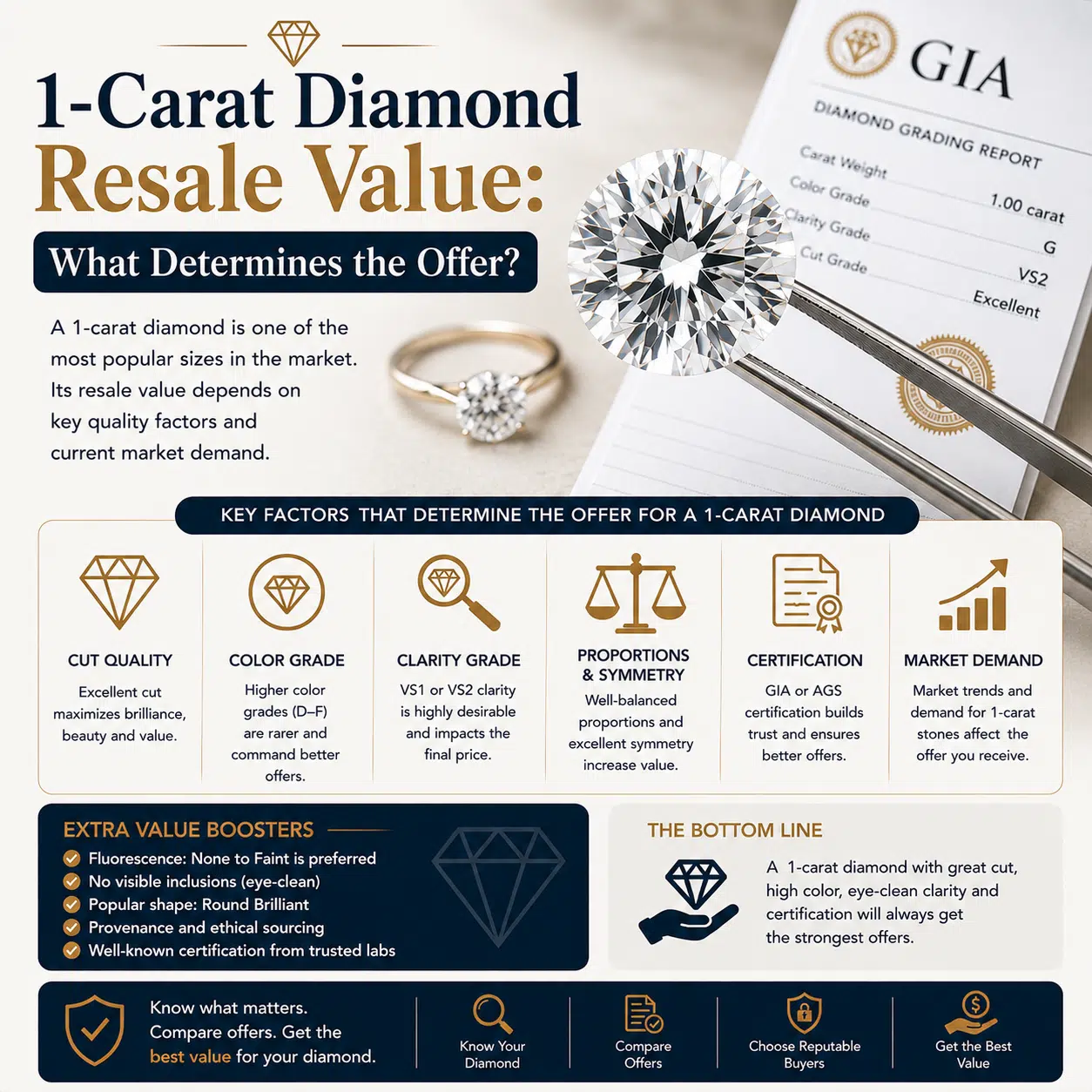
A one-carat diamond does not have one standard resale value. Two diamonds weighing exactly 1.00 carat can receive materially different offers because carat weight is only one part of the valuation.
The buyer must also consider colour, clarity, cut quality, shape, dimensions, fluorescence, transparency, grading report, natural or laboratory-grown origin and physical condition. If the diamond is mounted, its setting, side stones, precious metal and possible brand value may also affect the result.
The amount originally paid and the figure shown on an insurance appraisal can provide background information, but neither automatically establishes the diamond’s current resale value.
To determine how much you can sell a one-carat diamond for, a buyer must examine the exact stone and compare it with current demand for genuinely comparable diamonds.
Quick Answer: How Much Can You Sell a One-Carat Diamond For?
The resale value of a one-carat diamond cannot be determined from its weight alone. A well-cut, natural one-carat diamond with desirable colour and clarity, a recognised grading report and no damage may receive a substantially different offer from an uncertified, poorly cut, treated or laboratory-grown one-carat diamond.
A professional buyer normally calculates the offer from the diamond’s current resale potential. The buyer then accounts for any testing, grading, repair, insurance, selling costs, holding time and market risk.
For this reason, a reliable offer requires the following questions to be answered:
Is the diamond natural or laboratory-grown? Does it weigh exactly 1.00 carat, or does the jewellery contain one carat of diamonds in total? What are its colour, clarity and cut grades? Does it have a verifiable report? Is it damaged? Is it mounted in a generic setting or a desirable signed jewel?
Until these details are known, any precise online figure is likely to be speculative.
One-Carat Diamond Value Factors at a Glance
| Factor | Stronger resale position | Possible reason for a lower or more cautious offer |
| Origine | Verified natural diamond | Laboratory-grown, treated or uncertain origin |
| Weight | Confirmed 1.00 carat or above | Estimated weight or recutting risk below one carat |
| Tagliare | Attractive proportions and light performance | Hidden weight, poor spread or weak visual performance |
| Colore | Desirable verified grade | Visible tint, modifier or uncertain grade |
| Chiarezza | Attractive appearance with no durability concern | Visible or vulnerable inclusions |
| Forma | Strong current demand and attractive outline | Less liquid shape or unattractive proportions |
| Report | Recognised, verifiable and matching | Missing, unfamiliar or inconsistent report |
| Se è naturale o prodotto in laboratorio | No chips or significant abrasion | Damage requiring polishing or recutting |
| Setting | Valuable metal, side stones, craftsmanship or brand | Worn generic setting with limited resale demand |
| Market | Active buyers for the exact combination | Oversupply or narrow customer demand |
What Does “One Carat” Actually Mean?
Carat is a measurement of weight. One metric carat equals 200 milligrams, or 0.20 grams.
Carat does not measure visible diameter, quality or value. Two one-carat diamonds can look different in size because their weight is distributed differently.
A well-proportioned round brilliant may show more of its weight across its visible diameter. A deeply cut stone can carry extra weight below the girdle and appear smaller from above. Both diamonds may weigh 1.00 carat, but buyers and future customers may not view them as equally desirable.
The same principle applies across different shapes. A one-carat oval normally has different dimensions from a one-carat round, emerald or cushion cut. The visual size and outline must therefore be considered together with the weight.
One-Carat Centre Stone vs One-Carat Total Weight
Before estimating value, determine whether “one carat” refers to the centre diamond or the combined weight of every diamond in the jewellery.
A ring described as “1.00 carat total weight” might contain a 0.60-carat centre diamond and several smaller side stones. It is not commercially equivalent to a ring containing one centre diamond that weighs 1.00 carat.
Larger individual diamonds generally belong to different markets from collections of small diamonds. Side stones can contribute value, but they cannot normally be combined mathematically and priced as though they formed one large stone.
Look at the purchase invoice, grading report or jewellery description. Abbreviations such as “ct,” “ctw,” “tcw” or “total diamond weight” should be interpreted carefully.
If the jewellery has no documents, a specialist can estimate the mounted centre stone’s weight from its measurements. Exact weight may require professional removal, but removal should not be performed automatically or without considering the setting.
Why the One-Carat Threshold Matters
One carat is an important commercial size.
Diamond demand does not always increase in a perfectly smooth line. Particular weights—including 1.00 carat—are widely recognised and sought after. A diamond that reaches the one-carat category may therefore participate in a different comparison group from a nearly identical stone weighing slightly less.
A 0.99-carat diamond and a 1.00-carat diamond may appear almost indistinguishable without precise measurement. Nevertheless, the exact weight shown on a grading report can influence how the stone is listed, searched for and compared within the trade.
This threshold does not guarantee a particular premium. Colour, clarity, cut, shape, report and condition still matter. A badly cut or damaged 1.00-carat diamond can be less desirable than an attractive diamond weighing slightly under one carat.
The threshold becomes especially important when damage is present. If a 1.02-carat diamond must be recut and the finished weight is expected to fall below one carat, the buyer considers both the weight loss and the different resale category of the repaired stone.
Why There Is No Standard One-Carat Diamond Resale Price
The term “one-carat diamond” describes only the weight. It does not establish whether the diamond is natural, laboratory-grown, colourless, visibly included, damaged, well cut or documented.
Even among natural round diamonds weighing 1.00 carat, the possible quality combinations are extensive. A high-colour, high-clarity, well-cut stone cannot be compared fairly with a heavily included diamond that has weak proportions and visible damage.
Shape adds another layer. One-carat ovals, cushions, pears, emerald cuts and round brilliants have different supply, appearance and demand.
The same is true of documentation. A diamond with a recognised report that clearly matches the physical stone can be easier to assess and resell than an uncertified diamond whose origin and grades must be established.
This is why responsible buyers do not publish a single permanent answer to “How much is a one-carat diamond worth?” The exact stone and current market must be considered.
How Carat Weight Enters the Offer Calculation
Carat weight helps the buyer select an appropriate comparison group.
For a loose diamond, weight can be confirmed on an appropriate calibrated scale. For a mounted diamond, the buyer may need to estimate weight using measurements, shape and proportions.
An estimated one-carat diamond could prove to weigh 0.91, 0.97, 1.00 or 1.08 carats after removal. These differences may affect the final offer.
The buyer also asks whether the existing weight is stable. A chipped stone may need to be repolished, while a more severely damaged diamond may require recutting. The offer may then be based on the expected finished weight rather than the damaged stone’s current weight.
A buyer should explain when recutting risk has materially influenced an offer.
How Colour Affects a One-Carat Diamond’s Value
For many colourless to light-yellow or light-brown diamonds, colour is graded on a D-to-Z scale. D represents the colourless end, while later letters indicate an increasing presence of colour.
All other factors being equal, a more colourless natural diamond is generally rarer. However, the letter grade should not be evaluated in isolation.
Two diamonds with the same colour grade can appear different because of fluorescence, transparency, cut, shape or modifying tones. One diamond may carry a brown or grey component that affects market demand even if the headline grade looks similar.
Shape also influences how colour is perceived. Emerald cuts and other step cuts can reveal colour differently from brilliant-style cuts. The metal surrounding a mounted diamond can also influence its apparent colour.
Fancy-coloured diamonds are assessed through a different system. A laboratory-graded Fancy Yellow diamond cannot be valued using the ordinary D-to-Z assumptions. Hue, tone, saturation, colour distribution and natural or treated colour origin all matter.
How Clarity Changes the Offer
Clarity describes inclusions within the diamond and blemishes on its surface.
The clarity grade is important, but buyers also examine the nature, position, size, visibility and possible durability effect of each characteristic.
Imagine two one-carat diamonds with the same SI1 clarity grade. The first has a small inclusion near the outer edge that is difficult to see without magnification. The second has a dark inclusion directly beneath the table that is noticeable when the diamond is viewed face-up.
Although the laboratory grades may be the same, future customers may not respond to the diamonds in the same way.
Inclusions near the girdle, corners or points may also raise durability concerns. A feather in a vulnerable location can have a different commercial effect from a harmless inclusion positioned elsewhere.
The buyer therefore examines the clarity plot, report comments and physical diamond rather than pricing only the grade.
Cut Can Be Critical in a One-Carat Diamond
Cut quality affects how the diamond uses light and how large it appears from above.
A well-cut one-carat round brilliant can display strong brightness, fire and scintillation. A poorly proportioned stone may look dark, dull or smaller than expected despite having the same carat weight.
The buyer may assess the laboratory cut grade together with the table, depth, crown and pavilion angles, girdle, culet, polish and symmetry.
A very deep diamond can retain enough weight to reach the one-carat threshold while hiding a disproportionate amount below the visible surface. The owner may have paid for one carat, but a future customer may compare its visible size with better-spread diamonds.
A diamond can also be too shallow. Greater visible diameter does not automatically mean better cut if light performance or durability has been compromised.
For fancy-shaped diamonds, the buyer examines outline, symmetry, proportions, visible spread and areas of light leakage. An oval or pear may also display a bow-tie effect, which can range from subtle to visually dominant.
Shape and One-Carat Resale Demand
Round brilliant diamonds have a broad, established market, but no shape always receives the highest offer.
A one-carat oval may appeal to customers seeking an elongated appearance. An emerald cut can attract buyers who prefer broad, clean step facets. Cushions, radiants, pears, princess cuts and antique shapes each have their own markets.
Within each shape, appearance matters. An oval with an uneven outline or overpowering bow tie may be harder to sell. An emerald cut with visible central inclusions may have reduced demand because its open facets make clarity characteristics easier to see.
Length-to-width ratio can also influence appeal. Some customers prefer a longer oval or cushion, while others prefer a more balanced outline. There is no permanent ratio that guarantees the best resale result.
Market preferences change, so fixed shape premiums and discounts should be treated cautiously.
Natural vs Laboratory-Grown One-Carat Diamonds
Natural and laboratory-grown diamonds are separate resale categories.
They may share the same carat, colour, clarity and cut terminology, but their available supply, replacement prices and secondary-market demand are different. A laboratory-grown one-carat diamond should not be compared with natural-diamond listings when estimating resale value.
The original purchase price does not preserve a permanent relationship between the two categories. Both markets can change, but they do not necessarily move together.
A grading report may clearly state whether the diamond is natural or laboratory-grown. If the report is missing or uncertain, professional screening is required.
A diamond should never be assumed to be natural because it was expensive, inherited or purchased many years ago. Equally, visual appearance alone cannot reliably establish laboratory-grown origin.
How a Grading Report Affects the Resale Offer
A grading report can make a one-carat diamond easier to identify and compare.
Depending on the laboratory and report type, it may record the weight, measurements, colour, clarity, cut, polish, symmetry, fluorescence, proportions, comments and identifying characteristics.
The buyer should verify the report through the issuing laboratory’s official database when that service is available. The physical diamond’s measurements, inclusion pattern and any laser inscription can then be compared with the document.
A grading report does not state the diamond’s current resale value. It provides technical information used in a separate market assessment.
The buyer also considers the issuing laboratory. A recognised and verifiable report may reduce uncertainty, while a document from an unfamiliar laboratory may require more independent examination.
A one-carat diamond without a certificate can still be valuable. However, testing or grading costs and uncertainty may affect the timeline and offer. Learn more in the guide to selling a diamond without a certificate.
Does an Older Report Reduce the Offer?
Non automaticamente.
An older report remains useful if it can be verified and still matches the physical diamond. The buyer must nevertheless check whether the stone has been chipped, repolished, treated or replaced since it was graded.
A diamond graded as 1.01 carats several years ago may no longer weigh the same if it has been recut. A ring may also contain a different centre stone following a repair or insurance replacement.
The buyer should focus on whether the current diamond corresponds with the report rather than applying an automatic deduction based only on the report date.
Updated grading may be useful in some cases, but it should not be ordered automatically. Its expected commercial benefit should justify the cost, transport and delay.
Fluorescence and Transparency
Fluorescence describes the light some diamonds emit under ultraviolet radiation.
Its influence on a one-carat diamond is not automatically positive or negative. The buyer considers fluorescence strength, fluorescence colour, the diamond’s body colour, transparency and current market preference.
Strong fluorescence does not mean that a diamond will necessarily appear cloudy. The actual stone must be examined under appropriate conditions.
Transparency is also important. Clouds, graining and other characteristics can make one diamond appear less crisp or lively than another with similar headline grades.
A buyer may therefore offer different amounts for two one-carat diamonds with matching colour and clarity if their overall appearances differ.
How Condition Affects a One-Carat Diamond Offer
A one-carat diamond may have been worn for years in an engagement ring. Although diamond is highly resistant to scratching, it can still chip or develop abrasions.
Damage commonly requires attention around the girdle, culet, points and corners. Pear, princess and marquise shapes can have particularly vulnerable pointed areas if they are not properly protected by the setting.
A minor abrasion may have limited commercial effect. A significant chip can change the calculation because the buyer must consider repair, weight loss and the risk of further damage.
The one-carat threshold makes recutting particularly sensitive. A damaged diamond weighing only slightly more than 1.00 carat may fall below the threshold after repair.
The offer may therefore reflect the expected finished diamond rather than an imaginary undamaged version of the current stone.
Mounted vs Loose One-Carat Diamonds
A loose diamond can generally be weighed and examined more directly. A mounted diamond may have parts of its girdle, pavilion or inclusions hidden by metal.
This does not mean that you should remove the diamond before requesting a valuation. The ring may have value as a complete piece, particularly if it is antique, well-made or branded.
Improper removal can chip the diamond, damage the prongs or eliminate value in the original construction. If removal is necessary, it should be completed by an appropriately qualified professional after the risk, cost and insurance responsibility have been agreed.
An initial review can often begin while the diamond remains mounted. The final offer may remain conditional until exact weight and concealed areas can be verified.
Does the Ring Setting Add Value?
The setting can contribute value, but not necessarily its original retail manufacturing cost.
A buyer considers the precious metal, weight, side stones, workmanship, design, condition and current demand. A substantial platinum setting with valuable side diamonds may make a greater contribution than a worn generic setting.
The value may also depend on whether the jewellery should remain complete. A desirable antique or signed ring might lose value if dismantled.
Side stones are assessed separately from the one-carat centre diamond. Their total weight cannot normally be combined with the centre stone and priced at the centre diamond’s per-carat level.
Does a Luxury Brand Increase One-Carat Resale Value?
A recognised brand can influence the offer when the complete ring is authentic, desirable and in suitable condition.
The buyer may consider the model, serial number, signatures, construction, original box, papers, service history and unauthorised alterations.
Not every retail brand premium is recoverable. Part of the original price may have reflected the boutique experience, packaging, warranty and new-product positioning.
However, a buyer who specialises in signed jewellery may value the complete piece more strongly than one interested only in its diamond and metal.
A box or receipt alone does not prove authenticity. The physical jewellery must correspond with the documentation.
Retail Price Is Not the One-Carat Resale Value
The original retail price may have included VAT or sales tax, setting manufacture, brand positioning, shop overhead, marketing, financing, warranties and retailer margin.
These elements formed part of the original purchase. They are not all separate assets that can be recovered when the owner later sells the diamond.
A resale buyer starts with the current physical item and present secondary-market demand. The buyer must also account for testing, insurance, preparation, holding time and the risk of the diamond remaining unsold.
This is why a one-carat diamond purchased for a particular amount does not automatically produce a fixed percentage of that amount when resold.
Insurance Appraisal Is Not a Cash Offer
An insurance appraisal is normally prepared to describe the jewellery and support an appropriate replacement or coverage figure.
Replacement through a retailer can include tax, sourcing, craftsmanship and the cost of obtaining an equivalent item. A direct resale offer measures what a buyer can pay for the existing diamond in its current condition and market.
The two figures answer different questions.
An insurance appraisal can still be useful. It may contain measurements, photographs, a grading-report number and a detailed jewellery description. Upload it with the valuation request, but do not assume its final figure is the amount you should receive in cash.
How Current Market Demand Influences a One-Carat Offer
The one-carat category is popular, but demand is not equal across every quality combination.
A buyer considers whether customers are currently seeking that shape, colour, clarity, cut and price level. The number of comparable diamonds already available can also influence liquidity.
A standard, well-documented diamond with broad customer appeal may be easier to resell. An unusual one-carat diamond may require a specialist customer and a longer selling period.
Rarity alone does not guarantee liquidity. A technically uncommon diamond can have a narrow buyer pool, while a more common specification may trade more readily.
Market conditions, currency movements and customer preferences change. An offer should therefore be based on current evidence rather than a permanent price chart.
Why Different Buyers Offer Different Amounts
Buyers do not all serve the same customers.
One buyer may specialise in certified loose diamonds. Another may have strong demand for antique rings or luxury branded jewellery. A third may focus on precious-metal recovery rather than retaining the complete piece.
Their testing capabilities, insurance costs, inventory, holding times and resale routes may also differ.
A lower offer does not automatically mean that a buyer is dishonest. It may mean that the item is not a strong fit for that business. Compare the assumptions, conditions, deductions, payment timing and final net amount.
The best comparison is between inspected written offers—not between one buyer’s final offer and another website’s optimistic estimate.
Direct Buyer, Auction or Consignment
A direct buyer usually calculates what it can pay now after inspection. This can provide a clearer timeline and greater payment certainty.
An auction estimate concerns what the diamond might achieve at a scheduled sale. It does not guarantee a buyer, hammer price or net proceeds. Commission and expenses may apply.
Consignment exposes the item to potential customers over a longer period, but the asking price is not a completed sale. Payment occurs only if an end buyer completes the transaction under the consignment terms.
This page focuses on one-carat valuation. For the transaction differences, read direct diamond buyer vs auction vs consignment.
Three One-Carat Diamond Examples
The following scenarios are illustrative. They are not real Sothis transactions, standard price ranges or promises of value.
Example 1: Two certified one-carat round diamonds
Both diamonds weigh 1.00 carat and have the same stated colour and clarity.
The first has attractive proportions, good transparency, no visible damage and a recognised report that matches the stone. The second is deeply cut, looks smaller from above and contains a centrally positioned dark inclusion.
Their headline grades are similar, but their appearance and resale demand are not. The first diamond may therefore support a stronger offer.
Example 2: A damaged diamond slightly above one carat
A natural round diamond weighs 1.03 carats but has a significant girdle chip.
Repairing the damage is expected to reduce the weight below one carat. The buyer must consider the anticipated repaired stone, recutting expense and possibility that the result differs from the estimate.
The offer cannot be calculated as though the diamond were an undamaged 1.03-carat stone.
Example 3: A one-carat total-weight ring
A seller believes the ring contains a one-carat centre diamond. Inspection and paperwork show that the centre stone weighs approximately 0.62 carat, while smaller stones bring the total diamond weight to one carat.
The buyer values the centre stone, side diamonds, metal and complete design separately. The ring is not compared directly with a solitaire containing a single 1.00-carat diamond.
How to Receive a More Accurate One-Carat Diamond Estimate
Begin by confirming whether the stated one carat refers to a single centre diamond or the jewellery’s total diamond weight.
Submit clear photographs of the front, sides and underside of the item. Include hallmarks, engravings, brand signatures and visible damage. Upload the complete grading report, not just the section showing the 4Cs.
A purchase receipt, insurance appraisal or repair record may help identify the diamond and setting. If a particular detail is unknown, say so rather than guessing.
For example, write, “The centre stone was described to me as approximately one carat, but I have no grading report,” instead of claiming an unsupported exact weight and grade.
A preliminary online estimate can then determine whether a physical appointment or insured shipping process is appropriate.
How to Compare Offers for a One-Carat Diamond
Compare the net amount you will actually receive.
Check whether each proposal is based on physical inspection, whether the buyer confirmed natural or laboratory-grown origin and whether the diamond matches its grading report. Ask whether the setting and side stones are included and whether grading, repair or transport costs will be deducted.
You should also understand whether the figure is a preliminary estimate, final direct offer, auction estimate or consignment asking price.
The highest headline number may not produce the best outcome if it includes uncertain assumptions, high fees or no guaranteed buyer.
Use the complete guide on Un confronto responsabile dovrebbe verificare se ogni proposta è preliminare o definitiva, se vengono dedotti dei costi, quando verrà effettuato il pagamento e come verrà restituito il diamante se rifiuti l’offerta. Consulta la guida su come confrontare le offerte per i diamanti prima di scegliere tra diverse proposte. before accepting.
Frequently Asked Questions About One-Carat Diamond Resale Value
How much can I sell a one-carat diamond for?
The amount depends on whether the diamond is natural or laboratory-grown, its colour, clarity, cut, shape, report, condition and current market demand. Weight alone cannot produce a reliable figure.
Is every one-carat diamond valuable?
No. One carat is a desirable weight category, but quality, origin, condition and marketability determine the offer.
What does one carat equal?
One metric carat equals 200 milligrams, or 0.20 grams.
Does one carat measure size?
No. Carat measures weight. Visible size depends on shape, dimensions and proportions.
Why does one one-carat diamond look larger than another?
The diamonds may have different shapes or distribute their weight differently. A deeply cut diamond can appear smaller face-up.
Is a 0.99-carat diamond worth less than a 1.00-carat diamond?
The one-carat threshold can affect commercial comparison and demand, but the difference depends on the complete quality and market context.
Is a 1.01-carat diamond worth more than a 1.00-carat diamond?
Not automatically. A small increase in weight does not compensate for weaker cut, colour, clarity or condition.
Is a one-carat centre diamond the same as one-carat total weight?
No. Total weight may be divided among the centre and multiple side stones.
How do I know whether my ring has a one-carat centre diamond?
Check the grading report or purchase invoice. Without documents, a specialist can estimate the mounted weight and discuss whether exact weighing is necessary.
Which 4C matters most for resale value?
No single factor determines the offer. Carat, colour, clarity and cut must be considered together.
How much does colour affect a one-carat diamond?
Colour can materially influence value, but its effect depends on the other quality factors, shape, fluorescence and current market.
How much does clarity affect the offer?
The grade matters, but the position, visibility and nature of the inclusions can also influence marketability.
Is an eye-clean SI1 better for resale than a cloudy VS2?
It may be more attractive to some buyers despite the nominally lower clarity grade. The complete appearance must be assessed.
Does excellent cut increase resale value?
A desirable cut can improve brightness, visible size and market demand. The complete proportions should still be examined.
Which one-carat diamond shape sells best?
There is no permanent winner. Round brilliants have broad demand, while attractive ovals, cushions, emerald cuts and other shapes can also sell strongly.
Does a one-carat oval look larger than a one-carat round?
An oval may appear larger or more elongated from above, but exact dimensions and proportions determine the visible result.
Does an oval diamond’s bow tie affect value?
A strong or visually distracting bow tie can reduce appeal. A subtle bow-tie effect is common and should be considered with the complete stone.
Is a GIA report required to sell a one-carat diamond?
No. A recognised grading report can reduce uncertainty, but an uncertified diamond can still be submitted for assessment.
Does a GIA report state resale value?
No. A grading report records technical characteristics rather than a monetary offer.
Does the grading laboratory affect the offer?
It can. Buyers consider whether the report is recognised, verifiable and accepted in the intended market.
Can an old diamond certificate still be used?
Yes, if it can be verified and still matches the current diamond. Physical inspection remains necessary.
What if my diamond does not match its report?
The buyer cannot rely on the report until the discrepancy is explained. The stone may have been replaced, recut or paired with the wrong document.
Can I sell a laboratory-grown one-carat diamond?
Potentially, subject to current market demand and the buyer’s purchasing criteria.
Is a laboratory-grown one-carat diamond valued like a natural one?
No. Natural and laboratory-grown diamonds have separate supply and resale markets.
Can a treated one-carat diamond be sold?
Potentially. The treatment type, disclosure, stability and market demand must be considered.
Does fluorescence reduce a one-carat diamond’s value?
Not automatically. Its effect depends on strength, colour, transparency and overall appearance.
Can a chipped one-carat diamond still have value?
Yes. The offer depends on the chip’s position, severity, recutting requirements and expected finished weight.
Why is damage near one carat especially important?
Repair could reduce the diamond below the one-carat threshold, affecting both weight and commercial category.
Should I recut the diamond before selling?
Not without professional advice. Recutting removes weight and may not improve the net resale outcome.
Should I remove the diamond from its ring?
No. Submit the complete piece first. Improper removal can damage the diamond or setting.
Does a platinum setting add value?
It can. The buyer considers metal weight, craftsmanship, condition, side stones and the value of the complete ring.
Are side diamonds included in the offer?
They may contribute value, but they are assessed according to their individual size, quality, origin and marketability.
Does a luxury brand increase a one-carat ring’s value?
Potentially, if the ring is authentic, desirable, in suitable condition and supported by relevant documents.
Is the original box valuable?
It may improve completeness for a branded ring, but it does not establish authenticity by itself.
Why is my offer lower than the retail price?
The original price may include tax, manufacturing, retail overhead, services and margin. Resale value concerns the existing item and current secondary market.
Why is the offer lower than my insurance appraisal?
An insurance appraisal generally concerns replacement or coverage. A resale offer concerns the amount a buyer can pay for the existing diamond.
What percentage of retail will I recover?
There is no reliable universal recovery percentage. Original markups, taxes, diamond quality, condition and selling route vary widely.
Can an online calculator accurately value my one-carat diamond?
It can provide a broad indication but cannot physically verify origin, condition, transparency, report matching or exact marketability.
Is an online offer final?
It is normally preliminary unless expressly stated otherwise. A final offer generally follows physical inspection.
Why did the final offer change after inspection?
The buyer may have found different grades, damage, treatment, uncertain origin or a report mismatch. A material change should be explained.
Can two reputable buyers offer different amounts?
Yes. Their customers, inventory, expertise, costs and selling routes may differ.
Does a lower offer mean I am being scammed?
Not automatically. Compare the verified assumptions, deductions, payment terms and return process. A disagreement over price is not itself fraud.
Is auction better for a one-carat diamond?
It depends on the diamond. Auction may suit an exceptional or branded item, but scheduling, fees, reserve risk and delayed payment should be considered.
Is consignment better than a direct offer?
Consignment may target a retail customer but can take much longer and does not guarantee a sale. Compare likely net proceeds and certainty.
What documents should I provide?
Submit the grading report, receipt, appraisal, brand papers and relevant repair or ownership records if available.
Can I sell an inherited one-carat diamond without documents?
Potentially, yes. Explain how you acquired it and provide any estate, insurance, photograph or ownership evidence that remains available.
How can I receive the most accurate offer?
Provide complete information and clear photographs, then allow the physical diamond to be inspected and matched with its report.
Request a Valuation for Your Exact One-Carat Diamond
“One carat” is only the beginning of the valuation.
The offer depends on whether the diamond is natural or laboratory-grown, whether it weighs one carat individually or only as part of a total-weight ring, and how its colour, clarity, cut, shape, report and condition compare with current demand.
Submit clear photographs of the complete jewellery item, the full grading report and any available invoice, appraisal or brand documentation. If the diamond meets Sothis Diamonds’ current purchasing criteria, the next step may be a private Antwerp appointment or an agreed insured shipping process.
Following physical inspection and verification, you can receive a market-based offer that you remain free to accept or decline.
