


3-Carat and Large Diamond Resale Value: What Buyers Look For

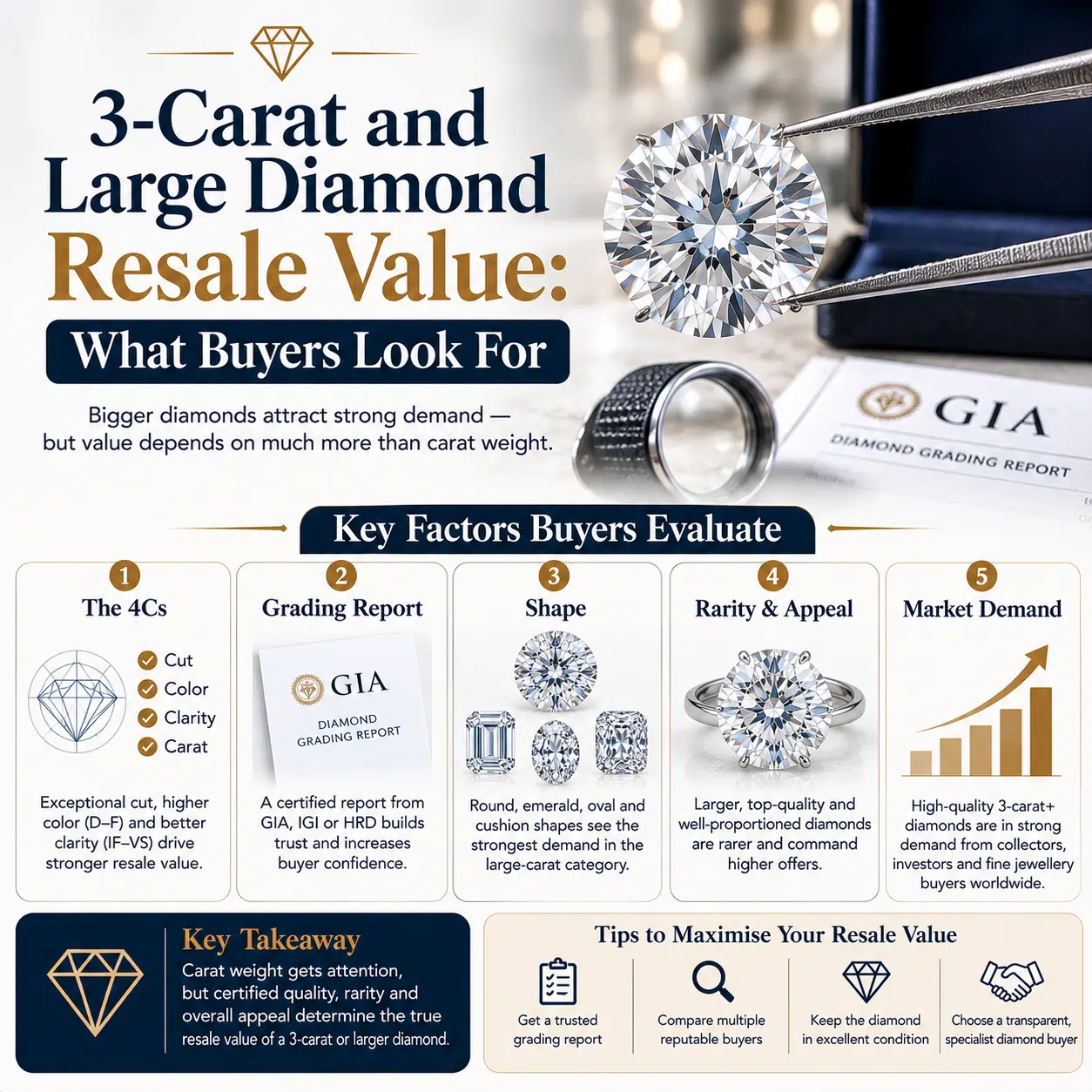
A three-carat or larger diamond can represent substantial value, but weight alone does not determine what a buyer will offer.
Larger natural diamonds are less common than smaller stones of comparable quality. However, rarity only strengthens value when the diamond also has a commercially desirable combination of colour, clarity, cut, shape, condition and documentation.
A well-cut, natural three-carat diamond with attractive proportions and a recognised grading report may receive strong interest. Another diamond of the same weight could have visible inclusions, weak transparency, hidden weight, damage or uncertain origin that materially changes its resale position.
The potential buyer pool also becomes more specialised as value increases. A large diamond may be rare but take longer to sell because fewer customers can purchase it. The offer must therefore reflect both rarity and liquidity.
A reliable valuation requires examination of the exact diamond rather than a static price chart, insurance figure or generic per-carat estimate.
Quick Answer: How Is a Three-Carat Diamond Resale Offer Calculated?
A buyer first determines whether the stone is a natural diamond, laboratory-grown diamond, treated diamond or simulant. Its exact weight, colour, clarity, cut, shape, dimensions, fluorescence, transparency, grading report and condition are then verified.
The buyer compares the diamond with current market evidence for genuinely similar stones. From its expected resale potential, the buyer accounts for any grading, testing, repair, recutting, insurance, secure transport, marketing and transaction costs.
The calculation must also consider how long the stone may remain unsold, how stable its market is and whether the buyer has access to suitable customers.
This means that a high-quality three-carat diamond does not simply equal three times the value of a one-carat diamond. Larger stones can command a different price per carat, but the complete quality combination determines whether that rarity is commercially desirable.
What Buyers Examine in a Three-Carat or Large Diamond
| Fattore di valutazione | What the buyer wants to establish | Why it matters more at higher values |
| Origin | Naturale, creato in laboratorio, trattato o simulante | The relevant markets and supply conditions differ substantially |
| Exact weight | Current weight and possible finished weight after repair | Recutting can move the stone into a lower size category |
| Cut and dimensions | Visual size, proportions and light performance | Hidden weight becomes commercially expensive in a larger diamond |
| Colore | Grade, modifying tones and distribution | Small grade differences can change the comparison group |
| Chiarezza | Inclusion visibility, location and durability | Large facets and greater visible area can reveal characteristics |
| Forma | Outline, proportions and present demand | Large fancy shapes may require specialist customers |
| Report | Laboratory, report number, comments and physical match | Reliable verification reduces significant financial uncertainty |
| Se è naturale o prodotto in laboratorio | Chips, abrasions, repolishing and previous alteration | Repair can involve considerable weight loss and risk |
| Liquidity | Number of realistic buyers and expected selling time | Higher-value stones often have a narrower customer pool |
| Complete jewellery | Setting, side stones, brand and provenance | A significant signed jewel may be worth more intact |
What Is Considered a Large Diamond?
There is no single universal legal or gemmological definition of a “large diamond.”
For the purpose of this guide, the term refers primarily to diamonds weighing three carats or more. The same valuation principles can apply to five-carat, seven-carat, ten-carat and larger stones, although the buyer pool, verification process and transaction structure may become increasingly specialised.
One metric carat equals 0.20 grams. A three-carat diamond therefore weighs 0.60 grams.
That may not sound physically heavy, but three carats is a substantial size for a polished jewellery diamond. At higher weights, combinations of strong colour, clarity and cut become progressively less common.
Size alone is not enough. A heavily included or poorly proportioned large diamond may have weaker demand than a smaller stone with exceptional quality.
Three-Carat Centre Diamond vs Three-Carat Total Weight
Confirm whether “three carats” refers to one centre diamond or the combined weight of every diamond in the jewellery.
A ring described as “three carats total weight” might contain a 1.75-carat centre diamond surrounded by smaller diamonds. It is not equivalent to a solitaire containing one centre stone weighing exactly 3.00 carats.
Larger individual diamonds generally have a different rarity and price structure from collections of small stones. The side diamonds may contribute value, but they cannot be combined and priced as though they formed one large diamond.
The grading report or purchase invoice should identify the centre stone’s weight. If no reliable paperwork exists, a specialist may estimate the mounted diamond from its dimensions.
Exact weight can normally be confirmed only when the diamond is loose. That does not mean it should be removed before the complete jewellery item has been assessed.
Why Larger Diamonds Can Be Worth More per Carat
All other quality factors being equal, a larger natural diamond is generally rarer than a smaller one. This can make its price per carat higher rather than simply producing a linear increase based on weight.
The relationship is not automatic. The larger stone must still possess characteristics that buyers want.
For example, a three-carat natural diamond with attractive colour, clarity and cut belongs to a different rarity category from three separate one-carat diamonds of comparable quality. The total weight may be the same, but the geological rarity and customer demand are not.
A large stone with weak transparency, visible damage or an undesirable shape may not benefit from rarity to the same degree. The buyer must determine whether the diamond is both uncommon and commercially marketable.
Why You Cannot Multiply a One-Carat Price by Three
Diamond value is not calculated through simple multiplication.
Carat weight categories, quality combinations, shape demand and scarcity affect price per carat. A three-carat diamond may be worth more per carat than a comparable one-carat diamond, but only when the origin and other characteristics are genuinely comparable.
A laboratory-grown three-carat diamond cannot be calculated by multiplying the value of a natural one-carat stone. Their supply and resale markets are fundamentally different.
The same is true when comparing shapes or grades. A three-carat round brilliant with excellent cut cannot be priced from a one-carat cushion with a different colour and clarity.
The correct approach is to find current evidence for diamonds that are close in origin, weight, shape, grades, proportions, fluorescence, report and condition.
Why There Is No Standard Three-Carat Resale Price
“Three-carat diamond” is a weight description, not a complete product specification.
A three-carat stone could be a natural D-colour flawless round brilliant, a heavily included warm-colour cushion, a treated diamond, a laboratory-grown oval or a chipped antique cut without a report.
Each belongs to a different comparison group.
The amount originally paid can also vary widely depending on the retailer, country, tax, brand, setting and purchase date. An insurance appraisal may use a retail replacement basis that does not represent resale.
Online asking prices create further confusion. A diamond can be advertised at any amount without selling. A meaningful valuation requires completed-market evidence and a realistic view of the buyer pool.
For these reasons, a fixed price range would be too broad to guide an individual seller and too unstable to remain evergreen.
Exact Weight and Commercial Categories
Every fraction of a carat can matter in a large diamond, particularly near a recognised round-number category.
A stone weighing 2.98 carats may look almost identical to one weighing 3.01 carats. Nevertheless, the two stones can be listed and searched for differently within the market.
This does not make the 3.01-carat diamond automatically more attractive. Cut, colour, clarity and condition remain decisive.
The weight becomes especially sensitive when damage is present. A chipped 3.04-carat diamond may require enough recutting to finish below three carats. The buyer must estimate the repaired stone’s likely weight and quality rather than treating the current damaged weight as permanently secure.
For very large diamonds, even a small percentage of weight loss can represent a commercially meaningful amount.
Cut Quality and Weight Distribution
Cut determines how effectively a diamond uses its weight and interacts with light.
A large diamond can retain additional weight in excessive depth, a thick girdle or other areas that do not improve its face-up appearance. The buyer may therefore find that a deeply cut three-carat diamond looks closer in size to a better-proportioned smaller stone.
For round brilliants, the laboratory cut grade provides useful information, but the buyer may also review table size, depth, crown and pavilion angles, girdle thickness, culet, polish and symmetry.
A large diamond with attractive proportions can combine visual presence with brightness, fire and scintillation. A poorly cut stone may look dark, dull or smaller than its weight suggests.
Cut quality is not merely an aesthetic issue. It affects how easily the diamond can be compared with alternatives available to future buyers.
Cut Assessment for Large Fancy Shapes
Fancy-shaped diamonds do not always receive the same standardised overall cut grade used for round brilliants.
The buyer must examine the actual outline, proportions, symmetry, visible spread and light behaviour.
A large oval can look impressive because of its elongated dimensions, but a strong bow-tie effect may dominate its appearance. A deep cushion can hide considerable weight. A poorly proportioned emerald cut may display windowing, while a pear or marquise with weak symmetry may look unbalanced.
At three carats and above, small proportional differences can become easier to notice because the physical diamond presents a larger visual area.
A buyer therefore needs more than the shape name and carat weight. High-quality photographs, precise measurements and physical inspection are essential.
How Colour Affects a Large Diamond
For colourless to light-yellow or light-brown diamonds, colour is commonly assessed using a D-to-Z scale. D represents the colourless end.
Larger diamonds can show body colour more readily because light travels through a greater volume of material. The effect depends on the shape, cut and setting, but colour differences can become commercially important.
Step cuts such as emerald and Asscher cuts may display colour differently from brilliant cuts. White-metal settings can make warmth more noticeable, while yellow or rose gold may complement a warmer diamond.
The buyer also looks for brown, grey or green modifiers that may affect market demand beyond the headline letter grade.
A difference of one colour grade does not create the same monetary result in every stone. Its effect depends on weight, shape, clarity, cut and current demand.
Fancy-Coloured Large Diamonds
Large fancy-coloured diamonds require a specialist valuation.
The buyer must consider whether the colour is natural or treated and examine its hue, tone, saturation and distribution. Terms such as Fancy Light, Fancy, Fancy Intense, Fancy Vivid, Fancy Deep and Fancy Dark describe different colour appearances and market categories.
The exact effect of clarity can differ from ordinary colourless-range diamonds. In certain rare coloured diamonds, the strength and desirability of the colour may be more commercially important than achieving a very high clarity grade.
An informal description such as “large yellow diamond” is not sufficient. A pale D-to-Z-range diamond and a laboratory-graded Fancy Vivid Yellow diamond belong to different markets.
Pink, blue, green, red and other rare colours may require highly specialised examination and buyer access. Treatment and colour origin must be established before a credible offer can be calculated.
How Clarity Affects a Three-Carat Diamond
Clarity concerns the diamond’s inclusions and surface blemishes.
At larger sizes, inclusion position and visibility can be especially important. A three-carat diamond presents a larger face-up area, and some characteristics may be easier to notice than they would be in a small stone.
Two diamonds with the same clarity grade can therefore receive different market responses.
One SI1 diamond might contain small inclusions positioned near the edge. Another SI1 might contain a dark crystal directly beneath the table. Although the grade is the same, the second characteristic may be more visible to a future customer.
The buyer also considers durability. Feathers, cavities or other characteristics near the girdle, corners and points can present different risks from fully enclosed inclusions in less vulnerable positions.
The clarity plot and report comments provide valuable information, but they do not replace examination of the physical diamond.
Transparency, Clouds and Graining
A diamond can possess a respectable colour and clarity grade but still appear hazy, milky or less lively.
This may relate to clouds, internal graining, inclusions or other transparency characteristics. The effect is not always fully communicated by the headline grade.
Transparency can be commercially important in a large diamond because customers expect a stone of substantial size to display an attractive, crisp appearance.
A buyer compares how the diamond looks under appropriate lighting and against similar stones. A fixed deduction should not be applied without observing the actual effect.
Natural vs Laboratory-Grown Large Diamonds
Natural and laboratory-grown diamonds belong to separate resale markets.
Both can be large, attractive and durable. Their market values differ because their supply conditions and replacement availability are different.
A natural three-carat diamond represents a geological occurrence followed by cutting and polishing. A laboratory-grown diamond is produced through a manufacturing process that can supply large high-colour and high-clarity stones more readily.
The resale value of a pre-owned laboratory-grown diamond is influenced by the current availability and pricing of equivalent new laboratory-grown stones. This can make the secondary market more selective and less predictable.
A large diamond’s origin cannot be established reliably from visual appearance. Professional screening or laboratory testing may be required.
Treatments and Large-Diamond Value
Treatments may change a diamond’s colour or apparent clarity.
High-pressure, high-temperature processing, irradiation, coating, fracture filling and laser drilling are among the treatments that may be encountered.
The commercial effect depends on the type of treatment, its stability, disclosure and acceptance within the relevant market.
A treated natural diamond should not be compared directly with an untreated natural stone of apparently similar quality. The buyer must select comparables from the correct category.
Because a large diamond can represent substantial financial exposure, uncertainty about treatment status may justify additional laboratory testing before a final offer.
Why the Grading Report Is Particularly Important
A recognised grading report can reduce major uncertainty in a high-value diamond transaction.
Depending on the report, it may record the diamond’s exact weight, dimensions, colour, clarity, cut, polish, symmetry, fluorescence, treatments, comments and identifying characteristics.
The buyer should verify the report through the issuing laboratory’s official service when available. The physical stone’s measurements, clarity characteristics and laser inscription can then be compared with the archived information.
A genuine report does not prove that the submitted diamond is the corresponding stone. Report matching remains essential.
The report is also not a valuation or purchase guarantee. It describes the diamond so that the buyer can determine its market position.
Does the Grading Laboratory Affect the Offer?
It can affect how confidently the buyer relies on the recorded grades.
A recognised, verifiable report that is accepted in the intended market can improve comparability. A report from an unfamiliar or inconsistent laboratory may create grading uncertainty.
For a small commercial diamond, a one-grade difference may already matter. For a large high-value stone, the financial effect of uncertainty can be considerably more significant.
The buyer may recommend regrading when the expected improvement in market confidence justifies the cost and delay. That work should not be ordered without explaining the reason, laboratory, timeframe and financial responsibility.
Can a Three-Carat Diamond Be Sold Without a Certificate?
Potentially, yes.
A missing report does not physically change a genuine diamond. However, the buyer must establish that it is a diamond, determine whether it is natural or laboratory-grown and assess its quality, treatment status and condition.
An initial review can begin with clear photographs, measurements and any surviving invoice, appraisal, old report number or insurance record.
For a significant loose diamond, independent grading may be commercially worthwhile because precise colour and clarity confirmation can materially affect its marketability.
It should not be ordered automatically. The buyer should first explain whether the likely benefit justifies the grading, insurance and transport costs.
For the full process, read how to sell a diamond without a certificate.
Older Reports and Large Diamonds
An older report can still provide valuable identification information.
The buyer must confirm that the diamond remains consistent with its recorded weight, measurements and clarity characteristics. Since grading, it may have been chipped, repolished, recut, treated or replaced.
A report issued many years ago should be presented with its original date visible. It should not be edited or described as a recent examination.
Updated grading may be considered when current verification would improve market confidence. Report age alone, however, should not trigger an automatic deduction.
Fluorescence in Large Diamonds
Fluorescence is the visible light some diamonds emit under ultraviolet radiation.
Its market effect depends on strength, colour, body colour, transparency and the diamond’s actual appearance. It is not automatically negative.
A diamond with strong fluorescence does not necessarily appear cloudy or oily. Conversely, a transparency issue should be investigated rather than attributed automatically to fluorescence.
In a high-value stone, buyers may be especially attentive to how fluorescence interacts with market preferences for that colour and quality category.
The physical effect must be observed instead of converted into a universal percentage deduction.
Condition and Recutting Risk
Condition can have a significant effect on a three-carat or larger diamond.
The buyer checks the girdle, culet, facet junctions, corners and pointed ends for chips, nicks, scratches and abrasions. Previous repolishing or recutting may also be relevant.
A large damaged diamond can sometimes be improved through recutting. The decision is commercially complex because the process removes weight and can change the shape, proportions, colour and clarity.
The cutter may discover that more material must be removed than initially expected. A 3.08-carat stone could finish below three carats, while a much larger stone could lose an important proportion of its weight.
The buyer must account for this uncertainty before the work is performed. An offer based on expected repaired value will therefore differ from the value of an undamaged diamond with the current weight.
Loose vs Mounted Large Diamonds
A loose diamond can normally be weighed and examined more precisely. Its complete girdle, pavilion and identifying characteristics are accessible.
A mounted large diamond may have significant areas hidden beneath prongs or a bezel. Metal can also influence colour assessment, and exact weight may need to be estimated.
This does not mean the owner should remove the stone before requesting a valuation.
A large diamond ring may be valuable as a complete signed, antique or well-crafted jewel. Removing the centre stone could damage the setting or destroy historical integrity.
If professional removal is necessary, the reason, risk, insurance, cost and possible resetting arrangements should be agreed before work begins.
The Setting, Side Stones and Complete Design
The setting can contribute significant value in large diamond jewellery.
A substantial platinum ring with well-matched side diamonds may be desirable as a complete piece. Antique workmanship, rare coloured side stones or a recognisable design can also matter.
The buyer considers metal content, side-stone quality, condition, craftsmanship and whether the complete jewel has an active resale market.
Small side diamonds cannot be priced using the centre stone’s per-carat comparison. They are assessed according to their own size, quality and reuse potential.
A generic or damaged setting may contribute mainly material value. A desirable complete ring may justify a different approach.
Brand and Signed Jewellery
A recognised jewellery signature can alter the resale strategy.
The buyer examines authenticity, model, serial number, construction, condition, alterations, original papers, box and service history. Current collector demand for the brand and design is also important.
A high-value signed ring may be worth more as a complete object than as separate stones and metal. Dismantling it before a specialist review could destroy value.
Not every part of the original boutique price is recoverable, but genuine brand demand can support a premium over comparable unbranded jewellery.
A box, receipt or engraved name alone does not prove authenticity. The complete item must be verified.
Antique Cuts and Historical Jewellery
A large old European, old mine or other antique-cut diamond should not automatically be compared with a modern brilliant.
Its value may depend on the complete historical jewellery item, cutting style, period, original construction, provenance and collector demand.
Repolishing an antique diamond into a modern shape may improve symmetry but remove significant weight and historical character. The resulting modern stone could be less valuable than the intact antique diamond or complete jewel.
A specialist buyer should assess whether preservation, minor repair or recutting offers the strongest market outcome.
Provenance and Ownership History
Documented provenance can matter for significant diamonds and signed jewellery.
Useful records may include historic invoices, auction catalogues, estate inventories, brand archives, insurance schedules, photographs and previous grading reports.
A family story can provide a valuable lead, but it must be distinguished from independently verified history.
Provenance has the greatest commercial influence when it connects the diamond or jewellery to a recognised maker, collection, event or former owner in a way that matters to buyers.
It does not replace gemmological quality. A documented history and the physical diamond must be assessed together.
Market Demand and Liquidity
Large natural diamonds are rarer, but their buyer pools can be narrower.
A three-carat commercial-quality engagement diamond may have a different market from a ten-carat high-colour stone or an important fancy-coloured diamond. Each requires customers with different preferences and budgets.
The buyer considers how many realistic customers exist, whether comparable stones are already available and how long the diamond may remain in inventory.
A rare stone can still be illiquid if few buyers want that particular combination of shape, colour, clarity and price. Conversely, a well-balanced large diamond with broad appeal may trade more readily.
Liquidity affects the offer because longer holding periods create financing, insurance, security and market-movement risks.
How a Buyer Calculates the Offer
A professional buyer begins with current evidence for comparable diamonds.
A meaningful comparable should be close in natural or laboratory-grown origin, weight, shape, colour, clarity, cut, proportions, fluorescence, report and condition. An online listing for a vaguely similar diamond is not sufficient.
The buyer estimates the amount the stone could realistically achieve through its resale channel. Necessary testing, grading, repair, secure transport, marketing and transaction costs are then considered.
The calculation also allows for the expected selling period and the possibility that the eventual result is lower than anticipated.
The remaining amount determines what the buyer can offer while covering operating expenses and commercial risk.
Read how diamond buyers calculate an offer for the complete valuation model.
Choosing a High-Value Diamond Buyer
A buyer suitable for an ordinary small diamond may not have the expertise, capital or customer network required for a large high-value stone.
The appropriate buyer should be able to verify the diamond, explain the valuation basis and document how the item will be received, insured, inspected, returned and paid for.
Specialist market access matters. A buyer with clients for large certified diamonds, rare shapes, fancy colours or signed jewellery may calculate the item differently from a general second-hand dealer.
The buyer should not promise an exceptional price from photographs alone or pressure you to transfer the diamond before the terms are clear.
For the wider due-diligence process, read how to choose a reputable diamond buyer.
Direct Buyer, Auction or Consignment
The best route depends on the diamond and your priorities.
A direct buyer can provide a final offer after inspection and may offer greater certainty and a shorter payment timeline. The offer reflects the risk the buyer accepts by purchasing the diamond before finding its next customer.
An auction may be appropriate for an exceptional diamond, important fancy colour, signed jewel or item with strong collector appeal. The result remains uncertain until bidding is complete, and commission, scheduling, reserve and buyer-payment risk must be considered.
Consignment may seek a retail-facing customer over a longer period. The advertised price is not a completed sale, and the seller may wait months without receiving payment.
For the transaction-model comparison, read direct buyer vs auction vs consignment.
Secure Transfer of a High-Value Diamond
Shipping and handover should be agreed before the diamond leaves your possession.
The process must identify the recipient, destination, carrier, packaging requirements, declared value, insurance, tracking and chain of custody. Standard parcel cover may exclude loose diamonds, jewellery or high-value shipments.
The seller should also know how the parcel’s arrival will be confirmed, who opens it and what happens if the final offer is declined.
For a very valuable diamond, the appropriate solution may involve a specialist collection, secure logistics service or private appointment rather than ordinary consumer shipping.
Do not describe the diamond inaccurately to reduce customs or insurance requirements. A false declaration can create legal problems and invalidate coverage.
Use the complete guide on how to ship a diamond safely before arranging transport.
Payment for a High-Value Diamond
Payment should follow written acceptance of the final offer and completion of the required identity, ownership and account checks.
The seller should know the amount, currency, deductions, payment method and expected initiation time. For an international transaction, currency conversion and correspondent-bank processing may affect the final timing.
Verify payment through your own bank. A screenshot, email or forwarded transfer receipt is not sufficient evidence that funds have reached your account.
Never pay an unexpected fee through a message to release incoming money. For additional protection, read the guide to diamond selling scams and fake payments.
Four Illustrative Large-Diamond Scenarios
The following examples are fictional. They are not actual Sothis transactions, price promises or standard recovery rates.
Example 1: Two three-carat round diamonds
Both stones are natural round brilliants weighing 3.01 carats with the same stated colour and clarity.
The first has attractive proportions, strong transparency, no damage and a recognised report matching the physical diamond. The second is deeply cut, looks smaller from above and contains a noticeable central inclusion.
Their headline specifications appear similar, but their visual performance and marketability differ. The first may therefore support a stronger offer.
Example 2: A damaged diamond near three carats
A natural diamond weighs 3.07 carats but has a significant girdle chip.
A cutter believes the stone may finish below three carats after repair. The buyer must consider the expected finished weight, recutting expense and risk that the result is less favourable than predicted.
The offer cannot be calculated as though the current stone were an undamaged 3.07-carat diamond.
Example 3: A large laboratory-grown diamond
A seller submits a laboratory-grown diamond with high colour and clarity grades and an old insurance appraisal.
The buyer verifies the report and physical stone, then evaluates it within the current laboratory-grown resale market. The insurance figure and historical retail price do not determine the offer.
The diamond’s appearance may be excellent, but its resale comparison must reflect current manufactured supply and buyer demand.
Example 4: A signed antique ring
A large old-cut diamond is mounted in a documented period ring from a recognised jewellery house.
A materials-only buyer might calculate the diamond and metal separately. A specialist in signed antique jewellery may assess the item as a complete collectible object.
Authenticity, originality, condition and provenance could therefore materially affect the most appropriate selling route.
How to Prepare a Three-Carat Diamond for Valuation
Begin with clear photographs of the complete item, including its front, side profile and underside. Hallmarks, engravings, brand signatures and visible damage should be shown.
Upload the full grading report rather than only the page or section containing the 4Cs. The report number, measurements, comments, plotting diagram and treatment information may all be relevant.
Purchase invoices, insurance appraisals, repair records, brand papers and provenance documents can help establish identity and history.
Do not polish, recut, repair or remove the diamond before receiving specialist advice. An intervention intended to improve value could instead remove weight or damage a complete jewellery item.
If the item is inherited, include the available ownership or estate information. The guide to documents needed to sell a diamond explains what may be useful.
How to Compare Offers for a Large Diamond
Compare inspected offers on a net basis.
First confirm whether each figure is a preliminary estimate, final direct offer, auction estimate or consignment asking price. These are not equivalent.
Ask whether the buyer has verified the diamond’s origin, grades, report and condition. Establish whether the setting, side stones, brand and provenance have been considered.
Testing, grading, repair, shipping, insurance, commission and currency costs should be identified. The payment timing and return process must also be clear.
The highest headline amount may not be the best proposal if it is conditional, subject to substantial expenses or dependent on finding a future buyer.
Use how to compare diamond offers before deciding.
Frequently Asked Questions About Three-Carat and Large Diamond Resale Value
How much can I sell a three-carat diamond for?
The amount depends on origin, exact weight, colour, clarity, cut, shape, grading report, condition and current demand. Weight alone cannot produce a reliable figure.
Is every three-carat diamond highly valuable?
No. A large diamond can still have weak colour, visible inclusions, poor cutting, treatment, damage or limited demand.
What does three carats weigh?
A three-carat diamond weighs 0.60 grams.
Is a three-carat diamond considered large?
For most jewellery contexts, three carats is substantial. There is no single universal definition of a “large diamond,” however.
Does three carats measure visible size?
No. Carat measures weight. Shape and proportions determine face-up dimensions.
Why can two three-carat diamonds look different in size?
A deeper diamond may hide weight below the girdle, while another may distribute its weight across a larger visible area.
Is three-carat total weight the same as a three-carat centre diamond?
No. Total weight may be divided among the centre and multiple side stones.
Is a 2.99-carat diamond worth less than a 3.00-carat diamond?
A round-number category can influence comparison, but the complete quality and market context determine the difference.
Is a 3.01-carat diamond automatically better than a 2.99-carat diamond?
No. The smaller diamond could have superior cut, colour, clarity, transparency or condition.
Is a three-carat diamond worth three times a one-carat diamond?
Not necessarily. Diamond pricing is not linear, and larger comparable natural diamonds may carry a different price per carat.
Are larger diamonds rarer?
All else being equal, larger natural diamonds are rarer than smaller ones. Rarity still needs to be combined with desirable quality and market demand.
Does colour become more visible in a large diamond?
It can. Larger stones contain a greater volume of material, although shape, cut and setting also influence appearance.
Does clarity matter more in a three-carat diamond?
Inclusion placement and visibility can become particularly important because of the diamond’s greater visible area.
Can a large SI1 diamond be eye-clean?
Yes. Some SI1 diamonds have inclusions that are difficult to see without magnification, while others have noticeable characteristics.
Is a VS2 always worth more than an SI1?
All else being equal, a higher clarity grade generally reflects greater rarity. Actual appearance and other quality factors still matter.
Does cut affect the value of a large diamond?
Yes. Cut controls light performance, face-up size and how efficiently the weight has been used.
Why can a deep three-carat diamond receive a lower offer?
It may look smaller than expected because weight is hidden below the visible surface.
Which large diamond shape has the best resale value?
No shape always produces the best result. Demand depends on the individual stone and current market.
Are large round diamonds easier to sell?
Round brilliants have broad demand, but their higher value can still narrow the realistic buyer pool.
Do large oval diamonds hold value?
Their resale potential depends on origin, quality, outline, bow-tie effect, dimensions, report and market demand.
Are large emerald-cut diamonds valuable?
They can be, particularly when they combine attractive colour, clarity, transparency and proportions.
Why is clarity important in an emerald cut?
The broad open facets can make inclusions easier to observe.
Do marquise and pear diamonds face special risks?
Their pointed ends can be vulnerable to damage if not properly protected.
Is a GIA report required to sell a large diamond?
No, but a recognised matching report can reduce significant uncertainty.
Does a grading report state resale value?
No. It records technical characteristics rather than assigning a monetary offer.
Does the grading laboratory affect the offer?
It can affect how confidently the reported grades are used in the intended resale market.
Can an older report still be useful?
Yes, provided it can be verified and still matches the physical diamond.
What if the diamond does not match its report?
The buyer cannot rely on the report until the discrepancy is explained. The diamond may have been replaced, recut or damaged.
Can I sell a three-carat diamond without a certificate?
Potentially, yes. Professional testing and possibly independent grading may be required.
Should I obtain a new report before requesting a valuation?
Not automatically. Begin with an initial review and determine whether the benefit justifies the cost.
Can I sell a large laboratory-grown diamond?
Potentially, subject to the buyer’s current criteria and laboratory-grown market demand.
Is a large laboratory-grown diamond valued like a natural one?
No. They belong to separate supply and resale markets.
Can a treated large diamond be sold?
Potentially. The treatment must be identified and the diamond compared within the appropriate category.
Does fluorescence reduce the value of a large diamond?
Not automatically. Strength, colour, transparency and actual appearance must be examined.
Can a cloudy large diamond still have value?
Potentially, but reduced transparency may affect appearance and demand.
Can a chipped three-carat diamond be sold?
Yes. The buyer must assess the damage, recutting options, expected weight loss and remaining marketability.
Why is recutting risk important?
Repair can remove meaningful weight, change the proportions and move the diamond below a significant weight category.
Should I recut a damaged large diamond before selling?
Not without specialist advice. The lost weight and cost may outweigh the improvement.
Should I remove a large diamond from its setting?
No. Submit the complete item first. Removal can damage the stone or destroy jewellery value.
Does a platinum setting add value?
It can. Metal weight, craftsmanship, side stones, condition and brand are considered.
Are side diamonds included in the offer?
They may contribute value, but they are assessed according to their own size, origin, quality and marketability.
Can a designer brand increase the offer?
Potentially, if the jewellery is authentic, desirable, complete and in suitable condition.
Does the original box increase value?
It may improve completeness for branded jewellery but cannot prove authenticity alone.
Can provenance increase the value of a large diamond?
Documented provenance may matter for significant, signed or historically important jewellery.
Does family history count as provenance?
It can provide useful leads, but unsupported stories are not equivalent to independently verified records.
Why is a rare diamond sometimes difficult to sell?
Rarity does not guarantee a large pool of buyers. A highly specialised diamond may require considerable time to find the right customer.
What is liquidity?
Liquidity describes how readily the diamond can be sold at an acceptable price.
Why does holding time affect the offer?
Longer holding periods create financing, insurance, security and market-price risk for the buyer.
Why is my offer lower than the retail price?
The retail price may include tax, manufacturing, services, overhead and margin. Resale concerns the existing diamond and present secondary market.
Why is the offer lower than my insurance appraisal?
The appraisal generally concerns replacement or coverage, while the offer concerns what a buyer can pay for the existing item.
What percentage of the original price will I recover?
There is no reliable universal recovery percentage. Quality, original pricing, condition and selling route vary too widely.
Can an online calculator value a three-carat diamond?
It can provide a broad indication but cannot verify condition, transparency, treatment, report matching or true marketability.
Is an online offer final?
It is usually preliminary. A final offer normally requires physical inspection.
Why did my offer change after inspection?
The buyer may have discovered different grades, damage, treatment, origin or a report mismatch. A material revision should be explained.
Can two high-value diamond buyers make different offers?
Yes. Their customers, expertise, inventory needs, costs and selling routes may differ.
Does a lower offer prove that the buyer is dishonest?
No. A disagreement over price is not automatically fraud. Compare the valuation basis and complete terms.
Is auction best for a large diamond?
It may suit an exceptional, rare or signed item. Commission, reserve risk, scheduling and payment uncertainty must still be considered.
Is consignment better than a direct offer?
Consignment may target a retail-facing buyer but can take longer and does not guarantee a completed sale.
How should I transport a high-value diamond?
Use a verified process with appropriate declared-value cover, tracking and chain of custody. Ordinary parcel insurance may exclude diamonds.
How should payment be made?
The written transaction should identify the amount, currency and payment method. Verify incoming funds through your own bank.
What documents should I submit?
Provide the complete grading report, purchase invoice, insurance appraisal, repair history, brand papers and relevant provenance or ownership records.
Can I sell an inherited large diamond without paperwork?
Potentially, yes. Submit any estate, insurance, photograph and ownership information that remains available.
How can I obtain the most accurate offer?
Provide complete documentation and clear photographs, then allow the physical diamond to be verified and matched with its report.
Request a Private Valuation for Your Large Diamond
A three-carat or larger diamond requires more than a generic online estimate.
Its resale value depends on whether it is natural or laboratory-grown and how its exact weight, colour, clarity, cut, shape, proportions, fluorescence, report and condition compare with current market demand.
The setting, side stones, brand and provenance may also influence whether the diamond should be sold loose or as a complete jewel.
Submit clear photographs, the complete grading report and any available invoice, appraisal, brand or ownership documentation. If the item meets Sothis Diamonds’ current purchasing criteria, the next step may be a private Antwerp appointment or an agreed insured transport process.
Following physical verification, you can receive a market-based offer that you remain free to accept or decline.
Request a private valuation for your three-carat or large diamond.
